How to Integrate AI into Your Existing Course Platform Without Disrupting Learners
Key Facts
- A large share of enterprises are already using or testing AI agents, per widely cited industry research
- Most businesses report competitive pressure to accelerate AI adoption
- Legacy system integration is consistently reported as the top barrier to enterprise AI adoption
- AI can automate repetitive tasks, freeing human resources for strategic work
- Starting with a pilot project helps identify integration challenges early
- Educating teams reduces cultural resistance and improves AI adoption
- AIQ Labs has deployed 200+ multi-agent systems and runs 4 live SaaS products daily
Hire a team member that works 24/7 — for less than a part-time wage.
AI receptionists, SDRs, dispatchers and 99+ roles. Trained on your business, fully managed.
Not sure where to start? Ask our AI planner
The Hidden Cost of Rushing AI Into Legacy Learning Platforms
Rushing AI onto a live course platform rarely looks like a technical misstep at first. It looks like speed. The hidden cost shows up later, when active learners hit friction, data pipelines break, and teams realize the integration was built to impress, not to last.
Legacy learning systems were not designed for real-time AI workloads. Industry research consistently finds that most enterprises struggle to integrate AI with their legacy systems. That struggle is amplified in education, where a single outage or confusing UI change can disrupt an entire cohort mid-module.
The learner experience is the first casualty. A forced chatbot overlay, a slow personalization layer, or an API call that times out during assessment creates immediate abandonment. AI can automate repetitive tasks and surface insights, but only when the workflow remains invisible to the user. When integration is rushed, automation becomes interruption.
Vendor lock-in and cultural resistance compound the problem silently. Teams under pressure to adopt quickly choose point solutions that embed proprietary data models and closed APIs. Vendor lock-in is a widely recognized risk when scalability is needed later. At the same time, cultural resistance is a barrier that requires education and training to overcome.
Pressure to move fast is real. Industry surveys report that most businesses feel pressure from competitors to accelerate AI adoption, and a majority of enterprises are already using or testing AI agents. That urgency drives shortcuts in assessment, data mapping, and change management.
The most common hidden costs of rushed modernization include:
- Learner disruption from UI changes, latency, or broken journeys during active courses
- Technical debt from brittle API connections to legacy LMS databases and single sign-on systems
- Vendor lock-in that limits future customization and raises switching costs
- Cultural resistance when instructors and support staff lack training and trust in the new tools
A non-intrusive approach prioritizes API and system integration that preserves existing user flows while adding intelligence underneath. AIQ Labs focuses on smooth, non-intrusive integrations that maintain user experience while adding intelligent automation across course delivery and support, whether that's an AI employee handling support triage or a targeted workflow rebuild. That means mapping data privacy and model bias requirements early, building two-way API integrations instead of overlays, and piloting with a limited cohort before platform-wide rollout.
The AI applications market has grown quickly through 2026 and continues to expand. Growth rewards platforms that integrate deliberately, not hastily.
Integration is a learner problem first, and a systems problem second. When AI is added without protecting the existing learning experience, the cost is measured in churn, support tickets, and lost trust.
A Non-Intrusive Integration Framework Backed by Production Data
Integrating AI into your course platform doesn't require a disruptive overhaul, it can be achieved through a phased, non-intrusive approach that protects learner experience while delivering measurable value. AIQ Labs has validated this methodology through 200+ multi-agent systems deployed across live platforms, plus 4 SaaS products the company runs daily, proving that smooth integration is possible when grounded in practical execution.
Begin with a targeted pilot project focused on a single, high-impact workflow, such as automating course enrollment reminders or personalizing content recommendations, to test AI capabilities without risking broader system stability. This aligns with industry best practices showing that starting small allows teams to identify challenges early and build confidence before scaling. With most enterprises already using or testing AI agents while many still struggle with legacy system integration, a controlled pilot is essential for success.
Throughout the process, prioritize data privacy and bias mitigation by selecting vendors who support true ownership and transparent model governance. Ensure compliance with regulations like GDPR and CCPA from the outset, and validate AI outputs for fairness and accuracy to prevent unintended discrimination. Most businesses feel competitive pressure to accelerate AI adoption, but rushing integration without safeguards risks eroding trust and triggering cultural resistance.
Choose integration partners who architect systems with enterprise-grade frameworks, enabling seamless connections to your existing CRM, LMS, and communication tools via modern APIs. This approach avoids vendor lock-in while maintaining scalability, critical for long-term AI maturity. AIQ Labs applies this same framework in its own production environments, where multi-agent orchestration powers personalized content delivery, intelligent chatbots, and regulated voice applications at scale.
- Launch a pilot focused on one repetitive task (e.g., support ticket triage or content tagging)
- Validate data handling practices for privacy compliance and bias detection
- Select vendors offering full code ownership and flexible deployment options
- Measure learner engagement and support metrics before expanding scope
- Provide role-specific training to ease team adoption and reduce resistance
By following this phased framework, rooted in production-tested principles rather than theoretical models, you can enhance your course platform with AI capabilities that feel native, not bolted on. The result is a learning environment where automation works quietly in the background, freeing instructors and support staff to focus on what matters most: learner success.
Ready to explore how this approach applies to your specific platform? Start the Fit Check, a two-minute assessment leading to a free 30-minute strategy call to map your highest-impact automation opportunities. If there isn't a clear win, we'll say so, no obligation, just clarity on your AI path forward.
Five Steps to Embed AI Without Interrupting a Single Learner
Learners notice disruption instantly, and course platforms can't afford downtime while intelligence is added. A phased embed keeps courses live while automation quietly improves delivery and support.
Start with a clear map of where learners and staff actually touch the platform. Audit current touchpoints, enrollment flows, content delivery, discussion forums, assessments, and support channels, to identify repetitive, high-volume workflows. Mapping the platform first identifies precise integration points. This inventory prevents scope creep and surfaces low-risk pilots that protect the learner experience.
Isolate one low-risk workflow for a pilot and keep it narrow. Best practice shows starting small with a pilot project tests integration and surfaces challenges early. A common first target is 24/7 support triage or automated content summarization, where AI assists without changing core learning paths. Pilots also reveal data privacy and model bias risks before wider rollout.
Deploy with human-in-the-loop guardrails so decisions stay accountable. Validation layers, configurable escalation, and audit trails ensure the AI suggests rather than overrides. Because so many enterprises struggle to integrate AI with legacy systems, controlled rollout is essential. Human review of outputs maintains quality and builds trust with instructors and learners.
Train internal teams before launch, not after. Education reduces cultural resistance and improves adoption. Instructors need clear guidance on what the AI handles, what remains human, and how to intervene.
Establish continuous monitoring with metrics tied to learner outcomes. Track resolution time, error rates, engagement, and support ticket volume, then adjust prompts, data sources, and guardrails. Ongoing evaluation and adjustment keeps the integration aligned with learner needs.
A practical embed sequence looks like this:
- Audit platform touchpoints and data flows for integration readiness
- Pilot a single workflow with human-in-the-loop controls
- Train staff on AI boundaries, escalation, and oversight
- Monitor learner-impact metrics and iterate weekly
With most enterprises already using or testing AI agents, pressure to move is real, most businesses say they feel pressure from competitors to accelerate AI adoption. AIQ Labs approaches these integrations as non-intrusive enhancements that maintain user experience while adding intelligent automation across course delivery and support. The result is seamless augmentation rather than disruption.
What Seamless AI Integration Looks Like in Practice
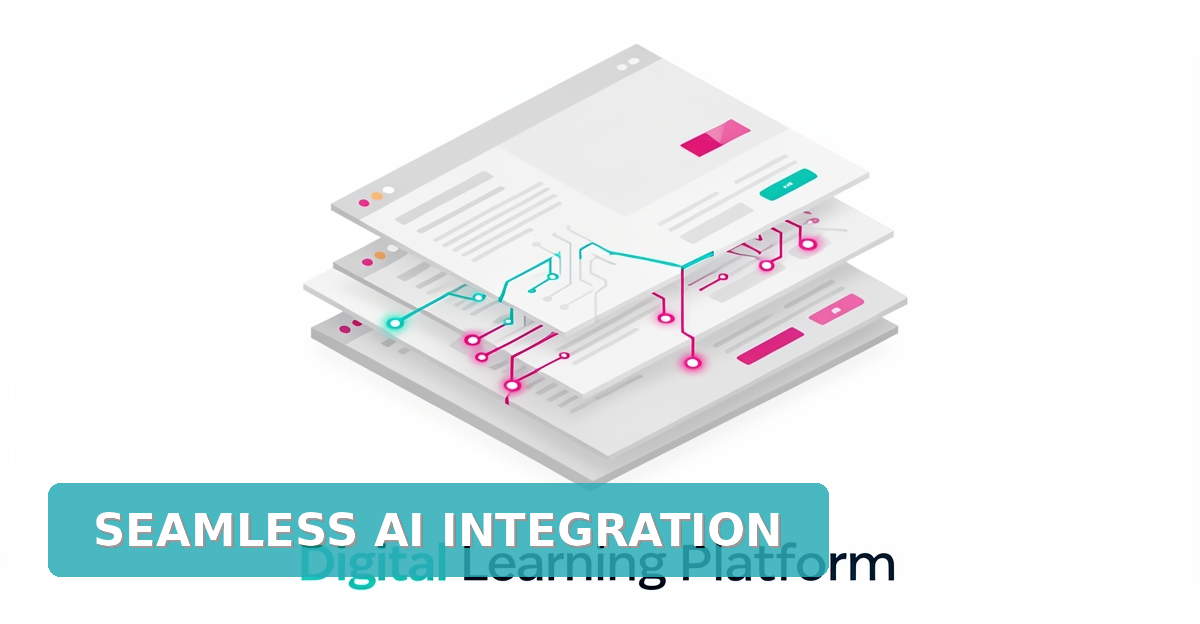
Learners shouldn't feel the AI at all. The best integrations keep the existing course interface intact while intelligent automation runs underneath, handling personalization, support and content creation without changing how students navigate.
Seamless integration is about making workflows work better by connecting AI tools to the apps and systems teams already use, so they can automate repetitive tasks, surface better insights, and take action on behalf of the platform. Most enterprises are already using or testing AI agents, yet many still struggle to integrate AI with their legacy systems.
That gap is where non-intrusive API and system integration matters. Rather than replacing a learning platform, AI is layered in through existing data connections, preserving UX while adding intelligence to delivery and support.
Real-world patterns from AIQ Labs' portfolio show how this works in practice:
- Personalized content agents that interview users to understand interests and preferences, then curate and tailor learning materials without altering the learner dashboard.
- Intelligent support chatbots built with multi-agent architectures and dual retrieval for contextual responses, handling course queries 24/7 while keeping the native help interface.
- Automated course building systems that research, draft and assemble modules behind the scenes, surfacing finished content to instructors within their current authoring tools.
These patterns demonstrate seamless integration that maintains user experience while adding intelligent automation across course delivery and support. AI enhances what learners see and instructors do, not how they log in.
Time savings at scale is a core benefit. AI can automate repetitive tasks, freeing up human resources for more strategic work. Faster, smarter decision-making follows as AI tools analyze large amounts of data, surfacing insights that would otherwise take hours or get missed altogether.
Improved consistency and quality also emerges. AI can maintain consistent tone in communications, flag errors before they go out, and ensure every learner gets a high-quality experience. That is critical for education, where support quality directly impacts retention.
Adoption pressure is real. Most businesses say they feel pressure from competitors to accelerate their AI adoption, and the AI applications market has continued to grow through 2026, reinforcing why platform owners need scalable, non-disruptive paths forward.
AIQ Labs specializes in smooth, non-intrusive integrations that prioritize user experience and scalability for legacy learning platforms, from a single workflow rebuild to a full AI operating system layered over your existing stack. The approach starts small with a pilot, chooses integration points that respect data privacy and model bias, and educates teams to overcome cultural resistance.
The result is AI that feels invisible to learners and invaluable to operators.
Still paying for 10+ subscriptions that don’t talk to each other?
We build custom AI systems you own outright. No vendor lock-in. Full control.
Not sure where to start? Ask our AI planner
Frequently Asked Questions
Will adding AI to our existing course platform disrupt learners mid-course?
How common is it for AI integrations to fail on legacy learning systems?
What's the biggest hidden cost of rushing AI onto a live LMS?
Do we need to replace our LMS to use AI?
How do we avoid vendor lock-in when choosing an AI partner?
Is there business pressure to adopt AI now, or can we wait?
The Best AI Integration Is the One Learners Never Notice
Rushing AI onto a live course platform creates friction for learners, brittle connections to legacy systems, vendor lock-in, and resistance from the very teams meant to champion it. The alternative is deliberate: map your touchpoints, pilot one low-risk workflow with human-in-the-loop guardrails, train your staff before launch, and monitor learner-impact metrics as you scale. With legacy integration cited across industries as the top AI adoption barrier, the platforms that win won't be the ones that moved fastest, they'll be the ones that integrated without breaking what already works. That's the approach AIQ Labs takes: non-intrusive, API-first integrations that keep your learner experience intact while adding intelligent automation to course delivery and support, backed by 200+ multi-agent systems deployed and 4 live SaaS products the company runs daily. If you're ready to see where AI fits into your platform without disrupting a single cohort, take the two-minute Fit Check at aiqlabs.ai/apply. You'll get a free 30-minute strategy call to map your highest-impact opportunities, and if there isn't a clear win, we'll tell you that too.
Make AI your competitive advantage — not just another tool.
Strategy, implementation and ongoing optimization. One partner, end to end.
Not sure where to start? Ask our AI planner