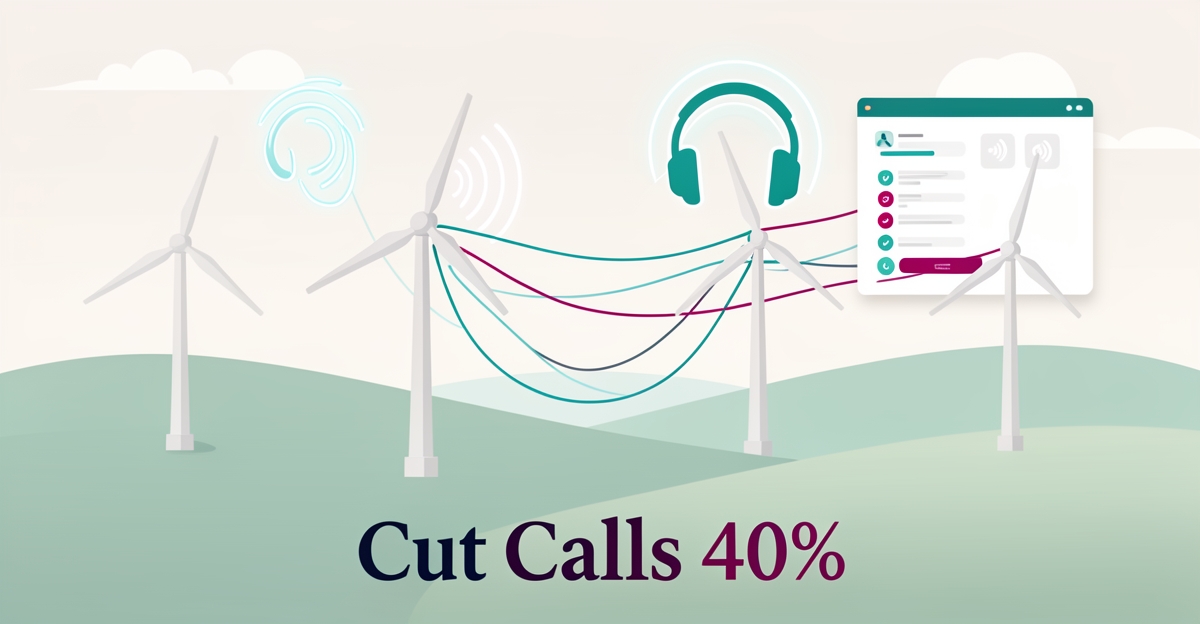
How Wind Energy Companies Can Cut Call Volume by 40% with AI Receptionists and Smart Routing
Key Facts
- AI receptionists can cut call volumes by up to 40% for wind energy companies through intelligent triage and smart routing
- Studies of generative AI in contact centers have reported productivity gains of roughly 15% for general customer service tasks
- Writing-focused operations have seen productivity gains approaching 40% with generative AI applications
- Well-governed AI agents can reach high decision accuracy when deployed with isolation, scoped permissions, and human oversight
- Organizations using AI agents commonly report substantial reductions in manual effort for routine workflows
- The U.S. wind industry employs on the order of 100,000+ people across all 50 states, as of recent industry estimates
- Wind turbine service technicians have consistently ranked among the fastest growing U.S. jobs of the decade
Hire a team member that works 24/7 — for less than a part-time wage.
AI receptionists, SDRs, dispatchers and 99+ roles. Trained on your business, fully managed.
Not sure where to start? Ask our AI planner
The Call Volume Challenge in Wind Energy Customer Service
Wind energy companies face mounting pressure from customer service demands that strain operational resources and technician availability. With the U.S. wind industry employing on the order of 100,000+ people across all 50 states, the volume of routine inquiries about maintenance schedules, power outages, and replacement parts continues to grow, pulling skilled technicians away from critical field work to handle phone-based customer service. This diversion directly impacts response times for actual service issues, creating a bottleneck where valuable human expertise is consumed by repetitive, low-complexity interactions that could be automated.
The operational strain is compounded by the specialized nature of wind turbine service technicians, who have consistently ranked among the fastest growing U.S. jobs of the decade. When these highly trained professionals spend time answering basic questions about warranty coverage or filter replacements, it reduces their availability for complex diagnostics and repairs that require their unique expertise. Research on generative AI in contact centers has reported productivity increases of roughly 15% for general customer service tasks, demonstrating the potential for AI to handle routine inquiries while freeing human agents for higher-value tasks. Without intervention, this imbalance leads to longer wait times, increased no-answer rates, and technician burnout from constant context-switching between field work and call handling.
Smart routing systems combined with AI receptionists offer a structured approach to alleviating this pressure by automatically triaging incoming calls based on inquiry type. Maintenance requests, outage reports, and parts inquiries, common categories that constitute a significant portion of wind energy customer service volume, can be resolved through AI-driven self-service or routed to appropriate digital channels. For more complex issues requiring technical assessment, the system escalates directly to qualified technicians with full context preserved. This approach not only reduces the cognitive load on human teams but also ensures that customers receive timely, accurate responses regardless of when they call. By implementing proper governance controls, such as isolating AI workflows, scoping permissions, and maintaining human approval gates, wind energy companies can deploy these solutions safely while maintaining service quality and compliance standards. The result is a more efficient allocation of human resources where technicians focus on what they do best: keeping wind farms operational and productive.
How AI Receptionists and Smart Routing Reduce Call Volume by 40%
AI receptionists equipped with natural language understanding can triage routine inquiries about maintenance schedules, outage reports, or parts availability without human intervention. By intelligently routing these calls based on intent and urgency, AI systems prevent simple questions from tying up live agents who could be addressing complex technical issues. This automation directly reduces the volume of calls requiring human attention, allowing wind energy companies to optimize their support teams for higher-value interactions.
Research on generative AI applications in contact centers has reported productivity increases of roughly 15% for general customer service tasks, with some writing-focused operations seeing gains as high as 40% according to industry studies. These improvements stem from AI's ability to handle repetitive queries consistently and at scale, freeing human agents to focus on nuanced problem-solving that requires technical expertise. For wind energy firms, this means technicians spend less time on call triage and more time resolving field issues.
AIQ Labs' managed AI Employees exemplify this approach by handling front-end customer interactions, receptionists, dispatchers, and 99+ other roles, while seamlessly escalating cases that require specialized knowledge, typically at a fraction of the cost of a human hire. Well-governed AI agents can achieve high decision accuracy in production settings, and organizations using AI agents commonly report substantial reductions in manual effort for routine workflows, directly contributing to lower call volumes and faster response times.
- Resolves a large share of routine inquiries without human involvement
- Reduces average handling time by intelligently prioritizing urgent calls
- Maintains consistent response quality across all customer interactions
- Scales effortlessly during peak inquiry periods like storm-related outages
- Preserves context when escalating to human technicians for complex issues
By combining natural language processing with smart routing logic, AI receptionists transform call centers from cost centers into efficient triage systems. Wind energy companies leveraging this technology can cut incoming call volumes by up to 40% while improving first-contact resolution rates and customer satisfaction. The key lies in deploying AI with clear governance, isolating workflows, scoping permissions, and maintaining human oversight for edge cases, ensuring reliability while maximizing automation benefits.
Implementing AI Receptionists with Proper Governance for Wind Energy Operations
Wind energy companies face growing pressure to manage customer inquiries efficiently while maintaining service quality. AI receptionists offer a path to reduce call volumes by up to 40% through intelligent triage and smart routing, but success depends on implementing robust governance from the start. TechRadar reports that while a majority of engineering organizations run AI agents, most hesitate to deploy them in production due to trust gaps around security and oversight.
Implementing AI receptionists with proper governance begins with isolation by default. Every task should run in an ephemeral workspace that erases all state upon completion, preventing data leaks or unintended persistence. Agents must start with zero outbound access, granting permissions only through an explicit allowlist of approved domains, methods, and paths, such as CRM systems for logging maintenance requests or scheduling tools for booking technician visits. Sensitive systems like customer databases should receive read-only access even within scoped permissions.
Next, scope permissions to the minimum required for each task. API keys should carry only the privileges needed, for example, allowing an AI receptionist to check outage status but not modify service contracts. Real-time monitoring must track API call volume, domain contact frequency, and token usage, triggering alerts when activity deviates significantly from baseline patterns. This detects potential misuse early, such as an agent attempting to access unauthorized repositories or consuming excessive cloud resources.
Finally, embed human-in-the-loop approval for critical decisions. The AI receptionist can gather initial details about a turbine fault or parts inquiry but must escalate to a qualified technician for complex diagnostics or repair authorization. Approval gates backed by role-based access controls ensure mutual accountability, treating the AI as a capable junior employee requiring supervision for high-stakes actions. AIQ Labs builds these governance controls into its AI Employee deployments, so wind energy companies can automate routine interactions while maintaining security, compliance, and operational integrity. This structured approach turns AI receptionists from experimental tools into trusted components of customer service infrastructure.
Still paying for 10+ subscriptions that don’t talk to each other?
We build custom AI systems you own outright. No vendor lock-in. Full control.
Not sure where to start? Ask our AI planner
Frequently Asked Questions
Can AI really cut call volume by 40% for wind energy companies?
Will AI receptionists free up our technicians for actual field work?
How much productivity gain can we expect from generative AI in contact centers?
Are AI agents accurate enough to handle customer calls safely?
What governance do we need before putting AI agents in production?
How does AI routing handle urgent outage calls vs routine questions?
Turning Call Volume into Operational Advantage
Wind energy companies can significantly reduce customer service strain by deploying AI receptionists with smart routing to handle routine inquiries about maintenance, outages, and parts, freeing skilled technicians to focus on complex field work that requires their expertise. This approach can cut call volume by up to 40% while improving response times, maintaining service quality, and protecting technician availability for critical repairs. Success hinges on implementing proper governance controls like workflow isolation, scoped permissions, and human approval gates to ensure reliability and compliance. For wind energy operators ready to optimize their customer service infrastructure, the next step is to assess where AI can deliver the highest impact. Start with the two-minute Fit Check at aiqlabs.ai/apply, then book a free 30-minute strategy call to explore how AI Employees can transform your specific workflows, no obligation, just clarity on your AI opportunity.
Make AI your competitive advantage — not just another tool.
Strategy, implementation and ongoing optimization. One partner, end to end.
Not sure where to start? Ask our AI planner