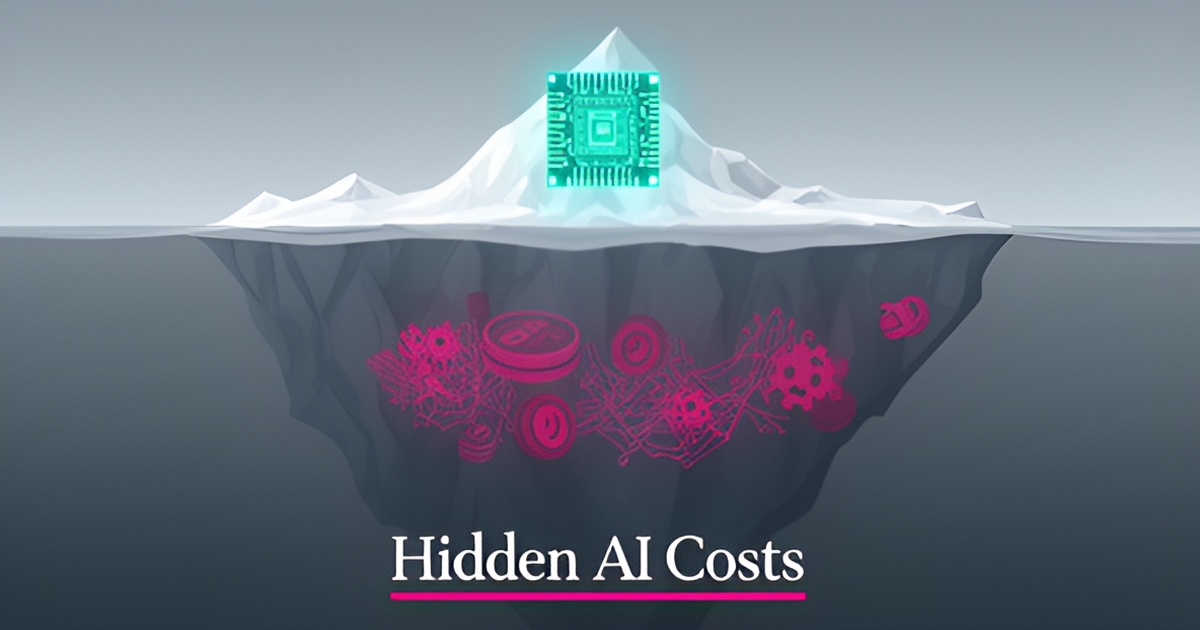
Identifying Hidden Expenses That Make AI Expensive To Run
Key Facts
- An award-winning AI document workflow cost $12–$14 per document in production versus roughly $0.80 for the manual process it replaced, a CIO.com audit found.
- Roughly 40% of transactions in the audited AI workflow fell into exception queues, where human resolution took 10 minutes versus a 4–5 minute manual baseline, according to the audit.
- Gartner forecasts inference costs per agentic workflow will rise more than fivefold through 2028, as workflow complexity offsets falling model prices.
- LLM inference costs for equivalent performance have dropped roughly 1,000x in three years — about 10x cheaper every year, per a16z analysis.
- Shadow AI tools paid on personal credit cards may represent close to 40% of application AI spend, largely untracked by procurement.
- Inference spending of $23.3B will surpass training spending of $19B in 2026, Gartner projects.
- 100% of executives surveyed by IBM canceled or postponed at least one generative AI initiative due to cost concerns, IBM's research shows.
Hire a team member that works 24/7 — for less than a part-time wage.
AI receptionists, SDRs, dispatchers and 99+ roles. Trained on your business, fully managed.
Not sure where to start? Ask our AI planner
Why Your AI Pilot Was Cheap and Your Production Bill Isn't
An award-winning AI project should be the poster child for automation economics. Instead, when one auditor pulled the actual cloud invoices, the numbers told a different story: a document workflow that cost $12–$14 per document in production, versus roughly $0.80 for the manual process it replaced — a 15–17x cost increase that never appeared in the case study.
The details come from a CIO.com audit of a celebrated enterprise deployment. During the three-month pilot, compute bills, data lookups, and third-party model fees were all charged to a central innovation fund. The department running the workflow never saw an invoice, so the tool looked essentially free. Once it hit production and invoices were allocated to the business line, the negative unit economics surfaced within 60 days.
The pilot had also run on clean demo files. Production brought low-res scans, rotated photocopies, handwritten notes, and conflicting terms — each triggering multiple extraction passes and verification checks. As the auditor put it, the company had swapped a predictable payroll line item for a consumption-based cost that scales directly with the work. And roughly 40% of transactions fell below confidence thresholds into exception queues, where human resolution took about 10 minutes against a 4–5 minute manual baseline. The business paid the cloud bill and kept the payroll.
This is why falling model prices don't rescue the budget. Stanford HAI documented a 280-fold drop in per-query benchmark costs between late 2022 and late 2024, yet Gartner forecasts inference costs per agentic workflow will rise more than fivefold through 2028 as workflow complexity offsets cheaper models. Cheap models do not guarantee cheap business processes.
The pattern shows up wherever AI moves from experiment to operations:
- Pilot accounting hides consumption costs until invoices hit the business line
- Real-world input quality multiplies processing passes and verification calls
- Exception queues quietly retain the human labor AI was supposed to replace
The core problem is simple: the price on the purchase order is rarely where AI gets expensive. It gets expensive in the workflow — which is why AIQ Labs designs systems around unit economics at production volume, not pilot conditions. The right questions to ask before scaling any deployment:
What does one completed transaction actually cost, including all compute and model charges? How often does a human intervene, and at what loaded payroll cost? Do the economics hold at full volume — or only in the demo?
The Five Expenses Hiding Inside Your AI Bill
The invoice for AI rarely matches the budget for AI. The most expensive parts of running these systems surface only after deployment, when experiments become operations and consumption bills start arriving.
1. Consumption-based compute and inference. The cost center is shifting from one-time training to continuous inference. Gartner projects inference spending at $23.3B will surpass training spending ($19B) in 2026, and forecasts per-workflow inference costs rising more than fivefold through 2028 as workflow complexity offsets falling model prices. Cheap models do not guarantee cheap processes.
2. Exception queues and double payment. In a CIO.com audit of an award-winning AI document workflow, roughly 40% of daily transactions fell below confidence thresholds and required human intervention — at twice the speed of the manual baseline. The company paid the cloud bill and kept the payroll.
3. Real-world input complexity. Clean vendor demo files never revealed the problem. In production, low-res scans, rotated photocopies, and handwritten notes triggered multi-pass processing and verification checks — each pass adding to the bill. The audited system cost $12–$14 per document versus roughly $0.80 for the manual process it replaced.
4. Shadow AI. According to Menlo Ventures, PLG-driven tools may represent close to 40% of application AI spend — largely untracked by procurement. Employees pay from personal cards; roughly 27% of that usage is work-related.
5. Maintenance, sprawl, and security triage. A Retool survey of 817 builders found time saved on one task is often offset by:
- Ongoing maintenance of custom builds
- Wrangling ungoverned tool sprawl — 60% built outside IT oversight last year
- Triaging security vulnerabilities
- Hidden subscription costs for customization and upgrades
The pattern across all five categories: you swap a predictable payroll line item for a consumption-based cost that scales with the work — whether the output is usable or not. That's why AIQ Labs designs workflows around unit economics at production volume, not pilot conditions, and favors owned systems over subscription stacks that quietly accumulate. The audit questions are simple: what does one completed transaction actually cost, how often does a human step in, and do the economics hold at full volume?
Falling Model Prices Won't Save You — Workflow Economics Will
Here's the paradox at the heart of AI economics: the model itself keeps getting cheaper, yet running AI keeps getting more expensive. a16z analysis shows LLM inference costs for equivalent performance have fallen roughly 1,000x in three years — about 10x cheaper every year. Yet Gartner forecasts that inference costs per agentic workflow will rise more than fivefold through 2028, because workflow complexity eats every model price cut.
The lesson from the award-winning document workflow that cost $12–$14 per document in production versus ~$0.80 for the manual process it replaced is blunt: cheap models do not guarantee cheap business processes. The economics of an automated system depend on the cost of the entire workflow — every compute call, data lookup, verification pass, and human exception — not just the base model's price tag.
Before scaling any AI system, ask three audit questions drawn from that production cost audit:
- What does one completed transaction cost compared to the manual baseline — including all compute, lookups, and model charges?
- How often does a human intervene, and at what fully loaded payroll cost?
- Do the economics still work at production volume, not pilot volume?
That third question is where most projects fail. In the audited case, ~40% of daily transactions fell below confidence thresholds into exception queues, where resolution took 10 minutes versus a 4–5 minute manual baseline — meaning the company paid the cloud bill and kept the payroll. The pilot looked free because compute charges sat in a central innovation fund; negative unit economics surfaced within 60 days of full production.
The fix is engineering the whole workflow, not shopping for a cheaper model. That means routing tasks to right-sized models — a small model trained on high-quality data can match or beat a large one on narrow tasks — and tuning validation layers and confidence thresholds so work doesn't pile up in exception queues. It also means designing for messy real-world inputs: low-res scans, rotated photocopies, and handwritten notes triggered multi-pass extraction and secondary checks in production that clean demo files never revealed.
This workflow-first approach is how we build at AIQ Labs — our own products run 70+ production agents daily, so unit economics get tested against real inputs, not demo conditions. When you evaluate any AI initiative, whether built internally or bought, judge it the way operations will: by cost per completed transaction at production volume. If the economics only work during the pilot, the system isn't creating operational leverage — it's creating an operating expense the pilot never measured.
How to Kill Hidden AI Costs: Measure, Consolidate, Own
Hidden AI costs don't die on their own — you kill them with three deliberate moves: measure what AI actually produces, consolidate sprawl into systems you own, and route work to models sized for the job.
Start with measurement. According to Retool's Build vs. Buy research, 35% of organizations have no AI productivity metrics at all — even though 75% of builders work under explicit AI mandates. Unmeasured spend is, functionally, wasted spend. The audited AI project in one CIO.com case study looked award-winning right up until someone asked what a single completed transaction cost versus the manual baseline. The answer — $12–$14 per document against roughly $0.80 manually — only surfaced when invoices were allocated to the business line instead of a central innovation fund. Ask three questions of every AI system you run:
- What does one completed transaction cost, including all compute, lookups, and model charges?
- How often does a human intervene, and at what loaded payroll cost?
- Do the economics hold at production volume, not just pilot volume?
Then consolidate. Shadow AI may represent close to 40% of application AI spend, largely untracked by procurement, per Menlo Ventures' enterprise research. Employees don't reach for personal credit cards out of rebellion — they do it because governed tools don't cover the need. Consolidation fixes that. ClickUp cut $200K per year in automation software by building six AI tools in-house, and Harmonic abandoned a $20,000/year third-party tool over slow support. Ownership beats subscription when the tool is core to the business.
Finally, right-size the model. IBM's analysis is blunt: you don't need large language models for everything, and a small model trained on high-quality data can match or beat an LLM on many tasks. With inference costs per agentic workflow forecast to rise more than fivefold through 2028 despite plummeting per-token prices, routing matters more than ever.
This is why AIQ Labs builds workflow-first: systems designed for production unit economics rather than pilot demos, AI Employees on flat monthly plans instead of consumption surprises, and ownership models — Build in Milestones or Own It Outright — that eliminate recurring subscription costs and vendor lock-in. The cheapest AI system is the one whose costs you can actually see, control, and switch off.
Audit Your AI Spend Before It Audits You
The most expensive AI failures rarely announce themselves. They surface quietly, 60 days into production, when the first real invoice lands on the business line instead of the innovation fund.
The CIO.com auditor who uncovered the $12–$14-per-document workflow offered three questions that any business can answer without a consultant. Run them against your own AI spend this quarter:
- What does one completed transaction cost versus the manual baseline — including all compute, data lookups, and model charges, not just the seat price?
- How often does a human intervene, and at what loaded payroll cost? In the audited case, ~40% of transactions fell into exception queues that took 2x longer than the manual baseline.
- Do the economics hold at production volume, or only at pilot scale with clean demo inputs?
If you can't answer these questions with real numbers, you're carrying hidden expenses. And the market no longer tolerates them: according to IBM's survey research, 100% of executives surveyed canceled or postponed at least one generative AI initiative due to cost concerns. Cost discipline has stopped being an accounting nicety — it's now a competitive requirement. The companies that know their true cost per transaction keep building; the ones that don't pull the plug.
Remember the tension underneath all of this: model prices keep collapsing — roughly 10x per year for equivalent performance — yet Gartner forecasts inference costs per agentic workflow will rise more than fivefold through 2028. Cheap models do not guarantee cheap business processes. The only reliable control is designing the entire workflow so the unit economics work at real-world volume, with messy inputs, from day one.
That's exactly what AIQ Labs builds toward. Start with the two-minute Fit Check, then book a free 30-minute strategy call — a real working session with an AI engineer, not a sales pitch. You'll map your biggest bottleneck, calculate your true cost per transaction, and identify where a workflow rebuild pays for itself. You'll get real numbers in writing — no fake price anchors. And if there isn't a clear win, we'll tell you that too.
Still paying for 10+ subscriptions that don’t talk to each other?
We build custom AI systems you own outright. No vendor lock-in. Full control.
Not sure where to start? Ask our AI planner
Frequently Asked Questions
Why did our AI pilot look cheap but our production bill is so expensive?
If AI model prices keep dropping, why is my AI bill going up?
What is the 'double payment' problem with AI exception queues?
What hidden AI costs should I look for beyond the subscription price?
How do I know if my AI system is actually saving money?
How can we reduce our AI operating costs without killing the project?
The Invoice You Can't See Yet
The pattern running through every example in this article is the same: AI gets expensive not on the purchase order, but in the workflow — where consumption-based compute, exception queues, messy real-world inputs, shadow tool spend, and maintenance overhead quietly pile up. The audited document workflow that cost $12–$14 per document against a $0.80 manual baseline wasn't a failure of the model. It was a failure to measure unit economics at production volume before scaling. That's the discipline worth adopting right now: calculate your true cost per completed transaction, count how often humans step in and at what payroll cost, and stress-test the numbers against messy inputs at full volume — not clean demos at pilot scale. The stakes are real; IBM research found 100% of surveyed executives canceled or postponed at least one generative AI initiative over cost concerns. This workflow-first, unit-economics approach is exactly how AIQ Labs builds systems — designed for production conditions, with ownership models that eliminate subscription sprawl. Start with the two-minute Fit Check, then book a free 30-minute strategy call: a real working session with an AI engineer where you'll map your biggest bottleneck and get real numbers in writing. If there isn't a clear win, we'll tell you that too.
Make AI your competitive advantage — not just another tool.
Strategy, implementation and ongoing optimization. One partner, end to end.
Not sure where to start? Ask our AI planner