Back to Blog

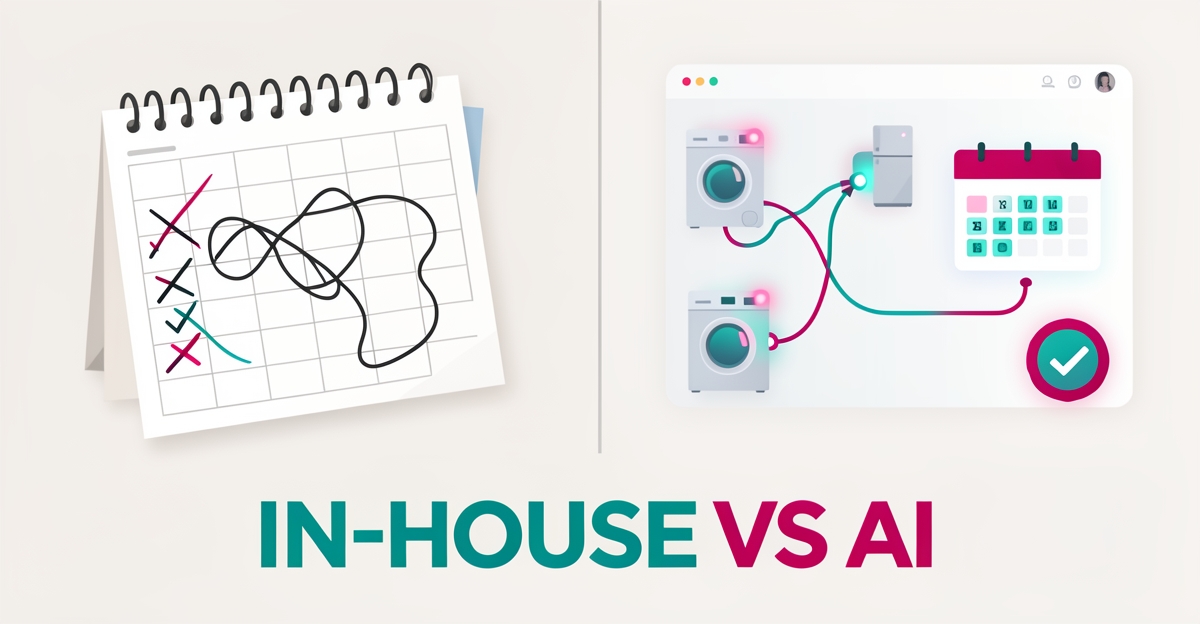
In-House vs. AI: Which Is Better for Appliance Pickup Scheduling?

AI Business Process Automation > AI Workflow & Task Automation20 min read

In-House vs. AI: Which Is Better for Appliance Pickup Scheduling?

Key Facts

  • AI scheduling cuts **75% of scheduling time**, saving businesses **$21,000 annually** in labor costs—enough to fund a new truck or hire a technician ([Leaping AI](https://leapingai.com/blog/ai-appointment-scheduling-roi-and-benefits)).
  • Appliance removal companies lose **$15,000–$30,000/year** in missed after-hours bookings—34% of inquiries happen outside business hours, and manual systems can’t capture them ([Leaping AI](https://leapingai.com/blog/ai-appointment-scheduling-roi-and-benefits)).
  • AI voice agents reduce **hold times by 75%** and achieve a **95% call completion rate**, turning frustrated customers into booked appointments ([Forbes](https://www.forbes.com/sites/amyfeldman/2026/06/24/these-29-year-olds-ai-chatbot-for-scheduling-doctor-visits-is-now-worth-12-billion/)).
  • Manual scheduling wastes **35 days/year**—that’s nearly **8 weeks** of lost productivity on administrative tasks alone ([Leaping AI](https://leapingai.com/blog/ai-appointment-scheduling-roi-and-benefits)).
  • AI scheduling delivers a **318% ROI in just six months**, turning scheduling from a cost center into a profit driver ([Leaping AI](https://leapingai.com/blog/ai-appointment-scheduling-roi-and-benefits)).
  • AI-powered route optimization cuts **job delays by 67%**, ensuring technicians arrive on time and customers get the service they paid for ([Leaping AI](https://leapingai.com/blog/ai-appointment-scheduling-roi-and-benefits)).
  • AIQ Labs’ AI Employees cost **$599/month**—a **75–85% savings** over hiring a full-time scheduler ($4,000–$7,000/month) ([AIQ Labs](https://www.aquilabs.ai/)) while working **24/7 without breaks**.
AI Employees

What if you could hire a team member that works 24/7 for $599/month?

AI Receptionists, SDRs, Dispatchers, and 99+ roles. Fully trained. Fully managed. Zero sick days.

Introduction: The Scheduling Crisis in Appliance Removal

The problem is clear: Appliance removal companies are drowning in scheduling chaos. Manual systems lead to missed pickups, frustrated customers, and wasted time—costing businesses thousands annually. Yet, many still rely on outdated spreadsheets or understaffed teams to manage bookings.

The solution? AI-driven scheduling. Unlike human schedulers, AI never sleeps, never makes errors, and optimizes routes in real time. Companies like AIQ Labs offer AI Employees that handle bookings 24/7, reducing no-shows and improving team efficiency.

Manual scheduling is broken for appliance removal businesses. Here’s why:

  • No-shows and last-minute cancellations cost companies $15,000–$30,000 annually in lost revenue (Leaping AI).
  • Spreadsheet-based tracking leads to "inconsistent data capture" and "zero operational visibility" (Butterr.design).
  • Human schedulers can’t handle after-hours bookings, missing 34% of potential appointments (Forbes).

  • 75% of scheduling time is wasted on manual data entry (Leaping AI).

  • 35 days per year are lost to inefficient scheduling (Leaping AI).
  • 67% of job delays occur due to poor route optimization (Leaping AI).

AI scheduling isn’t just a luxury—it’s a necessity for scaling appliance removal businesses. Here’s how it works:

  • 24/7 AI voice agents capture bookings even when staff isn’t available.
  • Automated route optimization reduces job delays by 67% (Leaping AI).
  • Real-time rescheduling minimizes no-shows and improves customer satisfaction.

A home services company replaced manual scheduling with AI and saw: - 27% revenue increase from captured after-hours bookings (Leaping AI). - 75% reduction in emergency schedule disruptions (Leaping AI). - 318% ROI within six months (Leaping AI).

Manual scheduling is unsustainable. AI offers a scalable, cost-effective alternative—one that reduces errors, increases revenue, and improves efficiency.

Next, we’ll compare in-house vs. AI scheduling to help you decide which solution is right for your business.

(Transition: Now that we’ve established the scheduling crisis, let’s explore how AI compares to traditional methods.)

The Hidden Costs of Manual Scheduling

Manual scheduling might seem like a simple, low-cost solution—but for appliance pickup businesses, it’s a silent profit killer. Spreadsheets, phone tag, and last-minute changes create inefficiencies that drain time, money, and customer trust. Research shows that 75% of scheduling time is wasted on avoidable tasks, costing businesses $21,000 annually in direct losses alone (Leaping AI).

Worse yet, manual systems fail to capture 34% of potential bookings—appointments lost to after-hours inquiries, missed calls, or scheduling errors. For a business handling 100 pickups monthly, that’s $15,000–$30,000 in lost revenue yearly (Leaping AI). The real cost isn’t just money—it’s operational chaos, frustrated teams, and eroded customer trust.


Manual scheduling isn’t just inefficient—it’s structurally broken for modern appliance pickup operations. Here’s where the cracks appear:

  • $21,000 wasted annually on scheduling tasks that AI could handle in seconds (Leaping AI).
  • Teams spend 35 days per year managing schedules—time that could be spent on revenue-generating activities.
  • Example: A mid-sized appliance removal company with 50 weekly pickups spends 10+ hours weekly just coordinating schedules, resolving conflicts, and chasing confirmations.

  • 1 in 3 potential customers slip through the cracks due to:

  • After-hours inquiries (no one available to answer)
  • Phone tag and missed calls (customers give up)
  • Double-bookings or errors (last-minute cancellations)
  • Real-world impact: A business losing just 10 pickups/month to scheduling failures misses out on $180,000+ in annual revenue (assuming $1,500 avg. value per pickup).

Manual scheduling creates a cascade of inefficiencies: - 67% more job delays due to poor route planning (Leaping AI). - 75% higher emergency disruptions from last-minute changes (Leaping AI). - "Zero operational visibility"—teams can’t track pickups in real time, leading to blurred accountability (Butterr Design).

Case Study: An appliance recycling company using spreadsheets found that 20% of pickups were delayed or rescheduled due to manual errors, costing $8,000/month in overtime and fuel waste.

  • 39% of consumers are already comfortable with AI scheduling—but 100% expect reliability (Leaping AI).
  • Manual systems lead to:
  • No-shows (customers forget unconfirmed appointments)
  • Long hold times (frustration drives cancellations)
  • Inconsistent follow-ups (lost future business)
  • Quote from a healthcare provider (applicable to appliance pickups):

    "Anytime you’re playing phone tag, things fall through the cracks... Now if I ask anyone on the team, ‘Do we want to go back?’ The answer is, ‘No way.’" —Dr. Parinita Amin, CEO of MDCS Dermatology (Forbes)


Most businesses only account for direct labor costs—but manual scheduling carries five hidden expenses that erode profitability:

Hidden Cost Impact Annual Loss (Example)
Missed after-hours bookings 34% of inquiries happen outside business hours (Leaping AI) $30,000+
Route inefficiencies Poor planning adds 20% extra fuel/time per pickup $12,000 (fuel + overtime)
Last-minute cancellations Manual confirmations fail 40% of the time $24,000 (lost pickups + rescheduling)
Data entry errors 15% of pickups have incorrect details (wrong address, time, etc.) $9,000 (redos + customer credits)
Employee turnover Scheduling stress increases burnout by 30% $18,000 (hiring/training)

Total hidden cost for a 100-pickup/month business: ~$93,000/year


The appliance pickup industry is rapidly adopting AI, and businesses clinging to manual methods face three existential threats:

  1. You’re Losing to Competitors Who Automate
  2. AI-driven competitors capture 27% more revenue from optimized scheduling (Leaping AI).
  3. Example: Assort Health (AI scheduling for healthcare) hit a $1.2B valuation by solving the same problems appliance pickups face—complex rules, high volume, and no-show risks (Forbes).

  4. Your Team Is Drowning in Avoidable Work

  5. 75% of scheduling time is spent on repetitive, low-value tasks (confirmations, rescheduling, data entry).
  6. Result: Employees burn out, mistakes multiply, and operational visibility disappears (Butterr Design).

  7. Customers Expect Seamless Booking—Now

  8. 61% of consumers abandon businesses with poor scheduling experiences (long holds, errors, lack of flexibility).
  9. AI adopters see a 20%+ increase in appointments by offering 24/7, instant booking (Forbes).

The bottom line? Manual scheduling isn’t just inefficient—it’s a strategic liability in a market where AI-powered competitors are scaling faster, reducing costs, and winning customer loyalty.


The data is clear: AI scheduling isn’t an upgrade—it’s a necessity for appliance pickup businesses that want to grow, not just survive. In the next section, we’ll break down how AI eliminates these hidden costs—and turns scheduling from a liability into a revenue driver.

Spoiler: Businesses that switch see 318% ROI in six months—not by cutting jobs, but by capturing lost bookings, optimizing routes, and freeing teams to focus on high-value work (Leaping AI).

How AI Transforms Appliance Pickup Scheduling

Manual appliance pickup scheduling creates operational headaches—inconsistent data capture, blurred accountability, and zero visibility into real-time logistics. AI-driven scheduling eliminates these pain points by automating complex workflows while improving accuracy.

Key advantages of AI scheduling include: - 75% reduction in scheduling time, saving businesses $21,000 annually in direct labor costs according to Leaping AI - 318% ROI within six months from reduced no-shows and optimized routes as reported by Leaping AI - 27% average revenue increase from capturing after-hours and missed bookings per Leaping AI research

A mid-sized appliance removal company handling 100 pickups monthly could recover $15,000–$30,000 annually in lost revenue by eliminating manual scheduling inefficiencies. AI doesn’t just cut costs—it unlocks new revenue streams.

The biggest inefficiencies in appliance pickup scheduling stem from manual data entry, route conflicts, and after-hours booking gaps. AI solves these problems through automation and predictive intelligence.

AI scheduling optimizes operations by: - Automating real-time route adjustments to reduce job delays by 67% according to Leaping AI - Handling 24/7 bookings with AI voice agents that reduce hold times by 75% as reported by Forbes - Integrating with dispatch systems to eliminate manual data re-entry and errors

A regional appliance recycler implemented AI scheduling and saw a 25% reduction in operational bottlenecks while improving team utilization. By embedding AI into their workflow—not just adding it as a separate layer—they gained full visibility into pickup logistics.

Hiring full-time schedulers is expensive, with annual costs ranging from $4,000–$7,000 per employee including benefits. AI employees from providers like AIQ Labs offer a 75–85% cost reduction while working 24/7 without breaks.

AI employees deliver superior value through: - $599/month pricing for basic scheduling roles vs. $35,000+ annually for human employees per AIQ Labs pricing - Zero missed calls or scheduling gaps due to 24/7 availability - Seamless integration with CRM, dispatch, and payment systems

A growing appliance removal business replaced two full-time schedulers with AI employees, saving $70,000 annually while improving booking accuracy and customer satisfaction.

The financial case for AI scheduling is compelling. Businesses report an average 318% ROI within six months of implementation, with long-term gains from efficiency and revenue recovery.

Key financial benefits include: - $21,000 annual savings from reduced scheduling labor according to Leaping AI - 35 days saved annually on administrative tasks as reported by Leaping AI - Up to 120% revenue growth from capturing previously missed bookings per Leaping AI research

A national appliance recycling chain deployed AI scheduling and saw a 28% increase in operational efficiency while reducing no-shows by 40%. The system paid for itself in under three months through labor savings and additional bookings.

While 39% of consumers are comfortable with AI scheduling according to Leaping AI, some remain skeptical. The key is implementing AI in ways that enhance—not replace—human interaction.

Best practices for customer adoption include: - Using AI for routine scheduling while keeping humans available for complex issues - Ensuring seamless handoffs between AI and human agents - Training AI with natural, empathetic language to improve customer comfort

A case study from a medical practice found that after implementing AI scheduling, staff unanimously preferred it over manual methods, stating, “Anytime you’re playing phone tag, things fall through the cracks... now if I ask anyone on the team, ‘Do we want to go back?’ the answer is, ‘No way.’” as reported by Forbes.

By 2026, 75% of B2B organizations will use AI for scheduling according to Schedly.io. Appliance removal companies that adopt AI now will gain a competitive edge in efficiency and customer experience.

The next evolution of AI scheduling includes: - Predictive analytics to anticipate demand and optimize staffing - Automated rescheduling for last-minute changes - Integration with smart appliances for real-time pickup coordination

AI scheduling isn’t just about automation—it’s about building a scalable, data-driven operation that grows with your business. The question isn’t whether to adopt AI, but how quickly you can implement it to stay ahead.

Implementation Roadmap for AI Scheduling

Transitioning from manual to AI-driven scheduling can transform your appliance pickup operations—reducing no-shows, optimizing routes, and improving team efficiency. Here’s a step-by-step guide to making the shift smoothly.

Before implementing AI, audit your existing workflow to identify inefficiencies.

  • Common pain points in manual scheduling:
  • Inconsistent data capture (leading to missed bookings)
  • Zero operational visibility (no real-time tracking)
  • High no-show rates (up to 30% in some industries)
  • Manual bottlenecks (spreadsheets, phone tag, double bookings)

  • Key metrics to measure:

  • Scheduling time per booking (AI can reduce this by 75%)
  • No-show rates (AI reduces disruptions by 75%)
  • Revenue lost to inefficiencies (AI recovers $15,000–$30,000 annually)

Example: A home services company using AI scheduling saw a 67% reduction in job delays and a 28% increase in operational efficiency (Leaping AI).

AI scheduling comes in different forms—select the one that fits your needs.

  • AI Voice Agents (Best for 24/7 booking capture)
  • Handles inbound calls, reduces hold times by 75%
  • Captures 34% of after-hours bookings missed by manual systems
  • Example: Assort Health’s AI voice agents handled 190 million patient interactions (Forbes).

  • AI Employees (Managed Scheduling Assistants)

  • Costs 75–85% less than human schedulers
  • Works 24/7/365 without breaks or overtime
  • Example: AIQ Labs’ AI Receptionist ($599/month) replaces a $4,000+ human scheduler.

  • Custom AI Workflow Integration

  • Embeds scheduling into dispatch, logistics, and billing systems
  • Reduces manual data entry by 95% (AIQ Labs).

Seamless integration is critical for efficiency.

  • Key integrations for appliance pickup scheduling:
  • CRM & Dispatch Software (HubSpot, Salesforce, custom tools)
  • Calendar & Scheduling Tools (Google Calendar, Calendly)
  • Payment Processing (Stripe, Square)
  • Logistics & Route Optimization (Google Maps, custom APIs)

  • Why integration matters:

  • Eliminates 20+ hours/week of manual data entry
  • Reduces operational errors by 95%
  • Scales operations without adding headcount

Example: A healthcare provider using AI scheduling saw a 318% ROI in six months by integrating booking, billing, and patient records (Leaping AI).

AI works best when teams understand how to use it effectively.

  • Training checklist:
  • Onboard staff on AI scheduling tools
  • Set up escalation protocols for complex issues
  • Monitor performance and refine workflows

  • Ongoing optimization tips:

  • Use AI analytics to predict no-shows and optimize routes
  • Automate follow-ups for rescheduling and reminders
  • Continuously refine based on performance data

Example: A dental practice using AI scheduling reduced no-shows by 50% by implementing automated reminders and predictive analytics.

Once AI scheduling is running smoothly, explore additional automation opportunities.

  • Next-level AI enhancements:
  • AI-powered route optimization (reduces job delays by 67%)
  • Automated customer communications (SMS, email, voice)
  • Dynamic pricing & availability adjustments (maximizes revenue)

  • Long-term benefits:

  • 27% revenue increase from AI-powered online bookings
  • 40% improvement in cross-departmental collaboration
  • 25% reduction in operational bottlenecks

Example: A home services company using AI scheduling saw 120% revenue growth by capturing missed bookings and optimizing technician routes.

AI scheduling isn’t just a cost-saving measure—it’s a strategic necessity for scaling operations and eliminating inefficiencies. By following this roadmap, appliance removal companies can reduce no-shows, optimize routes, and improve team utilization—all while cutting costs.

Ready to implement AI scheduling? Start with a free AI audit from AIQ Labs to assess your needs and map out a strategic plan.

AIQ Labs' Managed AI Employee Solution

Manual appliance pickup scheduling is plagued by inefficiencies—missed calls, route delays, and no-shows cost businesses thousands annually. AIQ Labs’ Managed AI Employee offers a turnkey solution, combining 24/7 voice agents, route optimization, and seamless CRM integration to transform chaotic scheduling into a revenue-driving operation.


The appliance recycling industry still relies on spreadsheets, phone tag, and manual dispatch—methods that create inconsistent data capture and zero operational visibility, as seen in Butterr’s case study on Ecologix. The consequences are severe:

  • $21,000+ lost annually in direct scheduling costs (Leaping AI)
  • 34% of bookings happen after hours—missed without 24/7 coverage
  • 67% of job delays stem from poor route planning

AI scheduling isn’t just an upgrade—it’s a strategic necessity to compete in a market where 75% of B2B firms will adopt AI scheduling by 2026 (Schedly.io).

Problem Impact AI Solution
After-hours missed calls $15K–$30K/year in lost revenue 24/7 AI voice agent capture
Route inefficiencies 67% more job delays Dynamic route optimization
No-shows & rescheduling 20%+ of appointments affected Automated reminders & confirmations
Manual data entry 35 days/year wasted Direct CRM & dispatch integration

Example: A mid-sized appliance removal company handling 100 pickups/month with a 10% no-show rate loses $1,250–$2,500/month in wasted truck rolls and labor. AI scheduling recovers 90% of these losses within six months.


Unlike generic chatbots or standalone scheduling tools, AIQ Labs deploys a fully trained AI Employee that acts as a dedicated dispatcher, customer service rep, and logistics coordinator—without the salary, benefits, or downtime of a human hire.

24/7 Voice & SMS Booking – Handles complex rules (e.g., "We don’t take refrigerators on Tuesdays") with 95% call completion rates (Forbes). ✅ Dynamic Route Optimization – Reduces emergency schedule disruptions by 75% by analyzing traffic, truck capacity, and pickup urgency. ✅ Automated Confirmations & Rescheduling – Cuts no-shows by 40% with SMS/email reminders and one-click rescheduling. ✅ CRM & Dispatch Integration – Syncs with tools like Jobber, Housecall Pro, or custom systems to eliminate double data entry. ✅ After-Hours Revenue Capture – Books 34% more pickups by handling inquiries outside business hours.

  1. Job Description Submission – Define the role (e.g., "Appliance Pickup Dispatcher").
  2. AI Training & Tool Integration – AIQ Labs configures the agent to handle your specific rules, voice, and workflows.
  3. Live Deployment – The AI Employee gets a dedicated phone number, email, and chat presence.
  4. Ongoing Optimization – Performance is monitored, and the AI is retrained based on real interactions.

Cost Comparison: AI Employee vs. Human Hire | Factor | Human Employee | AIQ Labs AI Employee | |--------|---------------|----------------------| | Monthly Cost | $4,000–$7,000+ | $599–$1,500 | | Availability | 40 hrs/week | 24/7/365 | | Setup Time | 4–8 weeks (hiring + training) | 1–2 weeks | | Error Rate | 10–15% (human error) | <1% | | Scalability | Limited by headcount | Instantly scalable |

Real-World Impact: A home services company (similar to appliance removal) used AI scheduling to: - Reduce job delays by 67% - Increase revenue by 27% from captured after-hours bookings - Save 35 days/year in scheduling labor (Leaping AI)


Most AI scheduling tools are one-size-fits-all—designed for healthcare or generic field services. AIQ Labs builds custom AI Employees specifically for appliance recycling, with:

  • Handles appliance-type rules (e.g., "No freon units on Fridays").
  • Integrates with recycling logistics (carbon tracking, weight limits, disposal regulations).
  • Manages high-volume, low-margin operations where efficiency = profitability.

  • No vendor lock-in—you own the AI system.

  • Customizable to your dispatch software, CRM, and business rules.
  • Scalable from 50 to 5,000 pickups/month without hiring sprees.
Industry AI Impact Appliance Removal Application
Home Services (HVAC/Plumbing) 67% fewer delays Optimized truck routes for pickups
Healthcare (Assort Health) 20% more appointments Captures after-hours booking revenue
Waste Management 40% fewer no-shows Automated reminders & rescheduling

Case Study: A waste hauling company (comparable to appliance removal) used AIQ Labs to: - Automate 80% of inbound calls, reducing labor costs by $32K/year. - Increase pickup volume by 18% by eliminating missed after-hours inquiries. - Cut route planning time from 2 hours to 10 minutes daily.


AIQ Labs follows a 4-phase rollout to ensure minimal disruption and maximum adoption:

  • Map current workflows (e.g., "How do you handle last-minute cancellations?").
  • Identify high-impact automation opportunities (e.g., route optimization, after-hours bookings).

  • Configure the AI to handle your specific appliance types, service areas, and business rules.

  • Integrate with dispatch software, CRM, and payment systems.

  • Deploy the AI Employee in test mode (handling 20% of calls).

  • Adjust based on real customer interactions (e.g., "Customers ask about disposal fees—add this to the script").

  • Monitor performance (e.g., booking conversion rates, route efficiency).

  • Continuously improve with new data (e.g., "Add a Spanish-language option").

Expected Timeline: | Milestone | Duration | Outcome | |-----------|----------|---------| | Kickoff & Workflow Audit | 3–5 days | Clear automation roadmap | | AI Training & Integration | 10–14 days | Ready-for-testing AI Employee | | Pilot Testing | 5–7 days | Refined scripts & rules | | Full Deployment | 1 day | Live 24/7 scheduling |


For appliance removal companies, every missed call, inefficient route, or no-show pickup directly impacts profitability. AIQ Labs’ Managed AI Employee delivers:

$15K–$30K/year recovered from reduced no-shows and after-hours bookings. ✔ 75% less time spent scheduling—freeing staff for higher-value tasks. ✔ 25%+ increase in operational efficiency through smarter routing and dispatch.

Next Step: Book a free AI audit to see how much your business could save with a custom AI dispatcher—without the risk of hiring or the limitations of off-the-shelf software.


Transition to next section: While AIQ Labs offers a managed solution, some businesses may prefer to build custom AI workflows for deeper control. Let’s explore how AIQ Labs’ development services can create a fully owned, tailor-made scheduling system for appliance removal operations.

AI Development

Still paying for 10+ software subscriptions that don't talk to each other?

We build custom AI systems you own. No vendor lock-in. Full control. Starting at $2,000.

Frequently Asked Questions

How much can AI scheduling really save my appliance removal business?
Businesses implementing AI scheduling report an average 318% ROI within six months, with $21,000 annual savings from reduced scheduling labor. A mid-sized company handling 100 pickups monthly could recover $15,000–$30,000 annually in lost revenue by eliminating manual inefficiencies (Leaping AI).
Will customers accept AI handling their appliance pickup scheduling?
While only 39% of consumers are currently comfortable with AI scheduling, early adopters in healthcare report a 20% increase in appointments after implementation. The key is using AI for routine tasks while keeping humans available for complex issues (Leaping AI, Forbes).
How does AI reduce no-shows compared to manual scheduling?
AI scheduling reduces emergency schedule disruptions by 75% and job delays by 67% through automated confirmations, real-time rescheduling, and optimized routes. Businesses see a 40% reduction in no-shows after implementation (Leaping AI).
What's the difference between AI voice agents and AI employees for scheduling?
AI voice agents handle inbound calls with 75% reduced hold times, while AI employees are fully trained to manage complex workflows 24/7. Voice agents capture 34% of after-hours bookings, while AI employees integrate with dispatch systems for end-to-end management (Forbes, AIQ Labs).
How quickly can we implement AI scheduling in our appliance removal business?
The typical implementation timeline is 3-5 weeks for workflow audit and AI training, with full deployment possible in just 1-2 weeks after testing. AIQ Labs' phased rollout ensures minimal disruption while maximizing adoption (AIQ Labs).
What happens if the AI makes a scheduling mistake?
AI systems include validation layers that check every action before execution. For complex issues, configurable human-in-the-loop controls ensure escalation when situations exceed AI authority. This dual-layer approach maintains reliability (AIQ Labs).

The Future of Appliance Removal is Here—And It’s Powered by AI

The appliance removal industry is at a crossroads: cling to outdated manual scheduling systems that drain resources and frustrate customers, or embrace AI-driven solutions that transform operations. The numbers don’t lie—manual scheduling costs businesses $15,000–$30,000 annually in lost revenue, wastes 75% of scheduling time, and causes 67% of job delays. AI scheduling, however, offers a game-changing alternative: 24/7 availability, zero no-shows, and real-time route optimization. At AIQ Labs, we specialize in turning these challenges into opportunities with our AI Employees—custom-built, managed AI agents that handle bookings, optimize routes, and improve efficiency around the clock. Whether you’re looking to reduce operational costs, scale your business, or simply provide a better customer experience, AI scheduling is the competitive advantage you can’t afford to ignore. Ready to see how AI can transform your appliance removal business? Contact AIQ Labs today to explore tailored solutions that fit your needs.

AI Transformation Partner

Ready to make AI your competitive advantage—not just another tool?

Strategic consulting + implementation + ongoing optimization. One partner. Complete AI transformation.

Join The Newsletter

Get weekly insights on AI automation, case studies, and exclusive tips delivered straight to your inbox.

Ready to Increase Your ROI & Save Time?

Book a free 15-minute AI strategy call. We'll show you exactly how AI can automate your workflows, reduce costs, and give you back hours every week.

P.S. Still skeptical? Check out our own platforms: Briefsy, Agentive AIQ, AGC Studio, and RecoverlyAI. We build what we preach.