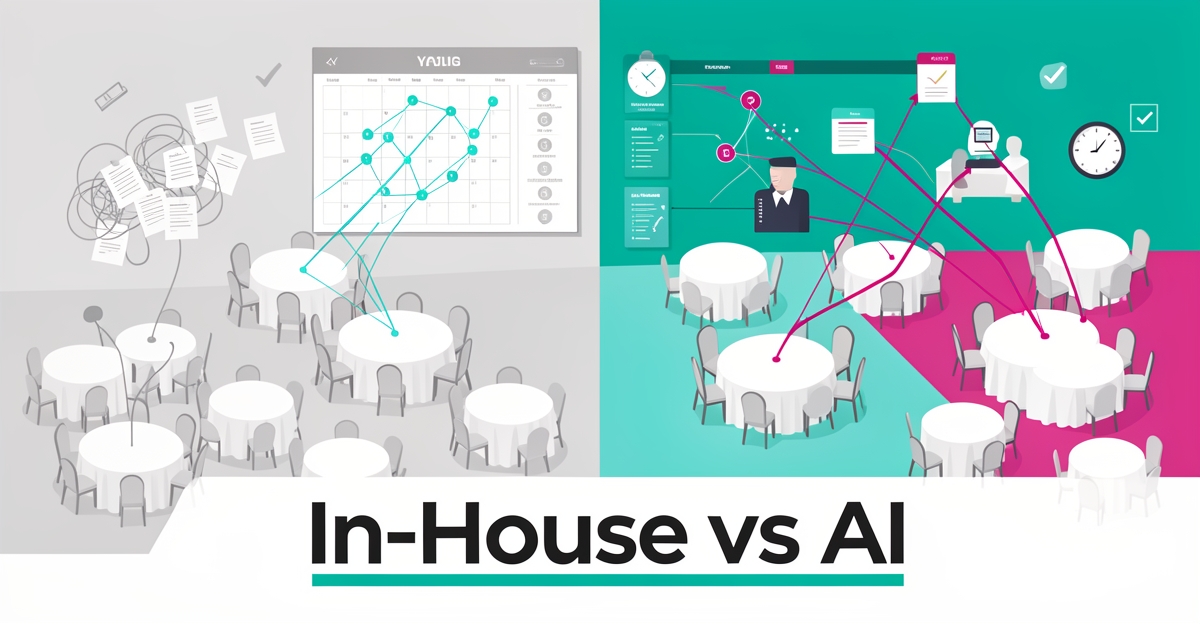
In-House vs AI: Which Is Better for Catering Scheduling in Banquet Halls?
Key Facts
- AI-powered menu planning typically reduces banquet hall planning time significantly by automating dietary customization and seasonal menu updates.
- AI staffing coordination reduces last-minute scheduling conflicts by aligning shifts with confirmed event timelines automatically.
- Vendor synchronization through AI decreases stockouts and over-orders by keeping inventory and orders tied to live event counts.
- AI systems can meaningfully reduce operational costs by cutting repetitive coordination work, with the size of savings depending on venue volume.
- In-house scheduling teams carry salaries, benefits, and ongoing training costs that strain mid-sized banquet hall budgets.
- AI systems analyze historical event data and seasonal trends to recommend optimal resource allocation.
- AI-powered solutions scale with business growth while reducing manual intervention and speeding service delivery.
Hire a team member that works 24/7 — for less than a part-time wage.
AI receptionists, SDRs, dispatchers and 99+ roles. Trained on your business, fully managed.
Not sure where to start? Ask our AI planner
Introduction
Banquet halls face mounting pressure to streamline event coordination while managing rising operational costs and evolving client expectations. Traditional in-house catering scheduling teams often struggle to balance personalized service with the efficiency needed to handle complex, high-volume events. As of late 2026, AI-powered automation has become a practical alternative for venues seeking to optimize menu planning, staffing, and vendor management without sacrificing quality.
AI-driven solutions can significantly reduce the administrative burden on banquet hall staff by automating repetitive tasks such as menu customization based on dietary restrictions, shift scheduling aligned with event timelines, and real-time vendor communication for inventory replenishment. These systems improve decision-making by analyzing historical event data, seasonal trends, and client preferences to recommend optimal resource allocation. This capability minimizes human error and accelerates response times during peak booking periods, allowing venues to handle more events with existing resources.
- Automated menu planning cuts hours of manual customization down to minutes
- AI staffing coordination flags and resolves scheduling conflicts before they reach the floor
- Vendor synchronization keeps orders matched to confirmed guest counts
While in-house teams offer deep familiarity with a venue's unique operations and client relationships, they often face limitations in scalability and adaptability. Maintaining dedicated scheduling staff involves ongoing costs related to salaries, training, and turnover, which can strain budgets, especially for mid-sized banquet halls experiencing fluctuating demand. Without continuous upskilling, internal teams may also lag in adopting new technologies, potentially slowing innovation and increasing vulnerability to operational disruptions during high-stakes events.
AIQ Labs supports banquet halls in navigating this transition through [AI Workflow Builds](/workflow-builds), rebuilding the one workflow that costs the most, at a fixed price, in phases, so venues retain full control over their automation journey while building sustainable competitive advantage. The choice between in-house expertise and AI augmentation ultimately depends on a venue's scale, growth trajectory, and readiness to invest in long-term operational resilience.
Key Concepts
Catering scheduling in banquet halls sits at the intersection of people, menus, and timing, and the way it is managed defines service quality.
In-house teams provide hands-on control and venue-specific tailoring. The traditional model is one where staff own the full guest journey, design, operation, and client communication. That model can feel cost-effective for a single property and allows decisions to be made quickly on site.
AI-powered solutions shift the workload from manual coordination to automated orchestration. AI can automate menu planning, staffing, and vendor coordination, reducing the workload and increasing efficiency for in-house teams. Systems can analyze large datasets and identify patterns, allowing for more informed decision-making and improved customer satisfaction.
Scalability is where the approaches diverge most clearly. AI-powered solutions can scale with business growth, reducing the need for manual intervention and increasing the speed of service delivery. In-house teams, by contrast, carry high salaries and benefits for staff and may struggle to keep up with changing customer demands and preferences, leading to decreased customer satisfaction.
Key concepts to weigh when comparing the two models include:
- Cost structure: ongoing payroll and training for in-house teams versus a fixed-price build for AI automation
- Speed and responsiveness: real-time adjustments to bookings, dietary requests, and vendor availability
- Scalability: handling multiple simultaneous events across banquet halls without proportional headcount growth
- Adaptability: keeping pace with evolving guest preferences and seasonal menu trends
In-house teams may require significant training and development to stay up-to-date with the latest technologies and trends, while AI systems can be updated centrally. The use of AI-powered solutions is increasingly common across the event management industry, with many venues and event planners adopting these technologies to improve efficiency and customer satisfaction.
For SMBs evaluating workflow automation, cost, speed, and scalability are the practical lenses. AIQ Labs focuses on practical automation for operations like menu planning, staffing, and vendor coordination, whether that means a single rebuilt workflow or [AI Employees](/ai-employees) that handle scheduling coordination as managed digital staff. The decision ultimately hinges on venue size, event volume, and how much manual oversight the team wants to retain versus automate.
Best Practices
AI-powered solutions are transforming catering scheduling in banquet halls by automating complex workflows like menu planning, staffing, and vendor coordination. These systems analyze large datasets to identify patterns, enabling more informed decisions that improve customer satisfaction and operational efficiency. AI-powered solutions can scale with business growth, reducing the need for manual intervention and increasing the speed of service delivery. Adoption across the events industry continues to grow as venues seek efficiency gains and better guest experiences.
In-house teams often face challenges related to high costs and limited scalability. Maintaining dedicated staff involves significant salaries, benefits, and ongoing training to keep up with evolving customer demands and technological trends. Without automation, in-house teams may struggle to respond quickly to changes, leading to decreased satisfaction and operational bottlenecks. AIQ Labs helps venues assess these trade-offs through a free 30-minute strategy call, identifying where automation delivers the highest return.
To successfully implement AI in catering scheduling, venues should follow a structured approach. First, conduct a thorough assessment of current workflows to pinpoint inefficiencies in menu planning, staffing, and vendor coordination. Second, prioritize integration with existing tools like CRM and scheduling software to ensure seamless data flow and minimize disruption. Third, establish clear governance frameworks to manage data security, compliance, and human oversight for critical decisions. Finally, invest in team training and change management to drive adoption and continuous improvement. A partner-led approach, combining custom development, managed AI employees, and ongoing optimization, ensures sustainable impact.
- Start with a single critical workflow, such as automated staffing scheduling, to prove value quickly
- Use AI to analyze historical event data and predict optimal menu and resource combinations
- Ensure AI systems include validation layers and human-in-the-loop controls for quality and safety
- Monitor performance metrics like response time and error reduction to guide scaling decisions
- Plan for cross-departmental expansion once core scheduling workflows are stabilized
By focusing on scalable, owned AI systems, banquet halls can reduce manual workload, improve service speed, and adapt to growth without proportional increases in headcount. The key is aligning automation with specific venue needs while building internal capability for long-term success. AIQ Labs supports this journey end-to-end, from strategy and development to deployment and optimization, ensuring AI becomes a lasting competitive advantage the venue owns outright.
Implementation
Transitioning from in-house catering scheduling to AI-powered automation requires a structured approach that addresses both technical and operational considerations. Successful implementation begins with a comprehensive assessment of current workflows and identification of high-value automation opportunities.
The first step involves mapping existing catering scheduling processes, including menu planning, staffing, and vendor coordination. This analysis helps identify bottlenecks and inefficiencies that can be addressed through AI automation. By understanding these pain points, venues can develop a targeted implementation strategy that maximizes ROI.
Next, venues should evaluate their technology infrastructure and data readiness. AI-powered solutions rely on high-quality data to function effectively, so ensuring data accuracy and completeness is crucial. This may involve consolidating data from various sources, such as CRM systems, inventory management tools, and customer feedback platforms.
When selecting an AI solution, venues should consider factors such as scalability, integration capabilities, and ease of use. AI automation can meaningfully reduce operational costs and improve efficiency, though the size of those gains depends on event volume and how much coordination work is currently manual. It's essential to choose a solution that aligns with the venue's specific needs and growth objectives, and to understand the payment model up front. AIQ Labs offers three: Start Monthly, Build in Milestones, and Own It Outright, so venues never get locked into renting software they could own.
Implementation should follow a phased approach, starting with a pilot project to test the AI solution in a controlled environment. This allows venues to identify and address any issues before full-scale deployment. Key steps in the implementation process include:
- Data migration and integration
- Staff training and change management
- Performance monitoring and optimization
- Continuous improvement and scaling
Throughout the implementation process, it's crucial to maintain open communication with staff and stakeholders. Addressing concerns and providing adequate training can help ensure a smooth transition and maximize adoption rates. Additionally, venues should establish clear metrics for success and regularly evaluate the AI solution's performance against these benchmarks.
By following a structured implementation approach, banquet halls can successfully transition from in-house catering scheduling to AI-powered automation, realizing cost savings, efficiency gains, and scalability benefits. The key to success lies in careful planning, stakeholder engagement, and a commitment to continuous improvement.
Conclusion
Choosing between an in-house catering scheduling team and AI comes down to cost, speed, and how well each approach scales with demand.
In-house teams offer tailored control and venue-specific knowledge, but they carry high salaries and benefits and can struggle to keep pace with changing customer demands and preferences. Maintaining in-house teams can be costly, and teams may fall behind as client expectations shift.
AI-powered solutions automate menu planning, staffing, and vendor coordination, reducing workload and increasing efficiency for in-house teams. AI can analyze large datasets and identify patterns, allowing for more informed decision-making and improved customer satisfaction.
Scalability is a decisive factor for banquet halls with seasonal peaks. AI-powered solutions can scale with business growth, reducing the need for manual intervention and increasing the speed of service delivery.
The trade-offs are clear when the two approaches are compared side by side:
- In-house teams provide tailored control for specific venue needs but face high ongoing costs and limited scalability
- AI-powered solutions deliver scalable, efficient operations with an upfront investment and an implementation learning curve
A comprehensive approach to event venue management, design, operation, and client relationships, remains essential regardless of tool choice.
For SMB banquet halls, the decision is not about replacing people, it is about freeing them to focus on guest experience while automation handles repetitive coordination. AI Workflow & Task Automation can be applied to menu planning, staffing, and vendor coordination without vendor lock-in, and for venues that want scheduling handled end to end, managed [AI Employees](/ai-employees) cover 99+ roles at a fraction of a human hire's cost.
AIQ Labs designs owned systems that scale with business growth. The right next step is to map your current scheduling bottleneck and test automation on one workflow before expanding.
Start the 2-minute Fit Check at https://aiqlabs.ai/apply to book a free 30-minute strategy call and identify high-ROI automation opportunities. If there is no clear win, the team will say so.
Still paying for 10+ subscriptions that don’t talk to each other?
We build custom AI systems you own outright. No vendor lock-in. Full control.
Not sure where to start? Ask our AI planner
Frequently Asked Questions
Is AI actually better than in-house teams for catering scheduling, or is it just hype?
What are the real cost differences between keeping an in-house scheduling team and using AI?
Can AI handle the personal touch banquet halls need for menus and client relationships?
How fast can AI improve our scheduling operations?
What happens if we try AI and it doesn't work for our venue size?
Are in-house teams really that hard to scale during peak seasons?
Choose Control, Speed, and Scale That Fit Your Venue
In-house catering scheduling teams deliver hands-on control and venue-specific knowledge, but they carry high payroll costs and limited scalability during peak seasons. AI-powered automation shifts the work from manual coordination to automated orchestration for menu planning, staffing, and vendor coordination, improving speed and responsiveness as demand fluctuates. The practical decision comes down to cost structure, speed of response to bookings and dietary requests, and the ability to scale across multiple simultaneous events without proportional headcount growth. For many banquet halls, the strongest path is not replacement but augmentation: freeing people to focus on guest experience while automation handles repetitive coordination. AIQ Labs supports this approach with custom AI systems that integrate with existing workflows and are owned by the business, not rented. Map your current scheduling bottleneck, test automation on one critical workflow, and expand from proven value. Start the 2-minute Fit Check at https://aiqlabs.ai/apply for a free 30-minute strategy call to assess your systems and identify high-ROI automation opportunities. If there is no clear win, the team will say so.
Make AI your competitive advantage — not just another tool.
Strategy, implementation and ongoing optimization. One partner, end to end.
Not sure where to start? Ask our AI planner