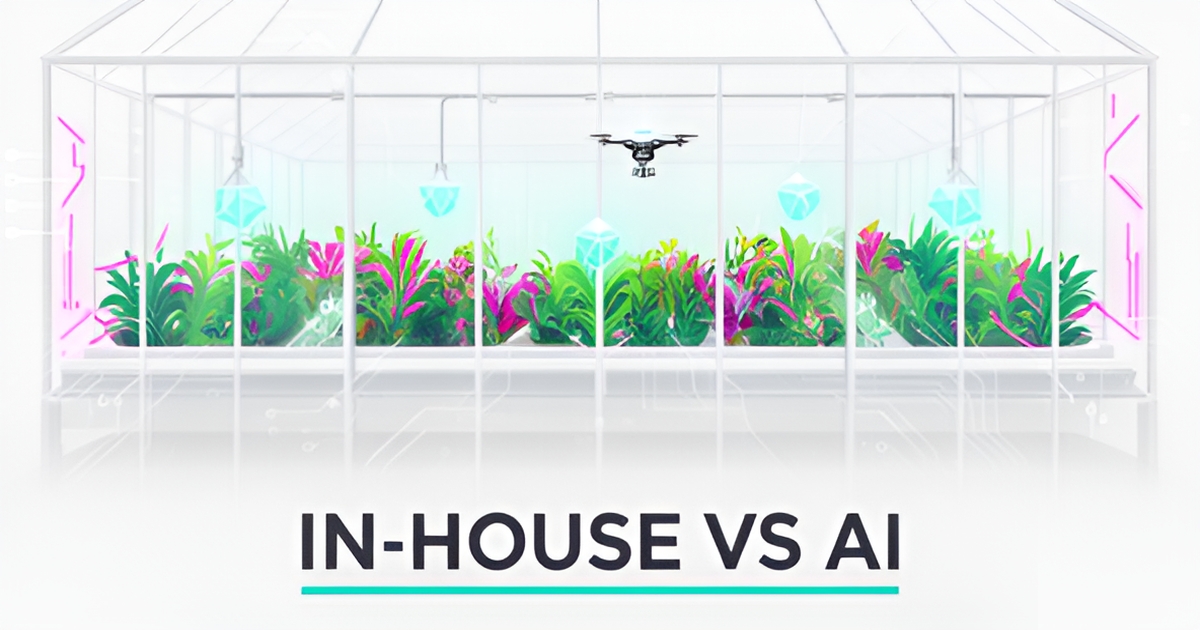
In-House vs. AI: Which Is Better for Daily Greenhouse Maintenance?
Key Facts
- AI Employees work 24/7/365 without sick days or shift gaps, eliminating overtime and coverage blind spots that cost yield and quality.
- AI Employees typically cost around 80% less than a human hire in an equivalent role, with flat monthly plans under part-time hire costs.
- AI-driven task automation provides continuous monitoring and data-driven actions, reducing hidden costs from turnover, inconsistency, and manual labor in greenhouses.
- Precision AI in agriculture analyzes satellite and thermal imagery for targeted irrigation and fertilization, minimizing waste in water and inputs.
- Starting with one repetitive workflow via a managed AI Employee typically delivers measurable ROI within the first one to two months, scaling only after proven results.
- AIQ Labs has deployed 200+ multi-agent systems and runs 4 live SaaS products daily — every AI Employee is built on infrastructure the company uses itself.
Hire a team member that works 24/7 — for less than a part-time wage.
AI receptionists, SDRs, dispatchers and 99+ roles. Trained on your business, fully managed.
Not sure where to start? Ask our AI planner
The Hidden Cost of Manual Greenhouse Labor
Manual greenhouse teams are stretched thin, and the bill shows up in places the P&L rarely explains clearly. Routine tasks like pruning, watering, and pest detection demand constant presence, and human coverage creates gaps that cost yield, quality, and cash.
Labor is not just salary. Overtime builds when crops need attention outside 40 hours, and fatigue drives inconsistency in watering and pruning decisions. Turnover compounds the problem; new hires require training time before they can reliably spot early pest pressure or maintain uniform canopy management.
Inconsistency is expensive in a controlled environment. Missed irrigation windows stress plants, uneven pruning reduces light penetration, and delayed pest detection allows issues to spread before a crew notices. These operational variances translate directly into waste and lost revenue.
Industry analyses of AI in agriculture consistently point to meaningful productivity gains when repetitive monitoring and decision tasks shift from manual coverage to automated systems — fewer manual checks, faster decision cycles, and continuous coverage rather than shift-limited attention. The same logic applies inside greenhouses, where over-watering and over-handling are common with manual routines: precision approaches that deliver inputs only when and where needed cut both waste and labor hours.
The financial burden of staffing routine tasks typically includes:
- Overtime and shift premiums for 24/7 crop monitoring
- Recruiting and training costs as seasonal turnover rises
- Yield loss from inconsistent pruning, watering, and pest detection
- Administrative overhead tracking labor hours and task completion
Human teams also face natural limits. Coverage stops at shift end, weekends, and sick days, creating blind spots for pest outbreaks or climate swings. AI-driven task automation removes those gaps by operating continuously and applying the same decision rules every hour.
AIQ Labs approaches this through AI Workflow Builds — rebuilding the one workflow that costs your operation the most, at a fixed price and in phases. The model shifts repetitive, time-sensitive tasks to managed AI Employees that work alongside human teams, handling monitoring and execution without the variability of manual coverage.
The result is a more predictable cost structure and steadier crop performance. With continuous monitoring and data-driven actions, greenhouses reduce the hidden drag of overtime, turnover, and inconsistency while capturing the productivity gains automation is built to deliver.
How AI Automation Delivers 24/7 Precision at Lower Cost
The night shift in a commercial greenhouse has always been a vulnerability — pests spread, irrigation drifts, and critical data goes uncollected while human teams rest. AI-driven automation closes that gap by operating on a continuous loop of perception, decision, and action that never pauses for fatigue or scheduling conflicts.
The operational upside compounds when intelligence directs physical workflows — pruning schedules adjusted in real time, nutrient recipes recalculated from live sensor feeds, and pest pressure mapped before infestations take hold. Typical capabilities include:
- Continuous environmental monitoring with sub-minute response thresholds
- Automated irrigation and fertigation tuned to plant-level demand signals
- Computer-vision pest and disease scouting that runs 24/7/365
- Predictive yield modeling that updates with every new data point
- Labor redeployment from repetitive monitoring to high-value crop decisions
AIQ Labs delivers this capability through managed AI Employees — purpose-built agents that integrate directly with climate computers, irrigation controllers, and ERP systems to execute greenhouse maintenance workflows end to end, at roughly 80% less cost than an equivalent human hire. The Fit Check helps growers quantify the labor gap and map the highest-ROI automation targets before any build begins.
Real-World Impact: Resource Savings and Operational Gains
When AI optimizes greenhouse workflows, the operational gains translate directly into measurable resource savings and efficiency improvements. Precision irrigation systems powered by AI can deliver water only when and where plants need it, and regional precision-agriculture programs in Europe have set ambitious water-replenishment targets through exactly this kind of targeted application. This level of precision not only conserves a vital resource but also reduces energy costs associated with pumping and distribution, creating a compounding effect on operational sustainability.
Beyond water management, AI-driven automation enhances productivity across routine greenhouse tasks such as pruning, pest detection, and environmental monitoring. By taking repetitive, time-intensive processes off human plates, these improvements free up skilled staff to focus on higher-value activities like crop planning, quality control, and strategic decision-making — amplifying human expertise without increasing headcount.
- Reduced water waste through real-time soil moisture and plant health analysis
- Lower labor costs via 24/7 automation of repetitive maintenance tasks
- Faster response times to pest outbreaks or nutrient deficiencies
- Consistent execution of standardized growing protocols
- Scalable operations that maintain quality during expansion phases
For greenhouse operators evaluating AI integration, these resource savings and operational gains represent more than cost reduction — they build resilience against labor shortages, climate variability, and rising input costs. AIQ Labs supports this transition with custom workflow builds that integrate with existing greenhouse management systems, ensuring automation enhances rather than disrupts established growing practices while delivering measurable efficiency improvements from day one.
Transitioning to AI-Powered Greenhouse Management
The leap from manual greenhouse routines to AI-driven operations doesn't require a wholesale overhaul — it starts with a single, well-scoped workflow that delivers measurable relief. Growers who target one persistent bottleneck — whether it's inconsistent irrigation scheduling, delayed pest scouting, or after-hours climate alarms — see faster ROI and build internal confidence for broader adoption. Even a narrow pilot is a high-leverage move when the workflow it removes is the one draining the most labor hours.
- Pick one repetitive, rules-based task that consumes disproportionate labor hours
- Define clear success metrics (e.g., reduced water waste, fewer missed alerts, faster response times)
- Deploy a managed AI Employee trained on your SOPs and integrated with existing sensors and software
- Run the pilot with regular performance reviews over the first 30–60 days
- Scale to adjacent workflows only after the first agent proves reliable
AIQ Labs structures this entry point through its Start Monthly model: a flat monthly plan that costs less than a part-time hire, covering the build, training on your specific greenhouse processes, tool integrations, ongoing monitoring, and continuous improvements — with the freedom to pause or adjust anytime. As your operation grows, the Build in Milestones model rebuilds larger workflows at a fixed price in phases, and Own It Outright lets you take full ownership of the system once it's proven. There are no long-term contracts, no platform lock-in, and no hidden setup-plus-subscription complexity. The same multi-agent architecture that powers AIQ Labs' production portfolio — 200+ deployed systems and 4 live SaaS products the company runs daily — backs every AI Employee, so the system handling your irrigation alerts or pest-detection escalations is built on proven infrastructure. The practical guidance most implementation experts emphasize is the same: start small, measure rigorously, and expand only after validated results.
Still paying for 10+ subscriptions that don’t talk to each other?
We build custom AI systems you own outright. No vendor lock-in. Full control.
Not sure where to start? Ask our AI planner
Frequently Asked Questions
How much can AI actually reduce labor costs for routine greenhouse tasks like watering and pest detection?
Will AI automation replace my experienced growers, or is it meant to work alongside them?
What kind of resource savings can AI-driven precision irrigation deliver?
How long does it take to see results from an AI automation pilot in a greenhouse?
Can AI really detect pests and diseases better than human scouts walking the rows?
What happens if the AI system makes a mistake with irrigation or climate control?
The Smartest Greenhouse Isn't the One With the Most Hands — It's the One That Never Sleeps
Manual greenhouse labor carries hidden costs that stretch far beyond payroll — overtime, turnover, inconsistent execution, and the inevitable blind spots that come with shift-based coverage. AI-driven automation closes those gaps with continuous monitoring, precision irrigation, and 24/7 pest detection, at roughly 80% less cost than expanding headcount. The transition doesn't require an overhaul — starting with a single, well-scoped workflow delivers measurable ROI and builds confidence for broader adoption. AIQ Labs helps growers make that shift through managed AI Employees built, trained, and integrated into existing systems under a flat monthly plan with no long-term lock-in. If you're ready to see where automation fits your operation, start the two-minute Fit Check — a free, no-obligation step toward a more predictable, resilient greenhouse.
Make AI your competitive advantage — not just another tool.
Strategy, implementation and ongoing optimization. One partner, end to end.
Not sure where to start? Ask our AI planner