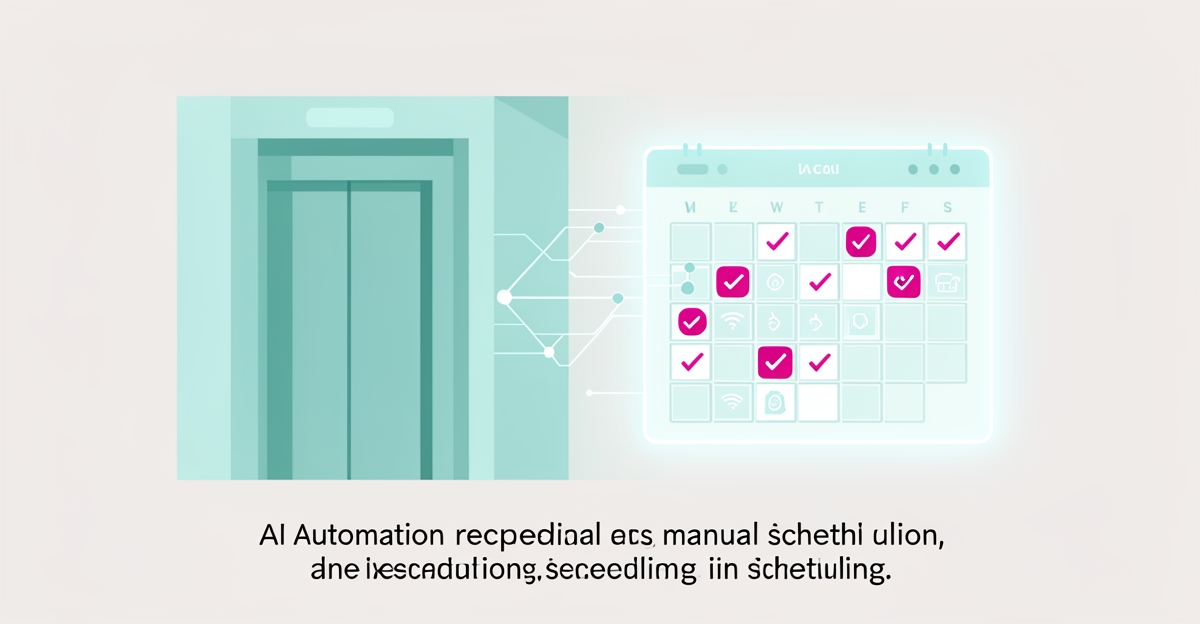
In-House vs AI: Which Is Better for Elevator Maintenance Scheduling?
Key Facts
- Manual scheduling can consume 20+ hours per week in administrative overhead, according to operational benchmarks
- Elevator technicians typically earn $60,000 to $80,000 annually, so admin hours carry a high opportunity cost
- Technician labor typically represents 40% to 50% of overall operational expenses in elevator service businesses
- Predictive maintenance can meaningfully improve elevator uptime and reduce emergency repairs compared with reactive scheduling
- AIQ Labs has deployed 200+ multi-agent systems and runs 4 live SaaS products daily as of late 2026
Hire a team member that works 24/7 — for less than a part-time wage.
AI receptionists, SDRs, dispatchers and 99+ roles. Trained on your business, fully managed.
Not sure where to start? Ask our AI planner
The Hidden Costs of Manual Elevator Scheduling
The true cost of managing elevator maintenance schedules manually extends far beyond the obvious time investment. When facility managers and senior technicians spend hours each week juggling spreadsheets, phone calls, and service windows, they're not just losing time, they're bleeding money and operational efficiency.
The most immediate drain is the sheer time consumption. Manual scheduling processes can consume over 20 hours per week in administrative overhead. That's half a full-time position dedicated solely to coordinating maintenance activities, tracking service histories, and managing technician calendars rather than improving building operations.
This administrative burden falls disproportionately on your highest-paid field staff. With elevator technicians typically commanding annual salaries between $60,000 and $80,000, every hour spent on scheduling administration represents a significant opportunity cost. Instead of performing revenue-generating maintenance or repairs, these skilled professionals, who often account for 40% to 50% of overall operational expenses, are tied to desks managing logistics.
The financial impact compounds when ongoing training investment is spent building expertise that then gets wasted on manual coordination tasks. The result is a cascade of operational inefficiencies:
- Senior technicians diverted from billable work to administrative tasks
- Increased overtime costs as scheduling errors require emergency adjustments
- Missed service windows that trigger compliance issues and tenant complaints
- Inability to optimize routes and schedules, leading to excessive travel time
- Reactive rather than preventive maintenance, increasing long-term equipment wear
These inefficiencies directly impact building performance. Manual scheduling often results in missed service windows that hurt elevator uptime and frustrate tenants who depend on reliable vertical transportation. When maintenance is delayed because a technician is double-booked or a service window was miscalculated, building managers face immediate pressure from occupants and potential liability issues.
AIQ Labs has observed that organizations attempting to scale operations while relying on in-house scheduling hit a ceiling where administrative overhead grows faster than service capacity. The hidden costs of manual scheduling, measured in lost productivity, technician burnout, and decreased tenant satisfaction, often exceed the apparent savings of avoiding automation investments.
How AI Automation Transforms Maintenance Operations
AI automation is reshaping how elevator maintenance teams operate by turning raw data into actionable insights. By analyzing sensor readings and historical maintenance records, AI systems can predict equipment failures before they occur, allowing technicians to address issues during planned service windows rather than reacting to unexpected breakdowns. This shift from reactive to predictive maintenance reduces unplanned downtime and extends the lifespan of critical components. Industry data as of late 2026 indicates that predictive maintenance can meaningfully improve elevator uptime while cutting operational costs through optimized scheduling and fewer emergency repairs.
Beyond failure prediction, AI enhances operational efficiency by intelligently routing service technicians based on location, skill set, and urgency of tasks. Dynamic scheduling algorithms minimize travel time between sites, ensuring that the right expert arrives at the right elevator at the right time. This level of coordination is difficult to achieve manually, especially in high-volume operations where dozens of buildings require attention daily. As a result, teams using AI-driven scheduling typically save 20+ hours per week on administrative tasks and route planning, freeing skilled labor for higher-value work. AI can analyze diverse data sources to not only predict maintenance needs but also optimize workforce deployment across complex service networks.
AIQ Labs applies this same principle of intelligent automation to maintenance workflows through AI Workflow Builds, rebuilding the one workflow that costs the most, at a fixed price and in phases. These systems integrate sensor data, service histories, and scheduling logic into a unified platform, eliminating manual coordination bottlenecks and reducing missed service windows by continuously learning from performance data. The result is a more reliable, cost-effective maintenance operation that scales with business growth, without requiring proportional increases in staff or oversight. By grounding decisions in real-time analytics rather than static calendars, AI transforms maintenance from a cost center into a predictable, optimized function.
Overcoming the Barriers to AI Adoption
Many organizations hesitate to adopt AI for elevator maintenance scheduling due to real-world barriers that extend beyond technical capability. These challenges, ranging from inconsistent equipment standards to trust in algorithmic recommendations, can stall implementation even when the potential benefits are clear. Addressing them requires a thoughtful approach that aligns AI deployment with operational realities rather than forcing technology into ill-fitting processes.
One of the most frequently cited obstacles is the lack of standardization across elevator manufacturers, which complicates data collection and model training for predictive systems. This fragmentation makes it difficult to deploy one-size-fits-all AI solutions without significant customization. Additionally, concerns about prediction reliability persist, with maintenance teams often skeptical of AI-generated recommendations until they've proven consistent accuracy over time. Data privacy and worker surveillance also raise valid concerns, particularly when systems monitor technician activity or building usage patterns. Finally, the upfront cost of implementation, including integration, training, and change management, can deter organizations despite long-term savings potential.
Custom-built AI systems directly address these barriers by adapting to existing infrastructure rather than requiring wholesale replacement. By designing models that ingest data from diverse sensor formats and maintenance logs, AIQ Labs creates solutions that work across mixed fleets without demanding manufacturer uniformity. These systems incorporate validation layers and human-in-the-loop controls to build trust in predictions, allowing technicians to override or refine AI suggestions while continuously improving model accuracy. Privacy-preserving architectures limit data collection to operational metrics essential for scheduling, avoiding unnecessary surveillance. Furthermore, because the AI is owned outright by the client, there are no recurring licensing fees or vendor lock-in, turning what feels like a cost barrier into a long-term asset. For high-volume operations, this approach typically saves 20+ hours per week in scheduling labor while reducing missed service windows through more reliable, adaptive planning.
Implementation Roadmap: From Manual to AI-Driven
Moving from manual scheduling to AI-driven automation isn't a single decision, it's a sequence. Teams that try to leap straight from spreadsheets to full automation often stall, while those that follow a phased roadmap build confidence at every step.
The first phase is identifying where scheduling actually breaks down. Manual scheduling is time-consuming and labor-intensive, and it rarely optimizes routes or service windows as effectively as AI can. Map the specific pain points: missed service windows, technician idle time, emergency callbacks disrupting planned work. These bottlenecks become your baseline for measuring improvement.
Next, translate those problems into defined use cases. Classify use cases by how they create value, for example, "automate routine task assignment so dispatchers spend less time on manual coordination." For elevator maintenance, high-ROI starting points typically include automated schedule optimization, predictive maintenance triggers, and proactive tenant communication.
Phase three is selecting the right AI architecture. AI systems can analyze data from sensors and maintenance records to predict when maintenance is required, and research indicates predictive maintenance can deliver meaningful reductions in operational costs and improvements in elevator uptime. Because the elevator industry faces a lack of standardization across manufacturers, the architecture must integrate with whatever data sources exist, CMMS records, sensor feeds, technician logs, rather than assuming clean, uniform inputs.
The final phase is deployment with human-in-the-loop guardrails. Reliability of predictions is a genuine concern; teams need confidence in AI recommendations before acting on them. Structure the rollout so AI proposes schedules and a human dispatcher approves them, with escalation rules for edge cases. Data privacy also matters, technician tracking should be transparent and limited to what scheduling genuinely requires.
This is where a partner like AIQ Labs adds value: rather than selling a point solution, the approach starts with a 2-minute Fit Check followed by a free 30-minute strategy call to identify high-ROI automation opportunities, then builds a custom system the business owns outright, designed to save 20+ hours per week in high-volume operations.
- Map current scheduling bottlenecks and missed service windows
- Define 2-3 high-ROI use cases tied to measurable outcomes
- Choose an architecture that integrates with existing, non-standardized data
- Deploy with human-in-the-loop approval before full automation
Considerations like cost of implementation are real, but phased deployment manages that risk: start with one workflow, prove the ROI, then expand. Teams that follow this sequence avoid the pilot trap and build a scheduling capability that scales with their portfolio.
The Business Case: Own Your Scheduling Intelligence
The real cost of elevator maintenance scheduling isn't just in technician wages, it's in the hidden hours spent coordinating, adjusting, and reacting to gaps in coverage. For many service providers, manual scheduling consumes 20+ hours per week that could be redirected toward preventive work or customer engagement. When you factor in dispatcher salaries, benefits, training, and turnover, the total cost of ownership for human-led scheduling quickly surpasses what a purpose-built AI system requires.
Owning your scheduling intelligence shifts the model from perpetual expense to strategic asset. Unlike SaaS subscriptions that renew indefinitely with no equity, a custom AI system built through AIQ Labs' AI Operating Systems becomes your property, fully controllable, adaptable, and free from vendor lock-in. This approach eliminates recurring fees while enabling deep integration with dispatch tools, CRM platforms, and technician calendars, creating a unified workflow that scales with your service volume.
The financial advantage compounds over time. An AI Employee handling dispatcher functions operates at roughly 80% less cost than a human hire, yet delivers 24/7 availability, zero missed shifts, and consistent adherence to scheduling rules. Meanwhile, human dispatchers incur ongoing costs for sick leave, overtime during peak periods, and retraining when protocols change. Over a 12-month period, these differences add up substantially without sacrificing responsiveness or accuracy.
Beyond direct labor savings, owned AI systems enable predictive optimizations that reduce wasted trips and improve first-time fix rates. By analyzing historical service patterns, technician availability, and equipment criticality, the system minimizes idle time and prevents scheduling conflicts that lead to missed service windows. This level of precision is difficult to achieve manually, especially when managing dozens of technicians across varied building types and service contracts.
Ultimately, owning your scheduling intelligence means investing in a system that appreciates rather than depreciates. It learns from your operations, adapts to seasonal demands, and evolves with your business, all while eliminating the recurring costs and limitations of third-party platforms. For elevator service providers seeking sustainable efficiency, the choice isn't just about automation, it's about who controls the schedule, and who pays for it month after month. See how the pricing works across Start Monthly, Build in Milestones, and Own It Outright models.
Still paying for 10+ subscriptions that don’t talk to each other?
We build custom AI systems you own outright. No vendor lock-in. Full control.
Not sure where to start? Ask our AI planner
Frequently Asked Questions
How much time are we really losing with manual elevator maintenance scheduling?
Can AI actually improve elevator uptime and cut costs?
Is in-house scheduling cheaper than AI automation?
What are the biggest barriers to adopting AI for elevator maintenance?
How do we move from spreadsheets to AI without disrupting operations?
Will AI replace our elevator technicians?
Smarter Scheduling Starts with a Simple Step
The article has shown that manual elevator maintenance scheduling drains valuable technician time, increases operational costs, and creates avoidable inefficiencies, from missed service windows to reactive maintenance cycles. In contrast, AI-driven automation transforms scheduling into a predictive, optimized function that typically saves over 20 hours per week, improves uptime, and reduces operational costs through intelligent routing and failure prediction. The path forward doesn't require a full overhaul, it begins with identifying your specific bottlenecks and testing a targeted solution. AIQ Labs helps service providers take that first step: complete the 2-minute Fit Check, then schedule your free 30-minute strategy call to uncover high-ROI automation opportunities tailored to your operations. If you're ready to stop losing time to spreadsheets and start owning your scheduling intelligence, the next move is simple.
Make AI your competitive advantage — not just another tool.
Strategy, implementation and ongoing optimization. One partner, end to end.
Not sure where to start? Ask our AI planner