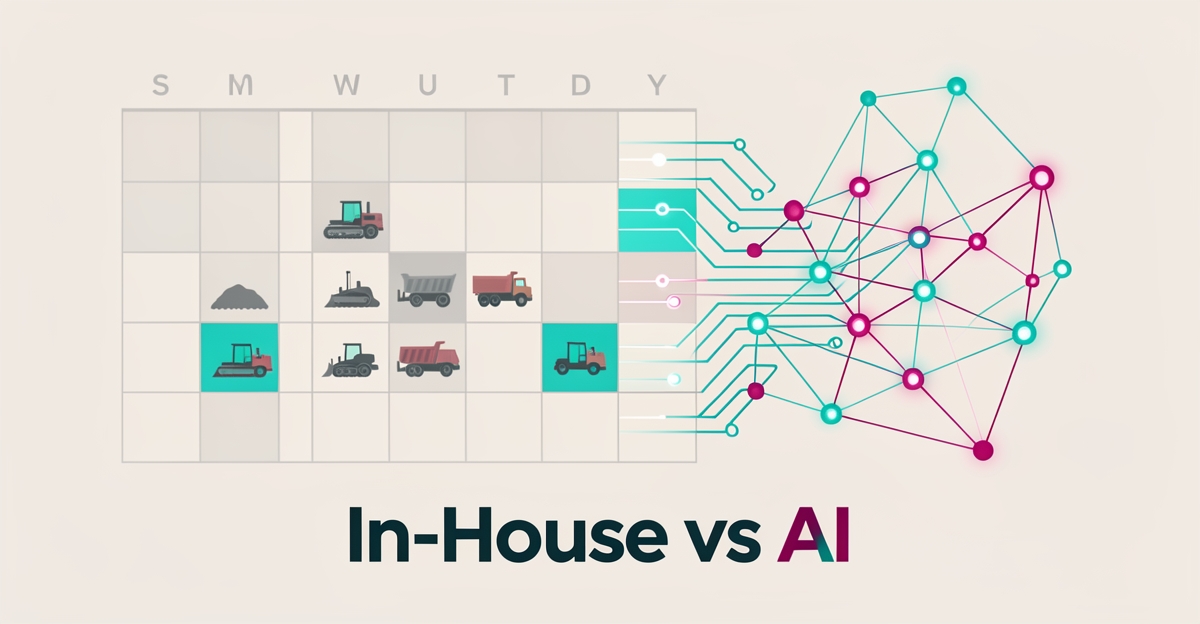
In-House vs AI: Which Is Better for Job Scheduling in Paving?
Key Facts
- A large share of enterprises struggle with AI implementation due to technical complexity, according to industry analysis
- AI scheduling tools can automatically reschedule to prevent overbooking or neglecting critical tasks per Wirecutter review
- AI scheduling platforms like Motion typically offer entry plans in the low tens of dollars per month per Zapier's analysis of leading AI scheduling platforms
- Reclaim offers per-user plans for managing recurring events and protecting team habits per Zapier research
- SkedPal provides time-blocking with natural language input on a low-cost monthly plan per scheduling platform analysis
- AI task-scheduling tools work best as helpers that prompt you to think more carefully about time use per time-management research
- The act of choosing what to work on and when helps people get their most important work done per Wirecutter review
Hire a team member that works 24/7 — for less than a part-time wage.
AI receptionists, SDRs, dispatchers and 99+ roles. Trained on your business, fully managed.
Not sure where to start? Ask our AI planner
The Hidden Cost of Manual Scheduling in Paving Operations
Manual scheduling in paving looks cheap on paper until the hidden costs start compounding across crews, equipment, and missed windows.
Every day spent coordinating jobs by phone, spreadsheet, or whiteboard pulls foremen and office staff away from revenue work. Industry analysis suggests a large share of enterprises struggle with AI implementation due to technical complexity, which is why many paving businesses stay with manual methods despite the drag. That hesitation creates a bottleneck of its own.
Time-intensive coordination is the most visible cost. Dispatchers manually check crew availability, truck locations, material deliveries, and weather windows before confirming a slot. When a job shifts, the ripple effect requires calls and re-entries across the team. AI task-scheduling tools are best used as helpers and as a prompt for you to think more carefully about how you use your time, highlighting how much mental load manual scheduling places on people.
Human error in resource allocation compounds the problem. Double-booked crews, forgotten equipment moves, and last-minute overtime are common when schedules live in multiple places. AI scheduling software plans tasks on your calendar's best free time, scheduling them around existing meetings with buffers or prioritization rules, a capability manual systems simply cannot replicate at scale.
Missed optimization opportunities quietly erode profitability. Without proactive rescheduling, paving firms leave gaps between jobs, drive excess mileage, and delay starts. The research notes AI can automatically reschedule to prevent overbooking or neglecting critical tasks, while manual processes rely on someone noticing the conflict first.
The hidden costs show up as:
- Labor hours lost to coordination, rework, and emergency fixes
- Idle equipment and crews during unplanned gaps
- Customer friction from delays and miscommunication
- Opportunity cost of jobs declined because the schedule looked full
For paving operations, where timing, weather, and crew mix determine margin, these frictions add up fast. The manual approach also limits scalability. Adding one more crew often means adding another dispatcher or accepting more errors.
This is where the business context matters. Comparing costs, time, and scalability of manual versus AI scheduling is exactly the kind of evaluation that feeds into a Workflow Build, rebuilding the one workflow that costs you the most, at a fixed price, in phases. At AIQ Labs, we see paving firms evaluate scheduling not as a software purchase but as an operational system that must maintain control over profitability while eliminating bottlenecks.
The most effective path is not wholesale replacement of judgment, but using automation for routine scheduling and keeping human oversight for strategic calls. That hybrid model reduces the time-intensive coordination and error risk while preserving the expertise paving businesses rely on for exceptional circumstances.
Where AI Scheduling Excels: Automation, Integration, and Conflict Prevention
AI-powered scheduling tools excel at automating the repetitive, time-consuming tasks that drain paving teams' productivity, turning manual calendar juggling into a streamlined, intelligent process. These systems continuously scan for open time slots, automatically book jobs around existing commitments, and apply prioritization rules to ensure critical tasks never fall through the cracks, capabilities demonstrated by tools like Motion, which uses AI to optimize schedules and document standard operating procedures on entry-level monthly plans according to Zapier's analysis of leading AI scheduling platforms.
Beyond basic automation, AI scheduling shines through seamless integration across the platforms paving businesses already rely on, eliminating data silos and reducing context-switching fatigue. Leading tools connect bidirectionally with Google Calendar, project management software like Asana or Trello, and even specialized dispatch systems, creating a unified view of crew availability, equipment allocation, and job timelines. This multi-platform connectivity ensures that when a crew lead updates a task in their project tool, the scheduling engine instantly reflects that change across all connected calendars, preventing the double-bookings and miscommunications that plague manual workflows.
Perhaps most valuable for high-volume paving operations is AI's proactive conflict prevention, where the system doesn't just react to scheduling clashes but anticipates and resolves them before they disrupt workflows. When a new urgent repair job is added or a weather delay shifts a pour schedule, AI scheduling software like Reclaim, which specializes in managing recurring events and protecting team habits on per-user plans per Zapier's research, automatically reschedules lower-priority tasks into the next optimal window, maintaining operational flow without constant managerial oversight. This predictive rescheduling capability directly addresses paving's unique challenges, where equipment dependencies, crew certifications, and material delivery windows create complex interdependencies that manual scheduling struggles to manage in real time.
For paving companies evaluating AI scheduling, the integration depth and automation sophistication offered by platforms like Motion and Reclaim represent more than convenience, they enable scalable operations where scheduling complexity grows linearly with business volume rather than exponentially. By handling routine time-blocking, conflict resolution, and cross-platform synchronization, these tools free supervisors to focus on strategic decisions like job prioritization based on client urgency, profitability, and strategic goals, areas where human judgment remains indispensable, as noted by time-management experts who emphasize that AI lacks the nuanced prioritization needed for true strategic alignment per Wirecutter's review of AI scheduling applications.
Why Human Judgment Still Matters: The Hybrid Approach for Paving Success
The most efficient paving schedule on paper collapses the moment a client's foundation pour runs three days late or a nor'easter saturates the subgrade. AI excels at the mechanics of scheduling, but it cannot look at a darkening sky and decide which job gets the crew.
Time-management research confirms that AI task-scheduling tools work best as helpers that prompt you to think more carefully about how you use your time. These systems lack the judgment to prioritize based on urgency, energy levels, and strategic goals, exactly the calculations a paving contractor makes when deciding whether to sealcoat the shopping center or patch the emergency pothole first.
Strategic prioritization drives meaningful work outcomes. Research shows that the act of choosing what to work on and when to work on it helps people get their most important work done. For paving operations, this means human expertise remains essential for:
- Assessing weather windows and soil conditions that demand immediate schedule pivots
- Prioritizing emergency repairs that protect client relationships over routine maintenance
- Managing material delivery delays and equipment breakdowns with creative resource reallocation
- Reading client stress levels during delays to preserve long-term contracts
Industry analysis suggests that most enterprises struggle with AI implementation due to technical complexity, often because they expect full automation rather than augmentation. The businesses that succeed treat AI as a digital dispatcher that handles the calendar mathematics while humans handle the judgment calls.
This hybrid approach eliminates the administrative bottleneck without surrendering control. AI manages the routine optimization, finding open slots, preventing double-booking, sending confirmations, while your team focuses on the strategic decisions that protect margins and reputation.
AIQ Labs builds these collaborative systems specifically for field service operations, whether that's an AI dispatcher handling routine coordination or a fuller AI Operating System connecting scheduling with the rest of your business. The technology handles the repetitive coordination, but you retain full authority over prioritization and client management. The result is a schedule that adapts to reality, not just algorithms.
Implementation Roadmap: From Manual to AI-Augmented Scheduling in Paving
Transitioning from manual job scheduling to AI-augmented systems doesn't require a complete overhaul, it starts with small, targeted steps that deliver immediate value. For paving companies, this means identifying repetitive scheduling tasks like crew dispatch, equipment booking, and daily job sequencing, which AI can automate while preserving human oversight for strategic decisions. The most effective implementations begin by pinpointing these routine activities and selecting tools designed specifically for scheduling optimization rather than seeking a single solution for every problem.
The next step is choosing AI scheduling platforms with strong integration capabilities that minimize disruption to existing workflows. Tools like SkedPal offer natural language input for time-blocking on a low-cost monthly plan, allowing crews to describe scheduling needs conversationally instead of navigating rigid interfaces. Akiflow provides cross-platform labeling and automatic task management across calendars and project apps, creating a unified view of jobs, equipment, and crew availability. Both tools support rapid validation, testing integration setup should take minutes, including calendar connection, to ensure the solution fits seamlessly into current operations without extensive retraining.
Finally, validate the setup using a milestone-based deployment approach aligned with AIQ Labs' implementation model. Start by automating one high-frequency task, such as daily crew dispatch, and measure time saved and conflict reduction within the first week. Use this phase to refine rules around job prioritization and buffer times, ensuring the AI augments rather than replaces human expertise in urgent or complex scenarios. Whether you Start Monthly, Build in Milestones, or Own It Outright, this iterative method reduces risk, builds team confidence, and lays the foundation for scaling AI across dispatching, equipment tracking, and customer scheduling workflows while maintaining full operational control.
Start the Fit Check at https://aiqlabs.ai/apply to assess your scheduling bottlenecks and map a high-ROI AI implementation plan, then schedule your Free 30-Minute Strategy Call at https://aiqlabs.ai/book. No obligation, just clarity on whether AI scheduling can eliminate your manual bottlenecks while preserving the judgment your team relies on.
Still paying for 10+ subscriptions that don’t talk to each other?
We build custom AI systems you own outright. No vendor lock-in. Full control.
Not sure where to start? Ask our AI planner
Frequently Asked Questions
Will AI scheduling replace the need for human judgment in paving operations?
How much time do paving companies typically lose to manual scheduling coordination?
What are the hidden costs of sticking with manual scheduling in paving?
Can AI scheduling tools integrate with the software paving companies already use?
Is AI scheduling too complex or expensive for small paving businesses to implement?
What's the first step for a paving company looking to transition from manual to AI-augmented scheduling?
The Bottom Line: Your Schedule Should Work as Hard as Your Crew
The choice between in-house and AI scheduling isn't binary, it's about matching the right tool to the right task. Manual scheduling drains resources through endless coordination, human error, and missed optimization opportunities, while AI excels at automated conflict prevention, seamless integration, and proactive rescheduling. Yet the research confirms that AI task-scheduling tools are best used as helpers, not replacements for the strategic judgment that keeps paving projects profitable when weather shifts or emergencies arise. The winning approach combines AI's efficiency for routine dispatch and calendar management with human oversight for client relationships and complex prioritization. If you're ready to eliminate scheduling bottlenecks without surrendering control, AIQ Labs can help you map a hybrid implementation that fits your operation. Start the Fit Check at https://aiqlabs.ai/apply, then book your free 30-minute strategy call at https://aiqlabs.ai/book to identify your highest-ROI automation opportunities.
Make AI your competitive advantage — not just another tool.
Strategy, implementation and ongoing optimization. One partner, end to end.
Not sure where to start? Ask our AI planner