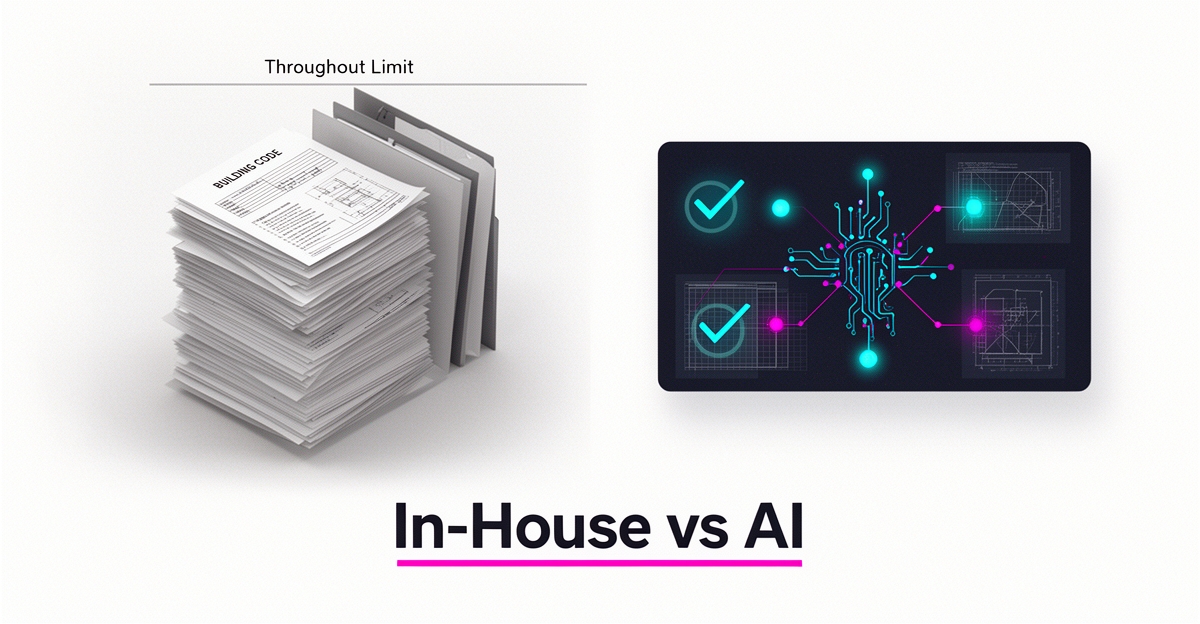
In-House vs AI: Which Is Better for Managing Building Code Submissions?
Key Facts
- Building code compliance market was $8.2B in 2023 and projected to $17.52B by 2032 according to market analysis.
- Average US AI specialist salary ranges between $120,000 and $180,000 annually per industry data.
- Senior AI engineers in major Canadian markets earn median compensation exceeding $200K per Holmes Consultants.
- 60% of successful AI programs use a hybrid of external consulting and internal teams according to AIDOLS research.
- AI-powered compliance solutions automate identification and reduce errors and subjective bias per Homesage research.
- AI consulting firms provide flexible pricing and immediate access to proven expertise as noted by Holmes Consultants.
Hire a team member that works 24/7 — for less than a part-time wage.
AI receptionists, SDRs, dispatchers and 99+ roles. Trained on your business, fully managed.
Not sure where to start? Ask our AI planner
The Hidden Cost of Manual Building Code Review
Manual code review is quietly becoming a liability as project pipelines swell and the people who know the codes get harder to keep.
Rising submission volumes collide with a shrinking talent pool, and the result is slower approvals, costly rework, and compliance risk that compounds with every project. Market analysis shows the building code compliance market was valued at $8.2 billion in 2023 and is projected to reach $17.52 billion by 2032, growing at a CAGR of 8.8%. That growth means more filings, more jurisdictions, and more complexity for teams already stretched thin.
In-house review also carries a human capital premium that is difficult to sustain. The average salary for AI specialists in the US ranges between $120,000 and $180,000 annually, with median compensation for senior AI engineers in major Canadian markets exceeding $200K. Recruiting, onboarding, and retaining that expertise requires significant upfront investment, and turnover resets institutional knowledge just when consistency matters most.
Error rates rise when volume outpaces capacity. Manual checks are prone to subjective bias and fatigue-driven misses, and each missed citation can trigger delays, penalties, or redesigns. Industry research notes AI-powered compliance solutions can automate and enhance identification processes, reducing the risk of errors and subjective bias. Without automation, teams absorb the cost in rework hours and lost schedule.
The hidden cost of manual review shows up across the operation:
- Throughput ceilings as reviewer hours cap the number of submissions processed per week
- Talent scarcity and wage inflation that make in-house scaling expensive and slow
- Inconsistent interpretations across reviewers and jurisdictions leading to rework
- Opportunity cost of senior staff spending time on repetitive checks instead of high-value design decisions
Organizations that rely solely on internal review often find themselves choosing between speed and accuracy. As compliance expectations tighten and project volumes climb, maintaining a purely manual function becomes unsustainable at scale.
This is where an implementation roadmap changes the equation. AIQ Labs works with teams through AI Strategy & Transformation Consulting to map high-impact automation opportunities and design a transition that preserves operational continuity. The goal is not to replace expertise, but to augment it so review teams focus on judgment while routine checks run consistently and faster.
With the compliance market expanding rapidly, the cost of waiting is measured in delays, errors, and missed capacity.
How AI Transforms Compliance Review: Speed, Accuracy & Scalability
AI-powered compliance review is reshaping how building code submissions are handled, turning a traditionally slow and error-prone process into a streamlined, reliable operation. By automating code validation, AI reduces the burden of manual checks while increasing consistency across large volumes of applications. This shift is especially valuable in fast-moving real estate markets where delays can impact project timelines and costs.
One of the most significant advantages of AI in compliance review is speed. Automated systems can process submissions in minutes rather than days, enabling faster approvals and reducing bottlenecks in permitting workflows. According to industry research, the building code compliance market is projected to grow to $17.52 billion by 2032, driven in part by demand for faster, more efficient review processes. AI helps meet this demand by handling repetitive validation tasks at scale, freeing up human reviewers to focus on complex interpretations and exceptions.
Accuracy is another key benefit. AI systems trained on current building codes and jurisdictional rules minimize human error, such as missed references or outdated interpretations. Unlike manual reviews, which can vary between reviewers, AI applies the same logic consistently every time. This reduces rework and delays caused by avoidable mistakes. Research shows that 60% of successful AI programs use hybrid models—combining external expertise with internal teams—to maintain high accuracy while building long-term capability. This approach ensures that AI tools are not only accurate but also continuously improved through human oversight.
Scalability further strengthens the case for AI in compliance workflows. During peak submission periods—such as after regulatory updates or development booms—AI systems can handle sudden spikes in volume without requiring additional hires or overtime. This elasticity prevents backlogs and keeps projects on schedule. As noted in expert analysis, AI consulting partners provide immediate access to scalable solutions, allowing organizations to adapt quickly without the delays of building internal teams from scratch.
For firms considering this shift, AIQ Labs offers tailored implementation roadmaps that support a smooth transition to AI-powered compliance review. By combining custom development with managed AI employees and strategic consulting, businesses can adopt AI at their own pace while maintaining control over their systems and data. The result is a compliance process that is not only faster and more accurate but also resilient enough to grow with the organization’s needs.
Why a Hybrid Approach Wins: AI Consulting + Internal Capability Building
The data reveals a clear pattern: organizations that succeed with AI don't choose between external expertise and internal capability—they combine them. Research from AIDOLS shows that 60% of organizations with successful AI programs use a hybrid model, leveraging consultants for immediate speed and specialized knowledge while gradually building their own teams for long-term ownership. This approach sidesteps the talent crunch where senior AI engineers command median compensation exceeding $200K in major Canadian markets, making pure in-house builds prohibitively expensive for most firms.
- External consultants deliver proven frameworks and immediate ROI on day one
- Internal teams develop institutional knowledge that compounds over time
- Risk distributes across both partners rather than concentrating in one
- Knowledge transfer happens through doing, not documentation alone
The building code compliance market—valued at $8.2 billion in 2023 and projected to reach $17.52 billion by 2032—exemplifies why this balance matters. AIQ Labs structures its AI Transformation Partner engagements around this exact principle: a Discovery Workshop maps high-value automation targets in days, a Strategic Planning engagement builds the roadmap in weeks, and Implementation Advisory guides the internal team through deployment while transferring capability at every step. The goal isn't dependency—it's a self-sufficient organization that owns its AI systems outright, with the code, agents, and data fully transferred upon completion.
Your Next Step: Assess Your Compliance Workflow for AI Readiness
Ready to determine if AI is the right fit for your building code submission process? Start with a two-minute Fit Check to uncover bottlenecks in your current workflow and identify high-ROI automation opportunities. This quick assessment helps pinpoint where delays, errors, or resource strain are impacting compliance timelines—especially critical as the building code compliance market is projected to grow to $17.52 billion by 2032 at an 8.8% CAGR. Industry research shows that organizations leveraging AI for compliance tasks see measurable gains in speed and accuracy, but only when the solution aligns with existing processes and team capacity.
Following the Fit Check, schedule a free 30-minute strategy call with an AIQ Labs engineer to dive deeper into your readiness for transformation. During this session, we’ll evaluate your current technology stack, data infrastructure, and team capabilities—key factors in determining whether an in-house build, AI consulting, or hybrid approach makes sense. Research indicates that 60% of successful AI programs use a blend of external expertise and internal development, allowing firms to accelerate implementation while building long-term capability. This balanced strategy reduces risk and avoids the pitfalls of over-investing in untested internal talent or becoming overly dependent on external vendors.
Use this discovery phase to assess your organization’s position on the AI maturity curve. Are you still in the exploration phase, running isolated pilots, or ready to scale across departments? Understanding where you stand helps clarify whether a targeted AI workflow fix—like automating code checklist validation or document routing—is the optimal first step. Consider these readiness indicators:
- Are compliance reviewers spending excessive time on repetitive data entry or cross-referencing?
- Do submission errors frequently trigger rework or delays in approval?
- Is your team struggling to keep up with evolving code requirements across jurisdictions?
- Do you lack real-time visibility into submission status or audit trails?
- Are scaling efforts hampered by manual bottlenecks during peak periods?
This evaluation isn’t about replacing your team—it’s about augmenting their expertise with intelligent automation that handles routine checks, flags inconsistencies, and ensures nothing slips through the cracks. By identifying where AI can deliver the fastest, most measurable impact, you lay the groundwork for a transformation that scales with your growth. The goal is to move beyond manual bottlenecks and toward a compliance workflow that’s faster, more reliable, and built to adapt—whether you choose to build, buy, or partner. Your next step is simple: start with the Fit Check, then let the data guide your decision.
Still paying for 10+ subscriptions that don’t talk to each other?
We build custom AI systems you own outright. No vendor lock-in. Full control.
Not sure where to start? Ask our AI planner
Frequently Asked Questions
Is AI really faster than manual building code review?
Will using AI for code compliance increase errors or reduce accuracy?
Is it too expensive to build an in-house AI team for compliance review?
What’s the best approach for adopting AI in building code compliance—build in-house, hire consultants, or use a hybrid model?
Can AI handle sudden spikes in building code submissions during peak periods?
How do I know if my organization is ready to use AI for compliance review?
Building a Smarter Path to Compliance
The article has shown that manual building code review struggles to keep pace with rising submission volumes, a shrinking talent pool, and increasing jurisdictional complexity—leading to delays, errors, and unsustainable costs. AI-powered solutions offer clear advantages in speed, accuracy, and scalability, especially when implemented through a hybrid approach that combines external expertise with internal capability building. Rather than choosing between in-house teams and AI consulting, forward-thinking organizations are leveraging both to accelerate results while developing long-term ownership. The data confirms that 60% of successful AI programs use this balanced model, allowing firms to move faster without sacrificing control or sustainability. If you're assessing whether your compliance workflow is ready for this shift, the next step is simple: start with the two-minute Fit Check to uncover bottlenecks and high-ROI opportunities, then schedule a free 30-minute strategy call with an AIQ Labs engineer to explore what’s possible for your team.
Make AI your competitive advantage — not just another tool.
Strategy, implementation and ongoing optimization. One partner, end to end.
Not sure where to start? Ask our AI planner