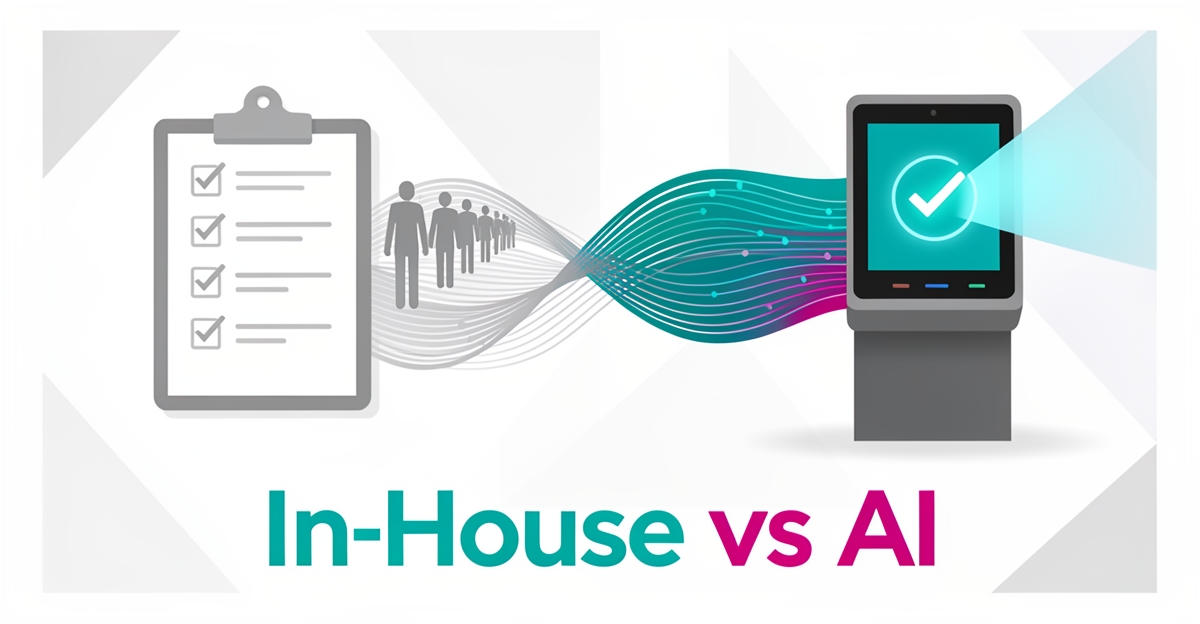
In-House vs AI: Which Is Better for Managing Camp Attendance and Check-Ins?
Key Facts
- Manual check-in lines and paperwork errors are the most common complaints from parents and staff on peak arrival days
- AI employees work 24/7/365 with no breaks, sick days or vacation coverage gaps
- AI staffing typically costs around 80% less than an equivalent human hire, per AIQ Labs' current AI Employees pricing model
- Real-time roster sync eliminates the siloed spreadsheets, paper waivers and separate attendance tools that cause compliance gaps
- AIQ Labs has deployed 200+ multi-agent systems and runs 4 live SaaS products daily, so these patterns are proven at operational scale
- A phased rollout with human-in-the-loop controls protects camp operations during the transition season
Hire a team member that works 24/7 — for less than a part-time wage.
AI receptionists, SDRs, dispatchers and 99+ roles. Trained on your business, fully managed.
Not sure where to start? Ask our AI planner
The Attendance Bottleneck Camps Face Today
Manual check-ins turn a camp's first impression into a bottleneck, and the pain shows up in long lines, missed data, and exhausted staff. When families arrive tired and excited, the front desk becomes the make-or-break moment for experience and operational control.
Guests and families now expect the speed and personalization they experience everywhere else, from hotel kiosks to food-delivery tracking. Camps that still run clipboard-and-spreadsheet arrivals feel that gap most on the first morning of a session, when every family shows up in the same 30-minute window.
Camps running in-house check-ins face three interlocking failures.
- Long lines and wait times that erode first-day experience and delay programming
- Human error in attendance capture, waiver signing, and medical notes that creates liability and inconsistent records
- Staffing gaps during peak arrival windows, with limited coverage for late arrivals or early departures
These friction points compound because data stays siloed. Check-in sheets, paper waivers, and separate roster tools rarely sync in real time, so leadership lacks a single source of truth for occupancy, staffing needs, and safety compliance.
For camps, the parallel to what hospitality operators have already solved is clear: predictive operations and data integration are critical for revenue and experience. Without real-time attendance data, managers cannot staff correctly, anticipate bottlenecks, or prove compliance. Manual processes also make it hard to personalize communications, track no-shows, or recover ancillary revenue.
The operational cost shows up as overtime, rework, and lost trust. Staff spend hours reconciling rosters instead of engaging families. Inconsistent capture creates gaps in medical alerts and emergency contacts. Over time, these issues limit growth because the team cannot scale check-in capacity without adding headcount.
Organizations navigating this shift benefit from structured change management and training. AIQ Labs builds managed AI Employees that slot into existing teams, and its phased delivery approach supports staff buy-in during process redesign. The goal is not to replace people, but to remove repetitive strain so teams can focus on hospitality.
When attendance data is accurate, unified, and accessible, camps can move from reactive firefighting to proactive hosting. That is the efficiency pressure now defining guest-facing organizations, and the same expectation is arriving at camp check-in.
Human Staff vs AI: Cost, Speed and Consistency Compared
When managing camp attendance and check-ins, the choice between human staff and AI employees hinges on availability, accuracy, cost, and scalability. Human teams typically operate set shifts, leading to gaps in coverage during early mornings, evenings, or weekends when check-in demand may spike. In contrast, AI employees work 24/7/365 without breaks, sick days, or vacation time, ensuring consistent attendance tracking and real-time updates regardless of shift changes or staffing shortages.
Accuracy and consistency also favor AI in high-volume scenarios. Human data entry is prone to fatigue-related errors, especially during peak arrival periods, while AI systems maintain uniform performance when integrated with registration and scheduling tools. Reliable check-in data enables better staffing forecasts and activity planning. For AI to deliver these gains, seamless data integration across registration, medical forms, and attendance systems is essential, because siloed data undermines both human and machine decision-making.
From a cost perspective, AI employees present a compelling alternative to traditional staffing. Human receptionists or coordinators typically command annual salaries in the mid-five figures plus benefits and taxes, while AI employees from AIQ Labs operate on a flat monthly model that typically costs around 80% less than an equivalent human hire. This structure eliminates recruiting expenses and reduces ongoing operational costs without the overhead of a part-time hire. For camps managing seasonal fluctuations, this scalability means AI can handle sudden surges in check-ins without overtime or temporary staffing, while scaling down during off-peak periods without layoffs or underutilization.
Ultimately, the effectiveness of either approach depends on workflow design and change management. AIQ Labs supports organizations in transitioning to AI-enhanced attendance systems through phased implementation, whether that is a single managed AI receptionist role or a broader Workflow Build that rebuilds the one arrival workflow costing you the most. By aligning AI capabilities with human oversight where judgment is needed, camps can achieve both operational resilience and a smoother experience for families arriving at check-in. To explore how this balance works in practice, start with the two-minute Fit Check to assess your current workflow and identify high-ROI automation opportunities.
How AI Changes Camp Check-In from Friction to Flow
The traditional check-in line is often the first point of friction for campers and parents alike, setting a tone of delay before the day even begins. AI transforms this moment from a bottleneck into a seamless flow, using automation to handle arrivals, departures, and everything in between without slowing the pace of fun.
Automated check-in and check-out systems powered by AI eliminate manual paperwork and long queues by verifying identities through QR codes, PIN entry, or voice confirmation the moment a camper arrives or leaves. These systems update rosters in real time, giving staff instant visibility into who is on-site, which activities they're signed up for, and any special considerations, all without a single clipboard or spreadsheet. This level of operational clarity mirrors the efficiency gains guest-facing organizations are already achieving with predictive operations tools.
Beyond logistics, AI enhances the parent experience through proactive, personalized communication. Instead of waiting for end-of-day summaries or chasing down counselors, parents receive automated updates, such as safe arrival confirmations, activity participation alerts, or gentle reminders about pickup times, delivered via SMS or app notifications based on their preferences. Families increasingly expect this kind of timely, relevant communication, and AI makes it practical at camp scale.
Behind the scenes, AI continuously analyzes attendance patterns to predict staffing needs. By identifying trends, such as higher absenteeism on rainy days or increased early pickups on Fridays, the system recommends optimal counselor-to-camper ratios and suggests shift adjustments before gaps emerge. This predictive capability reduces overstaffing costs while ensuring adequate supervision.
For camps navigating this shift, the transition isn't just about installing new software, it's about rethinking roles, building confidence in the technology, and preparing teams to work alongside AI as a collaborative partner. That's where AIQ Labs' phased approach becomes essential, helping organizations adopt these tools not as replacements, but as force multipliers that free up staff to focus on what matters most: creating safe, engaging, and memorable experiences for every camper.
Making the Switch Without Disrupting Camp Operations
Switching attendance from manual check-ins to AI assistance feels risky during peak camp season, but a phased change-management approach protects operations while building confidence.
Start with staff buy-in before any technology touches the front desk. Frontline teams need to see AI as support, not replacement, and early involvement reduces resistance. Assessment work identifies current pain points in check-in, roster tracking, and parent communication so the solution maps to real workflows. This is exactly how AIQ Labs begins every engagement, with a focused look at the workflow that costs the most.
Data readiness determines whether the rollout succeeds or stalls. Camps need to integrate data across registration platforms, medical forms, and daily attendance records, the same integration challenge hotels solved across property management, CRM, and loyalty systems. Accurate, up-to-date data is essential; unreliable inputs undermine both human and machine decision-making.
A phased rollout limits disruption and creates proof points. Pilot the AI-assisted check-in at one site or one session window, keep human staff in the loop, and measure time-to-check-in, error rates, and parent satisfaction. Training should be role-specific and continuous, not a one-time demo. Governance is established early with clear escalation paths, privacy controls, and audit trails for attendance records.
Staff training and adoption can be structured around:
- Role-based simulations that mirror real morning rush scenarios
- Clear ownership of exceptions, with human-in-the-loop controls for medical or custody issues
- Feedback loops where counselors report friction points weekly for rapid tuning
- Performance dashboards that show time saved and accuracy gains, not just activity
Predictive operations tools improve staffing and resource management, and the same principle applies to camp staffing and cabin assignments. When teams see measurable gains, adoption accelerates.
Governance and managed support keep the transition steady. AIQ Labs deploys managed AI Employees that work alongside human teams, with milestone-based builds and clear ownership at every phase. This ensures the camp maintains service quality while scaling efficiency without adding headcount. Camps that want a connected layer across registration, attendance, and parent communication can graduate to an AI Operating System over time.
The result is a calm, confident switch where staff feel equipped, parents notice faster check-ins, and leadership gains reliable attendance data for safer, smoother operations.
Still paying for 10+ subscriptions that don’t talk to each other?
We build custom AI systems you own outright. No vendor lock-in. Full control.
Not sure where to start? Ask our AI planner
Frequently Asked Questions
Is AI actually cheaper than hiring more front desk staff for check-in?
Can AI handle our morning arrival rush without long lines?
What mistakes happen with manual attendance and check-ins?
Will AI work with our existing registration, CRM and medical forms?
Does AI replace camp staff or just support them?
How do we switch to AI check-in without disrupting camp season?
From Check-In Lines to Confident Arrivals
Manual check-ins create the first impression camps can't afford to lose: long lines, error-prone rosters, and staff stretched thin during peak arrivals. AI shifts that moment from friction to flow by automating verification, updating attendance in real time, and delivering proactive parent communications, while predictive insights help staff correctly and anticipate bottlenecks. For camps, the business value is calmer mornings, reliable compliance data, and teams freed to focus on hospitality instead of reconciliation. A phased rollout with staff buy-in, role-based training, and clear governance protects operations while building confidence. If you're weighing in-house versus AI support for attendance, start with a focused assessment of your arrival workflow and pilot one session with human-in-the-loop controls. Take the two-minute Fit Check at https://aiqlabs.ai/apply, then book a free 30-minute strategy call at https://aiqlabs.ai/book to map your biggest bottleneck and identify high-ROI automation opportunities with AIQ Labs.
Make AI your competitive advantage — not just another tool.
Strategy, implementation and ongoing optimization. One partner, end to end.
Not sure where to start? Ask our AI planner