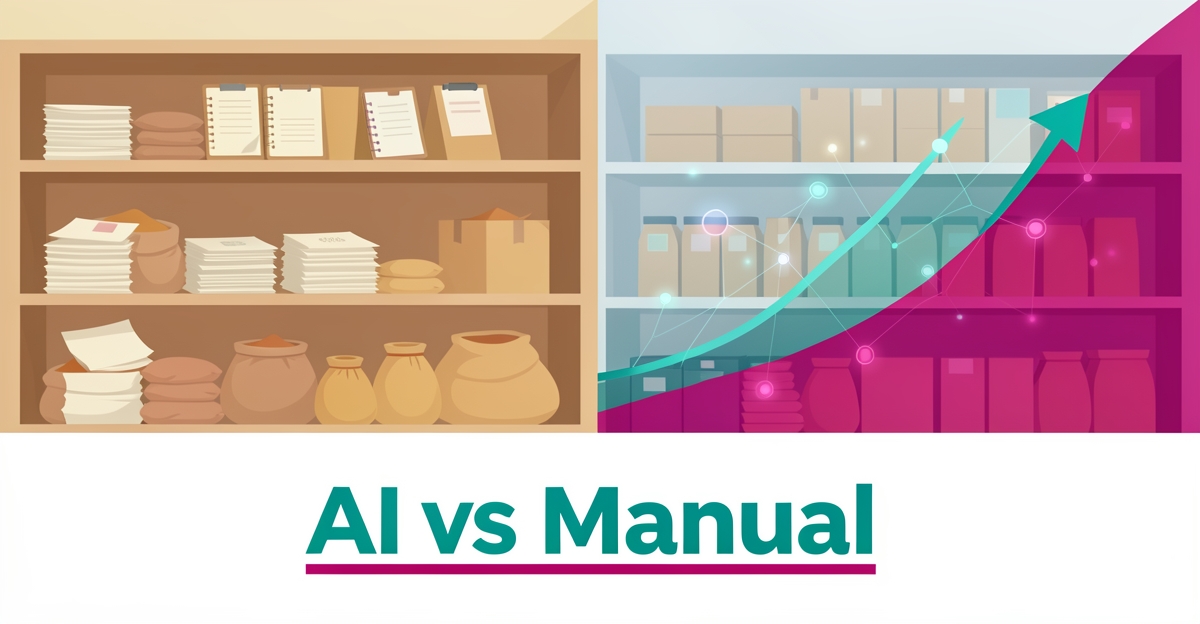
In-House vs AI: Which Is Better for Managing Inventory in Indian Food Businesses?
Key Facts
- AI-driven forecasting typically cuts inventory forecast errors by 20-50% compared to traditional manual methods, according to industry research.
- India's inventory management technology market was valued at roughly USD 2.2 billion in 2024, with strong double-digit growth projected through 2032.
- AI forecasting can reduce excess inventory by up to 30% and deliver warehousing cost savings of 5-10%, recent analysis shows.
- Logistics expenses consume a significant share of India's GDP, commonly cited around 14%, according to supply chain data.
- A majority of retailers, around 70% in industry surveys, are prioritizing real-time data as the driver of inventory technology adoption, industry research finds.
- Custom AI inventory systems can meaningfully reduce stockouts and excess inventory, improving cash flow and service consistency.
- AI forecasting analyzes festivals, monsoons, and even social media trends, signals spreadsheets and manual tracking simply cannot process.
Hire a team member that works 24/7 — for less than a part-time wage.
AI receptionists, SDRs, dispatchers and 99+ roles. Trained on your business, fully managed.
Not sure where to start? Ask our AI planner
Why Manual Inventory Tracking Is Costing Indian Food Businesses Money
Manual inventory tracking is costing Indian food businesses money through preventable stockouts, spoiled perishables, and inflated operational expenses. With seasonal demand swings and a complex supply chain, traditional methods fail to keep pace, leading to lost sales and wasted ingredients that directly impact profitability. This inefficiency is especially costly given that India's logistics expenses consume a significant share of GDP, commonly cited around 14%, eroding margins across the food sector.
The financial toll is amplified by the scale of the opportunity being missed. The India inventory management technology market was valued at roughly USD 2.2 billion in 2024 and is projected to keep growing rapidly through 2032, signaling a steady industry shift toward smarter solutions. Businesses still relying on manual logs and guesswork are not only incurring avoidable costs but also falling behind competitors who are adopting AI-driven forecasting to gain real-time visibility and control.
These manual processes create a cascade of avoidable losses: overstocking ties up working capital in slow-moving spices and sauces, while understocking leads to missed service opportunities and customer dissatisfaction. Perishable ingredients like fresh herbs, dairy, and prepared bases often expire before use, turning inventory into waste. Meanwhile, staff spend excessive time on reconciliation instead of value-added tasks, increasing labor costs without improving accuracy.
AIQ Labs addresses this gap through AI Workflow Builds, rebuilding the one inventory workflow that costs you the most, at a fixed price and in phases. A forecasting system that analyzes historical usage, seasonal trends, and supplier lead times can automate reordering and optimize stock levels, directly improving cash flow and service consistency. For larger operations, an AI Operating System connects inventory with procurement and sales data in one layer you own outright.
Without this shift, Indian food businesses continue to leak revenue through inefficiencies that are entirely solvable with the right technology. The market's rapid growth confirms that the future of inventory management is already here, and those clinging to spreadsheets and clipboards are paying the price every day.
What AI Inventory Forecasting Does That Spreadsheets and Staff Can't
Spreadsheets and staff juggling inventory in Indian food businesses often miss the subtle patterns that drive waste and stockouts. Traditional methods rely on historical averages and gut instinct, which struggle to keep pace with shifting demand, seasonal spikes, or sudden weather changes. This gap leads to overstocking perishable ingredients or running out during peak service hours, both costly outcomes for thin-margin operations.
AI inventory forecasting transforms this dynamic by analyzing multiple demand signals simultaneously. It processes sales history, local festivals, monsoon patterns, and even real-time social media trends to predict usage with far greater precision. According to industry research, this approach typically cuts forecast errors by 20-50% compared to manual methods, directly reducing the guesswork that inflates carrying costs.
Beyond prediction, AI automates critical inventory decisions that spreadsheets simply cannot handle at scale. It dynamically adjusts reorder points and safety stock levels based on lead times, supplier reliability, and real-time consumption data, ensuring fresh stock arrives just as it's needed. This capability enables Indian food businesses to reduce excess inventory by up to 30% while simultaneously minimizing stockouts, as noted in supply chain analytics. The result is leaner operations, less waste, and improved cash flow without sacrificing service reliability.
- Analyzes nonlinear relationships in data that traditional statistical models overlook
- Continuously learns from new sales, returns, and supplier performance data
- Integrates with POS and procurement systems for closed-loop automation
- Scales across multiple locations without proportional increases in manual oversight
For Indian food businesses managing spices, sauces, and perishable ingredients, this level of automation isn't just convenient, it's essential for maintaining quality and controlling costs in a competitive market. AIQ Labs develops custom forecasting models that embed these capabilities directly into existing workflows, turning inventory management from a reactive chore into a strategic advantage.
The Real Trade-Offs: Costs, Data Quality, and Change Management
Many Indian food businesses hesitate to adopt AI for inventory management due to perceived barriers around cost, integration, and people. These concerns are valid, but often overstated when viewed as solvable challenges rather than insurmountable obstacles.
Implementation costs for AI inventory systems vary widely, but businesses can begin with targeted workflow fixes rather than full-scale overhauls, aligning investment with immediate pain points. Legacy POS and warehouse systems commonly used in Indian food operations, such as Tally, Marg ERP, or custom spreadsheets, can integrate with modern AI platforms through APIs or middleware, avoiding the need for complete system replacement. The key is phased deployment: start with one critical workflow, like sauce or spice reordering, prove value, then expand.
Data quality remains a frequent concern, yet AI models are surprisingly resilient to imperfect inputs when properly configured. While clean, integrated data from POS, warehouse, and supplier systems improves accuracy, even moderate-quality historical sales data can yield meaningful forecasts, especially when combined with seasonal and promotional signals. Businesses don't need perfect data to start; they need a process to improve it over time. The real risk isn't starting with flawed data, it's waiting for perfect data that never comes.
Skill gaps and employee resistance are human challenges, not technical ones. Teams accustomed to manual spreadsheets may fear automation or lack confidence in interpreting AI-generated reorder suggestions. Addressing this requires more than training, it demands change management that involves staff early, explains how AI reduces tedious tasks (like daily stock counts or emergency supplier calls), and positions the technology as a collaborator. When employees see AI handling routine calculations while they focus on supplier relationships or menu planning, adoption accelerates.
Ultimately, the trade-offs of in-house inventory management aren't about eliminating difficulty, they're about choosing which problems to solve. Manual methods avoid upfront tech investment but perpetuate hidden costs: overstocking perishable ingredients, understocking during festivals, and staff hours lost to reconciliation. AI shifts the effort from reactive firefighting to proactive planning, with challenges that, while real, are well-documented and addressable through thoughtful implementation. The businesses gaining the most aren't those with the biggest budgets or cleanest data, they're the ones that started small, learned fast, and scaled what worked.
How to Move from Manual Tracking to AI-Driven Inventory in Practical Steps
Moving from a handwritten stock register to AI-driven forecasting feels daunting, but it doesn't have to be a leap, it's a sequence of practical steps that any Indian food business can follow, one phase at a time.
Step 1: Assess your current process. Document how you track spices, sauces, and ingredients today, where the data lives, how often it's updated, and where stockouts or waste occur most. This audit exposes the pain points an AI system must solve first.
Step 2: Define measurable objectives. Decide what success looks like: fewer 86'd menu items during dinner rush, less spoiled produce, tighter cash flow. AI-driven forecasting can cut forecast errors by 20–50% and reduce inventory levels by up to 30% compared to traditional methods, according to Microsoft research on agentic AI, so set targets against benchmarks like these.
Step 3: Prepare your data. AI models are only as good as what feeds them. Consolidate records from your point-of-sale system, purchase logs, and supplier lists, and clean up inconsistencies. Data quality and integration are consistently the make-or-break factors in AI inventory success.
Step 4: Select a solution that fits your operation. Look for a system that forecasts demand using historical sales, seasonality, and trend data, and automates reordering rather than just reporting. Custom builds, like the workflow builds AIQ Labs delivers for food businesses, can be tailored to your exact ingredient mix and service patterns instead of forcing you into a generic template.
Step 5: Implement in phases. Integrate the system with your existing tools and run it alongside manual checks before going fully live. Phased rollouts reduce risk and build confidence in the numbers.
Step 6: Train your team and monitor the model. Staff need to trust the reorder suggestions, and the model needs ongoing tuning as menus, seasons, and footfall change. Expect a learning curve, change management is one of the most cited adoption challenges.
Step 7: Iterate and optimize. Review forecast accuracy monthly, flag misses, and refine. With India's inventory management technology market projected to keep growing rapidly through 2032, the tools will keep improving, your process should too.
When budgeting, flexible engagement models matter. AIQ Labs offers three: Start Monthly (a flat monthly plan you can pause or adjust), Build in Milestones (pay per completed phase, keeping everything built so far), and Own It Outright (full ownership of code, agents, and data). No fake prices, real numbers come in writing after a strategy call. See pricing details for how each model works.
If you want clarity on which step offers the fastest win for your kitchen, start with the two-minute Fit Check, then book a free 30-minute strategy call, a working session with an AI engineer, not a sales pitch. If there's no clear win, they'll tell you that too.
Choosing Your Path: When AI Inventory Automation Makes Sense for Your Food Business
Choosing the right approach comes down to how much volatility you can afford to absorb with manual work.
For many Indian food businesses, the decision is not about preference but about scale, seasonality, and the cost of waste. Manual tracking can hold up a small kitchen with stable demand, but it strains quickly when menus expand, suppliers shift, or festivals spike orders.
Business size sets the baseline. A single outlet with predictable daily prep can often manage with spreadsheets and experience. Multi-outlet operations, central kitchens, or businesses selling spices, sauces and ingredients across channels face compounding complexity that manual processes cannot reconcile in real time.
Demand volatility is the next filter. Industry research shows AI-driven forecasting can reduce forecast error by 20-50% compared to traditional methods. That accuracy matters when perishable inventory turns over daily and weather or local events swing demand.
Waste levels reveal the financial case. Recent analysis notes AI forecasting can drive inventory reduction of up to 30% and warehousing cost savings of 5-10%. For food businesses where spoilage directly erodes margin, those savings compound quickly.
AI inventory automation makes sense when you see three signals together:
- Demand fluctuates weekly or seasonally and stockouts cost repeat customers
- Waste from expiry or over-ordering is visible in weekly P&L
- The team spends hours reconciling POS, warehouse and supplier data manually
In those cases, agentic AI moves beyond forecasting to action. Agents can autonomously monitor usage patterns for spices, sauces and ingredients, trigger automated reordering at optimal reorder points, and communicate with vendors about lead times and quality. This reduces manual intervention and allows faster response to changing conditions.
The market momentum supports the shift. Market data puts India's inventory management technology market at roughly USD 2.2 billion in 2024, with strong growth projected through 2032. Adoption is driven by the need for real-time data, with around 70% of retailers prioritizing it in industry surveys.
AIQ Labs builds custom AI solutions that predict usage patterns and automate reordering for food businesses, whether as a single workflow build or as part of a broader AI operating system, reducing waste and ensuring fresh stock for daily service. The right path is the one that matches current pain with measurable ROI.
Start the Fit Check at aiqlabs.ai/apply for a free 30-minute strategy call to map your highest-ROI automation opportunity.
Still paying for 10+ subscriptions that don’t talk to each other?
We build custom AI systems you own outright. No vendor lock-in. Full control.
Not sure where to start? Ask our AI planner
Frequently Asked Questions
Is AI inventory management worth it for a small restaurant or food business in India?
How much can AI forecasting actually reduce my food waste and stockouts?
Do I need perfect data before switching to AI inventory tracking?
Can AI inventory systems integrate with Tally, Marg ERP, or my existing POS?
How much does it cost to implement AI inventory management?
Will my staff resist or struggle to use an AI inventory system?
The Spice Rack Is Speaking, Are You Listening?
Manual inventory tracking in Indian food businesses isn't just inconvenient, it's a silent profit leak. From spoiled perishables during monsoon spikes to stockouts during festival rushes, the cost of guesswork compounds daily in wasted ingredients, tied-up capital, and lost customers. AI-driven forecasting changes the equation by turning historical sales, seasonal patterns, and supplier lead times into precise reorder decisions, cutting forecast errors by 20–50% and reducing excess inventory by up to 30%. The market agrees: India's inventory management technology sector is projected to keep growing rapidly through 2032. AIQ Labs builds custom AI systems that embed this intelligence directly into existing workflows, automating reordering for spices, sauces, and fresh ingredients so kitchens run leaner without sacrificing service. The shift doesn't require a full overhaul, just a clear first step. Start with the two-minute Fit Check, then book a free 30-minute strategy call to map your highest-ROI automation opportunity. No sales pitch, just a working session with an AI engineer to see where the numbers lead.
Make AI your competitive advantage — not just another tool.
Strategy, implementation and ongoing optimization. One partner, end to end.
Not sure where to start? Ask our AI planner