In-House vs AI: Which Is Better for Managing Mobile Locksmith Dispatches?
Key Facts
- AI dispatch systems handle many simultaneous calls without degrading quality, no hold queues during surge periods
- AI Employees from AIQ Labs typically cost around 80% less than a comparable human hire, on a flat monthly plan
- After-hours coverage gaps are one of the most common reasons locksmiths lose emergency jobs to competitors
- A hybrid model, AI for routine volume, humans for complex triage, preserves service quality while cutting overhead
- AIQ Labs has deployed 200+ multi-agent systems and runs 4 live SaaS products daily
Hire a team member that works 24/7 — for less than a part-time wage.
AI receptionists, SDRs, dispatchers and 99+ roles. Trained on your business, fully managed.
Not sure where to start? Ask our AI planner
The Dispatch Bottleneck Locksmiths Can't Ignore
When a potential customer calls a locksmith at 2 AM with an emergency lockout, the difference between answering and missing that call often determines whether they become a client or dial your competitor. Yet many mobile locksmith operations still rely on in-house dispatch systems that struggle with after-hours coverage, inconsistent follow-up, and the sheer volume of coordination required to keep technicians moving efficiently.
The operational toll is substantial. Manual dispatch demands significant time investment, dispatchers in service businesses routinely spend dozens of hours monthly on routine coordination tasks that could be automated. For locksmith businesses managing multiple technicians across a service area, this translates to entire shifts spent on phone tag, schedule juggling, and manual data entry rather than optimizing routes or handling complex customer needs.
Human limitations compound these challenges. While experienced staff excel at relationship building and nuanced decision-making, they face inherent capacity constraints. Consistency varies with workload and fatigue, and during high-volume periods, like holiday weekends when lockouts spike, quality slips as dispatchers rush to manage overlapping emergencies.
The bottlenecks manifest in predictable patterns:
- After-hours coverage gaps that send emergency calls to competitors
- Inconsistent follow-up on non-emergency inquiries and quote requests
- Limited scalability when call volume exceeds human capacity to coordinate
- Administrative burden consuming 30+ hours weekly that could focus on business growth
These friction points don't just frustrate staff, they directly impact revenue. Every missed call represents a lost service opportunity, while delayed follow-ups allow price-shopping customers to book elsewhere. The cumulative effect creates a ceiling on growth that no amount of hiring efficiently solves, since adding dispatchers increases coordination complexity rather than eliminating it.
Modern AI-driven dispatch systems address these constraints by handling many inquiries simultaneously without quality degradation, ensuring immediate response regardless of time or day. For locksmith owners evaluating their operational infrastructure, recognizing these bottlenecks is the first step toward deciding whether in-house management or AI automation better serves their growth trajectory.
What AI Dispatch Delivers That Humans Can't Match
When a locksmith emergency happens at 2 AM, human dispatchers are asleep. AI systems never miss a call.
The most immediate advantage of AI dispatch is 24/7 lead response: every call is answered the moment it comes in. Unlike human operators who work in shifts and require breaks, AI systems maintain constant availability without overtime costs or fatigue-related errors.
This always-on capability extends to volume spikes that would overwhelm a traditional dispatch desk. While human dispatchers struggle during peak hours or emergency surges, AI systems manage many simultaneous conversations without degradation in response quality or speed. For a locksmith business, this means the AI can dispatch a technician to a break-in, coordinate a car lockout across town, and schedule a commercial rekeying job all at the same time.
Consistency is another critical advantage. Human dispatchers have good days and bad days, but AI systems deliver consistent follow-up sequences that never vary based on mood, workload, or energy levels. Every customer receives the same professional follow-up, appointment reminders, and status updates, creating a reliable brand experience that builds trust.
Accuracy improvements are perhaps the most compelling argument. Because AI follows the same qualification, routing, and scheduling rules on every single call, it avoids the fatigue-driven mistakes that creep into manual dispatch during long shifts and surge periods. In practice, this means fewer missed appointments, less wasted travel time between jobs, and more reliable arrival estimates for anxious customers.
The efficiency gains extend beyond simple call handling. Hours previously spent on routine coordination shift back to your team, allowing human staff to focus on complex customer service issues, technician training, and business development.
Key capabilities that distinguish AI dispatch include:
- Processing routing and scheduling variables in seconds to optimize technician deployment
- Behavior-triggered responses that send confirmations and updates automatically
- Integration with existing CRM and scheduling tools for unified workflow management
- Scalable capacity that grows with your business without proportional increases in overhead
AIQ Labs implements these systems as managed AI Employees, receptionists, SDRs, dispatchers, and 99+ other roles that work around the clock at a fraction of the cost of a human hire. The technology handles routine coordination while human expertise remains available for complex problem-solving and customer relationship management.
The result is a dispatch operation that never sleeps, never gets overwhelmed, and maintains consistent performance regardless of call volume or time of day.
Cost Reality: In-House Staff vs. AI Employee Economics
Locksmith businesses face a critical staffing decision when managing mobile dispatches: hiring in-house personnel or adopting AI-driven solutions. The cost reality reveals stark differences that directly impact the bottom line.
A human dispatcher typically costs several thousand dollars monthly once you account for salary, benefits, taxes, and recruiting expenses, and that's for one person covering one shift. In contrast, AI Employees from AIQ Labs operate on a flat monthly plan that typically costs around 80% less than a human hire, while providing 24/7/365 availability and zero missed calls. One AI dispatcher covers what would otherwise require two or three rotating humans.
This economic advantage extends beyond labor savings. AI dispatch eliminates variability in response quality and ensures consistent lead handling regardless of call volume or time of day. The scalability is impossible for human dispatchers constrained by shift limitations and fatigue.
For locksmith owners evaluating this transition, the math becomes compelling when considering total cost of ownership. In-house dispatch requires ongoing investment in hiring, training, and management overhead; AI Employees deliver predictable monthly expenses with built-in monitoring and continuous optimization. The result is a dispatch operation that maintains peak performance during emergencies, holidays, and peak seasons without additional staffing costs or service degradation.
AIQ Labs keeps pricing straightforward, no fake prices, no invented case-study numbers. You can Start Monthly, Build in Milestones, or Own It Outright. Businesses ready to explore the shift can start with the 2-minute Fit Check and then a free 30-minute strategy call to map their specific dispatch bottlenecks and calculate potential ROI.
Where In-House Still Wins (And How to Keep That Edge)
Human dispatchers still carry value that automation cannot replicate in high-stakes locksmith moments. The edge shows up when calls are messy, emotional, or ambiguous.
In-house teams excel at complex negotiations and emergency triage. A locked-out parent with a child inside, a commercial client with a safe containing perishable inventory, or a tenant dispute at 2 a.m. requires real-time judgment, de-escalation, and priority overrides that template-based routing cannot safely execute. Manual processes offer complete control over every interaction, allowing deep customization and personal client relationships.
Reading caller distress and thin-market judgment remain human strengths. Experienced dispatchers hear hesitation, assess risk, and adjust tone instantly. They can read between the lines, make real-time adjustments, and maintain personal relationships that often drive referrals. In thin service areas with few technicians, that local knowledge prevents costly misdispatches.
A hybrid model preserves this expertise while offloading routine volume. AI handles the predictable, high-volume layer, freeing humans for the exceptions:
- 24/7 first response and lead capture for after-hours lockouts
- Instant qualification and ETA pre-screening before human handoff
- Automatic scheduling, reminders, and follow-ups for standard jobs
- Human dispatcher takeover for emergencies, distress signals, or negotiation
That capacity is useful for routine calls, but it does not replace nuanced triage. The point of automation isn't to remove humans, it's to reserve human judgment for the moments that matter most.
The hybrid approach also sustains service quality. Fast, consistent response is what customers remember; keeping a human in the loop for distressed calls protects that perception while AI ensures no lead goes uncontacted.
AIQ Labs designs these blended dispatch models through Workflow Builds, rebuilding the one workflow that costs you the most, at a fixed price and in phases, mapping which workflows stay human and which move to managed AI Employees. The goal is not full replacement, but a system where routine volume runs automatically and human judgment handles the exceptions.
Your 7-Step Transition Plan to AI-Powered Dispatch
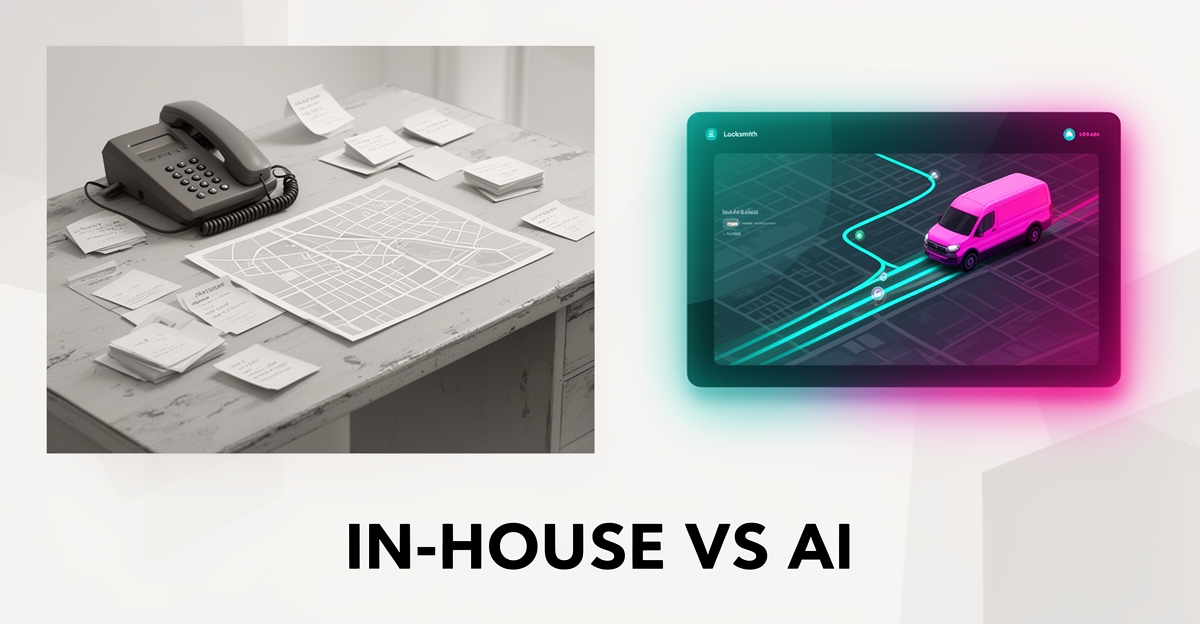
Moving from a phone-and-spreadsheet dispatch desk to AI-powered operations works best as a phased rollout, not a big bang. A structured transition protects service levels while exposing the real ROI of automation.
1. Audit where time and revenue leak today. Map current dispatch processes, identify bottlenecks, and quantify time spent on routine tasks like call triage, ETA updates, and invoice chasing. This baseline makes ROI modeling credible and shows staff you're solving real pain, not chasing hype.
2. Define integration requirements before you buy anything. Locksmith dispatch lives or dies on CRM, scheduling, payment, and technician location data. Document the exact fields, workflows, and handoffs you need so the AI can qualify leads, book jobs, and push work orders without manual re-entry.
3. Calculate ROI using your actual call volume. Apply realistic efficiency gains to your after-hours calls, missed first-response windows, and dispatcher overtime. Use your own numbers, not industry averages.
4. Pilot with after-hours coverage first. AI dispatch provides immediate 24/7 lead response. A contained pilot limits risk while proving response time, conversion, and satisfaction improvements under real load.
5. Train staff on escalation protocols early. Define clear human-in-the-loop triggers for emergencies, complex lockouts, and pricing exceptions. Role-play handoffs so technicians trust the system and customers never feel trapped in a bot loop.
6. Monitor key metrics weekly and adjust. Track response time, conversion rate, average job value, and customer satisfaction. Use the data to refine scripts, update knowledge bases, and tune routing rules before scaling.
7. Scale to full deployment once the pilot stabilizes. Expand from overnight to full-day coverage, add SMS and voice channels, and integrate payment collection. For larger operations, an AI Operating System connects dispatch with scheduling, invoicing, and customer follow-up in one operating layer, built in phases and owned outright, with no vendor lock-in.
Done correctly, the shift delivers consistent 24/7 response and frees your team to focus on high-value service rather than call chasing.
Still paying for 10+ subscriptions that don’t talk to each other?
We build custom AI systems you own outright. No vendor lock-in. Full control.
Not sure where to start? Ask our AI planner
Frequently Asked Questions
How much time do locksmith dispatchers typically spend on routine coordination tasks?
How much can locksmith businesses save by switching from human dispatchers to AI Employees?
Can AI dispatch systems handle high call volumes during emergencies without degrading service quality?
What tasks should remain with human dispatchers when implementing AI for locksmith dispatch?
What is the first step in transitioning from in-house dispatch to AI-powered dispatch?
Your Dispatch Desk, Upgraded: Making the Call on AI
The choice between in-house and AI dispatch isn't binary, it's about matching your operational reality to the right tool for the job. Human dispatchers excel at complex negotiations and reading distressed callers; AI systems eliminate the 2 AM coverage gaps and scalability ceilings holding back growth. For most locksmith operations, the hybrid model offers the clearest path forward: AI handles routine volume and after-hours emergencies while your team focuses on high-stakes situations requiring human judgment. If you're ready to stop losing calls to competitors and start capturing every lead, AIQ Labs can help you map the transition. Start with the 2-minute Fit Check, then book a free 30-minute strategy call to identify your dispatch bottlenecks and calculate the ROI of automation for your business, or reach the team directly at [email protected].
Make AI your competitive advantage — not just another tool.
Strategy, implementation and ongoing optimization. One partner, end to end.
Not sure where to start? Ask our AI planner