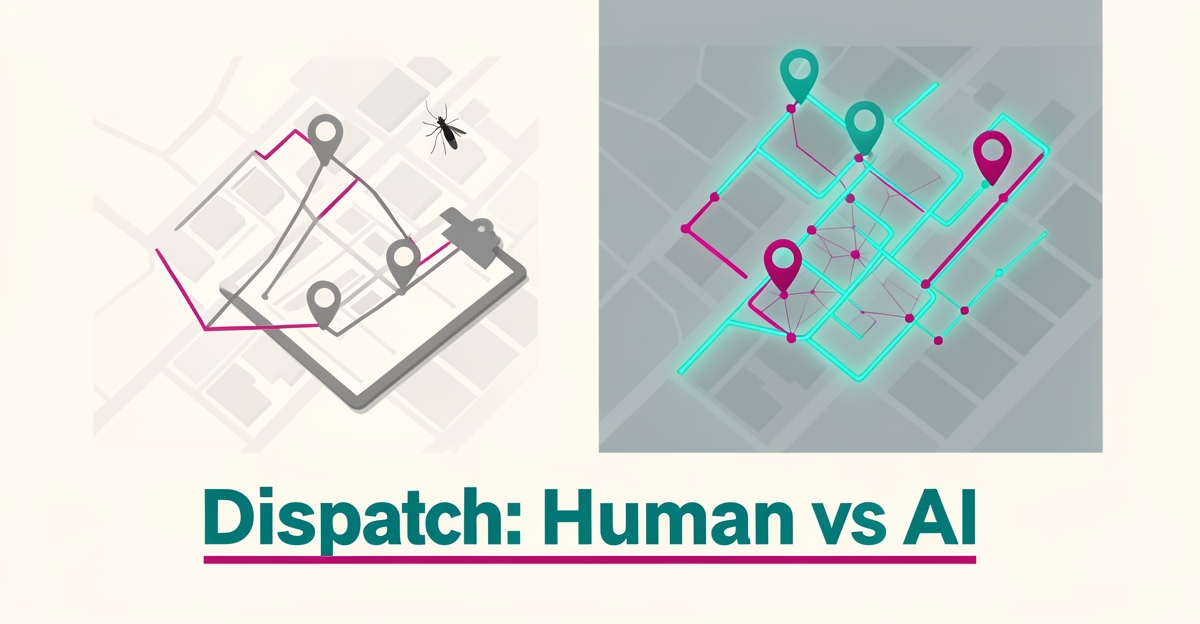
In-House vs AI: Which Is Better for Mosquito Control Service Dispatching?
Key Facts
- 734 organized mosquito control organizations operate across the United States according to the American Mosquito Control Association
- Over 1,105 residential communities run organized mosquito control programs per AMCA data
- AI dispatch agents typically reduce response times substantially through automated proximity matching
- Mosquito control agencies maintain large vehicle fleets and pesticide inventories with seasonal lifecycles due to mosquito tolerance
- Citizen science tracked an invasive mosquito species 1,300 km beyond its known range via the Mosquito Alert app
- A custom AI mosquito detection model achieved 88% accuracy offline and 82% in real-time field trials using computer vision and deep learning
- AI dispatch agents prevent overbooking by analyzing real-time technician availability and capacity through automated scheduling logic
Hire a team member that works 24/7 — for less than a part-time wage.
AI receptionists, SDRs, dispatchers and 99+ roles. Trained on your business, fully managed.
Not sure where to start? Ask our AI planner
The Dispatch Bottleneck in Mosquito Control Operations
Mosquito control is a race against biology, geography, and the calendar. When dispatching breaks down, the consequences ripple across entire communities.
The scale of operations alone creates immense pressure. According to the American Mosquito Control Association, approximately 734 organized mosquito control organizations and over 1,100 residential communities run organized programs across the United States. Each of these operations must coordinate personnel, vehicles, and equipment across sprawling service territories, and traditional in-house dispatching teams bear the full weight of that complexity.
The work itself is intensely labor-intensive. As operational overviews of mosquito control describe, staff must physically deploy larvicide pellets into remote standing water like catch basins and marshes, then pivot to adulticide fogging across broad woodland or urban habitats. Dispatchers juggle two fundamentally different treatment modes simultaneously, each with distinct equipment, timing windows, and crew requirements.
The bottleneck compounds across several dimensions:
- Personnel deployment, matching technician expertise and availability to specific treatment sites
- Equipment allocation, coordinating vehicle fleets, fogging rigs, and seasonal pesticide inventories with limited shelf lives
- Response time pressure, reacting to disease outbreaks and public complaints before small problems escalate
- Seasonal volatility, scaling staffing up and down as mosquito populations surge and decline
That last factor is uniquely punishing. Agencies must maintain large vehicle fleets, moderate staff levels, and significant pesticide inventories that carry a seasonal lifecycle due to mosquito tolerance, meaning dispatchers manage peak-season chaos with resources that sit underutilized for months.
Geographic sprawl makes manual coordination worse. When surveillance detects threats far outside expected ranges, as when citizen science data tracked an invasive mosquito species 1,300 km from its previously known location, response plans must be rebuilt on the fly. Human dispatchers juggling phone calls, maps, and spreadsheets simply cannot re-optimize routes and assignments at that speed.
This is precisely the gap where AI-driven scheduling enters the conversation. A dedicated [AI dispatcher](/ai-employees), for example, can typically cut response times substantially by automating the proximity-matching and capacity-checking work that consumes a human dispatcher's day. Understanding why the traditional model strains under these conditions is the first step toward evaluating whether automation can relieve it.
How AI Dispatch Agents Change Speed, Accuracy and Scalability
Traditional mosquito control dispatching depends on human teams making real-time decisions under pressure, often leading to delays when technicians are miles from service calls or when schedules overlap unexpectedly. AI-driven dispatching transforms this process by using algorithms to instantly match jobs with the nearest available crew, typically cutting response times substantially through optimized routing and automated decision-making. This speed advantage is critical during peak mosquito season when rapid response to breeding sites or public complaints directly impacts treatment effectiveness and customer satisfaction.
Accuracy improves significantly with AI systems that eliminate human error in scheduling and resource allocation. Unlike manual dispatching, which risks overbooking due to fatigue or miscommunication, AI agents continuously monitor technician availability, job duration, and geographic constraints to prevent scheduling conflicts before they occur. By assigning work based strictly on proximity and real-time capacity, these systems ensure that every service request is handled by the most appropriate team member without guesswork, reducing wasted travel time and improving first-visit resolution rates.
Scalability represents perhaps the most transformative benefit of AI dispatching for growing mosquito control operations. While human dispatchers face inherent limits in how many concurrent jobs they can manage effectively, AI systems scale to handle increased demand during outbreaks or seasonal peaks without requiring proportional staff increases. This capability allows organizations to maintain consistent service levels across expanding territories while avoiding the bottlenecks and inconsistencies that plague manual coordination, especially when managing complex Integrated Mosquito Management programs that require simultaneous larviciding, adulticiding, and surveillance activities across diverse habitats. AIQ Labs has deployed 200+ multi-agent systems and runs four live SaaS products daily, so these advantages are grounded in daily operational practice for field service businesses.
From Manual Coordination to AI-Enhanced Dispatch in Practice
Mosquito control teams move from reactive call-taking to coordinated field execution across a season that never stays still. The shift from manual coordination to AI-enhanced dispatch changes how surveys, source reduction, larvicide and adulticide work reach the right crew at the right time.
Traditional operations start with surveys to determine species composition, relative abundance, and seasonal distribution of adult and larval mosquitoes. Dispatchers then manually match personnel to sites, allocate vehicles and fogging equipment, and track response times by phone and spreadsheet. According to Wikipedia, mosquito control operations are labor-intensive, requiring staff to deploy larvicide pellets into remote standing water like catch basins and marshes, or adulticide fog into broad woodland or urban habitats.
The manual flow typically follows:
- Conduct surveys and map breeding sites
- Implement source reduction by removing standing water
- Apply larvicides where water cannot be eliminated
- Deploy adulticides during high nuisance or disease transmission periods
In the United States, approximately 734 organized mosquito control organizations specialize in area mosquito control, and upwards of 1,105 residential communities run organized programs. That scale makes manual coordination fragile when demand spikes.
AI-enhanced dispatch keeps the same operational stages but replaces phone-based triage with real-time capacity management. AI systems integrate with existing field software, work order tools and vehicle logs to see technician location, skill set and current load. Jobs are assigned based on geographic proximity and travel time, not whoever answers first.
Integration enables real-time capacity management and performance monitoring across the team. Dispatch agents prevent overbooking by analyzing live availability and automatically reschedule when a crew is committed. Supervisors monitor response metrics, completion rates and equipment use from a single dashboard instead of chasing updates.
The result is a dispatch layer that mirrors the Integrated Mosquito Management concept used by professionals, but executes it with consistent speed and visibility. AIQ Labs applies this approach through [workflow builds](/workflow-builds), where dispatch agents work alongside human teams to handle routing, scheduling and follow-up without replacing field judgment.
Choosing the Right Dispatch Model for Your Service Territory
The right dispatch model can make or break a mosquito control operation, especially when public health and seasonal surges collide. With 734 organized mosquito control organizations operating across the United States, the pressure to choose wisely has never been higher.
Cost structure sits at the heart of this decision. Traditional in-house dispatching carries substantial ongoing expenses: salaries, benefits, training, and the overhead of managing human schedulers who work fixed hours. AI-driven systems flip this model, requiring upfront investment but typically delivering meaningful response time reductions while operating continuously without fatigue. A managed AI dispatcher generally runs at a fraction of the cost of a comparable human hire.
Implementation complexity varies dramatically between approaches. In-house teams demand extensive hiring, onboarding, and institutional knowledge development, resources that many districts struggle to maintain. AI dispatch agents integrate with existing workflows but require quality data infrastructure and initial configuration to align with specific service territories.
Regulatory compliance adds another layer of scrutiny. Mosquito control operations must adhere to strict EPA guidelines governing pesticide application and public safety protocols. AI systems excel at maintaining audit trails and ensuring consistent protocol adherence, while human dispatchers bring contextual judgment to complex regulatory edge cases.
Technology dependencies create divergent risk profiles. Traditional dispatching relies on phone lines, radios, and institutional memory, vulnerable to staff turnover but resilient to technical failures. AI solutions depend on internet connectivity, software maintenance, and data quality, yet offer geographic proximity optimization that manual systems cannot match at scale.
When evaluating your territory's specific needs, consider these critical factors:
- Geographic complexity: AI excels at optimizing routes across dispersed service areas
- Seasonal demand fluctuations: Systems must scale without proportional cost increases
- Emergency response requirements: Speed matters during disease outbreak scenarios
- Budget predictability: Flexible AI plans versus variable personnel costs, see [current pricing options](/pricing)
- Integration capacity: Compatibility with existing fleet management and reporting tools
AIQ Labs' AI Employee model addresses these considerations through a Dispatcher role specifically designed for field services, offering the overbooking prevention and 24/7 availability that mosquito control districts require. You can start monthly, build in milestones, or own the system outright, so the payment structure matches how your district budgets, without the surprise costs that plague traditional dispatch expansion.
Your territory's unique combination of population density, seasonal pressure, and regulatory environment ultimately determines the right fit. The goal remains constant: faster response times, optimized resource allocation, and reliable service delivery when communities need protection most.
Still paying for 10+ subscriptions that don’t talk to each other?
We build custom AI systems you own outright. No vendor lock-in. Full control.
Not sure where to start? Ask our AI planner
Frequently Asked Questions
Is in-house dispatching still workable for mosquito control with how seasonal the work is?
How many mosquito control programs are we talking about in the US?
What makes mosquito control dispatching so labor intensive?
Do AI dispatch systems actually help with compliance and EPA rules?
Can citizen science data really change how dispatch routes are planned?
What's the biggest risk of sticking with manual dispatch during an outbreak?
Dispatch Smarter, Not Harder: Your Next Move
Mosquito control dispatching is a seasonal pressure test where delays cost public health, trust and money. Traditional in-house teams bring judgment and flexibility, but they buckle under geographic sprawl, volatile demand and the constant juggling of personnel, equipment and response windows. AI-driven scheduling flips the bottleneck into an advantage by matching jobs to the nearest available crew in real time, typically cutting response times substantially through optimized routing and automated decision-making, preventing overbooking and scaling without proportional headcount. The right choice isn't all-or-nothing; it's about where speed, consistency and cost predictability matter most for your territory. If you're evaluating that fit, start the 2-minute Fit Check at aiqlabs.ai/apply and book a free 30-minute strategy call to map your biggest dispatch bottleneck and identify high-ROI automation opportunities. You can also reach the team directly at [email protected].
Make AI your competitive advantage — not just another tool.
Strategy, implementation and ongoing optimization. One partner, end to end.
Not sure where to start? Ask our AI planner