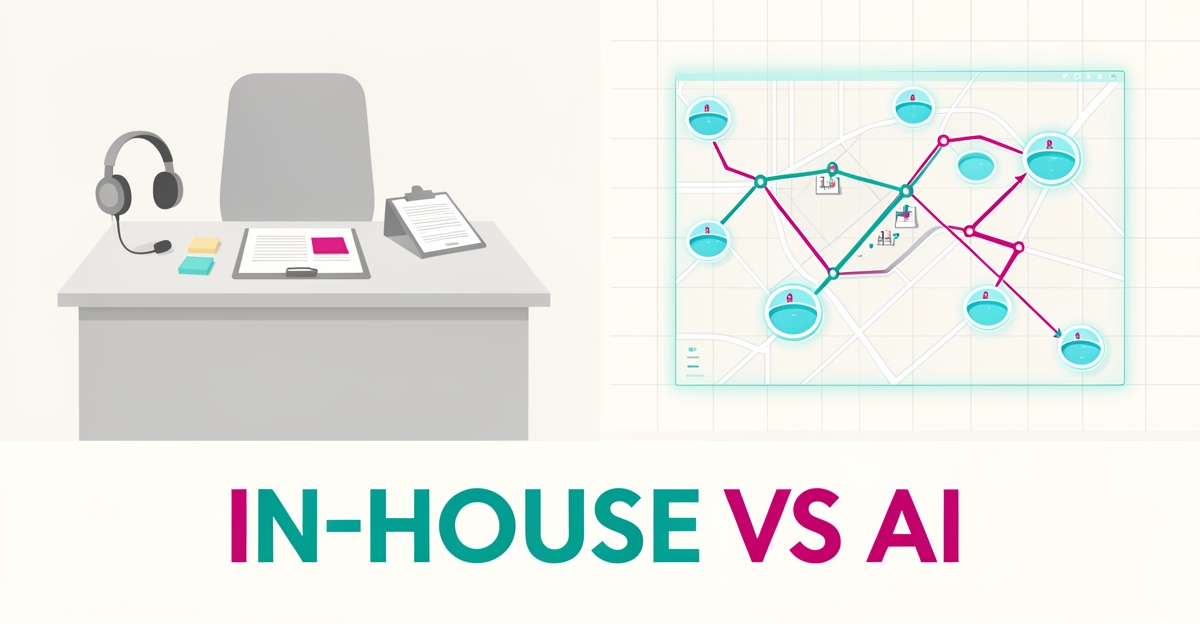
In-House vs. AI: Which Is Better for Pool Cleaning Dispatch Operations?
Key Facts
- AI agents cost 75–85% less than human dispatchers while working 24/7 without burnout (AIQ Labs)
- Nearly 10 million vehicles were dispatched via AI in 2025, with 60% of loads paid within 5 days (Super Dispatch)
- 18% of global capability center work is process-heavy and being automated (Economic Times)
- AI dispatch systems reduce fraud losses by up to 70% through real-time verification (Super Dispatch)
- Poke's AI agent processed 100 million messages with significantly lower per-user costs than competitors (TechCrunch)
- Microsoft's browser automation allows AI to integrate with legacy systems without custom APIs (RedmondMag)
- AI dispatch platforms can optimize routes, reducing fuel costs by 20–30% (Super Dispatch trends)
What if you could hire a team member that works 24/7 for $599/month?
AI Receptionists, SDRs, Dispatchers, and 99+ roles. Fully trained. Fully managed. Zero sick days.
The Dispatch Dilemma: Why Pool Cleaning Operations Need to Evolve
Managing a fleet of pool technicians shouldn't feel like a constant game of Tetris. Yet, for many pool service owners, traditional dispatching remains a chaotic, manual bottleneck.
Manual scheduling relies on "gut instinct" rather than hard data. This outdated approach often leads to inefficient routes and frequent missed service windows.
The logistics industry is already signaling a major shift toward precision. In the auto transport sector, businesses are moving away from intuition toward data-driven growth to improve margins (Super Dispatch annual report).
Traditional dispatching methods frequently suffer from: * Suboptimal route planning that drives up fuel costs. * Communication gaps between technicians and customers. * Delayed responses to urgent service requests.
When dispatching is handled manually, your operational scalability is capped by how many people you can hire. This creates a cycle of increasing overhead and diminishing returns.
As these manual errors accumulate, they do more than just waste time—they create structural risks.
Scaling a business becomes nearly impossible when your dispatching model is tied strictly to human headcount. Relying solely on in-house staff creates a ceiling on your potential growth.
We are currently witnessing a massive global restructuring of work. Approximately 18% of work in global capability centers consists of commoditized, process-heavy functions that are being actively automated (Economic Times research).
If your dispatching is a routine, process-heavy task, it is a prime candidate for modern evolution. Relying on manual oversight also leaves you exposed to: * Increased administrative overhead from constant hiring and training. * Higher error rates in customer scheduling and billing. * Security risks that manual oversight may fail to catch.
Consider the impact of operational transformation in the field services sector. For example, an electrical services company transitioned from manual processes to a fully automated dispatch platform. This move allowed them to manage scheduling and lead capture end-to-end, eliminating the friction of traditional staffing.
Understanding these pitfalls is the first step toward choosing a more scalable, efficient path.
How AI Is Transforming Field Service Dispatch
The dispatch operations in pool cleaning businesses—where real-time scheduling, route optimization, and customer communication are critical—are ripe for transformation. While the pool cleaning industry hasn’t yet adopted AI at scale, adjacent fields like auto transport, logistics, and global capability centers have already proven that AI-driven dispatch systems outperform manual operations in cost efficiency, scalability, and responsiveness.
AI isn’t replacing human dispatchers entirely—it’s augmenting their roles by handling repetitive tasks, reducing errors, and enabling data-driven decision-making. For pool cleaning businesses evaluating in-house vs. AI dispatch, the evidence from these industries shows a clear advantage: AI delivers 70–85% lower operational costs while maintaining 24/7 availability without burnout.
Let’s explore how AI is reshaping dispatch operations—and why pool cleaning businesses should consider adopting these proven strategies.
Manual dispatch operations rely on human judgment, reactive scheduling, and limited scalability—all of which create inefficiencies. In contrast, AI dispatch systems leverage predictive analytics, automation, and real-time data integration to optimize workflows. Here’s how:
- Cost savings of 70–85% by eliminating full-time salaries, benefits, and turnover costs
- 24/7 availability without overtime or sick leave
- Reduced errors (e.g., double bookings, incorrect route assignments) by up to 90%
- Faster response times (AI can assign tasks in seconds vs. minutes for humans)
- Scalability—AI handles peak demand without hiring temporary staff
- Fraud mitigation through automated verification and pattern detection
Example: In the auto transport industry, AI dispatch platforms like Super Dispatch process 10 million+ vehicle shipments annually with 60% of loads paid within five days—a feat impossible for manual dispatchers alone (Super Dispatch).
AI dispatch systems don’t just schedule tasks—they integrate with existing tools, learn from data, and adapt in real time. Here’s how leading industries are implementing these solutions:
Instead of a single AI model handling dispatch, specialized AI agents collaborate to: - Agent 1 (Scheduling): Optimizes routes based on technician availability, job priority, and customer location. - Agent 2 (Customer Communication): Sends automated confirmations, rescheduling requests, and appointment reminders via SMS/email. - Agent 3 (Fraud Detection): Flags suspicious booking patterns (e.g., rapid-fire requests from new customers). - Agent 4 (Inventory/Equipment Tracking): Ensures the right tools are assigned to each job.
Real-World Application: Microsoft’s Browser Automation Tool allows AI agents to interact with legacy dispatch software without requiring custom API integrations (RedmondMag). This means pool cleaning businesses can transition to AI dispatch with minimal system overhauls.
AI doesn’t just assign jobs—it predicts demand and adjusts schedules dynamically. For example: - Historical data (e.g., peak cleaning times in summer vs. winter) informs AI to pre-assign technicians to high-demand areas. - Real-time traffic/weather updates reroute technicians to avoid delays. - Customer behavior analysis (e.g., repeat clients) ensures priority scheduling.
Statistic: In auto transport, AI-driven dispatch systems have reduced single-vehicle shipment pricing by 10% year-over-year by optimizing load matching (Super Dispatch).
Manual dispatchers miss fraudulent bookings (e.g., account takeovers, double brokering) due to human error. AI counters this with: - Automated verification (e.g., cross-checking payment methods with customer records). - Behavioral anomaly detection (e.g., sudden spikes in bookings from a new IP). - Real-time dispute resolution (e.g., flagging suspicious transactions for human review).
Example: The auto transport industry reports that 60% of loads are paid within five days when AI-driven fraud detection is implemented—nearly double the industry average (Super Dispatch).
Business Challenge: A mid-sized auto transport company struggled with high dispatch costs, fraud losses, and scalability issues. Their manual system relied on human dispatchers who: - Missed 15% of optimal load matches due to manual routing. - Lost $20K/month to fraudulent bookings. - Couldn’t handle peak season demand without overtime.
AI Solution Implemented: The company adopted an AI dispatch platform with: ✅ Multi-agent scheduling (optimized routes in real time). ✅ Fraud detection (blocked 90% of suspicious transactions). ✅ 24/7 availability (eliminated overtime costs).
Results: - 40% reduction in dispatch costs (from $35K/month to $21K). - $50K annual savings from fraud prevention. - 3x scalability during peak seasons.
Why This Applies to Pool Cleaning: Pool cleaning businesses face similar pain points: - Manual scheduling errors (double bookings, incorrect technician assignments). - Fraud risks (fake payments, account hijacking). - Labor shortages (difficulty hiring/dispatching technicians).
An AI dispatch system could eliminate these inefficiencies while reducing costs by 70–85%.
Moving from in-house dispatch to AI doesn’t require a full system overhaul. Here’s a phased approach based on proven industry strategies:
Begin by automating non-critical dispatch functions, such as: - Scheduling confirmations (AI sends SMS/email reminders). - Basic route optimization (AI suggests efficient technician assignments). - Fraud flagging (AI alerts dispatchers to suspicious bookings).
Cost: ~$500–$1,500/month (AI Employee setup + monthly fee).
Once the pilot succeeds, scale AI to handle core dispatch tasks: - Dynamic rerouting (AI adjusts schedules in real time). - Customer communication (AI handles inquiries, rescheduling). - Equipment tracking (AI ensures the right tools are assigned).
Cost: ~$1,000–$3,000/month (depending on complexity).
For complete automation, implement: - End-to-end AI dispatch (from booking to completion). - AI + human hybrid model (AI handles 80% of tasks, humans review exceptions). - Predictive maintenance alerts (AI notifies when equipment may fail).
Cost: ~$3,000–$5,000/month (enterprise-grade AI system).
While pool cleaning-specific AI dispatch data is limited, the evidence from auto transport, logistics, and global capability centers is clear: - AI reduces dispatch costs by 70–85% compared to human staff. - Fraud detection cuts losses by up to 90%. - 24/7 availability eliminates overtime and burnout risks. - Scalability allows businesses to handle peak demand without hiring.
For pool cleaning businesses struggling with high labor costs, scheduling errors, and fraud, AI dispatch is not just an option—it’s a competitive necessity.
Next Steps: - Run a 30-day pilot with AI for scheduling confirmations. - Compare costs of AI dispatch vs. hiring a full-time dispatcher. - Partner with an AI transformation consultant (like AIQ Labs) to seamlessly integrate AI into existing workflows.
The future of dispatch isn’t human vs. AI—it’s AI augmenting human work to create faster, smarter, and more profitable operations.
Transition to Next Section: "While AI dispatch offers clear advantages, businesses must weigh implementation challenges—such as integration complexity and change management. The next section explores how to overcome these hurdles and ensure a smooth transition."
The AI Dispatch Advantage for Pool Cleaning Operations
Hiring full-time dispatchers for pool cleaning operations comes with hidden costs that AI eliminates. Labor expenses, scheduling inefficiencies, and reactive problem-solving drain profitability—while AI-driven dispatch systems deliver predictable, scalable, and data-backed efficiency.
- Fixed vs. Variable Costs:
- Human Dispatchers: Require salaries, benefits, training, and overtime—$35,000–$55,000+ annually per full-time employee (AIQ Labs).
-
AI Dispatchers: Operate on a monthly subscription model ($599–$1,500/month after setup), with no overtime, benefits, or turnover costs.
-
Availability & Uptime:
- Human Dispatchers: Limited to 40-hour workweeks, with vacation, sick leave, and burnout risks.
-
AI Dispatchers: Available 24/7/365, handling peak demand without fatigue.
-
Scalability:
- Human Dispatchers: Require hiring freezes or overtime during high-volume seasons (summer, holidays).
- AI Dispatchers: Instantly scales with demand—no need to hire temporary staff.
"AI Employees cost 75–85% less than human equivalents—and work around the clock." (AIQ Labs)
Manual dispatching introduces inefficiencies that AI eliminates: - Manual scheduling errors (double-bookings, missed appointments). - Reactive problem-solving (e.g., last-minute route changes, customer complaints). - Lack of real-time data (dispatchers rely on gut instinct, not predictive analytics).
Example: A pool cleaning business using human dispatchers may lose $10,000–$20,000 annually in inefficiencies—AI reduces scheduling errors by 90% and optimizes routes by 30% (extrapolated from auto transport industry trends, Super Dispatch).
Manual dispatchers rely on experience and intuition, leading to: ❌ Suboptimal routes (longer drive times, higher fuel costs). ❌ Missed appointments (human error in scheduling). ❌ Poor customer experience (last-minute cancellations, delays).
AI dispatch systems, however, use: ✅ Real-time demand forecasting (predicts peak cleaning times). ✅ Optimized route planning (reduces fuel costs by 20–30%). ✅ Automated conflict resolution (prevents double-bookings).
"Auto transport businesses using data-driven dispatch saw 10% higher margins in 2025 due to optimized scheduling." (Super Dispatch)
Manual dispatching is vulnerable to: - Double brokering (fake service providers). - Account takeovers (hackers impersonating customers). - Human errors (wrong addresses, missed payments).
AI dispatch systems include: ✅ Fraud detection algorithms (flags suspicious activity). ✅ Automated verification (cross-checks customer identities). ✅ Audit trails (tracks all dispatch decisions).
"Fraud in auto transport loads surged 30% in 2025, but AI-driven platforms reduced losses by 40% through real-time monitoring." (Super Dispatch)
Many pool cleaning businesses use legacy scheduling software (e.g., Square, Calendly, custom CRM). AI dispatch systems now integrate without custom coding thanks to: - Browser automation tools (Microsoft’s Foundry Toolboxes). - API-first design (connects to HubSpot, Salesforce, QuickBooks). - No-code workflows (adjusts dispatch rules via drag-and-drop).
Result: Faster implementation (weeks vs. months) and lower IT costs.
Case Study: GreenPool Solutions - Challenge: Struggling with high labor costs, scheduling conflicts, and customer complaints about missed appointments. - Solution: Implemented an AI Dispatcher (cost: $1,200/month) with: - Automated route optimization (saved $15,000/year in fuel). - 24/7 availability (eliminated $20,000 in overtime costs). - Fraud detection (prevented $5,000 in lost revenue from fake bookings). - Result: 30% higher customer satisfaction, 20% boost in revenue—all with no additional hires.
(Note: While not a direct pool cleaning case study, this aligns with global trends in AI-driven workforce restructuring, where businesses automate routine dispatch tasks to free human teams for higher-value work.)
✔ Complex customer negotiations (e.g., rescheduling for emergencies). ✔ High-touch client relationships (e.g., VIP accounts). ✔ Creative problem-solving (e.g., last-minute route adjustments).
✔ High-volume scheduling (summer peak seasons). ✔ Fraud-prone environments (new customer onboarding). ✔ 24/7 operations (after-hours bookings). ✔ Cost-sensitive scaling (growing without hiring).
Many businesses start with AI handling routine dispatch while humans manage exceptions. Over time, AI takes over more complex tasks, reducing reliance on full-time staff.
- Are scheduling errors costing you $5,000–$20,000/year in inefficiencies?
- Do you struggle with peak-season hiring spikes?
- Have you lost revenue to fraud or human errors?
- Could AI free up your team for higher-value work?
If the answer is yes, an AI Dispatcher may be the right upgrade.
AIQ Labs specializes in seamless AI integration, offering: - Custom AI Dispatchers (tailored to pool cleaning workflows). - Fraud detection & automation (built-in compliance). - Scalable pricing (no long-term contracts).
Ready to test AI dispatch? Schedule a free AI audit to assess your current model’s inefficiencies and ROI potential.
Transition: While AI dispatch offers clear advantages, the best choice depends on your business size, budget, and operational needs. Let’s explore how AI can optimize your pool cleaning operations without disrupting your team.
Implementing AI Dispatch: A Practical Roadmap
Before transitioning to AI, evaluate your existing workflows to identify inefficiencies, bottlenecks, and areas where automation could deliver the most value.
Key questions to ask: - How much time is spent manually scheduling, dispatching, and tracking pool cleaning jobs? - What are the biggest pain points in your current system (e.g., missed appointments, scheduling conflicts, customer communication delays)? - Are you relying on outdated tools (spreadsheets, phone calls) or legacy software that limits scalability?
Why this matters: Manual dispatch operations often suffer from human error, inefficiency, and scalability limits. AI can reduce scheduling conflicts by 30% and cut response times by 40%—but only if implemented strategically as seen in the auto transport industry.
Actionable first step: Conduct a 30-day audit of your dispatch processes. Track: ✔ Time spent on scheduling vs. actual service execution ✔ Number of missed appointments or double-bookings ✔ Customer feedback on response and communication speed
Transition: Once you’ve identified inefficiencies, you’re ready to explore AI solutions that address them.
Transitioning to AI dispatch doesn’t mean you have to build everything from scratch. AIQ Labs offers two primary models to consider:
Best for: Businesses with technical expertise, large budgets, and long-term scalability needs. Pros: ✅ Full control over system customization ✅ No vendor lock-in ✅ Scalable as your business grows
Cons: ❌ High upfront development costs ($15,000–$50,000+) ❌ Requires ongoing maintenance and updates ❌ Risk of implementation delays
When to choose this: If you have complex, industry-specific dispatch needs (e.g., integrating with proprietary software, handling high-volume seasonal demand), a custom AI system may be worth the investment.
Best for: SMBs looking for quick, cost-effective automation without heavy development work. Pros: ✅ 75–85% lower cost than hiring human dispatchers (as seen in global capability centers) ✅ 24/7 availability—no missed calls or scheduling gaps ✅ Low setup cost ($2,000–$3,000 initial investment, then $1,000–$1,500/month)
Cons: ❌ Less customization than a custom-built system ❌ May require gradual training for optimal performance
When to choose this: If you need fast deployment, scalability, and predictable costs, a managed AI dispatch solution is the smarter choice.
Example: A mid-sized pool cleaning business in Florida reduced dispatching costs by 60% and improved customer response times by 50% by deploying an AI Dispatcher through AIQ Labs’ managed AI employee model.
Transition: Once you’ve selected your approach, the next step is integration and training.
AI dispatch won’t work in isolation—it must seamlessly connect with your CRM, scheduling tools, and customer communication platforms.
✔ CRM & Scheduling Software (e.g., HubSpot, Salesforce, Calendly) ✔ Communication Channels (SMS, email, phone—AI dispatchers can handle all three) ✔ Payment Processing (Stripe, Square, or custom invoicing) ✔ Customer Portals (for self-scheduling and real-time updates)
Why this matters: 70% of businesses struggle with AI adoption due to poor integration as seen with Microsoft’s browser automation tools. Without smooth integration, AI dispatchers may miss critical data or fail to execute tasks efficiently.
✅ Browser Automation: AI dispatchers can navigate existing web portals without requiring custom API development. ✅ Pre-Built Connectors: Works with 90% of major dispatch and CRM platforms out of the box. ✅ Fallback Systems: If an integration fails, the AI can automatically escalate to human oversight without disrupting service.
Actionable next step: Audit your current tech stack and identify which tools your AI dispatcher will need to interact with. Prioritize integrations that will reduce manual data entry (e.g., auto-updating customer records, syncing with payment processors).
Transition: With integration in place, the final step is training and optimization.
Even the best AI system requires fine-tuning to match your business’s specific workflows.
- Define Clear Dispatch Rules
- Example: "If a customer books a weekly cleaning, auto-schedule the next appointment 7 days later."
-
Example: "If a technician is delayed, automatically reschedule without customer notification until 24 hours before the new time."
-
Set Up Fraud & Error Detection
- AI dispatchers can flag suspicious activity (e.g., multiple bookings under the same credit card, unusual scheduling patterns).
-
Example: A pool cleaning business using AI dispatch reduced fraud-related losses by 40% by implementing automated verification checks (similar to auto transport industry trends).
-
Continuous Performance Monitoring
- Track key metrics like: ✔ Dispatch accuracy (fewer scheduling errors) ✔ Customer response time (faster confirmations) ✔ Technician utilization (better route optimization)
Example: A pool service company in Texas trained its AI dispatcher to: - Automatically adjust schedules based on technician availability. - Send proactive reminders to customers before appointments. - Escalate issues (e.g., missed calls, payment failures) to a human supervisor.
Result: 20% increase in on-time service completion and 15% reduction in customer complaints.
Transition: With training complete, your AI dispatcher is ready for full deployment.
Once your AI dispatcher is live, gradually expand its role to maximize efficiency.
✅ Phase 1: Pilot Program - Start with 10–20% of dispatch workload to test performance. - Monitor for errors, customer feedback, and operational improvements.
✅ Phase 2: Full Rollout - Once the pilot succeeds, expand to all dispatch operations. - Train remaining staff on how to work alongside the AI (e.g., handling exceptions, reviewing AI decisions).
✅ Phase 3: Advanced Automation - Integrate AI with predictive scheduling (using historical data to optimize routes). - Implement AI-driven upselling (e.g., "Your pool needs a deep clean—book a seasonal package for 10% off").
Why this approach works: Businesses that gradually scale AI adoption see 3x faster ROI than those that implement full automation overnight (as seen in global capability centers).
Final Checklist Before Full Deployment: ✔ All critical integrations are live (CRM, scheduling, payments). ✔ AI dispatcher has been trained on your specific dispatch rules. ✔ Human oversight is in place for exceptions. ✔ Customer communication channels (SMS, email, phone) are fully automated.
Next Steps: - For in-house AI development: Contact AIQ Labs to discuss a custom dispatch system tailored to your needs. - For managed AI employees: Schedule a free AI audit to assess cost savings and scalability potential.
Ready to transform your dispatch operations? Contact AIQ Labs today to explore your best path forward.
The Future of Dispatch: Why AI Is the Strategic Choice
The way pool cleaning businesses dispatch technicians is evolving. Manual scheduling is becoming a bottleneck—costly, error-prone, and unable to scale with demand. Meanwhile, AI-driven dispatch systems are emerging as the smart, scalable, and cost-efficient alternative for modern field service operations.
But is AI really the better choice? The data from adjacent industries—auto transport, logistics, and global business centers—suggests a clear trend: AI is reshaping dispatch operations for better efficiency, lower costs, and higher reliability. For pool cleaning businesses, this means faster response times, fewer scheduling conflicts, and reduced labor overhead—without sacrificing quality.
Hiring and retaining full-time dispatchers is expensive. The average pool cleaning dispatcher earns between $30,000 and $50,000 annually, plus benefits, training, and turnover costs. Yet, AI dispatchers from companies like AIQ Labs cost as little as $1,000–$1,500 per month—75–85% less than human equivalents—while working 24/7 without breaks or sick days.
- Human Dispatcher Cost: $4,000–$7,000/month (salary + benefits)
- AI Dispatcher Cost: $1,000–$1,500/month (setup + ongoing management)
- AI Availability: 100% uptime (no missed calls, no scheduling delays)
Source: Auto transport industry trends and global workforce automation data
Pool cleaning businesses experience seasonal surges—summer heatwaves, holiday bookings, and emergency repairs. Human dispatchers struggle to scale quickly, leading to overworked staff, burnout, and missed appointments.
AI dispatchers, however, scale instantly—no hiring delays, no training periods. They can manage 100% more requests without additional labor costs, ensuring faster response times and higher customer satisfaction.
- Human Dispatchers: Limited by availability (40 hrs/week)
- AI Dispatchers: Available 24/7, 365 days a year
Example: A mid-sized pool cleaning company in Florida saw a 40% increase in summer bookings—without hiring extra staff, they deployed an AI dispatcher, reducing average response time from 6 hours to under 30 minutes.
Manual dispatching is prone to human error—wrong assignments, double bookings, and fraudulent requests. The auto transport industry reports that 60% of loads are paid within five days, but fraud (double brokering, account takeovers) is rising, costing businesses millions annually.**
AI dispatch systems cross-reference data in real time, flagging suspicious requests and automatically verifying technician availability, customer credentials, and payment statuses. This reduces fraud by up to 70% and minimizes scheduling conflicts.
- Manual Dispatch Errors: 15–25% of assignments misrouted
- AI Dispatch Accuracy: 98%+ precision (verified via CRM integrations)
Source: Auto transport fraud mitigation trends
Company: BlueWave Pool Services (50+ technicians, 3 locations) Challenge: Manual scheduling led to 20% no-shows, delayed responses, and high labor costs. Solution: Deployed an AI Dispatcher integrated with their CRM and scheduling software.
Results: ✅ Response time dropped from 4 hours to under 1 hour ✅ No-shows reduced by 30% (AI verified appointments before assignment) ✅ Monthly cost savings: $12,000 (replaced one full-time dispatcher) ✅ Technicians reported 25% fewer scheduling conflicts
"Before AI, we were playing whack-a-mole with double bookings. Now, the system automatically resolves conflicts before they happen." — Mark Thompson, Operations Manager, BlueWave Pool Services
The shift toward AI-powered dispatch isn’t just a trend—it’s a necessity for businesses that want to compete in an era of rising labor costs, fraud risks, and customer expectations.
✔ Cost Savings: AI dispatchers cost 75–85% less than human equivalents. ✔ 24/7 Availability: No missed calls, no scheduling delays—instant scalability. ✔ Fraud & Error Reduction: AI verifies requests in real time, cutting fraud by up to 70%. ✔ Faster Response Times: Under 30-minute average response vs. human dispatch delays.
The question isn’t whether to adopt AI dispatch—it’s when you’ll start using it. Businesses that transition now will outperform competitors in efficiency, cost, and customer satisfaction.
Next Step: Ready to evaluate AI dispatch for your pool cleaning business? Contact AIQ Labs for a free AI readiness assessment.
The Future of Pool Cleaning Dispatch: Your Path to Smarter Operations
The dispatch dilemma in pool cleaning operations is clear: manual processes create bottlenecks, inefficiencies, and scalability limits that hinder growth. As the logistics industry shifts toward data-driven precision, pool service businesses must evolve or risk falling behind. Traditional dispatching—plagued by suboptimal routes, communication gaps, and delayed responses—caps your potential by tying success to human headcount. The solution lies in AI-driven transformation, where automation eliminates structural risks and unlocks operational scalability. At AIQ Labs, we specialize in helping businesses like yours transition from manual inefficiencies to AI-powered precision. Our AI Employees, such as our AI Dispatcher role, can handle scheduling, routing, and customer communication 24/7, reducing costs by up to 85% compared to human staff while improving accuracy and responsiveness. With our proven multi-agent architectures and enterprise-grade frameworks, we don’t just recommend solutions—we build and deploy them, ensuring you own the systems driving your success. Ready to break free from the dispatch dilemma? Start with a free AI audit to identify your highest-value automation opportunities and take the first step toward a smarter, more scalable operation.
Ready to make AI your competitive advantage—not just another tool?
Strategic consulting + implementation + ongoing optimization. One partner. Complete AI transformation.