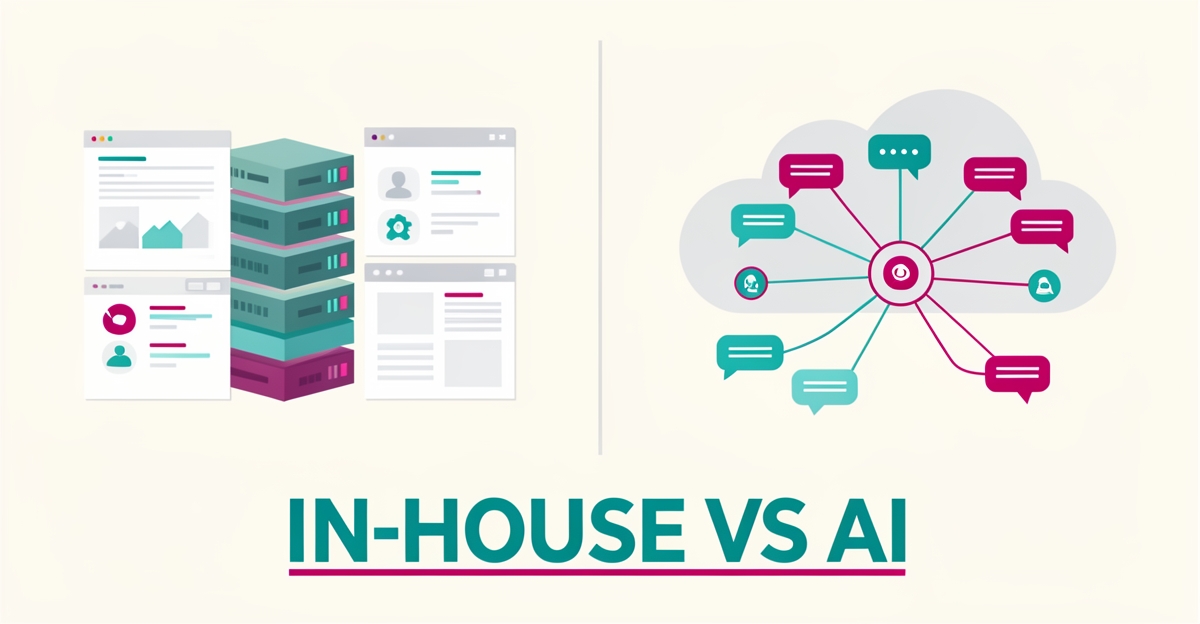
In-House vs AI: Which Is Better for Promotional Distributors Managing Client Inquiries?
Key Facts
- A fully-loaded in-house AI team typically costs several hundred thousand dollars or more in year one once recruiting, onboarding, and overhead are included
- In-house teams typically need 6 to 12 months before delivering production results; external partners commonly deploy working systems in 60 to 90 days
- Hiring senior AI talent is slow and expensive: months of recruiting plus compensation that often exceeds $200K, before benefits and overhead
- AIQ Labs has deployed 200+ multi-agent systems and runs 4 live SaaS products daily—proof the managed model works at production scale
- The hybrid model transitions from partner-led deployment in months 1–3 to full internal ownership, so you never trade speed for control
Hire a team member that works 24/7 — for less than a part-time wage.
AI receptionists, SDRs, dispatchers and 99+ roles. Trained on your business, fully managed.
Not sure where to start? Ask our AI planner
The Hidden Cost of Delay: Why In-House AI Teams Drain Budgets and Momentum
Building an in-house AI team for client inquiry management looks like control. In practice it looks like budget burn before any value arrives.
The fully-loaded cost of an in-house AI capability in year one typically runs well into the hundreds of thousands of dollars—a minimal team of three hires, plus the 25 to 35% added for benefits, equipment, and overhead. Recruiting agency fees of 20 to 25% of first-year salary and 3 to 6 months of onboarding before full productivity add further drag. For senior AI engineers, compensation often exceeds $200K, and hiring timelines in competitive markets routinely stretch to 6 to 9 months.
External AI partners offer a different math. Instead of carrying payroll for a team that spends its first months learning your business context, you pay for deployed systems. AIQ Labs' AI Employees model, for example, puts managed AI staff—receptionists, SDRs, dispatchers, 99+ roles—into production at roughly 80% less than the cost of a human hire, with no recruiting, onboarding, or management overhead on your side.
Speed compounds the cost gap. An in-house team needs 6 to 12 months before it can start delivering production results—time required for hiring, alignment with internal systems, and data structures. With an experienced external partner, working deployments in 60 to 90 days are common.
That delay is not neutral. The organization that deploys AI six months earlier accumulates six months of productivity gains, data insights, and organizational learning that the late adopter never fully recovers. In competitive distribution markets, speed to AI capability is a strategic asset.
For promotional distributors handling high-volume client inquiries, the hidden costs show up as:
- Recruiting risk: 6 to 9 months is a typical time to hire a senior AI engineer in major markets
- Idle payroll: salaries accrue while teams are still learning business context and integrating tools
- Opportunity cost: slower response times and manual handoffs persist while competitors automate
AIQ Labs works with SMBs on AI Workflow Builds that rebuild the one workflow costing the most—often inquiry routing and response—at a fixed price, in phases. The pattern is consistent: early deployment creates compounding advantage, while delayed internal builds drain budgets and momentum.
The decision is less about which model is better in theory and more about what fits your stage, data, and goals right now.
Speed to Value: How External AI Partners Deliver Measurable ROI in 60–90 Days
Speed to value is often the deciding factor for promotional distributors weighing in-house AI teams against external partners. While building an internal team requires 6 to 12 months before production results emerge, experienced partners commonly deliver measurable ROI in 60 to 90 days—critical for businesses managing fluctuating client inquiry volumes. This acceleration comes from pre-built frameworks, experienced teams, and reusable components that eliminate lengthy hiring and onboarding cycles. External partners also avoid the fully-loaded year-one cost of a minimal internal team, which typically reaches several hundred thousand dollars once benefits, equipment, and overhead are counted. Recruiting a senior AI engineer alone can take 6 to 9 months, with median compensation often exceeding $200K—delays that directly impact responsiveness to client needs.
- AI readiness assessments completed in weeks, not months
- Initial AI systems deployed within 60 to 90 days
- Measurable ROI achieved before internal teams finish onboarding
- No recruiting fees, benefits load, or management overhead
- Immediate access to cross-industry expertise and proven frameworks
For promotional distributors, this speed translates directly into faster validation of AI use cases—such as automating routine inquiry routing or enabling 24/7 support—without the risk of prolonged investment before seeing results. AIQ Labs follows this exact model, helping clients move from manual inquiry handling to AI-driven workflows in under three months while building internal capability for long-term ownership. The ability to validate outcomes quickly ensures resources are focused on initiatives that genuinely improve response times and scalability, turning AI from a cost center into a measurable advantage during peak inquiry periods.
The Hybrid Path: Building Internal AI Capability Without Sacrificing Speed or Control
Many promotional distributors face a dilemma: wait months to build internal AI expertise or risk long-term dependency on external vendors. A hybrid approach resolves this tension by combining rapid deployment with sustainable capability building—measurable ROI in 60 to 90 days while avoiding the full first-year cost of a fully loaded in-house AI team.
The transition unfolds in three clear phases. First, an external partner leads deployment and knowledge transfer for months one to three, establishing foundational AI systems for client inquiry management. Second, responsibility shifts to shared ownership from months four to six, with internal teams increasingly handling day-to-day operations under expert guidance. Finally, after month seven, the internal team leads ongoing optimization and expansion, with the partner providing only advisory support. This phased approach eliminates the speed risk of building from scratch and the sustainability risk of pure consulting dependency.
- Partner-led phase delivers immediate results and establishes the AI foundation
- Shared responsibility phase builds internal capability through hands-on experience
- Internal-led phase ensures long-term ownership and continuous innovation
This model maps directly to how AIQ Labs structures its AI Operating Systems: one connected operating layer for your business, built in phases, and owned outright by you. Flexible payment models—Start Monthly, Build in Milestones, or Own It Outright—let you match the engagement to your cash flow instead of locking into open-ended retainers. By starting with external expertise and transitioning to internal control, organizations gain both speed to market and sustainable AI maturity—without sacrificing data security, customization, or long-term strategic advantage. The result is a resilient, self-sufficient AI capability that evolves with business needs.
Still paying for 10+ subscriptions that don’t talk to each other?
We build custom AI systems you own outright. No vendor lock-in. Full control.
Not sure where to start? Ask our AI planner
Frequently Asked Questions
How much more expensive is building an in-house AI team compared to using an external partner?
How long does it really take to get ROI from an in-house AI team versus an external partner?
Is it hard to hire AI talent for a promotional distributor?
Will using an external AI partner lock us into a vendor long term?
When does it actually make sense to build an in-house AI team?
Can we get speed and still build internal control over time?
Speed First, Ownership Second
For promotional distributors managing high-volume client inquiries, the in-house versus AI decision comes down to timing and cost of delay. Building an internal team can mean a fully-loaded year-one bill in the high six figures and 6 to 12 months before production results, while external partners deliver measurable ROI in 60 to 90 days with far lower upfront cost. The hybrid path resolves the tension: deploy quickly with proven frameworks, transfer knowledge in months four to six, and move to internal-led optimization after month seven. That approach gives you compounding advantage now without sacrificing long-term control. AIQ Labs supports this model across AI Employees, Workflow Builds, and AI Operating Systems—200+ multi-agent systems deployed, backed by 4 live SaaS products the company runs daily. If you want clarity on which path fits your stage, data, and goals right now, start the two-minute Fit Check at https://aiqlabs.ai/apply for a free 30-minute strategy call to map your highest-ROI automation opportunity.
Make AI your competitive advantage — not just another tool.
Strategy, implementation and ongoing optimization. One partner, end to end.
Not sure where to start? Ask our AI planner