In-House vs AI: Which Is Better for Small Basement Waterproofing Operations?
Key Facts
- AI implementation shifts fixed staffing costs toward variable models aligned with actual workload
- AI-powered dispatching and scheduling scale dynamically during peak seasons without proportional cost increases
- Benefits packages typically add 25-35% to base compensation for human technicians
- AI tools process large volumes of data daily to optimize routes and predict material needs
- AI implementations typically reach productivity in weeks while new hires take months of recruitment and ramp-up
- AI handles increased call volume during rainy seasons without proportional cost increases
- Starting with scheduling optimization and customer communication delivers the fastest ROI for waterproofing operations
Hire a team member that works 24/7 — for less than a part-time wage.
AI receptionists, SDRs, dispatchers and 99+ roles. Trained on your business, fully managed.
Not sure where to start? Ask our AI planner
The Hidden Cost of Scaling with Staff in Field Services
The true cost of scaling with staff in field services extends far beyond base salaries. For small basement waterproofing operations, adding technicians means absorbing recruitment expenses, benefits packages, ongoing training, and inevitable idle time during slow seasons, costs that accumulate regardless of project volume. These fixed commitments strain cash flow and limit operational agility when demand fluctuates.
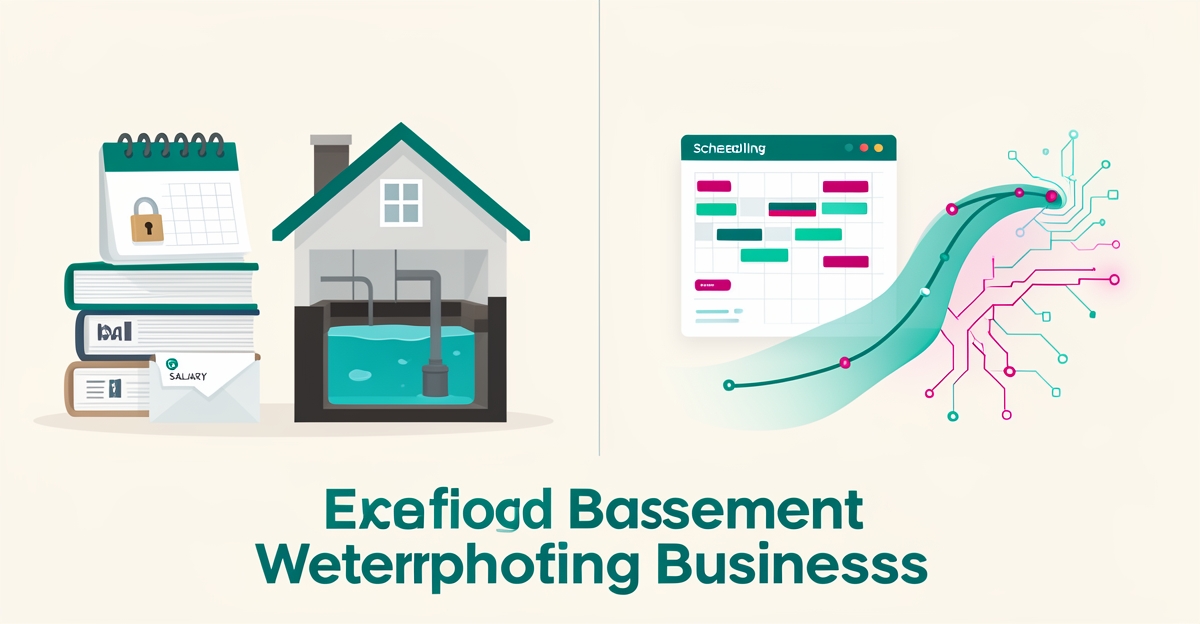
AI implementation transforms this cost structure into a variable model aligned with actual workload. Instead of maintaining a full team year-round, AI-powered dispatching, scheduling, and customer communication tools scale dynamically, handling increased inquiry volume during peak rainy seasons without proportional cost increases. This directly addresses the scalability challenge in field operations, where traditional hiring requires proportional headcount growth for every increment in business.
Consider the hidden burdens: recruitment cycles that drain managerial time, benefits typically adding 25-35% to base compensation, and training investments that may walk out the door with turnover. Meanwhile, AI systems deliver consistent performance without fatigue-related errors or scheduling gaps. Organizations adopting task-specific AI implementations, starting with scheduling optimization and customer communication, tend to see faster ROI by avoiding the complexity of overhauling entire workflows at once.
For waterproofing businesses facing seasonal demand swings, this flexibility proves critical. AI tools process large volumes of data daily to optimize technician routes, predict material needs, and manage customer expectations, all while eliminating the fixed overhead of idle staff during dry periods. The result is a leaner operation that maintains service quality without the financial burden of carrying excess capacity year-round.
By focusing on targeted AI applications first, such as automated job scheduling or intelligent customer intake, small operations can test value quickly before expanding to more complex field automation. This measured approach reduces implementation risk while building organizational confidence in AI collaboration, setting the foundation for sustainable scaling that matches actual market demand rather than speculative growth projections.
Where AI Delivers Immediate Value in Waterproofing Operations
When a small waterproofing crew is stretched thin, the fastest wins don't come from AI replacing your technicians, they come from handing off the repetitive office work that eats your day. Industry analysis points to a clear pattern: organizations see the quickest return when they start with low-risk, high-frequency tasks like scheduling optimization and customer communication, rather than attempting a company-wide overhaul all at once.
Microsoft's Cloud Adoption Framework reinforces this, advising businesses to begin AI strategy with use case identification, finding where results miss expectations or where people spend time on repetitive tasks. For a basement waterproofing operation, those pain points are predictable: missed calls during peak season, back-and-forth appointment rescheduling, delayed customer updates, and work orders that live on paper or in someone's head. Each of these is a task that happens often enough to justify automation, and each has a measurable outcome, fewer missed appointments, faster response times, cleaner records.
The highest-impact starting points for a small waterproofing operation include:
- Scheduling optimization, automatically filling calendar gaps, routing crews efficiently, and reducing the double-bookings that frustrate homeowners
- Customer communication, automated appointment confirmations, job status updates, and follow-ups that keep clients informed without tying up office staff
- Work order management, capturing job details, photos, and completion notes in a system that institutionalizes knowledge instead of losing it when a foreman moves on
- Lead response, answering inbound calls and qualifying inquiries 24/7, so a wet basement emergency at 9 p.m. becomes a booked inspection instead of a lost job
The research on enterprise modernization offers a caution worth heeding: AI can assess processes quickly, but the real challenge begins after assessment, because established workflows are woven into how a business actually operates. That's why task-specific deployment beats a "replace everything" strategy. One workflow at a time, with clear requirements and human oversight for critical decisions, exactly the approach GitHub's research recommends when it stresses that humans remain responsible for validating quality before anything goes live.
Speed matters here, too. AI implementations typically reach productivity in weeks, while new hires usually take months of recruitment and ramp-up. And the scale advantage compounds: AI handles increased call volume during a rainy spring without proportional cost increases, while staffing for peak season means paying for idle capacity the rest of the year.
This is the philosophy behind AIQ Labs' approach for small trades businesses, identify the single highest-ROI workflow, prove the value, then scale. That's exactly what AI Workflow Builds are designed for: rebuild the one workflow that costs you the most, at a fixed price, in phases. A waterproofing operation that starts with scheduling and customer communication typically sees ROI fast enough to fund the next phase, building momentum instead of betting the business on a moonshot.
The right first move is a clear-eyed look at where your operation actually leaks time and revenue. A free 30-minute strategy call with an AI engineer can map your biggest bottleneck and identify high-ROI automation opportunities, and if there isn't a clear win, you'll hear that too. Start the two-minute Fit Check at aiqlabs.ai/apply to book yours.
A Phased AI Adoption Roadmap for Small Field Teams
The biggest mistake small waterproofing operators make with AI isn't choosing the wrong tool, it's trying to adopt everything at once. A phased roadmap, grounded in how organizations actually succeed with AI, turns a risky leap into a series of low-stakes wins.
Phase 1: Discovery. Microsoft's Cloud Adoption Framework recommends starting with use case identification, asking, in plain terms, "where do results miss expectations" and "where do people spend time on repetitive tasks." For a waterproofing operation, that's usually scheduling bottlenecks, slow customer communication, and missed calls during busy season. Each problem should be translated into a short statement naming the activity and expected result, then classified by how it creates value.
Phase 2: Pilot one AI role. Research on AI adoption consistently points to starting with low-risk, fast-ROI implementations like scheduling optimization. For field service businesses, that often means deploying an AI Employee in dispatch or intake, answering calls, booking inspections, and qualifying leads before any crew coordination is touched. Managed AI staff like these cost roughly 80% less than an equivalent human hire and work around the clock. The pilot should run long enough to produce measurable data: calls answered, appointments booked, response times.
Phase 3: Integrate with what you already use. AI that sits in a silo fails. The Microsoft framework notes that some use cases require integration with existing systems, and that AI solutions must fit the skills and data an organization already has. Your AI intake agent should write directly into your CRM, calendar, and invoicing tools, not create another place to check.
Phase 4: Scale with human oversight. GitHub's research is blunt on this point: AI outputs still require human validation through comprehensive testing and quality checks. In a waterproofing context, that means the office manager reviews edge cases, unusual customer situations, warranty disputes, safety-related questions, while the AI handles routine volume. As GitHub's research puts it, humans remain responsible for validating quality.
A few principles keep the rollout on track:
- Write clear requirements before deployment, AI agents execute exactly what is defined, no more.
- Break work into parallel tasks rather than one big automation, so failures stay contained.
- Build monitoring loops so the system flags performance issues automatically.
- Shift your team's focus from reviewing every action to supervising outcomes and handling exceptions.
This last point matters more than most owners expect. The role of your existing staff evolves from task execution to system supervision, defining goals, designing workflows, and handling edge cases. That's the pattern playing out across industries as workers become orchestrators rather than operators.
The payoff of phasing is twofold: minimal disruption to crews in the field, and measurable gains at each step before you commit to the next. It's the approach AIQ Labs uses across its service lineup, discovery first, a single AI Employee pilot, integration, then scaling, so small operations can prove value before expanding. And because most implementations reach productivity in weeks rather than the months a new hire requires, each phase generates evidence quickly enough to guide the next decision.
If you want to see where AI would actually move the needle in your operation, take the two-minute Fit Check at aiqlabs.ai/apply and book a free 30-minute strategy call, a working session with an AI engineer to map your biggest bottleneck. If there isn't a clear win, they'll tell you that too.
Still paying for 10+ subscriptions that don’t talk to each other?
We build custom AI systems you own outright. No vendor lock-in. Full control.
Not sure where to start? Ask our AI planner
Frequently Asked Questions
How much can an AI Employee actually save compared to hiring a human for the same role?
What’s the fastest way to see ROI when adopting AI for a small basement waterproofing business?
Do I need to replace my entire workflow to benefit from AI, or can I start small?
Will my team still be needed if we bring in AI tools for scheduling and customer follow-up?
How long does it typically take for an AI solution to become productive compared to hiring a new technician?
Is there a risk that AI will make mistakes in customer communication or job scheduling that could hurt my reputation?
Your Next Step Toward Smarter Scaling
For small basement waterproofing operations, the choice between hiring more staff and adopting AI isn't just about technology, it's about building a resilient, agile business that scales with demand, not against it. Traditional hiring brings fixed costs that strain cash flow during slow seasons, while AI offers a variable cost model that aligns with actual workload, delivering faster ROI by starting with high-frequency tasks like scheduling and customer communication. By taking a phased approach, discovering bottlenecks, piloting one AI role, integrating with existing tools, and scaling with human oversight, waterproofing businesses can prove value quickly, minimize disruption, and evolve their teams from task executors to system supervisors. The real advantage lies in matching operational capacity to market demand without carrying idle staff year-round. If you're ready to see where AI could move the needle in your operation, start with a free two-minute Fit Check at aiqlabs.ai/apply to identify your biggest bottleneck and explore high-ROI automation opportunities, no obligation, just clarity.
Make AI your competitive advantage — not just another tool.
Strategy, implementation and ongoing optimization. One partner, end to end.
Not sure where to start? Ask our AI planner