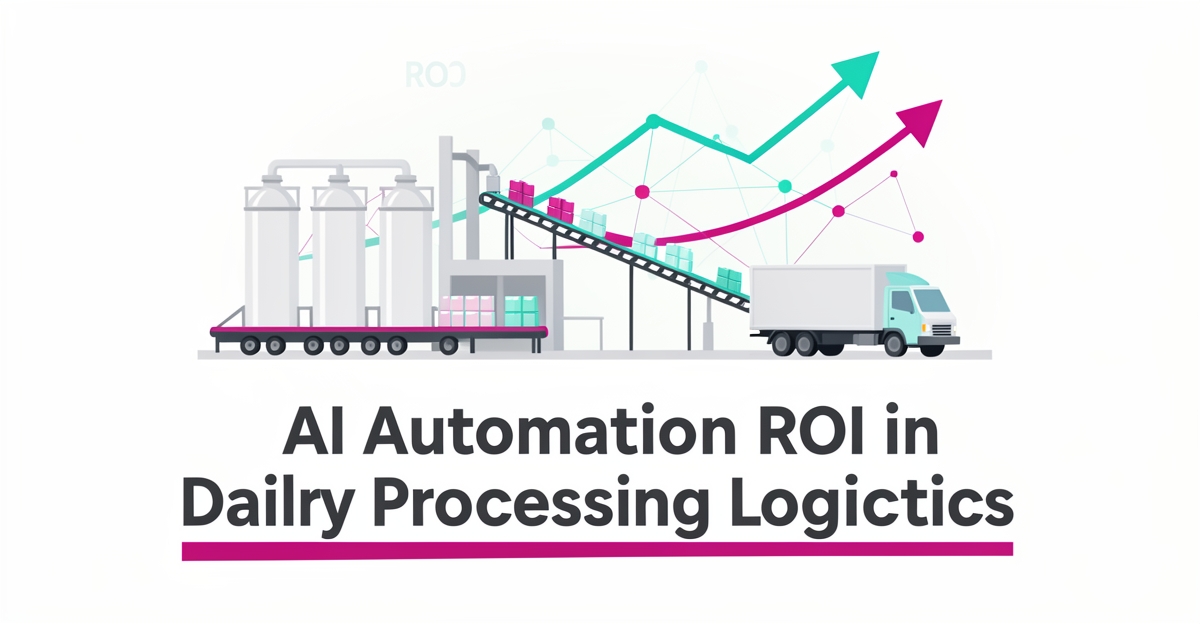
Is AI Worth It for Dairy Processors? A ROI Breakdown of Automation in Order Fulfillment and Logistics
Key Facts
- The global dairy market is a multi-hundred-billion-dollar industry that runs on operational precision and perishable inventory
- A large share of food and beverage companies are planning significant AI and supply chain investments, per industry reporting
- AI-driven demand forecasting is widely reported to reduce waste and overstock in perishable categories
- AI assistance in R&D-heavy food operations can meaningfully cut bench time within months, according to analysis
- AIQ Labs has deployed 200+ multi-agent systems and runs 4 live SaaS products daily
Hire a team member that works 24/7 — for less than a part-time wage.
AI receptionists, SDRs, dispatchers and 99+ roles. Trained on your business, fully managed.
Not sure where to start? Ask our AI planner
The Hidden Cost of Manual Order Fulfillment in Dairy
A single transposed digit on an order form can turn a profitable delivery into a write-off when the product spoiling in the back of the truck has a shelf life measured in days. That's the daily reality of manual order fulfillment in dairy processing, where thin margins and perishable inventory leave no room for error.
The pain shows up in three places. Order entry errors mean the wrong product ships, or the right product ships to the wrong customer. Inventory miscounts, often the result of spreadsheets updated hours after the fact, lead to stockouts on high-velocity SKUs and overstock that expires before it sells. Dispatch delays compound both problems, because every hour a chilled load sits on the dock eats into the cold chain window.
These aren't small leaks. The global dairy market is a multi-hundred-billion-dollar industry, and it runs on operational precision. When demand forecasting, inventory levels, and supply chain routing are managed manually, waste and rework quietly drain margin at every step. Industry reporting notes that AI can improve demand forecasting by analyzing historical sales data and market trends, leading to optimized production and reduced waste, while also helping processors manage inventory levels without overstocking.
The market has noticed. A large share of food and beverage companies are planning significant investments in AI and supply chain technologies, per Dairy Processing. That's not hype-driven experimentation, it's a response to the same operational pain this article describes.
So the question every processor is asking is fair: does AI actually pay for itself, or is it another buzzword with an invoice attached? The honest answer is that ROI depends on what you automate. The clearest wins sit in the workflows where manual labor is repetitive, error-prone, and expensive:
- Order processing, capturing, validating, and routing orders without re-keying data across systems
- Inventory tracking, keeping counts accurate in real time so production and sales see the same numbers
- Dispatch routing, sequencing deliveries against shelf life, delivery windows, and cold chain constraints
- Demand forecasting, aligning production runs with what customers will actually order
The economics of automation matter here. AI systems built on modern agent frameworks can handle these workflows end-to-end, and because they work around the clock, they don't add headcount to do it. AIQ Labs builds this kind of automation through AI Workflow Builds, rebuilding the one workflow that costs you the most, at a fixed price, in phases, which is the difference between a system that compounds value and one that rents it back month after month.
The rest of this article puts numbers behind that question, building a practical ROI model for automating order fulfillment and logistics in a dairy operation, and showing where the payback actually comes from.
Key takeaways: manual fulfillment costs dairy processors in errors, waste, and labor; the industry is already investing, the decision is how, not whether.
Where AI Pays: Order Processing, Inventory, and Dispatch Routing
Dairy processors are under pressure to fulfill faster with less waste, and manual order-to-delivery workflows are where margin leaks first appear. Automation turns repetitive processing into measurable ROI by removing errors, aligning stock with real demand, and moving product the moment it’s ready.
AI order processing eliminates the manual entry errors that slow fulfillment and trigger costly rework. By automating capture, validation, and routing of orders from retailers, distributors, and e-commerce channels, processors reduce exceptions and accelerate confirmation times. This workflow automation is a core AI Business Process Automation use case that frees teams from data entry to focus on exceptions and customer relationships.
Demand forecasting and inventory optimization cut waste and stockouts across perishable SKUs. AI algorithms analyze historical sales data, consumer preferences, and market trends to improve demand forecasting, leading to optimized production and reduced waste. The same models support inventory optimization by managing stock levels to avoid overstocking while protecting service. In a sector where freshness drives value, better forecasts directly protect revenue and cash flow.
Intelligent dispatch routing speeds fulfillment and lowers logistics cost per case. AI-driven routing considers order priority, cold-chain constraints, vehicle capacity, and real-time traffic to build efficient delivery plans. Faster, more reliable dispatch improves on-time delivery and reduces overtime and fuel spend.
The competitive context is clear. AI-driven operations are becoming a competitive shift inside a global dairy market worth hundreds of billions of dollars, and a large share of food and beverage companies are making significant AI and supply chain investments in the next year per industry reporting, signaling rapid adoption across processors.
ROI shows up in three measurable levers:
- Fewer manual errors and faster order-to-confirm times from AI order processing
- Lower spoilage and stockouts through predictive demand and inventory optimization
- Reduced miles and labor hours with intelligent dispatch routing
AIQ Labs approaches these areas as custom-built workflow and task automation rather than off-the-shelf widgets, designing systems that integrate with existing ERP, WMS, and TMS environments. Processors gain owned systems that reduce subscription sprawl and scale with volume without proportional headcount growth.
When order processing, inventory, and routing work as a connected loop, fulfillment becomes more reliable and profitable.
Building Your ROI Model: Labor, Errors, and Speed
Most dairy processors know their order fulfillment bleeds money, they just haven't quantified the bleed. A practical ROI model starts with three measurable levers: labor hours lost to manual entry, the compounding cost of fulfillment errors, and the revenue impact of slower dispatch cycles.
Labor reclamation is the easiest line item to calculate. For a mid-sized processor, manual order entry, load scheduling, and proof-of-delivery reconciliation can consume 20 or more hours weekly, time that AI workflow automation eliminates by connecting ERP, WMS, and carrier systems into a single data flow. According to industry analysis, a large share of food and beverage companies plan significant AI and supply chain investments in the coming year, with operational efficiency as the primary driver.
Error costs compound faster than most operators realize. Shorted orders trigger chargebacks. Mis-picked SKUs spoil in cold storage. A single misrouted pallet of cultured product can mean thousands of dollars in lost value and retailer penalties. AI-driven order validation catches mismatches before they leave the dock, while better demand forecasting typically reduces both excess inventory and stockouts, directly protecting perishable margins.
Speed gains translate to top-line growth. Faster fulfillment cycles mean fresher product on shelf, higher fill rates, and stronger retailer scorecards. Processors using AI-enhanced dispatch routing report measurable improvements in on-time delivery and cold chain compliance.
- Labor hours reclaimed from manual data entry and scheduling
- Cost of fulfillment errors, shorted orders, spoiled product, chargebacks
- Fulfillment speed gains from automated routing and validation
- Inventory carrying cost reduction via demand forecasting
- Cold chain protection through continuous monitoring
The AI Employee vs. human cost comparison sharpens the model further. Managed AI Employees, covering roles like order-processing clerks, dispatchers, and inventory coordinators, typically cost around 80% less than an equivalent human hire and run 24/7/365 without overtime, turnover, or coverage gaps. For order processing, dispatch coordination, and inventory tracking roles, that difference compounds across every shift. AIQ Labs builds these systems as owned assets, not rented tools, so the economics improve every month the system runs.
How to Implement AI Without Disrupting Your Plant
The fear that AI adoption means shutting down your plant for a full system overhaul is the single biggest reason dairy processors delay, and it's based on a myth. Modern implementations start with one broken workflow, not a rip-and-replace of your entire operation.
Start where the pain is sharpest. For most dairy processors, that's order entry: a manual, error-prone process where a single typo cascades into wrong pallets, missed deliveries, and credit notes. According to Dairy Processing, a large share of food and beverage companies plan significant AI and supply chain investments in the coming year, but the winners begin with a single workflow, prove the ROI, then expand. This phased approach mirrors AIQ Labs' AI Workflow Builds: rebuild one critical process at a fixed price, measure the result, and scale only when the numbers justify it.
Before you automate anything, audit your data. AI is only as reliable as the information feeding it, and industry analysis consistently flags data quality as the top implementation barrier. Check that your ERP, accounting software, and dispatch tools can expose clean data via API. If your records live in spreadsheets and inboxes, that's your first fix, not a reason to avoid AI, but a prerequisite for it.
Integration doesn't mean replacement. A well-architected system layers on top of your existing stack, pulling orders from email or EDI, validating them against inventory, and pushing clean data into your current accounting and routing tools. Keep humans in the loop for exceptions: pricing disputes, short-dated product decisions, and customer credits still need judgment. As Corbion's Ashley Robertson puts it, "AI is at its best when it's used to amplify human thinking, not replace it."
Three objections stall most projects:
- Data security: With digital systems handling sensitive customer and pricing data, cybersecurity is a legitimate concern, mitigate it with audit trails, role-based access, and on-premise or private-cloud deployment options.
- Integration complexity: Legacy dairy ERPs weren't built for AI, but middleware and API connectors can bridge them without forklift upgrades.
- Skill gaps: You don't need a data-science team; you need a partner who trains your staff and hands over documented, owned systems.
That last point matters more than most processors realize. Subscription software locks you into monthly fees and vendor roadmaps; ownership-based models don't. AIQ Labs structures engagements three ways: Start Monthly with a flat plan that costs less than a part-time hire, Build in Milestones where you approve and pay per phase and keep everything built so far, or Own It Outright with full code and data transfer. For processors whose fulfillment spans many workflows, an AI Operating System connects order processing, inventory, and dispatch into one operating layer, built in phases and owned outright. With margins tightening across the dairy industry, the processors who automate selectively, and own what they build, will compound that advantage for years.
From ROI Model to Real Numbers: Your Next Step
The ROI model only becomes real when applied to your specific operation. Generic projections won’t capture the nuances of your order volumes, SKU complexity, or delivery route constraints that directly impact fulfillment costs. What looks promising on paper may not translate to savings if your biggest bottleneck isn’t in order processing but in cold chain logistics or inventory variance.
That’s why we start with a working session, not a sales pitch. The free two-minute Fit Check at https://aiqlabs.ai/apply leads to a 30-minute strategy call with an AI engineer who maps your actual workflow. We’ll identify where manual errors are inflating costs, the same gaps driving much of the food and beverage industry’s current AI investment, and pinpoint whether automation in order fulfillment, inventory tracking, or dispatch routing delivers measurable ROI for your scale.
If the data shows AI isn’t a clear win for your current operation, we’ll say so. No obligation. Just clarity on where your highest-leverage automation targets actually live. Book your session at https://aiqlabs.ai/book to turn the ROI model into a plan built for your volumes, not a template.
Still paying for 10+ subscriptions that don’t talk to each other?
We build custom AI systems you own outright. No vendor lock-in. Full control.
Not sure where to start? Ask our AI planner
Frequently Asked Questions
Is AI actually worth it for dairy processors, or is it just hype?
Where does AI pay off the fastest in dairy order fulfillment and logistics?
How much can AI reduce errors and waste in perishable dairy operations?
Will implementing AI disrupt my plant or require a full system overhaul?
What are the biggest risks with AI in dairy, like data security and integration?
Do I need a data science team to run AI for order fulfillment?
The Cold Chain Doesn't Wait, Neither Should Your Automation
Manual order fulfillment in dairy processing isn't just inefficient, it's a margin leak measured in spoiled product, chargebacks, and hours lost to re-keying data across disconnected systems. The ROI case for AI automation comes down to three levers: reclaiming 20+ weekly labor hours, cutting fulfillment errors that cost thousands per incident, and accelerating dispatch so perishable inventory moves while it still has shelf life. A large share of food and beverage companies are planning significant AI and supply chain investments in the coming year, according to industry reporting, and the processors who act first will compound that advantage. The path forward doesn't require a plant shutdown or a rip-and-replace, it starts with one broken workflow, proven in production, then scaled. AIQ Labs builds these systems as owned assets, not rented subscriptions, so the economics improve every month they run. Take the two-minute Fit Check at https://aiqlabs.ai/apply and book a 30-minute strategy call with an AI engineer who maps your actual operation, no pitch, just clarity on where automation pays for itself.
Make AI your competitive advantage — not just another tool.
Strategy, implementation and ongoing optimization. One partner, end to end.
Not sure where to start? Ask our AI planner