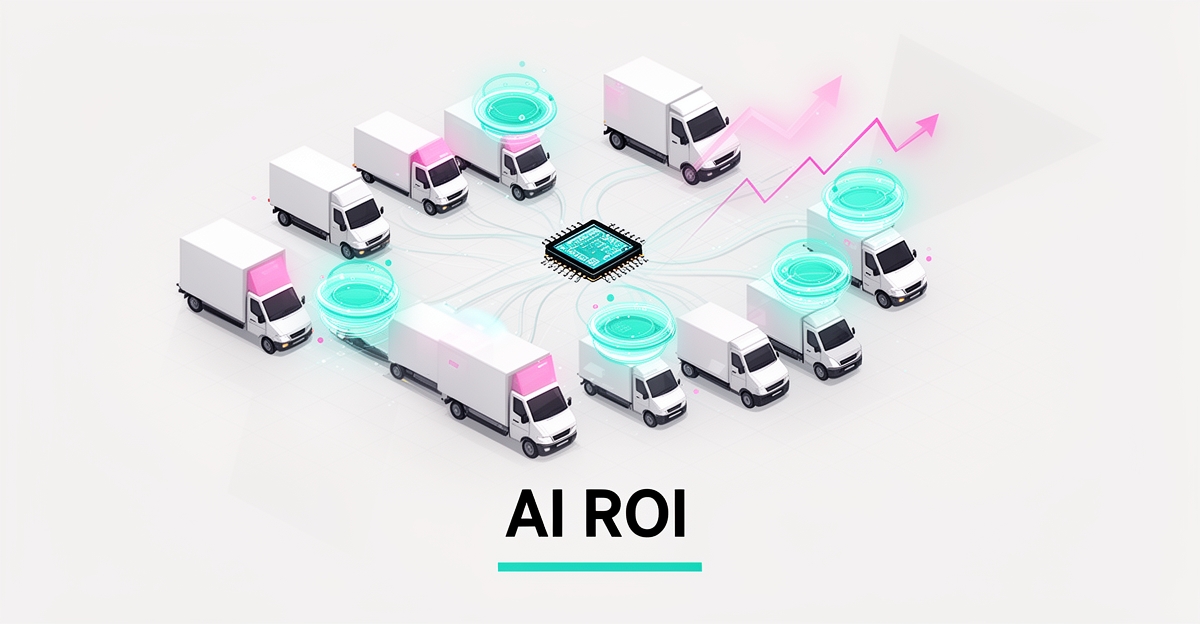
Is AI Worth It for Fleet Maintenance? A Cost-Benefit Analysis for SMBs
Key Facts
- The largest share of AI's cost advantage in fleet operations typically comes from eliminating redundant paperwork and reducing unplanned downtime, not from headline features.
- Industry analyses as of late 2026 suggest only a minority of fleets—often cited around a quarter—actually use predictive maintenance today.
- A majority of maintenance teams report plans to adopt AI by end of 2026, leaving a large gap between intent and execution.
- Predictive maintenance adopters commonly report maintenance cost reductions in the 10–34% range, depending on data quality and scope.
- Realistic full-implementation ROI timelines for SMB fleets generally run 6–18 months; narrow, single-workflow pilots can show returns in weeks.
Hire a team member that works 24/7 — for less than a part-time wage.
AI receptionists, SDRs, dispatchers and 99+ roles. Trained on your business, fully managed.
Not sure where to start? Ask our AI planner
The Fleet Maintenance Cost Trap SMBs Face
For many SMB fleet owners, maintenance feels like a leak that never stops. Vehicles go down without warning, paperwork piles up, and repairs shift from planned to panic-driven.
Unplanned downtime is the most visible cost. Industry research on AI-versus-manual fleet operations consistently finds that the majority of the cost advantage comes from eliminating redundant paperwork and reducing unplanned downtime. When a truck sits idle, revenue stops while labor and rental costs continue.
Reactive repairs compound the problem. Without early signals, teams replace parts too late or too early, and service bays become bottlenecks. Industry analyses typically cite around a 10% baseline maintenance cost reduction as achievable for fleets that shift from breakdown-driven to data-driven work orders—yet many SMBs never reach it because their schedules are set by failures, not forecasts.
The paperwork burden is larger than it appears. Drivers submit handwritten logs, dispatchers re-enter data, and mechanics chase history across systems. That manual loop creates delays, errors, and missed service windows that quietly erode margins.
Adoption remains low despite clear intent. As of late 2026, industry surveys suggest only about a quarter of fleets actually use predictive maintenance, while a strong majority of maintenance teams report plans to adopt AI. The gap reflects cost fears and integration concerns, not a lack of interest.
The trap shows up as three reinforcing drivers:
- Unplanned downtime that forces emergency repairs and lost deliveries
- Redundant paperwork across drivers, dispatch, and service vendors
- Reactive repairs that shorten vehicle life and inflate parts spend
These patterns keep fleets in a high-cost cycle. Predictive maintenance is the lever most operators rank as their top AI priority for 2026, yet legacy processes and data silos slow progress.
AIQ Labs works with SMBs on exactly this transition through AI Workflow Builds—rebuilding the one workflow that costs the most, at a fixed price, in phases. The goal is not wholesale replacement, but removing the friction that makes maintenance expensive.
With realistic ROI timelines of 6–18 months for AI fleet implementations, the business case hinges on stopping the bleed from downtime and paperwork first, then extending asset life over time.
Where AI Cuts Fleet Costs: Predictive, Routes, and Safety
The pattern across industry reporting is consistent: the highest returns in fleet AI cluster around three use cases that directly attack the biggest cost drivers. The majority of the cost advantage comes from eliminating redundant paperwork and reducing unplanned downtime—not from flashy features, but from removing the friction that bleeds budgets daily.
Predictive maintenance leads the pack. Vendors and industry case studies commonly report failure-prediction accuracy approaching 90% in well-instrumented fleets, with maintenance cost reductions frequently cited in the 10–34% range depending on data quality and fleet size. That accuracy translates to fewer catastrophic breakdowns, longer asset life, and maintenance teams shifting from reactive firefighting to planned work. Yet only a minority of fleets use predictive maintenance today while most plan to adopt AI—the gap represents unrealized savings sitting on the table.
Route optimization delivers the second lever. Industry use cases typically document fuel savings in the 5–15% range through AI-powered routing. Even at the lower bound, fuel savings compound fast across a fleet—especially when paired with reduced idle time and tighter delivery windows.
Driver safety systems close the triangle. Reported results vary widely, with accident reductions commonly cited between 25% and 50% from AI-driven safety monitoring. Fewer accidents mean lower insurance premiums, less vehicle downtime, and reduced liability exposure—costs that rarely appear in maintenance line items but devastate total cost of ownership.
- Predictive maintenance: failure-prediction accuracy approaching 90% in well-instrumented fleets; cost reductions commonly reported at 10–34%
- Route optimization: fuel savings typically in the 5–15% range
- Driver safety: accident reductions commonly reported between 25% and 50%
- Paperwork and downtime elimination: the largest single source of total cost advantage
These three use cases share a common thread—they each convert unstructured, reactive operations into predictable, data-driven workflows. That's where AIQ Labs sees the fastest path to ROI for SMBs: not in experimental pilots, but in AI Employees like AI dispatchers and maintenance coordinators that slot into existing processes at a fraction of the cost of a human hire. The technology is mature; the execution gap is where value lives.
ROI Reality Check: Payback Timelines and Implementation Risks
The promise of rapid returns makes AI fleet maintenance compelling, but the gap between vendor claims and operational reality warrants scrutiny. Some predictive maintenance vendors advertise payback in as little as 44 days, while broader industry analysis places the realistic ROI window at 6–18 months for full implementation. Grounded industry research typically supports a more modest baseline—around a 10% maintenance cost reduction across fleets adopting AI—significant, but far from the headline operating-cost reductions some vendors advertise.
- Data quality gaps that undermine predictive model accuracy
- Legacy system integration complexity and hidden costs
- Cultural resistance from maintenance teams accustomed to reactive workflows
- Inability to predict rare or novel failure modes without human oversight
These challenges explain why only a minority of fleets currently use predictive maintenance despite widespread plans to adopt. The disparity between planning and execution often stems from underestimating the organizational change required. AIQ Labs engagements start with a readiness evaluation that surfaces these exact blockers—data infrastructure gaps, team capability assessments, and integration roadmaps—before any build begins. A phased approach targeting a single high-impact workflow, such as automating work order prioritization or parts forecasting, lets SMBs validate returns in weeks rather than betting the fleet on a full-platform rollout.
From Pilot to Production: A Practical SMB Implementation Roadmap
Many SMBs hesitate to move beyond AI pilots because they lack a clear path to scale. The good news is that AI implementation doesn't have to be overwhelming—it can be approached in manageable, measurable steps. By following a lean roadmap aligned with proven transformation principles, fleets can transition from testing to full production without disrupting operations or overextending budgets.
Start by assessing your data quality, as AI models depend on accurate, complete inputs to deliver reliable predictions. Poor data quality is the most commonly cited reason predictive programs underdeliver, leading to false alerts or missed failure signals. Next, integrate AI with legacy systems such as maintenance logs or telematics platforms—a step often cited as complex but essential for seamless workflow automation. Then, train your maintenance team to interpret AI-generated insights and act on predictive alerts, addressing cultural resistance through hands-on familiarity. Finally, establish a rhythm of monitoring and adjustment, refining models based on real-world outcomes to sustain long-term value.
This four-step approach aligns directly with AIQ Labs' methodology and supports flexible adoption through three payment models: Start Monthly to pilot AI in one workflow, Build in Milestones as confidence grows, or Own It Outright for full system control once proven. For fleets ready to go further, an AI Operating System connects dispatch, maintenance, and safety into one operating layer, built in phases and owned outright. Each phase builds on the last, turning experimentation into enduring capability.
Still paying for 10+ subscriptions that don’t talk to each other?
We build custom AI systems you own outright. No vendor lock-in. Full control.
Not sure where to start? Ask our AI planner
Frequently Asked Questions
Is AI actually worth it for a small fleet, or is it just hype?
How fast can I realistically see a return on AI fleet maintenance?
What kind of cost savings should I expect from predictive maintenance?
Why aren't more fleets using AI if the savings are so big?
Will AI help with fuel and safety costs too, or just maintenance?
What's the biggest risk that makes AI fail in fleet maintenance?
Stop the Bleed, Start the Gain
Fleet maintenance for SMBs is stuck in a high-cost cycle of unplanned downtime, redundant paperwork, and reactive repairs. AI doesn't fix everything overnight, but it directly attacks the biggest bleed points: predictive maintenance commonly delivering 10–34% cost reductions, route optimization cutting fuel use by 5–15%, and driver safety systems reducing accidents by 25–50% in reported use cases. The largest share of the cost advantage comes from eliminating paperwork and unplanned downtime, with realistic ROI timelines of 6–18 months when implementation is phased. Success hinges on data quality, legacy system integration, and team adoption, not just the model. Start with a readiness check on your data and pick one high-impact workflow to pilot—such as work order prioritization or parts forecasting—then scale from proven results. AIQ Labs helps SMBs map where downtime and manual handoffs cost the most before designing targeted automation. Start the 2-minute Fit Check, then book a free 30-minute strategy call to map your biggest bottleneck and identify high-ROI automation opportunities with no obligation.
Make AI your competitive advantage — not just another tool.
Strategy, implementation and ongoing optimization. One partner, end to end.
Not sure where to start? Ask our AI planner