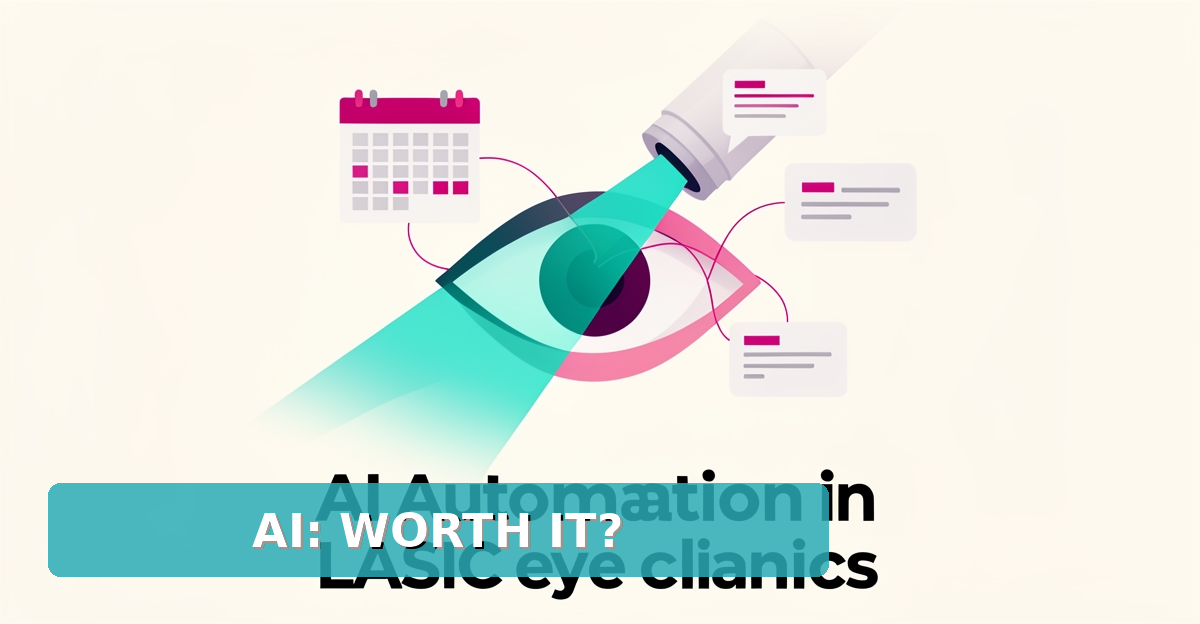
Is AI Worth It for LASIK Clinics? A Cost-Benefit Analysis of Automation
Key Facts
- Administrative work, scheduling, billing, and patient messaging, is typically the largest controllable overhead in a LASIK clinic.
- Automated scheduling can cut manual booking time substantially, freeing clinic staff for patient-facing work.
- AI revenue cycle tools can significantly reduce claim processing time, accelerating reimbursement and improving clinic cash flow.
- Voice and chat AI can handle a large share of routine patient inquiries, reducing call volume and improving response speed.
- AI can review insurance claims for accuracy before submission, helping practices avoid costly denials and delays.
- Ophthalmology practice management analysis notes that machine learning technologies help doctors be more efficient and take better care of patients.
Hire a team member that works 24/7 — for less than a part-time wage.
AI receptionists, SDRs, dispatchers and 99+ roles. Trained on your business, fully managed.
Not sure where to start? Ask our AI planner
The Administrative Burden Holding LASIK Clinics Back
Manual scheduling, billing follow-ups and patient messaging quietly consume hours each day in LASIK clinics, creating a bottleneck that limits how many consultations can be booked and how quickly revenue is collected. Administrative work is not a peripheral task; it is the operational spine that determines throughput, staff utilization and overhead.
Across small and midsize businesses, AI adoption is heaviest in admin, data processing, and customer service work, and businesses that integrate it into those core workflows tend to keep it. For ophthalmology practices, that pattern shows up most clearly in scheduling and revenue cycle tasks.
Patient scheduling represents one of the most time-consuming jobs at any practice. An intelligent system can book appointments by calculating time needed based on medical needs and treatment complexity, then efficiently book around a doctor's availability. Practice management analysis notes AI can monitor KPIs such as patient satisfaction, revenue per patient, and staff productivity to identify trends and areas for improvement.
Revenue cycle friction adds to the burden. Manual claim review, denial rework and billing inquiries tie up staff who could be supporting clinical care. AI can review claims for accuracy before submission, helping practices avoid costly denials and delays. That reduction in rework directly protects cash flow and reduces administrative headcount pressure.
Communication tasks compound the load. Patients call or message with common questions about candidacy, pricing, pre-op instructions and recovery timelines. AI chatbots on websites or over the phone assist with scheduling, answer common questions, and recommend educational resources based on patient conditions. As ophthalmology practice management analysis notes, new technologies can use machine learning to help doctors be more efficient and take better care of their patients.
The cumulative effect is reduced patient throughput and increased overhead that is avoidable. Clinics that keep these functions manual face longer wait times, missed appointments and slower collections. Automation shifts the focus from repetitive data entry to higher-value patient engagement.
Administrative burdens typically cluster in:
- Scheduling and rescheduling that relies on phone and manual calendars, driving no-shows and gaps in the day
- Billing and insurance verification that requires repeated data entry and claim rework
- Patient communication for reminders, pre-op instructions and post-op follow-up that staff handle one by one
- Record keeping and documentation that pulls clinical staff away from care
When these tasks are integrated into systems clinics already use, AI stops being a separate tool and becomes part of how the work happens. That is why a detailed evaluation of whether investing in AI pays off for a LASIK center, focusing on cost savings, increased appointment volume, and reduced administrative overhead, matters before any purchase. AIQ Labs' workflow builds are designed around exactly this: rebuilding the one workflow that costs the clinic the most, at a fixed price, in phases.
Where AI Delivers Measurable ROI in LASIK Operations
For LASIK clinics, AI delivers measurable returns by targeting operational pain points where automation directly impacts the bottom line. Automated scheduling systems reduce front-desk workload by handling appointment booking, rescheduling, and reminders without human intervention, cutting administrative labor costs while improving calendar utilization. Revenue cycle management tools accelerate cash flow by automating insurance claim validation and billing follow-ups, reducing denials and shortening payment cycles. Patient communication AI, such as voice agents and chatbots, minimizes no-shows through timely, personalized reminders and handles routine inquiries 24/7, freeing staff for higher-value interactions.
These applications align with broader healthcare trends where AI proves most valuable in admin, data processing, and customer service functions. Businesses that integrate AI into those areas tend to sustain it year over year, signaling lasting operational benefit. For LASIK clinics specifically, this translates to fewer missed appointments, faster reimbursement cycles, and reduced reliance on temporary or overtime staffing during peak periods.
AI-powered scheduling and reminders directly combat one of LASIK's costliest inefficiencies: patient no-shows. Automated outreach via SMS, email, or voice calls significantly improves attendance rates, ensuring surgical suites and diagnostic equipment operate at optimal capacity. When combined with AI-driven revenue cycle management, which reviews claims for errors before submission, clinics experience fewer billing delays and stronger monthly cash flow predictability. Patient communication tools further enhance efficiency by handling pre-op questions, post-op follow-ups, and rescheduling requests without tying up clinical coordinators, creating a smoother patient journey from inquiry to recovery.
For clinics without the budget to hire more front-desk staff, AI employees, managed AI receptionists, schedulers, and patient coordinators, cover these functions at a fraction of the cost of a human hire, typically around 80% less.
- Automated scheduling reduces manual booking time substantially, allowing staff to focus on patient-facing tasks
- AI revenue cycle tools shorten claim processing time, accelerating reimbursement and improving working capital
- Voice and chatbot AI handle a large share of routine patient inquiries, decreasing call volume and improving response speed
These efficiencies compound over time: higher show-up rates increase procedure volume without adding overhead, faster billing improves liquidity for technology reinvestment, and streamlined communication boosts patient satisfaction, all contributing to a stronger competitive position in the LASIK market. Clinics implementing these tools consistently report measurable improvements in operational KPIs, validating AI not as an expense but as a force multiplier for existing resources.
Implementing AI Without Disruption: A Practical Roadmap for Clinics
The clinics that see real returns from AI are rarely the ones that buy the most tools, they're the ones that follow a disciplined rollout. Businesses that integrate AI into the systems they already use, invoicing, customer records, financial reporting, daily communications, see the calculation change entirely. But that kind of retention only happens when implementation is deliberate, not impulsive.
The first step is identifying high-impact areas before evaluating any vendor. Ophthalmology practice management analysis groups healthcare AI into three categories, data analysis, administrative support, and communication enhancements, and scheduling stands out as one of the most time-consuming jobs at any practice. An intelligent system can calculate how long each visit should take based on medical needs and treatment complexity, then book appointments efficiently around a doctor's availability.
From there, integration becomes the make-or-break factor. A tool that lives outside your EHR and practice management platform creates friction; one that connects to them becomes part of how the work happens. Any vendor you evaluate should be able to demonstrate exactly how their system plugs into what you already run.
A practical rollout sequence looks like this:
- Map current workflows and pinpoint the highest-cost bottlenecks, scheduling, billing, and patient communication are the usual candidates.
- Verify integration capability with your existing EHR, scheduling, and billing platforms before signing anything.
- Confirm HIPAA compliance and data privacy protections, including audit trails and human-in-the-loop controls for clinical decisions.
- Train staff role by role, since comprehensive training is what separates smooth adoption from stalled pilots.
- Track ROI from day one: cost savings, patient throughput, claim denial rates, and satisfaction scores.
That last point deserves emphasis. AI's ability to gather and analyze large amounts of data can help practice administrators monitor KPIs like patient satisfaction, revenue per patient, and staff productivity, but only if those metrics are defined before deployment. Measuring ROI after the fact is how implementations stall.
Compliance and change management round out the roadmap. Healthcare regulations require robust data protection, and some patients may initially be uncomfortable with AI interactions, so communication tools should launch with clear human escalation paths. Structured guidance pays off here: rather than a single big-bang deployment, AIQ Labs builds in phases, starting with one high-cost workflow, proving the ROI, then expanding. Clinics can start monthly with a single AI employee, build in milestones as each workflow pays for itself, or eventually own an AI operating system outright, a connected operating layer across the whole practice, with no ongoing licensing dependence.
Start narrow, integrate deeply, train thoroughly, and measure relentlessly. Clinics that follow that sequence convert AI from an experiment into infrastructure, one that becomes too valuable to give up.
Still paying for 10+ subscriptions that don’t talk to each other?
We build custom AI systems you own outright. No vendor lock-in. Full control.
Not sure where to start? Ask our AI planner
Frequently Asked Questions
How much time can AI save on scheduling tasks in a LASIK clinic?
Do businesses keep AI tools after the first year?
Can AI help reduce patient no-shows in LASIK clinics?
How does AI impact revenue cycle management in ophthalmology practices?
What are the key steps for implementing AI in a LASIK clinic without disrupting operations?
Is AI in healthcare just a trend, or are clinics seeing lasting value from these tools?
From Administrative Drag to Operational Advantage
The evidence is clear: AI isn't just a futuristic add-on for LASIK clinics, it's a practical lever for reducing administrative burden, increasing patient throughput, and strengthening cash flow. By automating scheduling, revenue cycle tasks, and routine patient communication, clinics can redirect staff toward higher-value interactions while cutting no-shows, accelerating reimbursements, and improving schedule utilization. The real ROI comes not from chasing technology for its own sake, but from targeting specific workflow inefficiencies with tools that integrate seamlessly into existing systems. For clinics ready to move beyond manual bottlenecks, the next step is a focused assessment of where AI can deliver the fastest, most measurable impact. Take the two-minute Fit Check or book a free 30-minute strategy call to map your biggest operational pain points and explore how AI, built around your actual workflows, paid for monthly, in milestones, or owned outright, can become a sustainable competitive advantage.
Make AI your competitive advantage — not just another tool.
Strategy, implementation and ongoing optimization. One partner, end to end.
Not sure where to start? Ask our AI planner