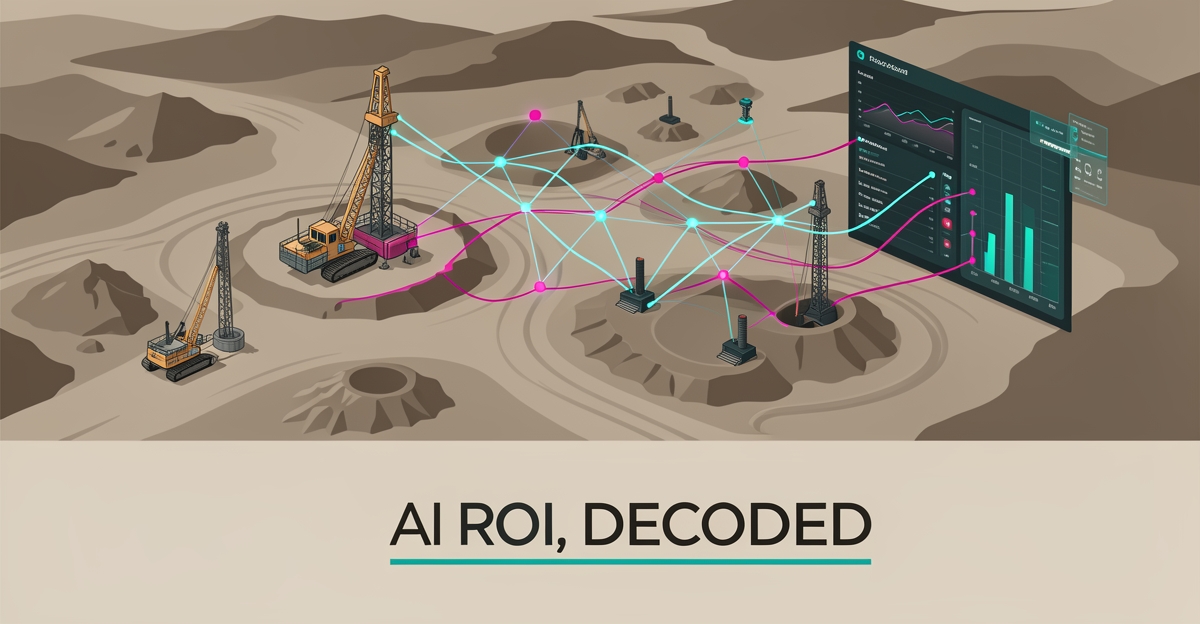
Is AI Worth It for Mineral Exploration Firms? A ROI Analysis of AI in Field Data Management
Key Facts
- AI infrastructure costs extend well beyond software licensing to include power, cooling, and connectivity, often underestimated in initial ROI planning
- Thousands of AI tools have launched in recent years, but most add operational complexity rather than measurable value
- AI pattern recognition can correlate geological surveys, assays, geophysical measurements, and drill history simultaneously, work that takes human teams weeks
- AIQ Labs has deployed 200+ multi-agent systems and runs 4 live SaaS products daily
- AI Employees typically cost around 80% less than an equivalent human hire while working around the clock
Hire a team member that works 24/7 — for less than a part-time wage.
AI receptionists, SDRs, dispatchers and 99+ roles. Trained on your business, fully managed.
Not sure where to start? Ask our AI planner
The True Cost of AI Infrastructure in Field Operations
Beyond software licensing, AI implementation in field operations demands real investment in underlying infrastructure, particularly data processing power, connectivity, and energy consumption. These hidden costs directly affect ROI calculations for mineral exploration firms and are often underestimated during initial planning. As of late 2026, growing scrutiny of AI buildouts has made clear that compute carries a genuine resource burden in power, cooling, and water, costs increasingly passed through to operators. For remote exploration sites, this translates into heightened demands on power generation, cooling systems, and network bandwidth, especially when processing large volumes of geospatial and sensor data in real time.
The infrastructure footprint extends beyond physical hardware to ongoing operational expenditures. AI workloads require consistent, high-bandwidth connectivity to transmit field-collected data to centralized or cloud-based processing units, a challenge in geographically isolated mining concessions where satellite or mesh networks may be necessary. Energy consumption scales with model complexity and data throughput, meaning continuous AI-driven analysis of drill logs, geochemical assays, or geophysical surveys can substantially increase site-level power draw. Firms must also account for thermal management in harsh environments, where maintaining optimal server temperatures adds further energy and maintenance overhead.
To manage these variables effectively, exploration companies should adopt a phased infrastructure strategy that aligns AI deployment with existing field capabilities. This includes assessing current data latency tolerance, evaluating edge computing options to reduce transmission loads, and integrating renewable energy sources where feasible to offset grid dependency. Partnering with providers who model long-term operational costs transparently, rather than quoting only upfront build prices, ensures infrastructure planning supports sustainable scaling. Accurate ROI assessment hinges on recognizing that AI's value calculation must include the full lifecycle cost of enabling it in demanding field conditions.
Separating Signal from Noise: Practical AI Tools for Field Data
Mineral exploration teams often drown in raw field data, rock samples, drill logs, geochemical assays, without a clear path to actionable insights. The real challenge isn't collecting data, but separating meaningful geological signals from environmental noise before costly drilling decisions are made. A disciplined "test and validate" approach to AI tool selection ensures exploration firms invest only in solutions that demonstrably accelerate data interpretation without adding operational complexity.
Practical AI adoption begins with rigorous testing against real field workflows. With thousands of AI tools on the market, genuinely useful ones are identified not by feature lists but by whether practitioners actually use them to get work done, a principle directly applicable to evaluating AI for geological pattern recognition or sample classification. This focus on proven utility over novelty helps exploration companies avoid investing in systems that require extensive retraining or disrupt established field protocols.
Validation must extend beyond technical accuracy to measure tangible improvements in field data processing speed and reporting timelines. AI-driven anomaly detection in geophysical surveys can reduce manual review time by flagging only high-potential targets for geologist review, turning weeks of analysis into days. Similarly, natural language processing tools that auto-extract key findings from drill log narratives accelerate report generation, freeing senior geologists to focus on interpretation rather than data wrangling. These gains directly address the operational bottlenecks that delay project timelines, a critical concern for exploration firms managing seasonal field windows and investor expectations.
Crucially, the test-and-validate process must account for infrastructure realities often overlooked in AI adoption. Deploying models for real-time field data processing can shift significant electricity and cooling demands to local sites or cloud providers, creating hidden costs that erode projected ROI. Exploration firms operating in remote locations must assess whether AI tools require constant connectivity or can function effectively on edge devices with intermittent access, a practical consideration that determines whether a solution truly improves field efficiency or merely shifts workloads elsewhere.
Ultimately, the value of AI in field data management lies not in its sophistication but in its ability to deliver faster, more reliable insights that reduce uncertainty in target selection. By anchoring tool selection in validated performance metrics, reduced time-to-insight, improved drill hole success rates, fewer false-positive anomalies, exploration firms can move beyond technological experimentation to measurable operational advantage. If you want a structured way to start, AIQ Labs' AI Workflow Builds rebuild the single workflow that costs you the most, at a fixed price and in phases, so you validate value before committing further.
From Data to Discovery: AI Pattern Recognition in Geological Analysis
In the high-stakes world of mineral exploration, the difference between a viable deposit and a dry hole often comes down to recognizing patterns across massive, disparate datasets. AI excels at exactly this kind of work: as IBM notes, AI enables machines to simulate human learning, comprehension, problem solving, and decision-making, and modern systems apply those capabilities to complex, multi-variable analysis at a scale no human team can match.
The parallel with other data-intensive sciences is instructive. Fields like biomedical research have spent years applying machine learning to enormous volumes of complex data to identify subtle indicators human analysts might miss, from protein structure prediction to autonomous laboratory platforms. The same class of pattern recognition tasks applies directly to geological data analysis in mineral exploration.
What makes AI particularly valuable for exploration firms is its ability to process and correlate multiple data types simultaneously, geological surveys, geochemical assays, geophysical measurements, and historical drilling data. This multi-modal capability is what turns a shelf of disconnected reports into a coherent picture of subsurface potential.
The key insight is that AI doesn't replace geological expertise; it amplifies it. By handling the heavy lifting of pattern recognition across massive datasets, AI frees geologists to focus on interpretation and decision-making. This matters in an industry where missing a subtle geological indicator can mean the difference between a major discovery and a costly failure.
For exploration firms considering AI adoption, the lessons from other scientific domains are clear:
- Start with specific, high-value pattern recognition tasks rather than attempting to automate entire workflows
- Focus on data quality and integration before implementing AI solutions
- Develop clear metrics to measure AI's impact on discovery rates and exploration timelines
- Invest in training programs that combine geological expertise with AI literacy
The transformation potential is significant, but success requires more than technology. The focus should be on tools that genuinely improve productivity rather than chasing hype. This is where strategic guidance matters, AIQ Labs helps exploration firms develop tailored roadmaps that align AI capabilities with specific business objectives, drawing on experience deploying 200+ multi-agent systems.
The precedent from other scientific fields demonstrates that AI's true value lies not in replacing human expertise but in augmenting it, allowing specialists to focus on high-level interpretation and decision-making. For mineral exploration, this means AI handles the laborious task of identifying patterns across vast datasets, while geologists validate findings and make strategic decisions about where to focus exploration efforts.
As exploration firms face increasing pressure to improve discovery rates while controlling costs, the ability to extract maximum value from existing data becomes a critical competitive advantage. Firms that successfully integrate AI into their exploration workflows will be better positioned to identify promising targets and reduce the time from data collection to discovery.
The Three-Pillar Implementation Framework for Exploration Firms
Successful AI adoption in mineral exploration requires a structured approach that balances immediate operational needs with long-term strategic goals. The sheer volume of AI tools entering the market demands a disciplined framework to separate genuine solutions from distracting noise.
A comprehensive three-pillar implementation framework addresses this challenge by integrating custom development, managed AI staff, and a connected operating layer. This approach mirrors the systematic transformation seen in other data-heavy sciences, where AI accelerates discovery through pattern recognition across massive datasets rather than simply automating isolated tasks.
The first pillar involves custom AI development tailored to specific exploration workflows. Rather than forcing geological data into generic software molds, firms build proprietary systems for core logging, geochemical analysis, and drill target generation. This custom approach proves essential given the significant infrastructure costs associated with AI compute, electricity, cooling, and connectivity that can unexpectedly impact operational budgets if not properly architected.
The second pillar deploys managed AI employees to handle continuous data processing tasks. These digital team members work alongside field crews, processing assay results and updating geological models around the clock. AIQ Labs' AI Employees cover 99+ roles, from data-entry clerks to dispatchers, at roughly 80% less cost than a human hire, scaling exploration capacity without linear increases in overhead.
The third pillar connects everything into a single operating layer, ensuring organizational readiness and measurable ROI. This guidance helps firms navigate the transition from manual field books to AI-enhanced data rooms while maintaining data integrity. AIQ Labs structures this transformation through three engagement models:
- Start Monthly with a single AI employee handling data entry, less than a part-time hire, with 24/7 processing capacity
- Build in Milestones to reconstruct specific workflows like sample tracking or report generation, paying per phase with full ownership of completed work
- Own It Outright with an AI Operating System that integrates field data capture, processing, and regulatory reporting into one platform you own
This phased methodology allows exploration firms to validate ROI at each stage before expanding. By combining custom development for unique geological workflows, managed AI employees for continuous data processing, and a connected operating layer for organizational alignment, firms transform field data management from a bottleneck into a competitive advantage. The result is faster decision-making, reduced administrative overhead, and exploration timelines that keep pace with market opportunities.
Building Internal Capability: Training Your Team for AI Integration
Field data teams cannot absorb AI by installing software alone. The human capital gap between geological domain expertise and AI operation determines whether field data management gains stick or stall.
Mineral exploration firms need structured knowledge-sharing programs that mirror how scientific communities have historically scaled new methods: pairing funding and tools with deliberate mentorship and cross-team collaboration. Programs that endure are the ones that combine resources with structured onboarding, not one-off workshops.
The same pattern applies to AI integration. Without intentional training, teams default to hype-driven adoption. With thousands of AI tools launching and most adding little measurable value, the discipline of testing against real work, rather than feature checklists, is what separates productive adoption from shelfware.
Building internal capability starts with bridging domain and AI literacy through role-specific training:
- Role-based learning tracks for geologists, field technicians, and data managers that map AI outputs to field decisions
- Peer knowledge exchanges to share wins, failures, and field adaptations across projects
- Hands-on validation sprints where teams test AI on real field datasets before scaling
- Change management rituals that document new workflows and preserve institutional knowledge
Training must also address infrastructure reality. AI compute carries genuine costs in electricity, cooling, and connectivity, and those invoices eventually land with operators. Exploration leaders should factor these ongoing operational costs into capability planning, not just upfront build budgets.
AIQ Labs treats adoption and change management as formal parts of every engagement, not an afterthought. The focus is on practical value over hype, ensuring teams can operate, question, and improve AI systems in the field.
Successful integration requires a combination of domain experts and AI specialists rather than replacement of field expertise. Teams that learn together build trust faster and reduce the risk of pilot stagnation.
Continuous feedback loops keep capability current. As models and tools evolve, internal champions maintain the bridge between field reality and AI potential, protecting ROI and project timelines.
Still paying for 10+ subscriptions that don’t talk to each other?
We build custom AI systems you own outright. No vendor lock-in. Full control.
Not sure where to start? Ask our AI planner
Frequently Asked Questions
What are the hidden infrastructure costs of implementing AI in remote mineral exploration sites?
How can mineral exploration firms ensure they're investing in AI tools that actually improve field data processing rather than just adding complexity?
What specific benefits does AI offer for geological pattern recognition in mineral exploration?
How does AIQ Labs' three-pillar framework support sustainable AI adoption in exploration firms?
Why is training and internal capability building critical for successful AI integration in field data teams?
What lessons can mineral exploration firms learn from the application of AI in other scientific fields?
From Cost Center to Discovery Engine
AI is worth it for mineral exploration firms only when the full lifecycle cost is accounted for and the value is measured in faster, more reliable decisions under the drill rig. The real ROI comes from separating signal from noise in field data, reducing time-to-insight, and aligning infrastructure choices with remote operational realities like power, connectivity, and edge processing. That requires more than software licenses; it demands a phased approach, validated tools that fit existing workflows, and teams trained to combine geological expertise with AI literacy. Firms that anchor adoption in measurable outcomes, reduced manual review time, improved target selection, shorter reporting cycles, turn AI from experiment into operational advantage. If you're evaluating where AI can deliver the clearest return in your exploration program, start with the 2-minute Fit Check at aiqlabs.ai/apply, then book a free 30-minute strategy call at aiqlabs.ai/book to map high-ROI opportunities with AIQ Labs. You can also reach the team directly at [email protected].
Make AI your competitive advantage — not just another tool.
Strategy, implementation and ongoing optimization. One partner, end to end.
Not sure where to start? Ask our AI planner