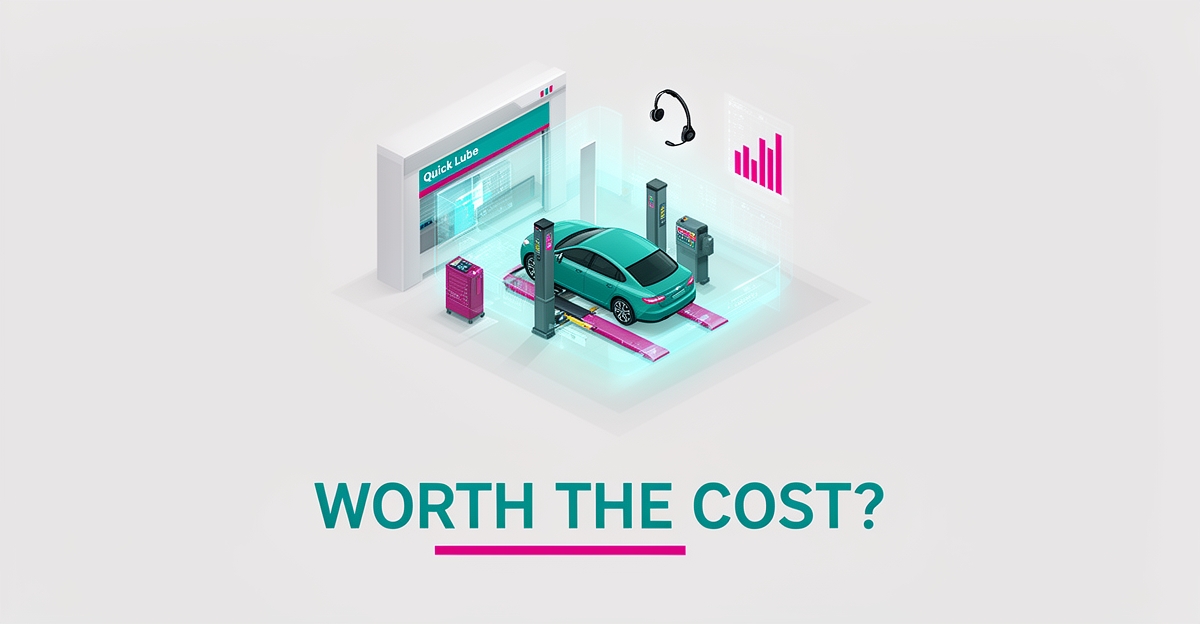
Is AI Worth It for Quick Lube Franchises? A Cost-Benefit Analysis
Key Facts
- Stonebriar Auto Services attributes $6,000 per location per month to AI handling inbound calls according to industry reporting
- Revmo AI handled 132,758 inbound calls across Stonebriar’s 128 Jiffy Lube locations in a documented case study
- PitCrew computer vision delivers a reported minimum 10% improvement in overall efficiency and speed per operator reports
- Atlantic Coast Enterprises planned a PitCrew rollout across 66 Jiffy Lube stores after a pilot per industry coverage
- AI phone answering typically costs a fraction of a full-time front-desk hire, making the ROI math straightforward for multi-location operators
Hire a team member that works 24/7 — for less than a part-time wage.
AI receptionists, SDRs, dispatchers and 99+ roles. Trained on your business, fully managed.
Not sure where to start? Ask our AI planner
The Hidden Cost of Missed Calls and Idle Bays
Every missed ring is a car that never pulls in. In quick lube, a single distracted technician or an unanswered phone call creates a cascade of idle bays, lost appointments, and revenue that walks to the competitor down the street.
Missed inbound calls are a direct revenue leak. Industry reporting on quick lube AI adoption documents a major franchisee attributing $6,000 per location per month to AI handling inbound calls, with 132,758 calls handled across the network. That is not a marginal gain; it is recovered demand that would have been lost after hours or during peak service rushes.
Technicians pulled off the floor to answer phones compound the problem. When staff leave bays to take calls, service timers stall and throughput drops. Shop-level case studies show conversational AI keeps technicians on the floor while ensuring 24/7 customer engagement, separating intake from service execution.
Bay utilization suffers from invisible downtime. Vehicles sit with no technician working, oil changes exceed target times, and managers lack real-time visibility. Computer vision systems that layer over existing security cameras automate timer start/stop and flag idle bays immediately. Field results cite a minimum 10% improvement in overall efficiency and speed as typical for shops using bay monitoring.
The pain points show up as three recurring operational gaps:
- Unanswered calls during peak service windows and after hours
- Manual timer tracking and delayed intervention on slow bays
- Technician distraction from revenue work to handle intake
Automation closes those gaps without new hardware. Solutions are designed to use current cameras and phone systems, turning passive infrastructure into smart operations. The result is faster appointment turnover, fewer missed opportunities, and measurable revenue recovery per location.
This is why a data-driven readiness view matters. AIQ Labs evaluates labor costs, appointment turnover, and service downtime to map high-impact automation first, rather than chasing technology for its own sake. An AI receptionist or dispatcher can absorb the intake workload at a fraction of the cost of another hire, while a targeted workflow build rebuilds the one process that costs you the most.
With the right fit, franchises stop losing revenue to missed calls and idle bays and start converting every inbound request into a completed service. Efficiency gains compound when AI handles repetitive intake and visibility tasks, freeing teams to do the work only people can do.
How AI Delivers Measurable ROI in Quick Lube Operations
Two technologies have moved from pilot programs to proven profit drivers in the quick lube sector: computer vision for bay monitoring and conversational AI for customer intake. Both solve the same core problem — technicians pulled off the floor for administrative tasks — but they attack it from opposite ends of the workflow.
Computer vision platforms like PitCrew by Leverege layer onto existing security cameras, turning passive feeds into active operational intelligence. The software automatically starts and stops service timers when vehicles enter and exit bays, flagging idle cars and jobs exceeding target times without any new hardware investment. Operators report a minimum 10% improvement in overall efficiency and speed once the system goes live. The platform processes video locally at the edge, sending only anonymized metrics to the cloud, which keeps privacy compliance simple while giving managers real-time visibility into bottlenecks that previously went unnoticed.
- Automated timer tracking eliminates manual stopwatch errors and frees technicians to stay under the hood
- Idle-vehicle alerts reduce bay downtime between appointments
- Vehicle-count reconciliation with invoices catches revenue leakage and potential theft
- No capital expenditure required — works with cameras already on the ceiling
On the customer-facing side, conversational AI agents handle inbound calls, texts, and emails around the clock. Stonebriar Auto Services, which operates 128 Jiffy Lube locations, attributed $6,000 per location per month in revenue directly to its AI call system after it processed over 132,000 calls. The AI books appointments, answers service questions, and routes complex issues to staff without pulling technicians away from revenue-generating work. Atlantic Coast Enterprises planned to roll the technology out across 66 stores following a successful pilot, signaling confidence in the model.
The common thread across both tools is integration over replacement. Neither requires ripping out POS systems, replacing camera networks, or retraining entire crews. They plug into what franchises already own and automate the repetitive, high-frequency tasks that drain labor hours. That architectural approach — layering intelligence onto existing infrastructure — is exactly how AIQ Labs structures engagements: identify the highest-leverage workflow, deploy a targeted AI employee or vision system, measure the lift, then scale. You can start monthly, build in milestones, or own the system outright — no long lock-ins, no inflated promises. The result is a measurable ROI path that starts in weeks, not quarters.
A Strategic, Low-Risk Path to AI Adoption
A low-risk AI rollout starts with outcomes, not tools. Quick lube franchises that anchor pilots to service time and revenue attribution avoid the common trap of buying technology for its own sake and instead prove value before scaling.
Begin by defining a clear business outcome tied to labor cost, appointment turnover, or service downtime. A strategic AI approach anchored to specific objectives such as revenue growth or cost reduction prevents fragmented efforts that generate activity without enterprise value.
Audit existing camera and phone systems next. Computer vision solutions like PitCrew are designed to layer over existing security cameras, turning passive cameras into smart cameras without new hardware. Industry coverage of quick lube AI notes this approach avoids high capital expenditure while enabling bay monitoring and timer automation.
Pilot one high-leverage use case in a single location. Options include AI phone answering to keep technicians on the floor or bay timing to flag services exceeding target times. Stonebriar Auto Services attributed $6,000 per location per month in revenue to AI handling inbound calls, with 132,758 calls handled across its network. Case studies in the sector report a minimum 10% improvement in overall efficiency and speed from computer vision monitoring.
Measure impact on service time and revenue attribution with disciplined data governance. Clean, governed, and accessible data is non-negotiable for success, and pilots should track call answer rates, average service duration, and attributed bookings. AIQ Labs starts every engagement with a 2-minute Fit Check that maps your current technology stack, data infrastructure, and team capabilities to high-ROI automation targets — so you know before spending anything whether AI is the right move for your locations.
Scale only after proven ROI, with change management built in. Staff need training and clear workflows for human-AI collaboration, and solutions must integrate seamlessly with existing POS and scheduling systems.
A practical franchise rollout framework includes:
- Identify business pain points such as missed calls, idle bays, or timer tracking errors before selecting tools
- Audit cameras and phone systems to confirm integration feasibility with minimal hardware spend
- Pilot AI phone answering or bay timing in one store and measure service time reduction and revenue attribution
- Refine workflows with staff feedback, then scale across the network with training and governance in place
This outcome-first, pilot-then-scale path reduces risk while building the data foundation and adoption habits required for sustainable transformation.
Still paying for 10+ subscriptions that don’t talk to each other?
We build custom AI systems you own outright. No vendor lock-in. Full control.
Not sure where to start? Ask our AI planner
Frequently Asked Questions
Is AI actually worth the investment for quick lube franchises?
Do I need to buy new cameras or hardware to use AI in my shop?
How does AI improve bay efficiency and service times?
Can AI really answer phones and book appointments effectively?
What's the best way to start implementing AI without disrupting operations?
How does AIQ Labs help franchises get started with AI?
Turning Missed Opportunities into Measurable Gains
The evidence is clear: AI isn’t just a futuristic add-on for quick lube franchises—it’s a practical solution to recover lost revenue from missed calls, idle bays, and technician distractions. By layering computer vision and conversational AI onto existing infrastructure, franchises can achieve immediate efficiency gains, with real-world results showing at least a 10% improvement in service speed and up to $6,000 per location monthly in attributed revenue from automated call handling. These aren’t theoretical benefits—they’re documented outcomes from pilots that paid for themselves in weeks. The path forward starts not with technology, but with a clear outcome: identify your biggest bottleneck, audit what you already own, and pilot one high-impact use case like AI phone answering or bay timing. Measure the lift, refine with your team, then scale. AIQ Labs helps franchises navigate this journey with a data-driven Fit Check and a tailored plan that ties every AI investment to measurable business results. Ready to see where your biggest opportunity lies? Start with a free strategy call to map your high-ROI automation targets—no obligation, just clarity. Book your free 30-minute strategy call and discover how AI can turn operational friction into your next competitive advantage.
Make AI your competitive advantage — not just another tool.
Strategy, implementation and ongoing optimization. One partner, end to end.
Not sure where to start? Ask our AI planner