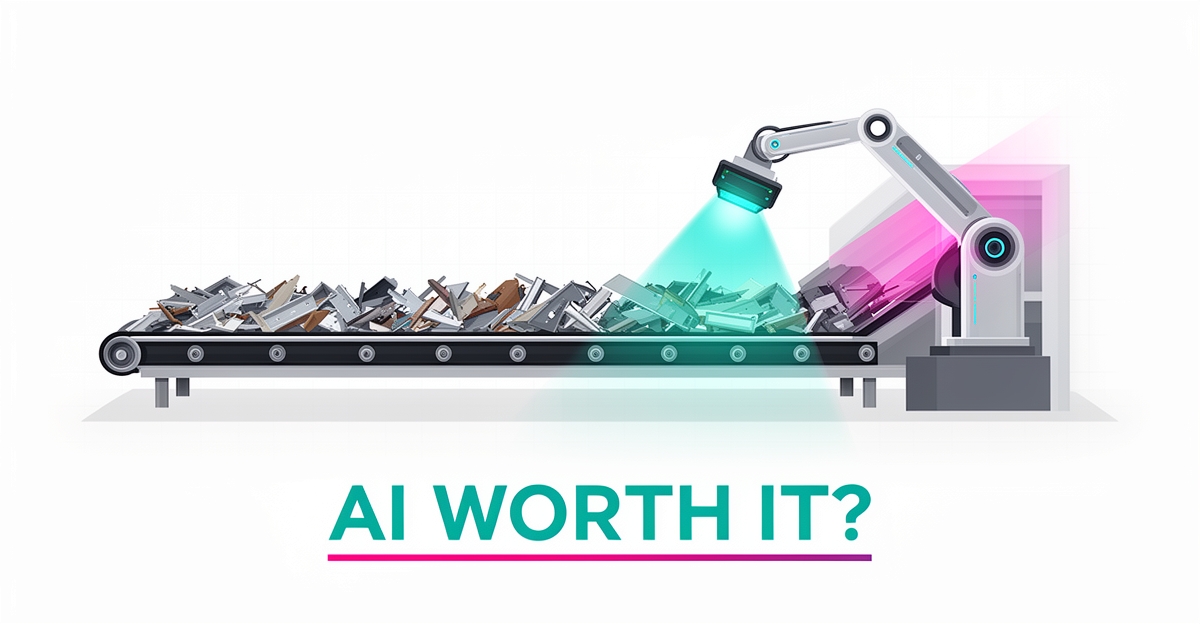
Is AI Worth It for Scrap Metal Recycling? A Cost-Benefit Breakdown for Small to Mid-Sized Operations
Key Facts
- AI systems can accurately process up to 160 items per minute, compared to human sorters typically managing 30–40 items per minute according to process automation research
- AI-guided LIBS and hyperspectral sorting have lifted recovery yields above 98% in documented deployments while reducing copper contamination below 0.1% per market analysis
- AI implementation has been associated with 15–20% improvements in processing capacity without additional equipment investments in facility case studies as documented in industry analyses
- AI-driven operational optimization has reduced energy costs by up to 30% in some facilities per operational benchmarks
- AI-powered robotic systems can perform up to 120 picks per minute with roughly 99% accuracy per industry analysis
- AI systems can maintain contamination rates below 2% in many applications per operational benchmarks
- The average copper content in obsolete scrap rose to roughly 0.35% as of 2025, exceeding the 0.2% threshold most long-product EAFs can tolerate per market analysis
Hire a team member that works 24/7 — for less than a part-time wage.
AI receptionists, SDRs, dispatchers and 99+ roles. Trained on your business, fully managed.
Not sure where to start? Ask our AI planner
The Labor and Efficiency Crisis in Scrap Metal Recycling
Scrap metal recyclers face a growing labor and efficiency crisis that directly threatens their bottom line. Human sorters are typically limited to processing 30–40 items per minute, creating a bottleneck that restricts throughput and increases operational costs. This slow pace makes it difficult for small to mid-sized facilities to keep up with incoming material volumes, especially during peak seasons.
The reliance on manual sorting also drives high error rates and contamination issues. Workers fatigue over long shifts, leading to misidentified metals and mixed batches that reduce recovery yields and trigger price penalties from buyers. AI systems, by contrast, can accurately process up to 160 items per minute with roughly 99% accuracy, dramatically improving both speed and precision in material separation.
- Human sorters typically manage 30–40 items per minute compared to AI's 160 items per minute
- AI systems achieve roughly 99% sorting accuracy in documented deployments, far exceeding human consistency
- Manual processes contribute to contamination rates that can exceed acceptable thresholds for premium scrap
These inefficiencies compound over time, eroding profitability and limiting scalability. Facilities stuck in manual workflows struggle to meet the rising demand for high-purity scrap from automotive and electronics manufacturers, who increasingly require certified low-residual materials with guaranteed chemistry. Without intervention, small to mid-sized recyclers risk losing market share to larger competitors equipped with automated sorting lines.
AIQ Labs helps operators assess where automation delivers the greatest impact, such as inbound sorting or inventory logging, without over-investing in unnecessary capabilities. That starts with a 2-minute Fit Check that maps high-value AI applications to specific pain points, so businesses target solutions that improve throughput, reduce labor dependency, and enhance material quality. This strategic approach ensures any AI adoption aligns with operational realities and long-term growth goals.
How AI Transforms Sorting Accuracy and Throughput
A single misidentified alloy can downgrade an entire shipment, and human sorters miss more than most yard owners realize. The gap between manual and machine sorting has widened to the point where it now defines who commands premium prices and who eats contamination penalties.
The throughput numbers tell the story. Human sorters typically manage 30–40 items per minute, while AI systems can accurately process up to 160 items in the same timeframe, a more than 4x advantage, according to process automation research. Robotic picking systems compound this, performing up to 120 picks per minute with roughly 99% accuracy.
Accuracy matters as much as speed. AI-guided Laser-Induced Breakdown Spectroscopy (LIBS) and hyperspectral sorting systems have lifted recovery yields above 98% while driving copper contamination below 0.1% in documented deployments, per a market analysis. That last figure is critical: average copper content in obsolete scrap rose to roughly 0.35% as of 2025, exceeding the 0.2% threshold most long-product electric arc furnaces can tolerate. Facilities that can't strip copper below spec are selling into a shrinking pool of buyers.
The technologies behind these results work in layers:
- Computer vision and machine learning identify and separate metals by their optical fingerprints, classifying by purity level, grade, and alloy composition.
- Hyperspectral and LIBS systems distinguish materials that look identical to the naked eye, aluminum foil versus cans, or 303 versus 304 stainless steel, each with different recycling values.
- Contaminant detection flags glass, wood, plastic, and hazardous items like batteries or aerosol containers before they damage equipment or trigger rejected shipments.
- Laser object detection catches non-metallic items that would otherwise contaminate the final product.
The commercial payoff is straightforward. Facilities implementing AI report higher recovery rates of valuable metals, fewer rejected shipments, and reduced processing costs. Contamination rates below 2% are now achievable in many applications, and AI-driven optical sorters can identify polymers, colors, and even specific brands with 95%+ purity, capabilities that support the certified low-residual scrap with guaranteed chemistry that automotive and electronics manufacturers increasingly demand.
For small to mid-sized operations, the practical question isn't whether these systems work, it's where they fit. Sorting hardware is only part of the picture; the same facility also needs accurate inventory logging and material tracking to capture the value AI sorting creates. A structured readiness assessment, like the one AIQ Labs uses to map high-impact automation targets, helps owners identify which workflows justify investment before committing capital.
Cleaner streams command higher prices. That's the core equation, and AI now sets the standard for what "clean" means.
Quantifying the ROI: Cost Savings vs. Investment Barriers
For small to mid-sized scrap metal recyclers, the financial equation of AI adoption hinges on balancing tangible operational gains against significant upfront and ongoing costs. AI systems can deliver measurable efficiency improvements, with industry analyses showing processing capacity gains of 15–20% without requiring new equipment investments. This throughput boost comes from faster, more accurate sorting, AI-powered systems can accurately process up to 160 items per minute, far exceeding the 30–40 items per minute typically managed by human sorters. Additionally, AI-driven optimization of energy use during peak and off-peak periods has reduced facility energy costs by up to 30% in some operations, directly impacting the bottom line.
However, these benefits are counterbalanced by substantial financial barriers. Initial deployment costs for full-scale AI sorting and tracking systems often range from hundreds of thousands to over a million dollars, depending on scale and complexity. Beyond the capital outlay, facilities must also budget for ongoing maintenance, with annual service contracts frequently exceeding $20,000. For smaller recyclers operating on thin margins, this combination of high entry costs and predictable recurring expenses can make full-scale AI adoption financially prohibitive without clear, near-term ROI.
The decision ultimately depends on an operation's scale, current labor costs, and ability to leverage AI for higher-value outputs. Facilities that process large volumes of mixed or contaminated scrap may see faster payback through improved recovery rates, AI-guided LIBS and hyperspectral sorting have lifted yields above 98% while reducing copper contamination below 0.1%, enabling premium pricing for cleaner output. Others might find greater value in targeting specific pain points, such as inbound material logging or inventory tracking, where AI can reduce manual labor without requiring full-scale sorting line overhauls. AIQ Labs helps recyclers model these trade-offs through a structured Fit Check, identifying where targeted automation, like AI Employees for administrative workflows or a Workflow Build for the one process that costs the most, can deliver meaningful efficiency gains without over-investing in infrastructure that may not align with current throughput or budget constraints. This strategic approach ensures AI adoption serves operational goals rather than becoming a costly, underutilized asset.
Practical AI Adoption Pathways for Small to Mid-Sized Recyclers
For small to mid-sized scrap metal recyclers, adopting AI doesn't require a full-scale overhaul to deliver value. Many operations see immediate efficiency gains by targeting specific pain points where manual processes create bottlenecks, such as inbound lead handling or inventory logging. Starting with a focused pilot allows recyclers to measure impact before expanding, reducing risk while building internal confidence in AI-driven workflows.
AIQ Labs' readiness assessment helps identify which areas will yield the highest return on investment based on current operations, data infrastructure, and team capacity. Rather than guessing where AI might help, this structured evaluation pinpoints high-impact opportunities, like automating lead qualification or streamlining material intake logs, so investments are directed where they matter most. Facilities using AI for sorting and classification have reported contamination rates below 2% and processing speeds up to 160 items per minute, far exceeding the 30–40 items per minute typically managed by human sorters according to industry analysis and supported by operational benchmarks.
AIQ Labs offers three entry points sized to different budgets. AI Employees are managed AI staff, receptionists, SDRs, dispatchers, and 99+ other roles, that run administrative workflows at roughly 80% less cost than a human hire, billed monthly so you can start small. A Workflow Build rebuilds the one workflow that costs the most, say, inbound material logging, at a fixed price and in phases, so you pay only for completed milestones and keep everything built so far. And when you're ready to connect everything, an AI Operating System builds one connected operating layer across the business, phased over time and owned outright. By starting small, operations can achieve measurable improvements, like the 15–20% processing capacity gains documented in facility case studies, while avoiding large upfront costs. Over time, these incremental wins compound, creating a scalable path toward broader AI integration that aligns with budget, capacity, and strategic goals.
Still paying for 10+ subscriptions that don’t talk to each other?
We build custom AI systems you own outright. No vendor lock-in. Full control.
Not sure where to start? Ask our AI planner
Frequently Asked Questions
How much faster can AI sort scrap metal compared to human workers?
What accuracy rate do AI sorting systems achieve in scrap metal recycling?
Can AI help reduce contamination in recycled metal streams?
What are the main financial barriers to adopting AI in small to mid-sized scrap recycling operations?
Is there a way to adopt AI without a full system overhaul for smaller recycling facilities?
What ROI benefits can scrap recyclers expect from AI implementation?
Turning Scrap into Strategy: Your Next Competitive Edge
The numbers are clear: AI-powered sorting transforms what's possible in scrap metal recycling, boosting throughput from 30–40 items per minute with human sorters to up to 160 items per minute with roughly 99% accuracy, driving recovery yields above 98% and cutting copper contamination below 0.1% in documented deployments. For small to mid-sized recyclers, the real value isn't in overhauling everything at once, but in targeting high-impact areas like inbound sorting or inventory tracking where AI delivers measurable gains without excessive investment. AIQ Labs helps operators pinpoint exactly where automation creates the most value, starting with a 2-minute Fit Check, then a free 30-minute strategy call to map your biggest opportunities. With 200+ multi-agent systems deployed and four live SaaS products running daily, the approach is proven: start monthly, build in milestones, and own what you build outright. If you're ready to see whether there's a clear win for your operation, book the call and find out.
Make AI your competitive advantage — not just another tool.
Strategy, implementation and ongoing optimization. One partner, end to end.
Not sure where to start? Ask our AI planner