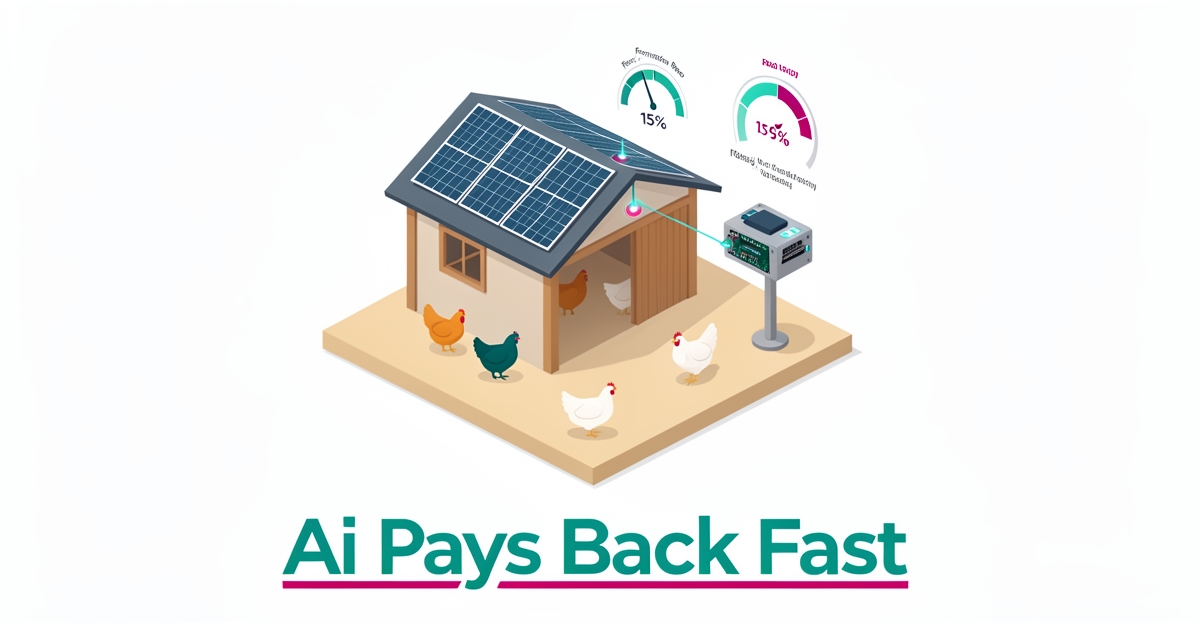
Is AI Worth It for Small Poultry Farms? A Cost-Effective Breakdown
Key Facts
- AI-powered egg counting has reached near-perfect accuracy on low-cost edge hardware like a Raspberry Pi 5 in field trials.
- Machine learning has been reported to improve feed conversion ratio by up to 15% in poultry operations according to case studies.
- Mortality reductions of up to 23% in early growth stages have been reported with AI monitoring from real-world deployments.
- A conservatively run pilot can pay back in 6–18 months via lower mortality and labor per industry analysis.
- Industry guidance recommends a 6–8 week pilot in one house to tune alerts before scaling AI.
- Without AI, investigating an 8% feed intake drop can take hours or even days on small farms.
- Forecasting models can predict egg yield and feed consumption up to 10 days in advance with PoultryFI.
Hire a team member that works 24/7 — for less than a part-time wage.
AI receptionists, SDRs, dispatchers and 99+ roles. Trained on your business, fully managed.
Not sure where to start? Ask our AI planner
The Small Farm AI Dilemma: Data Overload, Tight Margins, and Manual Labor
The reality for many small poultry farms is stark: timing is everything, yet critical data arrives too late to act on. Feed intake, mortality rates, and environmental conditions are tracked manually, often requiring hours of daily labor just to compile basic reports. By the time trends are spotted, the window for intervention has closed, and thin margins leave no room for error. Without AI, investigating a performance issue like an 8% drop in feed intake can take hours or even days, during which bird health and profitability deteriorate. This delay isn't just inefficient—it directly impacts survival rates and feed conversion, two levers small farms cannot afford to mismanage.
Labor shortages compound the problem. Skilled workers are scarce, and existing staff are stretched thin across feeding, cleaning, and bird health checks—tasks that demand constant attention but offer little time for data analysis. Manual monitoring means farmers react to crises instead of preventing them, relying on observation rather than insight. As one industry source notes, Early alerts save both birds and margins, but only if they arrive in time. For farms operating on tight budgets, the fear isn't just about cost—it's about whether AI solutions, often designed for large-scale integrations, can deliver value without requiring a complete overhaul of existing workflows or hiring specialized IT staff.
- Manual data analysis slows decision-making, turning preventive action into damage control.
- Labor-intensive checks divert skilled workers from higher-value animal care tasks.
- Delayed insights increase vulnerability to feed waste, disease spread, and mortality spikes.
- Small farms need AI that fits their scale—not enterprise systems demanding six-figure investments.
- Trust in AI depends on reliable, actionable alerts—not noise that overwhelms already-stretched teams.
AIQ Labs understands this tension. Our approach starts with assessing what data already exists on the farm—feed logs, environmental sensors, mortality records—and builds lightweight AI layers that analyze it in real time, turning delayed reports into immediate, actionable insights. This isn't about replacing farmers with machines; it's about giving them back the time to do what they do best: care for their flock. By focusing on readiness, not replacement, we help small operations determine if AI is a fit—before any significant investment is made. Start with our free [Fit Check](/apply) to see where automation would pay off first.
What AI Actually Does on a Poultry Farm (No Robots Required)
AI isn't about replacing farmhands with robots—it's about turning the data you already collect into faster, smarter decisions. For small poultry farms, this means using computer vision to monitor flock behavior, machine learning to optimize feed, and predictive alerts to catch health issues before they spread. These tools work quietly in the background, giving you insights that used to take hours or days to uncover manually.
A recent study found that without AI, investigating a drop in feed intake could take hours or even days—time during which a small issue can escalate into a costly outbreak. With AI, that same analysis happens in real time, allowing managers to link symptoms like reduced movement or changes in posture to potential stressors such as heat or nutritional imbalances. This "first level of assessment" doesn't replace veterinary care but enables quicker, more targeted responses that protect flock health and productivity.
Low-cost applications are already delivering measurable results. Field trials show that AI-powered egg counting achieved 100% accuracy using affordable hardware like a Raspberry Pi 5, proving that advanced monitoring doesn't require expensive infrastructure. Meanwhile, case studies report machine learning models improving feed conversion ratio by up to 15% and reducing mortality by up to 23% in early growth stages—directly impacting both efficiency and profitability.
- Computer vision tracks feeding patterns, movement, and social behavior to detect early signs of distress.
- Feed optimization algorithms adjust rations based on real-time consumption and growth data.
- Predictive analytics forecast disease risk and environmental needs up to 10 days in advance.
- Audio-visual monitoring combines video and audio cues for deeper welfare insights.
- Automated egg counting eliminates manual checks while improving inventory accuracy.
These systems aren't about futuristic automation—they're about making your existing observations actionable. By starting with a focused pilot in one house, small farms can validate alerts, refine thresholds, and build confidence before scaling. The goal isn't to replace your expertise but to amplify it, giving you the speed and clarity needed to protect your birds and your bottom line. AIQ Labs helps farms navigate this transition with practical, owned solutions designed for real-world constraints—not hype.
The Real Costs and ROI: From DIY Sensors to Managed Systems
The sticker shock of enterprise AI platforms often stops small poultry farms before they start, but the investment spectrum is wider than most realize. A DIY computer vision setup using open-source models and off-the-shelf cameras can cost a fraction of integrated platforms, while IoT sensors for microclimate monitoring offer another low-barrier entry point. According to industry analysis, a conservatively run pilot in a single house can pay back in 6–18 months through lower mortality, improved feed conversion, and reduced labor hours. The key is matching the tool to the bottleneck rather than buying a suite and hoping it fits.
- DIY camera systems with TensorFlow or PyTorch models for behavior tracking and early illness detection
- IoT sensors (temperature, humidity, ammonia) for environmental optimization and ventilation control
- Audio-visual monitoring platforms that analyze flock vocalizations and activity patterns for welfare alerts
- Integrated platforms combining egg counting, forecasting, and recommendation engines on edge hardware
Research from the PoultryFI platform demonstrates that even low-cost hardware like a Raspberry Pi 5 can achieve 100% egg-count accuracy using edge vision models, proving that enterprise-grade results don't require enterprise-grade budgets. Meanwhile, case studies report machine learning improving feed conversion ratio by up to 15% and reducing mortality by as much as 23% in early deployment. These gains compound quickly on farms where feed represents 60–70% of operating costs.
The smartest approach mirrors what AIQ Labs recommends for any SMB: start with a targeted assessment to identify the highest-ROI workflow, run a 6–8 week pilot to tune thresholds and build staff trust, then scale based on measured outcomes. Farms that treat AI as a series of focused workflow fixes — not a blanket technology purchase — consistently reach payback faster and avoid the "pilot purgatory" that stalls so many ag-tech initiatives. Our [Workflow Builds](/workflow-builds) service is built exactly for this: rebuild the one workflow that costs the most, at a fixed price, in phases.
A Practical Implementation Path: Starting Small and Scaling Smart
Starting small is the smartest way to test AI on a poultry farm without overcommitting resources. A focused 6–8 week pilot in a single house allows farmers to validate the technology, tune alert systems, and build confidence among staff before expanding. Industry guidance emphasizes this phased approach as critical for reducing false positives and ensuring alerts are actionable, not overwhelming.
During the pilot, data hygiene becomes foundational—tagging events, maintaining incident logs, and mapping sensor IDs to specific locations ensures the system learns accurately and supports compliance needs. Farm operators note that reliable data collection is the backbone of any effective AI system, especially in environments where manual entry is impractical due to heat, dust, or time constraints. Voice-enabled tools help overcome this by allowing hands-free data input, improving accuracy and adoption among workers.
To avoid alert fatigue, thresholds should be refined iteratively using real-world observations from the pilot phase. Combining vision-based monitoring with environmental sensors—such as temperature and humidity feeds—provides richer context and reduces reliance on any single data stream. Best practices show that farms using fused data streams see fewer false alarms and faster response times to genuine issues like feed disruption or early signs of distress.
Offline capability is non-negotiable for poultry sheds, where internet connectivity can be spotty or nonexistent. Tools that store data locally and sync when connectivity returns ensure no insights are lost, keeping the system dependable regardless of infrastructure limits. This resilience, paired with intuitive voice interfaces, makes AI accessible even for teams with limited technical experience.
After validating the pilot—measured through reduced mortality, better feed conversion, or saved labor hours—farmers can scale with confidence. Conservative estimates suggest a well-run pilot can pay back in 6–18 months through these efficiencies. AIQ Labs supports this journey with tailored systems designed for low-bandwidth environments and gradual rollout, ensuring technology adapts to the farm—not the other way around.
How AIQ Labs Builds Cost-Effective AI for Small Farms
Small poultry farms don't need enterprise-scale platforms to see measurable returns from AI. The right fit is a focused workflow that pays for itself through lower mortality, better feed use, and fewer manual checks.
Research on cost-effective poultry AI shows that value comes from targeted monitoring, not blanket automation. A modular AI platform designed for small and medium farms can integrate multiple AI-powered modules for welfare and productivity while prioritizing non-invasive, flock-level monitoring rather than individual bird tracking. Field trials demonstrate near-perfect egg-count accuracy on low-cost hardware like Raspberry Pi 5, with robust anomaly detection and reliable short-term forecasting. The same system predicts egg yield and feed consumption up to 10 days in advance and uses an optimizer to maximize camera coverage with minimal hardware.
For small operations, implementation discipline matters more than technology spend. A conservatively run pilot can pay back in 6–18 months through lower mortality rates, improved feed conversion, and reduced labor hours. Guidance for small farms recommends starting small with a 6–8 week pilot in one house to fine-tune alerts and reduce false positives. Early alerts save both birds and margins, and AI combines computer vision, machine learning, and IoT sensors to turn streams of data into timely actions around feed, ventilation, and disease detection.
That is where a no-blanket approach becomes practical for limited budgets. Instead of a one-size-fits-all suite, AIQ Labs designs low-cost, high-impact systems mapped to a farm's specific bottleneck. We've deployed 200+ multi-agent systems and run four live SaaS products daily, so we build what we use ourselves.
A tailored approach typically focuses on:
- A single high-ROI workflow fix, such as automated egg counting or feed intake monitoring, rebuilt as a custom solution the farm owns outright.
- A managed [AI Employee](/ai-employees) for repetitive coordination tasks—scheduling, supplier follow-ups, record-keeping—delivered on a flat monthly plan that typically costs around 80% less than a human hire.
- A low-risk [Fit Check](/apply) to identify the highest-return automation opportunity before any build begins.
The Start Monthly model supports this by covering build, training on your business, tool integrations, monitoring, and improvements in a flat monthly plan you can pause or adjust anytime. Prefer to pay as milestones complete, or own the system outright? We offer Build in Milestones and Own It Outright as well. It mirrors the pilot-first advice in the research: prove value in one house, measure outcomes, and iterate.
AI's primary practical benefit for poultry is not futuristic robots but the ability to rapidly analyze existing farm data and generate actionable insights. Without AI, investigating a performance issue can take hours or even days, by which time the production cycle has moved on. With the right system, managers can ask plain-language questions and instantly cross-reference historical data, environmental conditions, and breed performance to find root causes.
By pairing research-backed pilot practices with tailored AI architecture and clear ownership, small farms can access enterprise-grade capabilities at SMB-appropriate investment levels—without committing to a full [AI Operating System](/ai-operating-systems) on day one.
Still paying for 10+ subscriptions that don’t talk to each other?
We build custom AI systems you own outright. No vendor lock-in. Full control.
Not sure where to start? Ask our AI planner
Frequently Asked Questions
Is AI actually worth it for a small poultry farm with tight margins?
How much does AI cost to start on a small farm?
What does AI actually do on a poultry farm — do I need robots?
Can AI really improve feed conversion and mortality?
What's the smartest way to test AI without overcommitting?
Will my team need special IT skills to use it?
Turning Data Into Decisions: Your Next Step Forward
Small poultry farms don't need enterprise-scale AI to see real returns—what they need is a focused, practical approach that turns existing data into faster, smarter decisions. As we've seen, even lightweight systems using affordable hardware like a Raspberry Pi 5 can deliver near-perfect egg-count accuracy, improve feed conversion by up to 15%, and reduce mortality by up to 23%, directly impacting profitability where it matters most. The path forward isn't about overhauling your farm—it's about starting small with a 6–8 week pilot in one house, validating results, and scaling only what works. AIQ Labs helps SMBs navigate this journey with tailored solutions built for real-world constraints, not hype. If you're ready to explore whether AI is a fit for your operation—without commitment or complexity—take the first step with our free [Fit Check](/apply) and 30-minute strategy call to identify your highest-ROI opportunity.
Make AI your competitive advantage — not just another tool.
Strategy, implementation and ongoing optimization. One partner, end to end.
Not sure where to start? Ask our AI planner