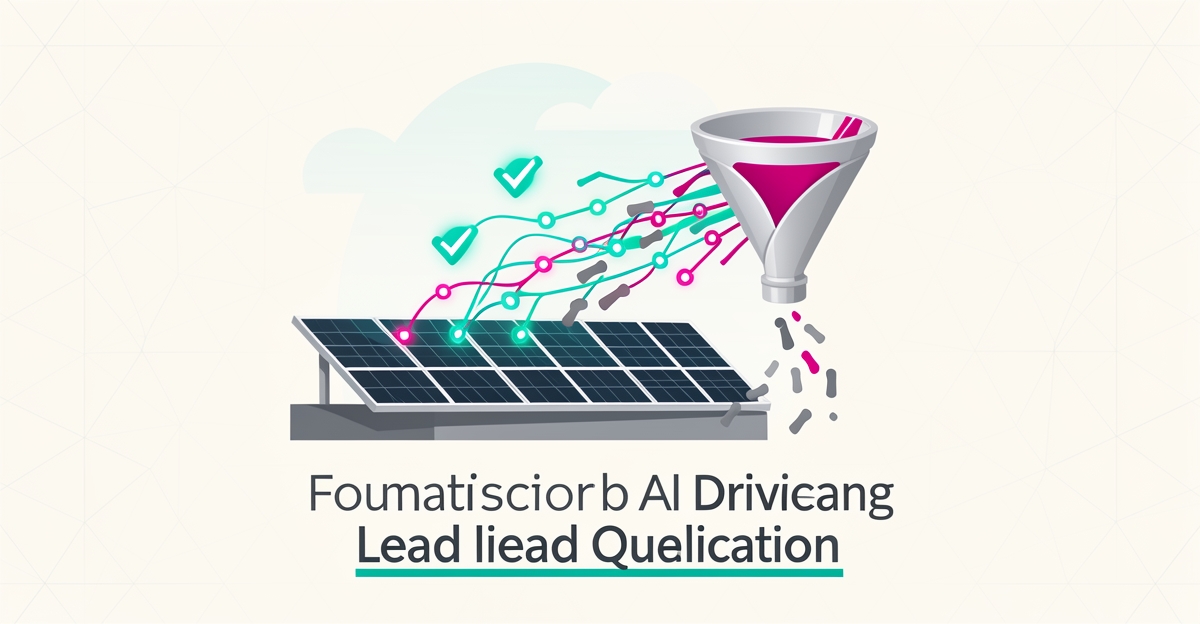
Is AI Worth It for Solar Installers? A ROI Breakdown of AI-Driven Lead Qualification
Key Facts
- Rising energy costs continue to drive strong consumer interest in solar, pushing lead volume up while conversion rates lag.
- A large share of initial solar inquiries, often the majority, lack viable installation potential, wasting installer resources.
- AI-driven lead qualification typically increases sales productivity by automating scoring, enrichment, and prioritization.
- Teams that prioritize high-intent leads typically see fewer wasted field visits and lower cost per qualified lead.
- AI Employees from AIQ Labs cost roughly 80% less than a comparable human hire and work 24/7/365.
- As of late 2026, millions of US homes already have solar systems, creating massive lead qualification challenges at scale.
- Panel efficiency keeps climbing in advanced cell technologies, raising the stakes for qualified leads.
Hire a team member that works 24/7 — for less than a part-time wage.
AI receptionists, SDRs, dispatchers and 99+ roles. Trained on your business, fully managed.
Not sure where to start? Ask our AI planner
The Solar Lead Waste Problem Costing Installers Revenue
Solar installers are facing a growing paradox: energy cost concerns keep driving consumer interest, yet conversion rates remain stubbornly low. Lead volume is surging, but most inquiries never translate into installations. This mismatch creates a costly inefficiency where sales teams spend hours chasing unqualified prospects instead of closing real opportunities.
The root of the problem lies in manual lead qualification processes that simply can't keep pace with scale. As solar adoption continues to climb across millions of existing US systems, installers drown in low-intent leads while high-value opportunities slip through the cracks. Field technicians waste precious hours driving to sites where homeowners lack suitable roofs, financing readiness, or genuine purchase intent, turning what should be revenue-generating visits into sunk costs.
Traditional lead scoring methods fail because they rely on static rules and incomplete data, not predictive intelligence. Sales teams end up prioritizing leads based on superficial criteria like form completion speed or basic demographics, missing behavioral signals that indicate true readiness to buy. This qualification bottleneck doesn't just waste time, it actively erodes profitability by increasing customer acquisition costs and reducing the efficiency of every sales rep and installer on the team. Without a smarter way to filter leads at scale, solar businesses leave money on the table with every unproductive field visit.
- Field visits to unqualified leads commonly consume a large share of installer teams' weekly capacity
- Manual qualification typically adds days to the average sales cycle
- A majority of initial solar inquiries often lack viable installation potential
How AI-Driven Lead Qualification Changes the Economics
Solar installers face a growing challenge: lead volume is rising, but conversion rates aren't keeping pace. Traditional qualification methods rely on manual scoring and gut instinct, leading to inconsistent follow-up and missed opportunities. AI-driven lead qualification changes this dynamic by applying predictive models to identify high-intent prospects before a single field visit is scheduled. The typical result: higher sales productivity and stronger close rates on qualified leads. The shift isn't just about working faster, it's about working smarter by directing human effort where it delivers the highest return.
The economics of AI lead qualification become clear when comparing outcomes. Teams using AI scoring typically see a meaningful reduction in cost per lead through automated enrichment and prioritization, while eliminating a substantial share of wasted field visits on low-intent prospects. These efficiency gains translate directly to revenue uplift: installers who prioritize high-intent leads see higher conversion rates and shorter sales cycles. As AI adoption in solar continues to increase, more companies are investing in lead qualification systems to combat rising customer acquisition costs. And as panel efficiencies keep climbing in advanced cell technologies, the marginal value of each qualified lead grows, making precise targeting even more critical.
AI-driven qualification doesn't replace human judgment, it augments it by surfacing patterns in behavioral and demographic data that manual review misses. The result is a leaner, more profitable sales process where installers spend less time chasing dead ends and more time closing deals. For businesses evaluating AI, the ROI isn't theoretical; it's measured in reduced labor costs, higher revenue per lead, and a scalable system that improves with every interaction. As solar markets mature and competition intensifies, the installers who qualify leads with AI won't just save money, they'll capture a larger share of the available demand.
ROI Metrics Solar Installers Should Track Before and After AI
You can't manage what you don't measure, and AI-driven lead qualification is no exception. Before investing in any AI system, solar installers need a clear baseline of current performance metrics to accurately gauge ROI after implementation.
The most critical metric is wasted field visits. Every time a sales rep drives to an unqualified lead, you're burning labor costs, vehicle expenses, and opportunity cost. AI systems that prioritize high-intent prospects can dramatically reduce these fruitless trips, which directly translates to fewer wasted site evaluations.
Sales productivity lift is another key performance indicator. When AI handles initial lead qualification and scoring, your sales team spends more time on high-value activities like consultations and closing deals. AI can automate routine tasks, freeing up human resources for more complex and high-value work. This shift doesn't just improve morale, it directly impacts your bottom line.
Close rates on qualified leads reveal whether your AI system is actually identifying the right prospects. Track the percentage of AI-qualified leads that convert to signed contracts compared to your historical baseline. If your close rate on AI-qualified leads isn't significantly higher than your previous average, the system needs recalibration.
Labor savings extend beyond the sales team. AI can reduce the administrative burden of manual lead scoring, data entry, and follow-up scheduling. Calculate the hours your team currently spends on these tasks weekly, then measure the reduction after AI implementation. These recovered hours represent real cost savings or capacity for revenue-generating activities.
Response time to new leads matters enormously in solar sales. AI systems can engage prospects instantly, qualifying them while your competition is still reviewing their inbox. Track your average response time before and after AI deployment. Faster response times typically correlate with higher conversion rates.
Here's a practical framework for measuring ROI:
- Cost per qualified lead: Total lead generation and qualification costs divided by qualified leads delivered
- Field visit efficiency: Percentage of site visits that result in proposals or contracts
- Sales cycle length: Days from first contact to signed contract for AI-qualified versus traditional leads
- Revenue per sales rep: Total closed revenue divided by number of sales team members
The implementation costs require honest accounting. Beyond the AI system itself, factor in training time, integration with your existing CRM, and the learning curve period. AI implementation typically requires investment in software, integration, and training. These upfront costs are real, but they're one-time or periodic expenses, while the efficiency gains compound monthly. AIQ Labs offers flexible payment models, [Start Monthly, Build in Milestones, or Own It Outright](/pricing), so the investment structure can match your cash flow instead of working against it.
Data quality directly impacts AI performance. AI requires high-quality data to function effectively. If your historical lead data is incomplete or inconsistent, your AI system will struggle to identify patterns accurately. Budget time for data cleanup before expecting optimal AI performance.
Monitor these metrics monthly for the first quarter after implementation, then quarterly thereafter. The goal isn't perfection, it's measurable improvement in efficiency, cost reduction, and revenue growth that justifies the investment.
Implementation Roadmap for AI Lead Qualification in Solar
Moving from evaluation to execution requires a structured approach that accounts for the unique data landscape of solar sales. AI requires high-quality data to function effectively, which can be a challenge in an industry where lead information is often fragmented across marketing platforms, CRM entries, and field notes. Before any model can prioritize high-intent prospects, installers must audit their existing records for accuracy, completeness, and consistency. This foundational step determines whether the system reduces wasted field visits or simply automates existing inefficiencies.
- Audit lead data sources for completeness and standardization
- Define clear qualification criteria tied to historical close rates
- Train sales and operations staff on AI-augmented workflows
- Deploy AI-driven prioritization to surface high-intent leads first
- Establish weekly performance reviews with conversion feedback loops
Implementation costs and cybersecurity risks represent the two most cited barriers to adoption. Significant upfront investment in software, integration, and training is typically required, and AI systems handling customer data need proper safeguards to protect data integrity. A phased rollout, starting with a single workflow like inbound lead scoring, contains both cost and risk exposure. That's exactly how AIQ Labs approaches it: [AI Workflow Builds](/workflow-builds) rebuild the one workflow that costs you the most, at a fixed price and in phases. For teams that want managed staff rather than a build, [AI Employees](/ai-employees) handle inbound qualification, follow-up, and scheduling around the clock, integrating directly with existing CRMs and scheduling tools, no internal engineering resources required, with full data ownership.
Continuous monitoring closes the loop. Companies achieving the strongest returns treat implementation as an ongoing discipline, not a one-time project. Weekly calibration using actual field outcomes, booked appointments, site visit conversions, signed contracts, keeps the model aligned with market reality. When the feedback loop breaks, so does the ROI. Installers who want qualification connected to every downstream process can graduate to a full [AI Operating System](/ai-operating-systems): one connected operating layer, built in phases, owned outright.
Still paying for 10+ subscriptions that don’t talk to each other?
We build custom AI systems you own outright. No vendor lock-in. Full control.
Not sure where to start? Ask our AI planner
Frequently Asked Questions
Is there really enough demand to justify AI lead qualification for solar?
Will AI replace my sales team or just help them?
What's the biggest risk before implementing AI lead scoring?
Is AI implementation too expensive for a small installer?
How do I measure ROI after switching to AI qualification?
Can AI keep up as solar adoption scales?
From Lead Waste to Installation Revenue
Solar installers are sitting on a clear ROI opportunity: stop burning capacity on low-intent inquiries and focus sales and field teams where conversion is real. AI-driven lead qualification replaces manual scoring and gut instinct with predictive, real-time prioritization that cuts wasted site visits, shortens sales cycles, and lifts revenue per rep. The economics hold up when you track the right metrics, cost per qualified lead, field visit efficiency, close rates on AI-qualified prospects, and sales cycle length, before and after implementation. Success hinges on clean data, clear qualification criteria tied to historical closes, and a phased rollout with continuous feedback from actual field outcomes. Demand will keep growing as energy costs stay top of mind; the winners will be the installers who qualify smarter. AIQ Labs has deployed 200+ multi-agent systems and runs four live SaaS products daily, helping teams implement AI-driven qualification that integrates with existing CRMs and scheduling tools, with ownership of the build. Start the 2-minute Fit Check at https://aiqlabs.ai/apply for a free 30-minute strategy call to map your biggest bottleneck and identify high-ROI automation opportunities.
Make AI your competitive advantage — not just another tool.
Strategy, implementation and ongoing optimization. One partner, end to end.
Not sure where to start? Ask our AI planner