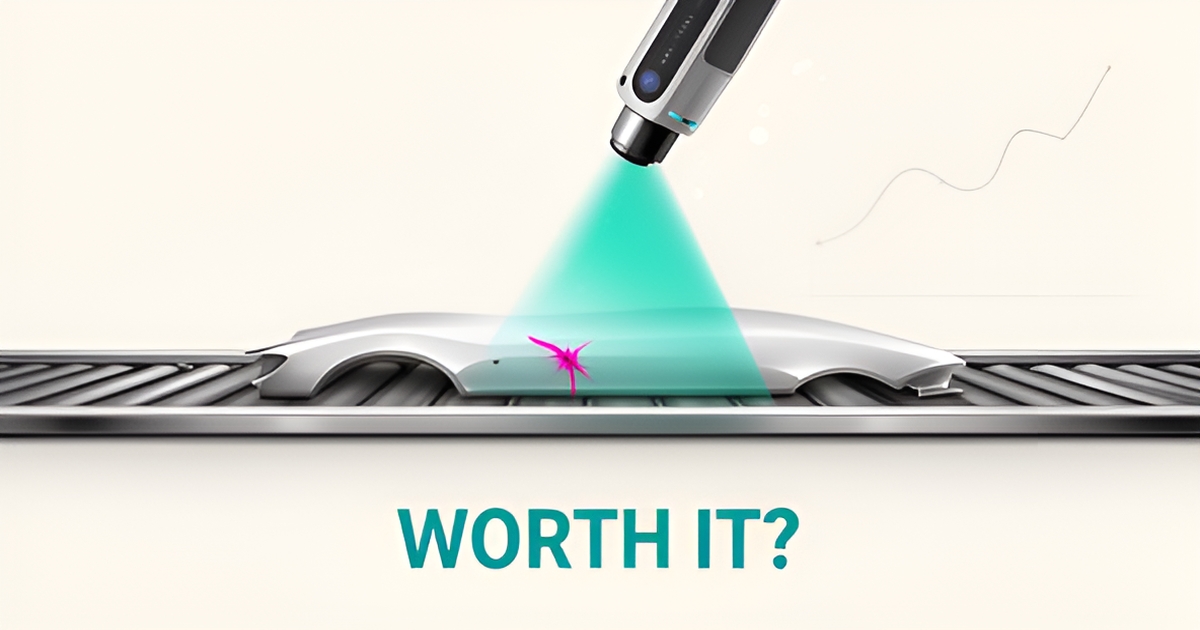
Is AI Worth It for State Inspection Stations? A Cost-Benefit Analysis
Key Facts
- AI vision systems are widely reported to outperform human inspectors on repetitive surface-defect detection, though exact accuracy figures vary by deployment—always validate against your own baseline.
- The economics hinge on volume: AI inspection generally becomes cost-effective once daily throughput is high enough to offset upfront deployment costs.
- Human inspectors typically miss a meaningful share of defects under normal production conditions due to fatigue and variability—commonly cited in the 20–30% range in industry research.
- Manual inspection usually relies on sampling; AI enables 100% inline inspection of every unit produced.
- Human inspector performance declines over a shift due to fatigue, while AI maintains consistent output across shifts.
Hire a team member that works 24/7 — for less than a part-time wage.
AI receptionists, SDRs, dispatchers and 99+ roles. Trained on your business, fully managed.
Not sure where to start? Ask our AI planner
The Financial Case: Labor Cost Reduction and Defect Elimination
When a state inspection station evaluates AI, the conversation usually starts with technology—but it should start with arithmetic. The real question isn't whether AI vision systems work; it's whether the cost of not having them exceeds the investment required to deploy them.
Start by totaling what manual inspection actually costs your station. Inspector labor is the obvious line item: salaries, benefits, training, and the management overhead that comes with a team. But the hidden cost is escaped defects—problems that slip through and come back as rework, customer disputes, warranty exposure, and in a regulated inspection context, potential liability. Industry case studies of AI-assisted inspection commonly report total annual savings in the hundreds of thousands of dollars for high-volume operations, but the honest answer is that your number depends entirely on your labor baseline, your defect rate, and your throughput.
The savings break down into distinct drivers:
- Labor cost reduction: Repetitive visual inspection tasks shift from human hours to software, letting you redeploy or reduce headcount.
- Defect elimination: Fewer escaped defects means less rework, fewer disputes, and lower liability exposure.
- Throughput gains: AI inspects each unit in seconds rather than tens of seconds, enabling 100% inline inspection instead of sampling.
- Consistency: AI eliminates the performance drop human inspectors experience over a shift and the drift between inspectors.
The defect elimination driver deserves particular attention for state inspection stations, where a missed defect doesn't just trigger a warranty claim—it can create liability exposure and regulatory consequences. Human inspection under normal conditions is well documented to miss a meaningful share of defects—industry research commonly cites 20–30%—due to fatigue, lighting, and inconsistency between inspectors. AI systems, by contrast, can be tuned to catch surface defects that are difficult to see under production conditions.
It's worth noting that the upfront investment is real. Deployment costs for AI inspection systems vary widely depending on camera hardware, integration complexity, and site conditions, which is why the economics favor high-volume operations. Below a certain throughput threshold, the investment typically can't be recovered through labor savings alone—well within range for busy stations, out of reach for small ones.
Building a credible business case requires more than plugging generic industry figures into a spreadsheet. AIQ Labs approaches this through [AI Workflow Builds](/workflow-builds): we identify the single workflow that costs your station the most, model the ROI against your actual labor baselines, defect rates, and volumes, and rebuild it on a fixed price, in phases—so the payback projection reflects your station's real economics, not an industry average.
Performance Superiority: Accuracy, Speed, and Consistency Gains
State inspection stations live or die on throughput and defect escape risk, and manual inspection is hitting its limits under rising volume and compliance pressure.
AI vision systems deliver measurable gains across the three metrics that matter most to operations. On repetitive surface-defect detection—paint flaws, scratches, texture inconsistencies—deployed AI systems are consistently reported to outperform human inspectors, catching a meaningfully higher share of defects before they escape. Exact accuracy figures vary by deployment and defect class, so treat vendor claims as a starting point and validate against your own baseline.
Speed compounds the advantage. AI inspects a unit in seconds rather than the tens of seconds a manual check requires, keeping lines moving without adding headcount.
Consistency is where human variability becomes expensive. Individual inspectors disagree on defect calls—sometimes substantially—and performance declines over a shift due to fatigue. AI maintains consistent output across shifts, eliminating inter-inspector disagreement and shift-to-shift drift.
Coverage shifts from sampling to certainty. Manual programs typically inspect only a fraction of units due to time constraints. AI enables 100% inline inspection of every unit, closing the gap that statistical sampling leaves open.
The practical gains show up in daily operations:
- Detection of small surface defects that are hard to see under production lighting
- Stable throughput per unit with no fatigue-related decline
- Elimination of inter-inspector disagreement and shift-to-shift drift
For stations evaluating ROI, these performance shifts translate directly into labor reduction and compliance risk mitigation. AIQ Labs quantifies savings from reduced labor costs, fewer escaped defects, and faster turnaround as part of a structured workflow rebuild—no invented numbers, just your data.
The hybrid reality remains important. AI excels at high-volume, repetitive detection while humans retain value for novel defect types, subjective aesthetic judgments, and physically inaccessible areas. That balance is central to a sound business case.
Performance superiority is not theoretical. It is measured in accuracy, speed, and consistency gains that manual inspection cannot sustain at scale.
When to Keep Humans: The Hybrid Model for Complex Judgments
For state inspection stations, the decision to retain human inspectors isn't about resisting technology—it's about recognizing where human judgment still delivers irreplaceable value. While AI excels at speed and consistency, certain inspection scenarios demand the nuanced adaptability that only humans can provide, particularly when defects are unprecedented or assessments require subjective interpretation.
Human inspectors remain essential for detecting novel defect types. A person can adapt to a new flaw within hours of exposure, whereas AI systems typically require hundreds to thousands of annotated examples per defect class and a retraining cycle to achieve comparable accuracy. That immediacy matters during new product launches or process changes, where waiting for a model update could allow defective units to pass undetected. Subjective quality assessments—such as evaluating color matching across dissimilar materials, or interpreting design intent for surface finishes—also rely on contextual understanding that current AI struggles to codify reliably. And physically inaccessible areas, including engine block interiors, fuel tank cavities, and wiring inside sealed housings, still require manual methods like borescopes or tactile inspection, since AI cameras need an unobstructed line of sight to function effectively.
These limitations define the practical boundary for AI adoption, creating a volume threshold where automation becomes economically viable. For stations processing low daily volumes, the upfront investment in AI systems typically can't be justified by labor savings alone. Beyond that threshold, however, the speed advantage of AI and its ability to perform 100% inline inspection transform the cost equation, making AI a favorable long-term investment for high-volume, repetitive tasks. This hybrid approach leverages the strengths of both systems: AI handles repetitive defects and high-throughput consistency, while human inspectors focus on complex judgments that safeguard quality where algorithms fall short. That balance isn't a compromise—it's the optimized strategy for sustained inspection quality.
Implementation Roadmap: From Data Readiness to Regulatory Compliance
Deploying an AI inspection system begins with a clear definition of the inspection use case—detecting surface defects, verifying tolerances, or something else—ensuring the operation's volume justifies the investment. The most critical phase is data readiness: collecting and annotating a substantial set of labeled examples per defect class is essential, as models trained on thin datasets routinely underperform. This step often determines whether the system achieves the accuracy rates promised in real-world deployments.
Hardware selection and placement follow, requiring careful configuration of cameras, lighting, and sensor geometry to maintain a clear line of sight for reliable detection. Model training then takes weeks, depending on defect complexity and dataset size. IT/OT integration frequently adds further time to the timeline, particularly in regulated environments where bridging operational technology networks with enterprise IT systems demands specialized engineering and standards like OPC-UA for seamless data flow to MES or ERP platforms.
Validation for compliance comes next, involving acceptance testing against performance thresholds and documentation aligned with frameworks such as the NIST AI RMF. Deployment proceeds with human-in-the-loop controls—initially having AI flag potential defects for human review—to ensure regulatory adherence while building trust in the system. Continuous monitoring and retraining are vital, since adapting to new defect types takes longer for AI than for human inspectors. Throughout this process, AIQ Labs supports stations with phased builds and clear ownership: you pay in milestones, and when the build is done, you own it outright—no perpetual platform dependency.
Still paying for 10+ subscriptions that don’t talk to each other?
We build custom AI systems you own outright. No vendor lock-in. Full control.
Not sure where to start? Ask our AI planner
Frequently Asked Questions
Is AI inspection actually worth the cost for a state inspection station?
How accurate is AI inspection compared to human inspectors?
Will AI inspection replace my human inspectors entirely?
What's the minimum daily volume needed to justify AI inspection?
How long does it take to implement an AI inspection system?
How much faster is AI inspection than manual inspection?
Where Data Meets Decisive Action in Inspection
The evidence points one direction: for high-volume state inspection stations, AI vision systems deliver measurable savings by reducing labor costs, cutting escaped defects, and enabling 100% inline inspection. Yet the smartest path forward isn't full automation—it's a hybrid model where AI handles high-volume, repetitive detection while human inspectors focus on novel defects, subjective judgments, and physically inaccessible areas. If your station is ready to move beyond spreadsheets and see what AI could actually unlock in your specific operation, the next step is a focused conversation. Start the Fit Check—a two-minute assessment that leads to a free, no-obligation 30-minute strategy call with our team to map your biggest inspection bottleneck and identify high-ROI automation opportunities tailored to your volume, defect types, and compliance needs.
Make AI your competitive advantage — not just another tool.
Strategy, implementation and ongoing optimization. One partner, end to end.
Not sure where to start? Ask our AI planner