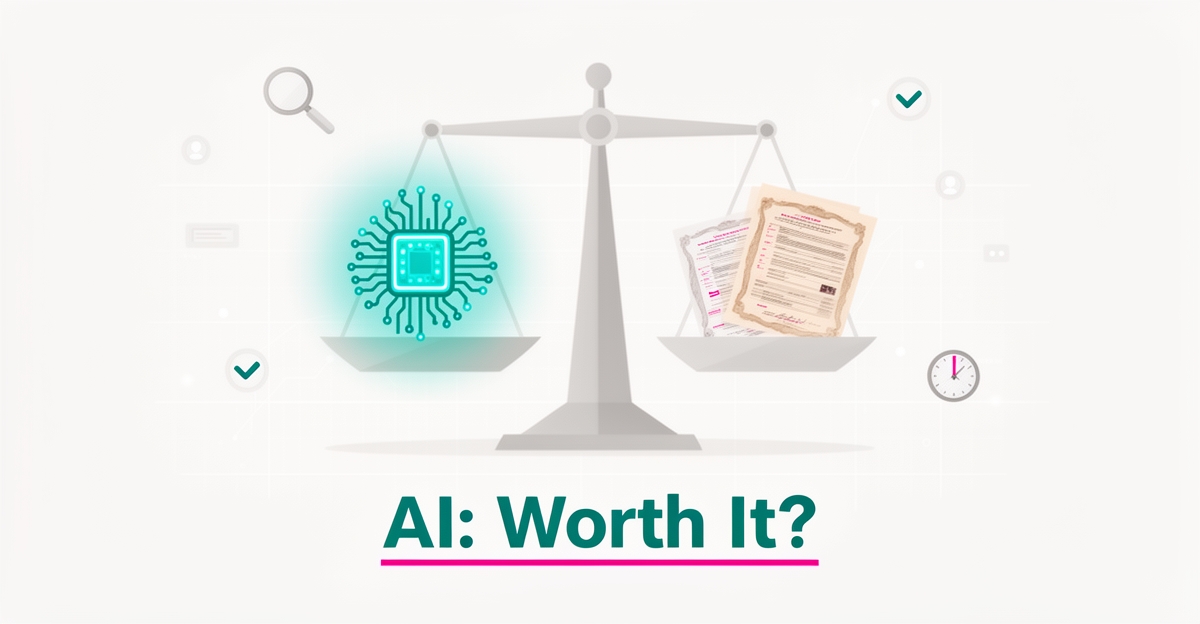
Is AI Worth It for Surety Bonding Agencies? A Cost-Benefit Analysis for Small to Mid-Sized Firms
Key Facts
- US and Canadian surety direct written premiums have grown into a multi-billion-dollar market in recent years, industry data confirms.
- AI can compress operational investigation time from 30–40 minutes to just minutes, technical analysis reveals.
- The 'verification-value paradox' means every minute AI saves may be lost checking its accuracy, legal research warns.
- Most people now use AI in some form, but only about half trust it, studies show.
- Surety bond costs typically range from 1–4% of the bond amount, market data shows.
- Applicants with poor credit typically face surety bond premiums of 5–15%, according to industry reports.
- Adding explanations and a 'skip' button to an AI advisor boosted client engagement by 60% in one study.
Hire a team member that works 24/7 — for less than a part-time wage.
AI receptionists, SDRs, dispatchers and 99+ roles. Trained on your business, fully managed.
Not sure where to start? Ask our AI planner
The Operational Drag: Where Surety Agencies Lose Time and Money
The operational reality for many surety bonding agencies is that skilled staff spend excessive time on repetitive, manual tasks that directly impact profitability and scalability. US and Canadian surety direct written premiums have grown into a multi-billion-dollar market in recent years, yet agencies often fail to capture full value due to inefficient internal workflows. Industry research confirms that underwriting and risk assessment remain labor-intensive, relying heavily on manual review of financial statements, credit reports, and project details—a process prone to delays and human error.
This operational drag manifests in three key areas: manual data analysis, document review, and reactive monitoring. Underwriters routinely spend 30–40 minutes investigating a single operational issue, time that could be redirected toward strategic client advisory or business development. Technical analysis reveals that AI can reduce this investigation time to mere minutes, but only if verification systems are in place. Without them, the time saved is often consumed by double-checking AI outputs—a hidden cost known as the "verification-value paradox."
- Manual financial statement analysis consuming large blocks of underwriter time every week
- Document review cycles delayed by incomplete or inconsistent applicant submissions
- Reactive monitoring that misses early warning signs of principal distress
- Staff diverted from high-value tasks like relationship management and portfolio optimization
- Inability to scale bond issuance without proportional headcount increases
These inefficiencies create a ceiling on growth, particularly for small to mid-sized firms competing against larger players with dedicated analytics teams. The surety industry’s core reliance on trust and risk assessment—evidenced by bond costs typically ranging from 1–4% of bond amount, and premiums of 5–15% for poor-credit applicants—means any technological solution must preserve accuracy while reducing friction. Market data underscores that even minor improvements in processing speed and risk insight can significantly impact conversion and retention.
For agencies evaluating AI readiness, the critical insight is that automation alone does not drive ROI—trustworthy automation does. AIQ Labs’ Workflow Builds help agencies rebuild the one workflow that costs the most—often underwriting intake or financial review—identify verification burdens, and design systems where AI acts as a diagnostic layer, not a replacement for expert judgment. This approach ensures that time saved translates directly into capacity for higher-value work, without introducing new risks or compliance gaps.
AI’s Promise and Peril: Efficiency Gains vs. the Verification-Value Paradox
AI can automate time-consuming tasks like financial analysis and risk flagging, but its value hinges on managing the hidden cost of verification. For surety bonding agencies, where trust and accuracy are foundational, AI’s promise of efficiency is real—but only if the burden of checking its outputs doesn’t erase those gains. AI can reduce the time for investigating operational issues from 30–40 minutes to just minutes, yet a law review paper highlights the "verification-value paradox," where every minute AI saves may be lost checking whether it got the answer right. This creates a hidden tax: if staff spend as much time auditing AI as they save using it, net efficiency drops to zero. Surveys show most people now use AI, but only about half trust it, reflecting a broader skepticism that’s especially acute in high-stakes industries like surety. The solution isn’t to avoid AI, but to engineer trust through structured verification—treating AI as a diagnostic layer, not a decision-maker, and building systems where human oversight is targeted, not endless.
- Build an exam dataset of gold-standard surety scenarios to test AI outputs
- Grade responses on correctness, relevance, and hallucination using a simple rubric
- Reserve human review for high-risk decisions while using automated checks for routine tasks
Engineering Trust: Building a Verification System That Preserves AI’s ROI
A surety agency’s credibility hinges on accurate risk assessment, yet AI’s promise of speed can unravel if every output requires manual recheck. The verification-value paradox reveals that efficiency gains vanish when staff spend saved minutes auditing AI for hallucinations or errors—turning automation into a hidden tax on productivity. To preserve ROI, agencies must treat AI not as an oracle but as a diagnostic tool whose outputs demand structured validation before informing underwriting decisions.
Start by building an exam dataset of 10–20 gold-standard surety scenarios, such as completed risk assessments or financial analyses, with ideal answers that include edge cases like incomplete applications. Grade AI outputs using a rubric focused on correctness, relevance, hallucination, and contextual relevancy to establish a baseline for reliability. Combine this with automated checks for routine monitoring and reserve human review for high-risk results requiring judgment, ensuring AI flags anomalies while experts retain final authority on bond approvals or claim predictions.
Instrument the AI system to log every decision—including data sources and reasoning—so teams can measure accuracy on live queries, not just test cases. Tie success metrics to business outcomes like whether a risk assessment prevented a default or reduced bond issuance time, and actively track verification effort to uncover and reduce the hidden tax of over-auditing. This framework transforms AI from a liability into a trustworthy efficiency layer, freeing skilled staff for strategic advisory and relationship work that drives true agency value.
From Assessment to Advantage: How AIQ Labs Helps Surety Agencies Implement AI Wisely
Knowing that AI could help your surety agency is one thing; knowing how to implement it without falling into the "verification-value paradox" is another entirely. This is where the right partner makes all the difference, turning potential into measurable ROI.
The research is clear: the "biggest risk is over-reliance," and treating AI as an infallible decision-maker is a recipe for failure. As one industry analysis notes, the goal is to use AI as a "diagnostic layer," not a replacement for human judgment. This principle is the foundation of a successful AI strategy.
At AIQ Labs, we structure our engagement model around this principle. We don’t sell off-the-shelf software; we work as a build partner, guiding surety agencies from initial assessment to scaled, secure implementation—200+ multi-agent systems deployed, and four live SaaS products we run ourselves every day. Our process is designed to build trust and verify value at every step, with three ways to start depending on where you are.
It begins with a Fit Check. Before writing a single line of code, we analyze your existing workflows, data infrastructure, and team capabilities. This isn't a sales pitch; it's a data-driven evaluation to identify the highest-ROI opportunities and determine if AI is a genuinely smart investment for your agency's specific scale and operational needs.
From there, we focus on building systems that are both powerful and accountable. This means:
- Integrating securely with your core systems, like your CRM and accounting software, to create a single source of truth.
- Building with transparency, ensuring every AI-driven output is explainable and auditable, which is critical in a regulated industry like surety.
- Implementing human-in-the-loop controls, so your team validates critical decisions, effectively managing the "hidden tax" of verification.
This approach directly addresses the "verification-value paradox," where, as one legal tech analysis warns, "every minute AI saves may be lost checking whether it got the answer right." By building evaluation frameworks directly into the system, we ensure your team isn't bogged down by "endless auditing."
For example, an AI Employee can handle the initial data gathering for a bond application, but it operates under strict guardrails. It flags anomalies and prepares a summary for a human underwriter, who makes the final call—at a fraction of the cost of a human hire. This frees up your experts from tedious work, allowing them to focus on the complex risk assessments that drive your business. For agencies ready to go further, an AI Operating System connects underwriting, intake, and monitoring into one operating layer you own outright.
Ultimately, our goal is to help you scale intelligently. We start with a targeted pilot, prove the ROI with clear metrics, and only then expand—built in milestones, paid in milestones, so you're never committed beyond the value you've already seen. This phased approach ensures you’re building a sustainable competitive advantage, not just chasing the latest tech trend. It’s about making AI a valuable, trusted asset—a core part of your operational strength.
Still paying for 10+ subscriptions that don’t talk to each other?
We build custom AI systems you own outright. No vendor lock-in. Full control.
Not sure where to start? Ask our AI planner
Frequently Asked Questions
How much time can AI actually save underwriters on operational issues in surety bonding?
What is the verification-value paradox and why does it matter for surety agencies?
Can small surety agencies compete with larger firms using AI?
What are the key steps to build a trustworthy AI system in surety bonding?
How does AIQ Labs help surety agencies avoid over-reliance on AI?
What business outcomes should surety agencies track to measure AI’s real ROI?
The Bottom Line: Making AI Work for Your Agency
For small to mid-sized surety agencies, the question isn't whether AI can deliver value—it's whether your workflows are ready to capture it. The potential is clear: reducing investigation time from 30–40 minutes to mere minutes and freeing skilled underwriters from manual data analysis to focus on strategic advisory work. Yet the verification-value paradox remains the critical hurdle; without structured frameworks to audit AI outputs, efficiency gains evaporate into endless double-checking. The agencies that succeed will be those that treat AI as a diagnostic layer rather than a decision-maker, building trust through gold-standard testing and human-in-the-loop controls. If you're ready to move beyond the hype and determine whether AI is a smart investment for your specific scale and operations, AIQ Labs can help. Start with a two-minute Fit Check to map your current workflows, or book a free strategy call to identify your highest-ROI opportunities—with no obligation, just clarity on your next steps.
Make AI your competitive advantage — not just another tool.
Strategy, implementation and ongoing optimization. One partner, end to end.
Not sure where to start? Ask our AI planner