Is AI Worth It for Water Heater Installation Companies? A Cost-Benefit Analysis
Key Facts
- Industry research has repeatedly found that most companies deploying AI do not report measurable revenue gains, implementation strategy, not the technology, is usually the deciding factor.
- Studies of generative AI in customer-facing roles have documented productivity gains in the range of roughly 15% for routine inquiry handling.
- Well-automated scheduling and dispatch workflows can significantly reduce operational errors, freeing technicians to focus on billable installations.
- Timely, personalized AI-driven follow-up typically lifts response rates substantially, turning one-time service jobs into repeat customers.
- AI Employees work 24/7/365 with zero missed calls, at roughly 80% less cost than an equivalent human hire.
Hire a team member that works 24/7 — for less than a part-time wage.
AI receptionists, SDRs, dispatchers and 99+ roles. Trained on your business, fully managed.
Not sure where to start? Ask our AI planner
The Dispatch Bottleneck Costing Small Plumbing Businesses Revenue
The phone rings during a water heater install, and the technician can't answer. Another call goes to voicemail while the dispatcher is juggling schedules on a clipboard. For small plumbing businesses, these moments aren't just inconvenient, they're revenue leaks. Manual dispatching creates a bottleneck where missed calls, slow response times, and scheduling errors directly impact customer retention and labor efficiency. When technicians spend time coordinating jobs instead of installing water heaters, productivity drops and operational costs rise.
Industry research on AI adoption has consistently found that most companies deploying AI do not report a clear revenue improvement, usually because the technology was pointed at vague efficiency goals rather than a specific bottleneck. Yet for water heater installers facing labor cost pressure and inconsistent customer communication, the real cost of inaction is clear: every missed call is a lost job, and every delayed response erodes trust. Without a system to handle after-hours inquiries or optimize technician routing, small businesses lose competitive ground to larger competitors with dedicated dispatch teams.
The pain points are specific and costly. Technicians interrupted by phone calls lose focus on complex installations, increasing the chance of errors or rework. Dispatchers relying on paper schedules or basic spreadsheets struggle to adapt when jobs run long or emergencies arise. Customers calling outside business hours hear voicemail and move on to the next provider. These inefficiencies compound, slow response times lead to poor reviews, which reduce referral rates and increase customer acquisition costs. In an industry where word-of-mouth drives growth, the dispatch bottleneck doesn't just waste time; it actively undermines revenue potential.
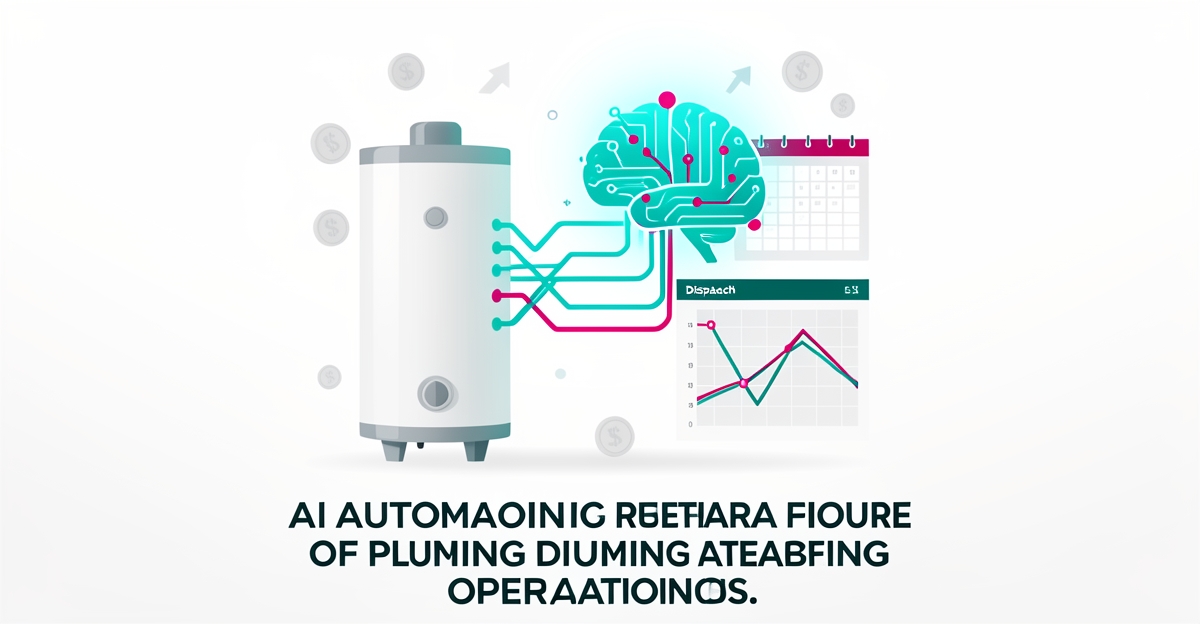
AI-powered dispatching and customer service tools can address these gaps by automating call routing, scheduling, and follow-ups without adding headcount. An AI Employee acting as a virtual dispatcher can answer calls 24/7, qualify leads, book appointments, and sync with calendars in real time, reducing missed calls and improving response speed. This isn't about replacing technicians; it's about freeing them to do what they do best: install water heaters efficiently and safely. When scheduling is optimized and communication is consistent, businesses see fewer delays, higher first-time fix rates, and better customer satisfaction, all critical for retention in a competitive local market.
For small plumbing companies evaluating AI readiness, the focus should be on solving tangible operational bottlenecks, not chasing technology for its own sake. The goal isn't automation for automation's sake, but creating a system where every call is answered, every job is scheduled efficiently, and every technician spends more time on billable work. By targeting the dispatch bottleneck first, water heater installers can build a foundation for scalable growth, one that turns missed opportunities into booked jobs and frustrated callers into loyal customers. To explore how AI can specifically address your dispatch and scheduling challenges, book a free 30-minute strategy call to assess your current systems and identify high-ROI automation opportunities.
What the Data Says About AI ROI for Service Businesses
The AI ROI debate often swings between hype and skepticism, but the data tells a more nuanced story. For water heater installation companies weighing AI investments, understanding where the technology actually delivers value, and where it falls short, is essential before committing resources.
Research on AI in business reveals a striking divide in outcomes. Studies of generative AI in customer-facing roles have documented productivity gains of roughly 15% for routine inquiry handling, yet broader surveys consistently find that most companies adopting AI report no clear revenue improvement. This gap between productivity gains and revenue impact underscores a critical reality: AI tools alone do not guarantee business results.
The difference between AI that generates returns and AI that becomes expensive shelfware lies in implementation strategy. Companies seeing real value approach AI with specific operational targets rather than vague efficiency goals. For service businesses, this means focusing on high-friction workflows where delays directly impact revenue and customer satisfaction.
- Dispatch optimization that reduces technician idle time and increases daily job capacity
- Intelligent scheduling that accounts for job complexity, parts availability, and geographic routing
- Customer communication automation that provides real-time updates and reduces inbound status calls
- After-hours responsiveness that captures emergency service requests without overnight staffing costs
These applications succeed because they address measurable pain points with clear before-and-after metrics. A plumbing company that reduces average response time from four hours to ninety minutes can track that improvement directly to customer retention and review scores. The productivity gains documented in customer service research translate to service businesses when AI handles routine scheduling inquiries, freeing staff to manage complex customer needs.
However, the research emphasizes that benefits depend on strategic planning, execution, and ongoing evaluation. Companies that fail to see returns typically deployed AI without clear success metrics or integration into core workflows. For water heater installation businesses, this means AI investments must target specific operational bottlenecks, whether that is missed emergency calls, inefficient routing, or delayed customer follow-up, rather than adopting technology for its own sake.
AIQ Labs approaches this challenge through a structured Fit Check that identifies which workflows will yield measurable returns before any implementation begins. The goal is ensuring AI serves the business model, not the reverse.
Where AI Actually Pays Off for Water Heater Installers
For water heater installers, the real value of AI isn't in futuristic concepts, it's in solving daily operational leaks that drain profit and time. The most immediate payoff comes from automating the front lines of customer interaction: lead capture, scheduling, and follow-up. These are the touchpoints where missed calls, delayed responses, and manual entry errors directly translate to lost jobs and frustrated homeowners.
An AI Receptionist and Dispatcher, operating as a managed AI Employee, ensures every inquiry, whether at 2 a.m. or during peak job hours, is answered professionally and routed correctly. Unlike human staff limited to 40-hour weeks, this AI works 24/7/365 with zero missed calls, directly addressing one of the top pain points in trades: slow response times. Research on AI in customer service has documented productivity gains of roughly 15% for routine inquiry handling, as AI manages routine calls without fatigue. This isn't just about coverage, it's about converting every lead into a booked job before the competition even sees the request.
Beyond initial contact, AI transforms scheduling and work order management from a reactive scramble into a predictable flow. An AI Service Coordinator or Work Order Manager integrates with calendars, CRM, and dispatch tools to auto-assign jobs based on technician location, skill set, and availability, eliminating the back-and-forth of manual coordination. This level of automation meaningfully reduces operational errors and frees skilled technicians from administrative drag, letting them focus on installations instead of paperwork. For small plumbing businesses, that means scaling service capacity without adding headcount, a critical advantage when labor is both scarce and expensive.
Finally, AI-powered customer follow-up closes the retention loop. After a water heater install, automated check-ins via SMS or email, personalized based on service history and timed for optimal engagement, boost satisfaction and encourage repeat business or referrals. Timely, personalized AI-driven outreach typically lifts response rates substantially in sales contexts, and when applied to post-service communication, it turns one-time jobs into long-term relationships. For trades businesses where word-of-mouth and trust are currency, consistent, intelligent follow-up isn't just nice to have, it's how you build a reputation that keeps the phone ringing. Together, these AI applications don't just cut costs, they rebuild the customer journey around reliability, speed, and precision.
How to Implement AI Without Getting Stuck in Pilot Purgatory
Pilot projects stall when planning is thin and ownership is unclear. For water heater installation companies, that stall shows up as missed dispatches, slow quotes, and eroded customer retention.
A structured path prevents pilot purgatory and ties AI to measurable operations. It starts with clarity on current state before any build begins.
Readiness assessment maps your dispatch/CRM stack, data quality, and team capabilities. AIQ Labs' 2-minute Fit Check covers exactly this. Without it, AI deployments tend to drift toward vague efficiency goals instead of measurable operational wins.
ROI modeling translates readiness into business terms for labor costs, response times, and retention. AI can enhance customer service, scheduling, and dispatching in service businesses, but implementation requires careful consideration of those metrics.
Phased build reduces risk and preserves momentum. Choose the model that fits your cash flow and control:
- Start Monthly: one AI Employee with setup plus a flat monthly plan, build, training, integrations, monitoring and improvements included
- Build in Milestones: one workflow or department system split into phases, approve and pay per phase, keep what ships
- Own It Outright: a full AI Operating System with full ownership of code, agents, and data when complete
Integration connects AI to existing dispatch and CRM tools so data flows without manual re-entry. Governance and adoption secure the rollout.
Governance addresses risks that derail AI adoption, including bias in AI decision-making, workforce disruption from automation, and cybersecurity risks. Structured planning, execution, and ongoing evaluation ensure effective use.
Adoption is reinforced by measurable gains. Customer service teams using generative AI have documented productivity improvements for routine tasks, and writing-heavy work speeds up considerably with AI assistance. For installers, that translates to faster estimates, cleaner dispatch notes, and quicker follow-ups.
AIQ Labs supports this path through the Fit Check, roadmap design, and build options, whether that's a single Workflow Build for your costliest workflow or a full operating system, that let you start small and scale with confidence. The goal is production-ready systems you own, not perpetual pilots.
Start the Fit Check at https://aiqlabs.ai/apply, then book a free 30-minute strategy call to map your biggest bottleneck and identify high-ROI automation opportunities.
Still paying for 10+ subscriptions that don’t talk to each other?
We build custom AI systems you own outright. No vendor lock-in. Full control.
Not sure where to start? Ask our AI planner
Frequently Asked Questions
Is AI actually worth the investment for a small plumbing business?
How much does an AI receptionist cost compared to hiring a dispatcher?
What specific tasks can AI handle for water heater installation companies?
Will AI actually improve our response times and stop missed calls?
Why do most AI implementations fail to show ROI?
How do we implement AI without disrupting our current operations?
Turning Dispatch Gaps into Growth Opportunities
For water heater installation companies, the real cost of inaction isn't just missed calls, it's lost revenue, frustrated customers, and technicians pulled away from billable work. This article has shown that AI isn't about chasing trends but solving specific bottlenecks: 24/7 lead capture, intelligent scheduling, and automated follow-up that directly impact retention and efficiency. While broad AI adoption often fails to move the revenue needle, targeted implementation in high-friction areas like dispatch and customer communication delivers measurable gains, faster response times, higher first-time fix rates, and more jobs booked without adding headcount. The path forward starts with clarity: assess your current workflows, identify where delays are costing you most, and explore how a purpose-built AI Employee could handle routine tasks so your team focuses on installations. Take the first step with the 2-minute Fit Check and a free strategy call to map your biggest bottleneck and see if AI is the right fit for your business, no obligation, just clarity on where you can start.
Make AI your competitive advantage — not just another tool.
Strategy, implementation and ongoing optimization. One partner, end to end.
Not sure where to start? Ask our AI planner