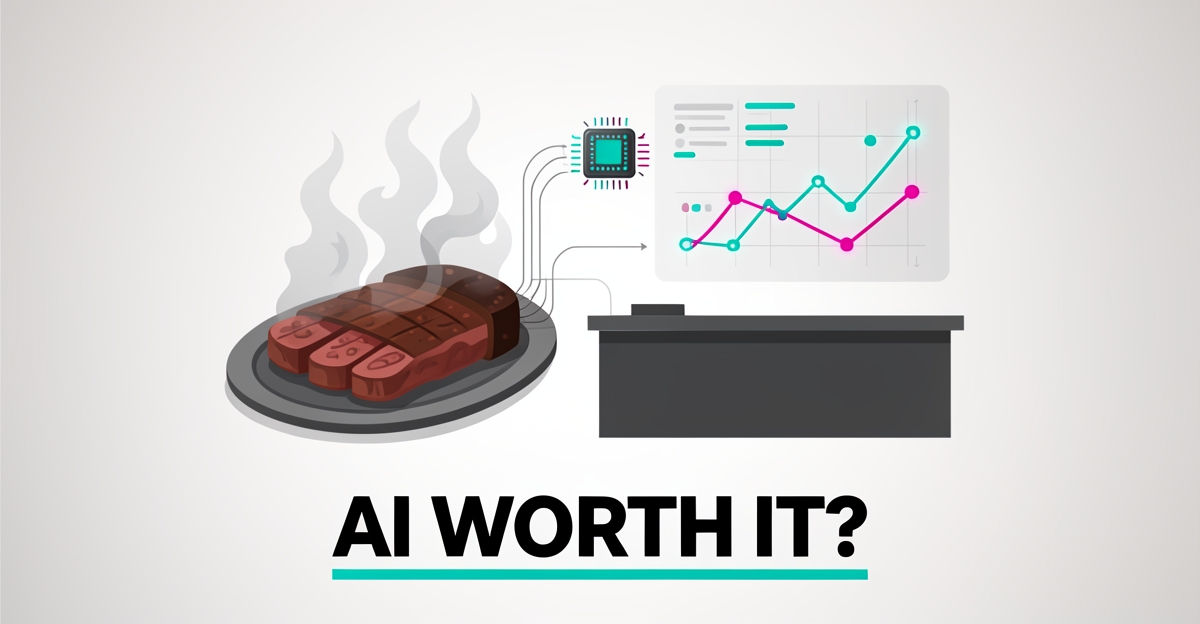
Is AI Worth It for Your BBQ Restaurant? A Cost-Benefit Breakdown of Automation in Service Flow
Key Facts
- As of late 2026, roughly a quarter of restaurant operators report using some form of AI tooling, and adoption is accelerating
- Industry analyses estimate restaurants lose a meaningful share of revenue, often cited in the high single digits to low teens as a percentage, to poor demand forecasting, food waste, and disconnected ordering systems
- AI-powered inventory and forecasting tools have been reported to reduce food waste by 30-40% in restaurant deployments
- AI-assisted POS and digital menu systems have been credited with increasing average order value by 10-30% through consistent upsell suggestions
- AI-powered loyalty platforms have been associated with 15-25% more repeat visits via personalized engagement
- AI-assisted scheduling can trim labor spend while protecting service quality during rush hours
- Full-scale restaurant AI implementations can run from tens of thousands to hundreds of thousands of dollars depending on scope, which is why phased adoption matters
Hire a team member that works 24/7 — for less than a part-time wage.
AI receptionists, SDRs, dispatchers and 99+ roles. Trained on your business, fully managed.
Not sure where to start? Ask our AI planner
The Hidden Cost of Inefficiency in BBQ Restaurant Operations
Walk into any busy BBQ joint on a Saturday night and you'll see it: a packed dining room, a smoke pit running at full capacity, and a front-of-house team scrambling to keep up. What you won't see is the money quietly leaking out of the operation, through overstaffed shifts, wasted brisket, and missed opportunities at the register.
The numbers behind that leakage are sobering. Labor typically represents roughly 30-35% of a restaurant's operating costs, and scheduling it efficiently remains one of the hardest operational problems to solve. For a BBQ restaurant running on thin margins, that means tens of thousands of dollars a year riding on whether the right people are on the floor at the right time.
Food waste tells a similar story. Industry analyses as of late 2026 estimate restaurants lose a meaningful share of revenue, often cited in the high single digits to low teens as a percentage, to poor demand forecasting, food waste, and disconnected ordering systems. In the BBQ world, where brisket, ribs, and pulled pork require hours of low-and-slow cooking, over-estimating demand is especially costly, you can't "un-smoke" a shoulder that nobody ordered.
Scheduling inefficiencies compound the problem during peak hours. When staffing doesn't match the lunch rush or weekend surge, service quality suffers exactly when revenue potential is highest. Restaurant operations advisors consistently report that the number one thing operators want AI to do is help with scheduling and labor.
The cumulative effect of these inefficiencies shows up in several predictable ways:
- Overstaffing during slow periods, draining payroll without corresponding sales
- Understaffing during rushes, leading to long waits, order errors, and lost tables
- Excess prep and cooked inventory that ends up discarded at closing
- Disconnected systems, POS, inventory, and scheduling that don't talk to each other
This is the context in which AI automation has entered the conversation. As of late 2026, roughly a quarter of restaurant operators already use AI tools, and adoption is accelerating faster than many expected. The framing that sticks: AI isn't just about what the guest sees, it's about helping operators run stronger, more efficient teams from the front to the back of house.
For BBQ restaurant owners weighing the investment, the first step is honest accounting: quantify what inefficiency is already costing you. That's exactly the starting point AIQ Labs takes, before any technology decision is made, the question is which single workflow costs you the most, and whether rebuilding it pays for itself. If that workflow is phone handling, reservations, or order intake, AI Employees, managed AI receptionists, SDRs, and dispatchers, at roughly 80% less cost than a human hire, can be a fast, low-risk entry point.
Where AI Delivers Measurable ROI in Food Service Environments
For BBQ restaurants running on thin margins and high-volume service, AI is moving from experiment to operational lever. The gains show up where waste, labor, and repeat business live.
Food waste drops first. Industry reporting on AI-powered inventory tools has cited waste reductions in the 30-40% range. Predictive demand models adjust prep for brisket, sides, and sauces to actual traffic patterns, not guesswork. That reduction directly protects cost of goods in a category where protein spoilage is expensive.
Average check rises without pressuring staff. Research on AI-assisted POS and digital menus finds these systems suggest add-ons and upgrades at the right moment, consistently and without human error, with reported lifts in average order value in the 10-30% range. For a BBQ pit, that is extra sides, sauces, or dessert prompts timed to order flow rather than server memory.
Repeat visits become more predictable. Data on loyalty automation indicates restaurants using AI-powered loyalty platforms have seen repeat visits increase by 15-25%. Personalized offers based on past orders and visit timing keep regulars coming back between weekends.
Labor efficiency improves during rushes. Analysis of scheduling tools notes AI-powered scheduling can reduce unnecessary labor spend while protecting service quality during peak hours. Labor typically represents 30-35% of a restaurant's operating costs, and scheduling it efficiently is one of the hardest operational problems to solve. Even modest savings compound across a busy service week.
Measurable ROI areas for BBQ service flow include:
- Inventory and waste control that trims food cost through smarter forecasting
- Smart upsells at POS and kiosk that lift average order value
- Loyalty and re-engagement automation that drives more repeat visits
- Demand-based scheduling that cuts unnecessary labor spend while maintaining service quality during rushes
These outcomes align with how AIQ Labs evaluates ROI for food service environments: pick the one workflow that costs the most, rebuild it at a fixed price, and measure the result before moving on. The focus stays on labor costs, order accuracy, and customer experience improvements rather than technology for its own sake.
When the benefits are stacked, the business case shifts from cost to margin protection. Consistent operational improvements deliver the return, not a single big change.
Implementation Realities: Costs, Integration, and Phased Adoption for BBQ Restaurants
The gap between AI's promise and its practical payoff comes down to one thing: how you implement it. Restaurants that treat automation as a phased, milestone-driven investment consistently outperform those that chase a single "big fix."
The first reality is cost. Full-scale restaurant AI implementations can range from tens of thousands to hundreds of thousands of dollars depending on scope, which is why the research consistently emphasizes that ROI comes from consistent operational improvements, not a single big change. A BBQ restaurant should therefore start where the pain is greatest, and the data points clearly at labor. Labor typically represents 30-35% of a restaurant's operating costs, and scheduling it efficiently is one of the hardest operational problems to solve. As restaurant operations advisors consistently report, the number one thing operators want AI to do is help with scheduling and labor.
The second reality is data and integration. AI requires high-quality data to function effectively, and AI tools must be integrated with existing systems, your POS, inventory, and ordering platforms, to deliver results. This matters because fragmented systems aren't just inconvenient; they're actively expensive, contributing to the revenue leakage cited earlier in this article.
This is where a phased, milestone-based approach minimizes risk. Rather than committing six figures upfront, a BBQ restaurant can sequence adoption around measurable wins:
- Start with scheduling and labor optimization, where AI can trim labor spend while improving service during rush hours. If phone volume is part of the labor problem, an AI receptionist or order-taker can start delivering value within weeks, not quarters.
- Add AI-powered inventory forecasting next, since restaurants using these tools have reported cutting food waste by 30-40%.
- Layer in POS-driven upselling, which has been credited with increasing average order value by 10-30% through consistent, error-free add-on suggestions.
- Finish with customer-facing systems like AI-powered loyalty platforms, which have been associated with 15-25% more repeat visits.
Each phase should have a defined milestone, cost saved, waste reduced, order value increased, and only proceed once the previous phase proves out. This structure also protects your investment: if a phase isn't delivering, you stop there and keep what's already working.
This maps directly to how AIQ Labs structures engagements. AI Workflow Builds rebuild the one workflow that costs you the most at a fixed price, in phases. If your ambition goes further, AI Operating Systems connect your whole operation into one layer, built in phases and owned outright by you. The payment models, Start Monthly, Build in Milestones, Own It Outright, mean you approve and pay per phase as it ships, and can stop anytime while keeping everything built. No fake prices, no invented case-study numbers: the business case stands on your real operational data.
The right mindset is the one operators keep coming back to: AI is not just about what the guest sees. It's about helping you run a stronger, more efficient team, from the front to the back of house. Implementation done right reflects exactly that, quiet, compounding operational gains, phase by phase.
Still paying for 10+ subscriptions that don’t talk to each other?
We build custom AI systems you own outright. No vendor lock-in. Full control.
Not sure where to start? Ask our AI planner
Frequently Asked Questions
Is AI actually worth it for a BBQ restaurant or is it just hype?
Where will AI save me the most money first?
How much does it cost to implement AI in a BBQ restaurant?
Will AI make my customers order more?
Can AI help bring customers back between weekends?
Do I need perfect data before starting AI?
Where AI Meets the Pit: Turning BBQ Inefficiencies Into Operational Wins
Running a successful BBQ restaurant means balancing smoke, spice, and razor-thin margins, where small inefficiencies in labor, waste, and service can quietly erode profitability. This article showed how AI isn't about flashy tech, but about solving real operational pain points: cutting food waste through smarter forecasting, boosting average order value with consistent upsells, increasing repeat visits through personalized loyalty, and optimizing labor during peak rushes without sacrificing service quality. The ROI isn't in a single overhaul, but in phased, measurable improvements, starting where the pain is greatest, like scheduling and inventory, then building on what works. As of late 2026, roughly a quarter of restaurant operators already use AI tools, and the shift is underway not as experimentation but as competitive necessity. For owners ready to move beyond guesswork, the next step is clarity: take the 2-minute Fit Check to see where your operation leaks value, then book a free 30-minute strategy call to map your biggest bottlenecks and find where AI can deliver tangible gains for your pit.
Make AI your competitive advantage — not just another tool.
Strategy, implementation and ongoing optimization. One partner, end to end.
Not sure where to start? Ask our AI planner