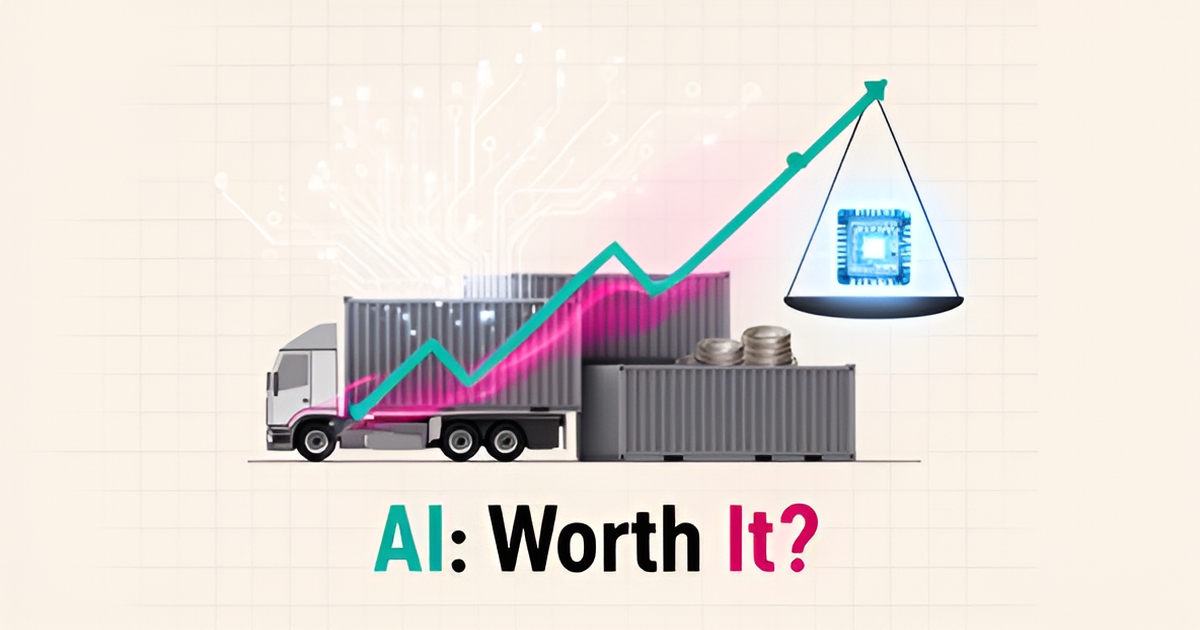
Is AI Worth It for Your Freight Brokerage? A Cost-Benefit Breakdown
Key Facts
- Most logistics companies were still hesitating on AI adoption as of late 2026, even as early movers post measurable cost reductions — typically in the range of 15-40% on the workflows they automate
- Large brokerages have publicly reported AI agents handling millions of shipment-related tasks, with quote responses dropping from hours to seconds
- AI route optimization can meaningfully cut distance per tonne, permanently lowering delivery costs on the same volume
- Only a minority of supply chain leaders have a formal AI strategy in place, which keeps the advantage with early movers
- AIQ Labs has deployed 200+ multi-agent systems and runs 4 live SaaS products daily — the patterns that work in freight are proven, not theoretical
Hire a team member that works 24/7 — for less than a part-time wage.
AI receptionists, SDRs, dispatchers and 99+ roles. Trained on your business, fully managed.
Not sure where to start? Ask our AI planner
The AI Adoption Gap in Freight Brokerage
Here's a puzzle at the heart of modern freight brokerage: the technology works, the savings are real, and yet most of the industry is still watching from the sidelines. As of late 2026, most logistics companies still hesitate on AI adoption, even as early movers post results that are difficult to ignore.
The evidence for what's possible keeps mounting. Large brokerages like C.H. Robinson have publicly described deploying dozens of AI agents that handle millions of shipment-related tasks — quoting, load booking, appointment scheduling — with confirmations returned in under a minute. The specifics of any single deployment matter less than the pattern: the quoting bottleneck that used to eat broker hours is now a solved problem at scale.
The financial benchmarks are just as striking. Major shippers and FMCG companies have reported tens of millions of dollars in annual savings from AI-driven logistics optimization, and route optimization deployments have meaningfully cut average distance per tonne — permanently lowering cost per delivery while maintaining the same volume. Treat any specific figure as a signal, not a promise: your brokerage's numbers depend on your lanes, volumes, and current labor costs.
So why the hesitation? The barriers are real, but they're mostly organizational rather than technical:
- Legacy data trapped in siloed TMS, ERP, and email systems, requiring cleansing and normalization before models can be trained
- Integration complexity across carrier portals, rating APIs, and warehouse platforms
- Change management resistance from brokers and dispatchers who must learn to trust machine recommendations
- Uncertainty about ROI timelines, which vary from weeks for add-on tools to 6-12 months for comprehensive platforms
There's also a governance gap compounding the problem. Only a minority of supply chain leaders have implemented a formal AI strategy, and organizations often deploy AI faster than they establish oversight frameworks. Most organizations ask what AI can do but neglect to evaluate whether they have the operating models and human oversight capacity to control it.
The gap between the brokerages that have built strategy and those that haven't is where competitive advantage is being decided right now. Brokers who move first lock in compounding cost advantages — savings that grow as models learn and improve. Those waiting for perfect conditions are paying the difference in manual quoting hours, missed loads, and slower carrier response times.
This is precisely why the economics deserve a proper model before any decision. Quantifying savings from labor reduction, faster quoting, and improved carrier retention — against realistic implementation timelines — turns hesitation into an informed choice. AIQ Labs does this in a free 30-minute strategy call: real numbers, in writing, before any commitment. If the math doesn't show a clear win, a good partner will tell you that too.
Quantifying the ROI: Labor Savings, Missed Loads, and Carrier Retention
Quoting speed is the first place most brokerages feel AI. When responses drop from hours to seconds, you can answer every incoming request instead of losing opportunities to faster competitors — particularly on time-sensitive spot freight, where speed often determines win rates. Large deployments have shown this pattern at scale: AI agents handling thousands of email-based shipment orders daily, turning what was once a bottleneck into a competitive advantage.
Processing email-based shipment orders without human delays eliminates a major source of missed loads and billing errors, as AI systems classify LTL shipments by NMFC codes with consistent accuracy. That volume would require substantial headcount to match manually — driving up costs while introducing variability in performance. AI maintains throughput around the clock, so no orders fall through the cracks during off-hours or peak volumes.
AI-driven carrier matching cuts empty miles and improves asset utilization — a structural cost advantage that compounds quarterly as models learn from real-time data, creating ongoing efficiency gains rather than one-time reductions. The same logic applies to carrier communication: consistent, instant responses improve carrier retention, which reduces the cost of re-brokering loads and rebuilding relationships.
The fastest way to see these numbers for your own operation is AI Employees — managed AI staff like receptionists, SDRs, and dispatchers that cost roughly 80% less than a human hire and start monthly with no long commitment. Or book a free strategy call to model the savings for your specific brokerage.
Choosing Your AI Path: Platform vs. Module vs. TMS Upgrade
Choosing the right AI path for your freight brokerage depends on your operational readiness, integration needs, and timeline for results. All-in-one platforms require a complete overhaul of your tech stack — data migration, workflow redesign, and team retraining — with implementations typically spanning 3-6 months. While this approach demands significant upfront effort, it offers end-to-end automation from load posting to invoice reconciliation, with ROI typically arriving 6-12 months after full deployment.
Specialized AI modules provide a faster, lower-risk entry point by enhancing existing systems like McLeod LoadMaster or Axon TMS. These tools integrate via API in a few weeks, targeting specific pain points such as intelligent load matching or automated carrier scoring without disrupting core operations. With subscription pricing typically ranging from a few hundred to a couple thousand dollars monthly, brokers can begin seeing ROI in weeks to months through reduced manual effort and improved load acceptance rates.
AI-enhanced TMS upgrades from established vendors offer a middle ground, embedding AI features into familiar interfaces. These solutions require moderate integration effort and minimize workflow disruption while adding capabilities like predictive pricing or real-time tracking. For brokers prioritizing continuity and vendor reliability, this path balances innovation with operational stability, though AI sophistication may trail behind pure-play platforms.
- All-in-one platforms: 3-6 month implementation, higher upfront costs, 6-12 month ROI timeline
- Specialized modules: weeks to integrate, subscription pricing, weeks-to-months ROI
- AI-enhanced TMS upgrades: fast deployment, familiar interface, moderate customization
Your choice should align with your brokerage's scale, tech maturity, and tolerance for disruption — whether you're ready to transform your entire operation or prefer to enhance existing workflows incrementally. AIQ Labs maps these paths to three entry points: AI Employees for a monthly, low-commitment start; Workflow Builds to rebuild the one workflow that costs you the most at a fixed price; and AI Operating Systems for a single connected layer, built in phases and owned outright. Payment follows the same logic: Start Monthly, Build in Milestones, or Own It Outright — no fake prices, and the ROI is modeled before you commit.
Governance and Compliance: The Hidden Cost of Speed
The race to deploy agentic AI in freight brokerage often outpaces the establishment of necessary oversight, creating significant regulatory exposure. Agentic AI adoption is outpacing governance across regulated industries, where organizations deploy capabilities faster than they build the frameworks needed for responsible deployment. This gap is particularly dangerous in freight brokerage, where FMCSA regulations demand strict documentation for carrier qualification, insurance verification, and pricing decisions.
Without centralized governance, AI-driven pricing algorithms and carrier matching systems operate as black boxes, making audit trails impossible to generate or validate. Traditional audit workflows were designed around human pacing and judgment, while agentic AI moves sequentially at speed — a fundamental mismatch in oversight capability. Junior staff frequently review AI-generated work they don't fully understand, compounding the risk of undetected non-compliance.
Establishing governance before deployment requires three critical elements: a centralized function with both business and technical representation, clear accountability for model performance with defined escalation paths, and workforce development programs focused on evaluating AI output. AIQ Labs builds these frameworks in from the start — especially in AI Operating Systems builds, where phased delivery means oversight is designed alongside capability, not retrofitted after incidents. This proactive approach transforms governance from a cost center into a strategic advantage that enables sustainable, scalable AI adoption in regulated freight brokerage operations.
Implementation Framework: From Assessment to Optimization
Moving from curiosity to measurable ROI requires a disciplined path, not a patchwork of tools. Freight brokers who skip structure risk the governance gaps seen across regulated industries, where AI is deployed faster than oversight can follow.
Assessment starts with operations, not technology. Map the manual processes that consume broker time, then prioritize use cases with clean inputs and measurable outputs — quoting, load matching, and carrier communication are the usual suspects. Large-scale deployments show the pattern: dozens of AI agents handling millions of shipment-related tasks, with quote responses cut from hours to seconds.
Choosing an adoption path shapes cost, speed, and disruption. There are three primary paths: all-in-one AI platforms that replace your TMS, specialized modules that enhance existing systems, and AI-enhanced upgrades from established vendors. The choice determines your implementation timeline from weeks to 3-6 months.
Governance must be built before scale. Create a centralized function with business and technical representation, define accountability for model performance, and establish escalation paths. With most logistics companies still hesitating and only a minority of supply chain leaders holding a formal AI strategy, early governance is itself a competitive differentiator.
Data quality and integration are the foundation. Audit existing TMS, ERP, and email data for accessibility, cleanse and normalize before training, and integrate flows across systems before production deployment. Brokers who skip this step face months of delay and unreliable models.
Change management determines adoption. Train staff to trust AI recommendations, provide clear human-override controls, and build feedback loops for continuous improvement. The most advanced deployments — where AI manages nearly all container moves across ocean, rail, and road — earned that level of trust through training and oversight, not overnight.
Performance measurement closes the loop. Define KPIs for cycle-time reduction, tender acceptance rates, and cost savings, then monitor against baselines. This structured approach mirrors how AIQ Labs guides brokerages: model the ROI first, build in milestones, and measure against the baseline you started with.
- Assess current operations and identify high-impact use cases with immediate ROI potential
- Choose the right adoption path based on readiness, budget, and disruption tolerance
- Establish governance and oversight with clear accountability and human-in-the-loop controls
- Ensure data quality and integration before model training and production deployment
- Implement change management and training to build trust and adoption
- Measure and optimize performance against KPIs like cycle-time reduction and tender acceptance
With the right framework, AI shifts from experiment to operational necessity that compounds savings over time.
Still paying for 10+ subscriptions that don’t talk to each other?
We build custom AI systems you own outright. No vendor lock-in. Full control.
Not sure where to start? Ask our AI planner
Frequently Asked Questions
Is AI worth it for a small freight brokerage, or is it only for big players like C.H. Robinson?
How long does it really take to see ROI from AI in freight brokerage?
Why are so many freight brokers still hesitant about AI if the savings are proven?
Should we replace our TMS with an all-in-one AI platform or enhance what we already have?
What compliance and governance risks should we worry about with agentic AI?
How can we avoid getting stuck in pilot purgatory and actually scale AI?
The Cost of Waiting Is No Longer Theoretical
The pattern is clear: freight brokers deploying AI at scale are cutting quoting times from hours to seconds, reducing empty miles, and locking in compounding cost advantages that grow with every shipment. Large brokerages now have AI agents handling millions of tasks, and major shippers report tens of millions in annual savings from AI-driven routing alone. Meanwhile, most of the industry remains on the sidelines. The gap isn't technical — it's organizational. Brokers who move first aren't just automating tasks; they're building operational muscle that competitors can't easily replicate. The three adoption paths — platform replacement, specialized modules, or TMS upgrades — each offer valid entry points depending on your readiness and risk tolerance. But every path requires governance, data discipline, and change management to succeed. AIQ Labs helps brokers quantify the upside before committing, with 200+ multi-agent systems deployed and ROI modeling that turns hesitation into a documented business case. If the numbers don't support the move, we'll say so. Start the two-minute Fit Check to see where your brokerage stands.
Make AI your competitive advantage — not just another tool.
Strategy, implementation and ongoing optimization. One partner, end to end.
Not sure where to start? Ask our AI planner