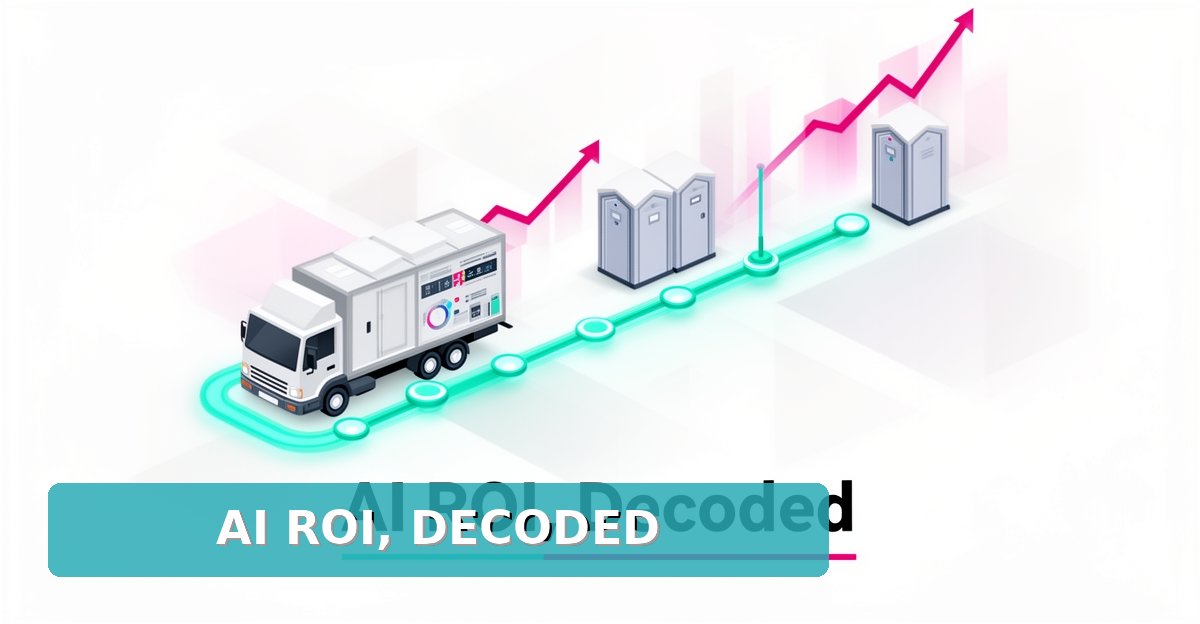
Is AI Worth It for Your Portable Toilet Rental Company? A Real-World ROI Breakdown
Key Facts
- AI route optimization saves 15–25% on fuel, yielding $800–$2,000 monthly for a 3-truck fleet.
- Automated billing recovery adds $1,000–$3,000 monthly by capturing previously unbilled construction extensions.
- AI phone agents save 2–4 staff hours daily, potentially avoiding $2,500/month in temporary labor costs.
- The total monthly automation stack costs $230–$740, often offset by a single premium event rental.
- Event rentals carry 30%–50% higher margins than standard construction rentals, driving superior profitability.
- Proactive outreach to past clients converts at 20%–30%, generating $5,000 from just 10 re-engagements.
- Route optimization savings alone typically pay for the entire automation stack, making entry risk-free.
What if you could hire a team member that works 24/7 for $599/month?
AI Receptionists, SDRs, Dispatchers, and 99+ roles. Fully trained. Fully managed. Zero sick days.
1. The Logistics Reality: Why AI Fits Portable Sanitation
Portable sanitation is fundamentally a logistics business, not a cleaning operation. Value comes from operational intelligence like routing, billing, and dispatch rather than physical cleaning robots.
AI automation delivers the highest impact in route planning, billing accuracy, and service verification. These areas directly address the operational chaos that defines the industry.
According to Kenyon AI, logistics is exactly where AI makes the biggest difference. This shifts the focus from hardware to software-driven efficiency.
Route optimization is the single highest-impact automation for portable rental companies. It provides immediate, measurable fuel savings and capacity gains without complex implementation.
Implementing AI-optimized service routes is identified as the most effective starting point for operational improvement. The savings from this single tool often pay for the entire stack of automation tools.
Key efficiency metrics include:
- 15–25% savings on fuel and drive time through optimized routing
- $800–$2,000 monthly savings for a typical 3-truck operation
- 1–2 hours earlier route completion, creating capacity for new accounts
Drivers finish routes significantly faster with AI optimization, allowing fleets to add accounts without adding trucks. This immediate cost reduction validates the investment quickly.
A significant portion of revenue is lost due to unbilled rental extensions, particularly in construction projects. Automated countdown timers capture this "leakage" effectively.
Automated billing for rental extensions can recover an additional $1,000–$3,000 per month. This converts potential lost revenue into consistent income with minimal manual effort.
Specific revenue opportunities include:
- $1,000–$3,000 monthly recovery from unbilled construction extensions
- 30–50% higher margins on event rentals compared to standard construction
- $5,000 in revenue from re-engaging just 10 past event clients
Event rentals carry superior margins but require efficient booking pipelines. Automated follow-up systems handle this administrative burden, allowing staff to focus on high-value tasks.
Offices handling 30 to 50 calls per day see 60% as routine booking or pricing inquiries. Automating these routine calls saves critical staff time daily.
AI phone agents can save 2–4 hours of staff time daily, potentially eliminating the need for temporary staff during peak seasons.
Labor cost comparisons reveal significant advantages:
- 2–4 hours saved daily by automating routine phone inquiries
- $2,500/month avoided in temporary staff costs during peak seasons
- Zero missed calls with 24/7 AI availability
This labor efficiency allows existing teams to focus on complex customer issues rather than repetitive scheduling tasks.
The total monthly cost for a comprehensive automation stack is estimated between $230–$740. This is often offset by the savings from a single premium event rental.
Route optimization alone typically pays for the entire stack of automation tools according to industry data. This makes the initial investment virtually risk-free for most operators.
Specific tool costs break down as follows:
- Route optimization: $50–$200/month
- AI phone answering: $100–$300/month
- Billing automation: $30–$80/month
- Service verification: $30–$100/month
With such low overhead, the financial barrier to entry is minimal compared to the potential returns.
Understanding that portable sanitation is a logistics business clarifies why software automation outperforms hardware solutions. The next section breaks down the specific financial impact of these tools.
We will compare these labor savings and revenue recoveries against implementation costs to determine true ROI. This data-driven approach ensures every dollar spent delivers measurable value.
2. The Immediate ROI: Fuel, Labor, and Revenue Recovery
For portable toilet rental operators, the question isn’t whether AI works, but how quickly it pays for itself. The answer is immediate. Unlike abstract tech investments, AI in sanitation delivers measurable financial returns within the first month by targeting your three biggest cost centers: fuel, labor, and billing leakage.
According to industry data from Kenyon AI’s industry research, the portable sanitation business is fundamentally a logistics operation. This means AI-driven route optimization offers the highest immediate ROI, often covering the cost of your entire automation stack on its own.
Route optimization is the single highest-impact automation for rental fleets. By reducing unnecessary drive time and idle fuel consumption, you immediately lower your largest variable cost.
- 15–25% reduction in fuel and drive time costs.
- $800–$2,000 monthly savings for a typical 3-truck operation.
- 1–2 hours faster route completion, allowing drivers to handle extra accounts.
The financial math is compelling. For a mid-sized fleet, the $50–$200 monthly cost of an AI routing tool is negligible compared to the $1,000+ in fuel savings generated weekly. This creates an immediate positive cash flow from day one.
Administrative bottlenecks often force operators to hire temporary staff during busy seasons. AI phone agents and automated scheduling remove this volatility by handling routine inquiries instantly.
Research from Kenyon AI’s operational analysis shows that 60% of daily calls (30–50 calls) are routine booking or pricing questions. Automating these tasks frees up 2–4 hours of staff time daily.
- Avoid $2,500/month in temporary staffing costs during peak events.
- Zero missed calls with 24/7 AI receptionist coverage.
- Faster response times increase customer satisfaction and conversion rates.
By deploying an AI Employee like a receptionist or dispatcher, you replace fluctuating labor costs with a fixed, predictable monthly fee. This stabilizes your P&L and allows human staff to focus on high-value strategic tasks.
Many rental companies leave money on the table through unbilled rental extensions, particularly in construction where projects often overrun their initial terms. AI billing systems act as an automatic safety net.
Automated billing for rental extensions can recover an additional $1,000–$3,000 per month. This is pure profit that previously slipped through the cracks due to manual oversight.
- $1,000–$3,000 monthly recovery from unbilled construction extensions.
- 20–30% conversion rate on automated re-engagement for past event clients.
- $5,000 revenue boost from re-engaging just 10 past event clients.
A single lost municipal contract can cost $2,000–$5,000 monthly. Service verification tools provide the GPS and photo proof needed to protect these high-value contracts, ensuring every service rendered is billed correctly.
The total monthly cost for a comprehensive automation stack ranges from $230 to $740. This is often less than the revenue from a single premium event rental. When you combine fuel savings, labor avoidance, and recovered revenue, the net monthly gain often exceeds $3,000.
This isn’t a long-term theoretical benefit; it’s a month-one financial improvement. By addressing route efficiency, call volume, and billing accuracy, AI transforms operational chaos into predictable profit.
With the immediate financial baseline established, let’s look at how to structure these savings into a sustainable, scalable growth model.
3. The Cost Benchmark: Stack vs. Single Rental
When evaluating the financial viability of AI automation, the comparison isn’t about profit margins—it’s about opportunity cost. The total monthly investment for a comprehensive AI automation stack is estimated between $230 and $740. This range covers route optimization, automated billing, AI phone answering, service verification, and event pipeline management.
Most operators underestimate the value of their existing assets. The entire cost of this five-tool stack is roughly equivalent to the revenue generated from just one premium event rental per month. This means every night you don’t automate, you are essentially paying for your new technology out of pocket by losing a high-margin booking.
To understand the magnitude of this investment, consider the economics of a single premium event. Event rentals carry 30% to 50% higher margins than standard construction rentals. A single large-scale event can generate thousands in profit with minimal incremental labor if managed correctly.
By automating the backend logistics, you ensure that every rental extension is billed and every service is verified. The savings from route optimization alone typically pays for the entire stack, according to industry analysis from Kenyon AI.
This creates a risk-free entry point: * Fuel & Drive Time Savings: AI route optimization saves 15% to 25% on fuel. * Monthly Impact: For a 3-truck operation, this equals $800 to $2,000 in monthly savings. * Net Position: Even if you ignore revenue growth, the operational savings exceed the maximum stack cost of $740.
Beyond direct savings, AI provides critical contract protection. A single lost municipal contract is valued at $2,000 to $5,000 per month. Service verification systems using GPS and photo documentation ensure you have irrefutable proof of service, protecting these high-value revenue streams.
Reliable service verification is not just about compliance—it’s about revenue retention. Without automated proof of service, disputes can lead to non-payment or contract termination.
| Automation Tool | Monthly Cost Range | Primary ROI Driver |
|---|---|---|
| Route Optimization | $50 – $200 | Fuel savings ($800–$2,000/mo) |
| AI Phone Answering | $100 – $300 | Avoids $2,500 temp staff costs |
| Rental Period Automation | $30 – $80 | Recovers $1,000–$3,000 in unbilled revenue |
| Service Verification | $30 – $100 | Protects $2k–$5k municipal contracts |
| Event Booking Pipeline | $20 – $60 | Captures high-margin event revenue |
Implementing these tools transforms fixed operational costs into variable, revenue-generating assets. The next step is determining which specific workflow yields the fastest return for your unique fleet size.
4. Strategic Implementation: From Pilot to Transformation
Moving from AI hype to tangible ROI requires a structured partnership rather than a scattered software subscription. Strategic implementation transforms theoretical benefits into operational reality through a phased, ownership-based approach.
For portable toilet rental companies, this means starting with high-impact logistics tasks before expanding to full-scale transformation. The goal is to eliminate vendor lock-in while building a custom competitive advantage.
The most effective entry point is deploying a single AI Employee for a specific, high-volume task. Instead of overhauling entire departments, target isolated pain points like dispatch or frontline reception.
This "AI Employee" model provides a managed, production-grade agent that works alongside your human team. It handles real workflows end-to-end, from answering calls to routing service requests, without the complexity of custom coding.
- AI Receptionist: Handles 60% of routine booking and pricing inquiries automatically (Kenyon AI).
- Cost Efficiency: Eliminates the need for $2,500/month temporary staff during peak seasons.
- Immediate Impact: Saves 2–4 hours of staff time daily, allowing human employees to focus on complex field issues.
By starting with an AI Employee, you prove the concept with minimal risk. The monthly cost of $599–$1,500 is often offset by the savings from a single premium event rental or recovered labor hours.
Once the pilot demonstrates value, expand into custom workflow automation to address deeper operational inefficiencies. This phase moves beyond generic tools to build systems that integrate directly with your existing CRM, dispatch software, and accounting platforms.
For rental companies, this typically involves automating route planning and billing verification. These are the areas where AI delivers the highest financial return by reducing fuel waste and capturing lost revenue.
- Route Optimization: Saves 15–25% on fuel and drive time for a 3-truck operation.
- Revenue Recovery: Captures $1,000–$3,000 monthly from unbilled rental extensions.
- Service Verification: Protects $2,000–$5,000 monthly municipal contracts through automated proof of service.
This stage transitions your business from using off-the-shelf tools to owning a unified operational powerhouse. You gain complete control over customization and future development, ensuring the system evolves with your business needs.
The final stage involves embedding AI into your core operating model through strategic transformation consulting. This is where you move from tactical efficiency to strategic market advantage.
AIQ Labs acts as your long-term partner, guiding you through governance, adoption, and continuous optimization. This ensures AI becomes a sustainable capability rather than a temporary fix.
- Scalability: Expand AI into sales, marketing, and HR as your fleet grows.
- Governance: Establish frameworks for data security and compliance in regulated industries.
- Innovation: Continuously identify new use cases as technology evolves.
The total investment for a comprehensive automation stack is estimated between $230–$740 per month, a fraction of the value generated. This structured path ensures you build enterprise-grade AI capabilities without the enterprise-level risk.
By following this phased approach, you ensure every dollar spent drives measurable returns. This method allows you to scale confidently, knowing each step is backed by data and designed for long-term ownership.
Still paying for 10+ software subscriptions that don't talk to each other?
We build custom AI systems you own. No vendor lock-in. Full control. Starting at $2,000.
Frequently Asked Questions
Is AI actually worth it for a small portable toilet rental fleet, or is it overkill?
Does AI replace the need to clean the toilets physically?
How much money can I realistically recover from unbilled rental extensions?
Will AI phone agents handle customer complaints properly?
What is the fastest way to see a return on investment with AI?
Can AI help me get more high-margin event rentals?
Turn Operational Chaos into Competitive Advantage
For portable sanitation businesses, the question isn't whether AI is worth the investment, but whether you can afford to ignore it. As demonstrated, the true value lies not in cleaning hardware but in software-driven logistics: optimizing routes to save $800–$2,000 monthly in fuel, and recovering $1,000–$3,000 in lost revenue through automated billing extensions. These immediate, measurable gains validate the ROI of automation quickly, often funding the entire tech stack. At AIQ Labs, we help SMBs like yours move beyond theoretical pilots to production-ready systems. We don’t just offer recommendations; we architect custom AI solutions that you own, eliminating vendor lock-in and subscription chaos. Whether through targeted AI Workflow Fixes, managed AI Employees for dispatch and billing, or comprehensive Transformation Consulting, we ensure your automation delivers sustainable business impact. Stop leaving money on the table due to manual inefficiencies. Schedule your Free AI Audit & Strategy Session today to map out your path to a more profitable, automated operation.
Ready to make AI your competitive advantage—not just another tool?
Strategic consulting + implementation + ongoing optimization. One partner. Complete AI transformation.