Is AI Worth It for Your Restaurant Equipment Repair Business? A Cost-Benefit Breakdown
Key Facts
- Labor typically accounts for 25-35% of revenue in food-service-adjacent businesses, and repair firms carry similar overhead while delivering reactive service
- Industry analyses of AI operating systems for food service generally report payback within roughly 6 to 12 months, though results vary by scope and volume
- Predictive maintenance powered by AI reduces emergency calls and improves first-visit fix rates by turning maintenance data into scheduled, predictable work
- Consolidating disconnected tools into one connected operating layer reduces manual data entry, scheduling errors and repeat truck rolls
- AIQ Labs has deployed 200+ multi-agent systems and runs 4 live SaaS products daily, so the implementation patterns described here are proven in production, not theory
- AIQ Labs offers three entry points, AI Employees, Workflow Builds and AI Operating Systems, with payment models (Start Monthly, Build in Milestones, Own It Outright) that let you match spend to risk
Hire a team member that works 24/7 — for less than a part-time wage.
AI receptionists, SDRs, dispatchers and 99+ roles. Trained on your business, fully managed.
Not sure where to start? Ask our AI planner
The Hidden Cost of Reactive Repair Operations
Reactive repair keeps restaurant equipment repair businesses in a constant state of firefighting, and the bill shows up in ways that are easy to miss until margins collapse.
When a walk-in cooler fails on a Friday night, the cost is not just the service call. It is lost sales, spoiled inventory, and a restaurant owner who will remember who arrived late. Traditional workflows rely on phone triage, manual dispatch, and technicians working from memory, which creates delays that compound quickly.
Labor is the dominant pressure point. Industry benchmarks generally put labor at 25-35% of restaurant revenue, and repair businesses carry similar overhead while delivering reactive service. Inefficient routing, repeat visits, and after-hours emergencies inflate those hours without predictable return.
Downtime is the hidden revenue leak. Restaurants typically operate on thin margins, often in the low single digits, and a large share do not survive their first few years. For a repair provider, every hour a kitchen is down increases the risk of churn and permanent loss of that client.
Restaurant owners expect rapid response when equipment is offline, and reactive operations struggle to meet that expectation consistently across a growing service area.
The strain shows up as:
- Emergency response delays from manual call handling and dispatch
- Labor inefficiencies from unoptimized routing and repeat truck rolls
- Customer churn driven by downtime and inconsistent communication
These frictions are operational, not technical. They persist because teams are busy managing the next urgent ticket instead of preventing the next failure. That reactive posture makes it hard to price work, forecast capacity, or protect client relationships.
AIQ Labs evaluates ROI for service businesses by mapping current service volume and repair types against these hidden costs, which is how the business case for change becomes clear. Shifting from reactive to predictive work reduces the labor drag that eats margin and improves retention when response times are reliable.
Without visibility into failure patterns and technician utilization, repair businesses absorb the cost of inefficiency while restaurants absorb the cost of downtime.
How AI Transforms Equipment Repair: Predictive Maintenance and Workflow Optimization
Restaurant equipment repair businesses are losing money on every delayed dispatch and missed failure window. AI shifts the model from reactive call-outs to proactive service, turning maintenance data into predictable revenue.
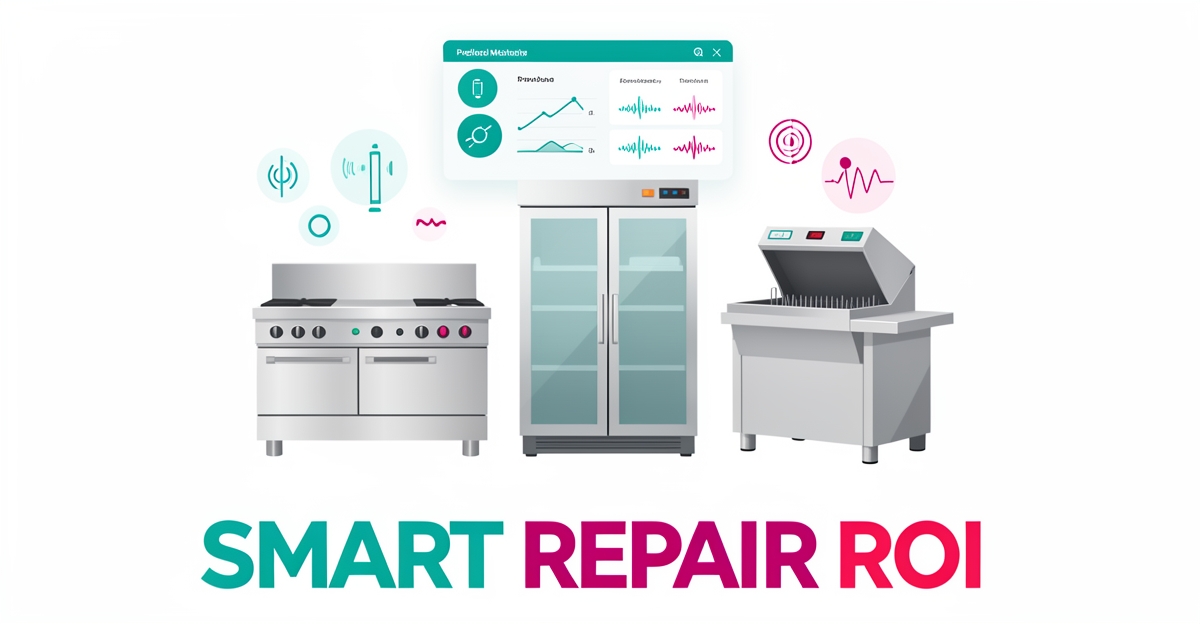
Predictive failure modeling is the foundation. By analyzing equipment age, usage patterns, service history and environmental factors, AI systems flag assets likely to fail before they do. For repair firms, the payoff is fewer emergency calls, higher first-visit fix rates, and better client retention.
Intelligent technician dispatch and automated scheduling complete the loop. AI matches job complexity, parts availability, travel time and technician skill to each request in real time. The result is tighter routes, less windshield time, and faster response. Food-service businesses that adopt AI commonly report meaningful efficiency gains, gains directly transferable to service operations where route density and utilization drive margin.
The financial case depends on scope, but the pattern is consistent: businesses that replace manual triage and disconnected tools with a connected operating layer typically recover the investment through labor savings, better technician utilization and fewer emergency call-outs. Exact numbers vary, which is why AIQ Labs models ROI against your actual service volume and repair types rather than quoting industry averages.
Workflow optimization shows up in everyday tasks:
- Automated service scheduling that balances technician workload and client urgency
- Predictive parts ordering to reduce truck stockouts and return trips
- Dynamic dispatch that re-routes on the fly for new priority calls
- Automated follow-ups and invoicing that shorten payment cycles
AIQ Labs offers three ways to capture these gains. AI Employees handle roles like dispatchers and receptionists at roughly 80% less cost than a human hire. Workflow Builds rebuild the one workflow that costs you the most, at a fixed price and in phases. And AI Operating Systems connect everything into one operating layer, built in phases and owned outright. The shift in all three cases is from manual triage to data-driven operations: consistent, measurable service delivery instead of experience-based dispatch, with efficiency gains that scale with volume.
Implementation Roadmap: From Assessment to Measurable ROI
Starting your AI transformation begins with a clear assessment of current repair workflows to pinpoint where automation delivers the highest impact with the lowest risk. AIQ Labs' methodology starts with a workflow assessment that identifies bottlenecks in dispatch, scheduling, and customer communication, areas where AI Employees deliver measurable gains quickly. This phase ensures you target fixes that validate ROI before scaling.
Pilot deployment focuses on high-impact, low-risk workflows like AI-powered dispatch, which automates technician routing and service call prioritization based on real-time equipment data and technician availability. Consolidating disconnected systems into one connected layer eliminates manual data entry, reduces scheduling errors, and improves first-time fix rates through predictive maintenance triggers, freeing your team to focus on skilled repair work rather than system management.
Scaling to full integration builds on pilot results, expanding AI across inventory management, preventive maintenance scheduling, and customer follow-up, each phase delivering incremental ROI. Starting with a single workflow fix, such as deploying an AI dispatcher, allows you to measure tangible improvements in response times and customer satisfaction before expanding to broader automation, ensuring every step delivers proven value. Payment models match this phased approach: Start Monthly to validate, Build in Milestones as each phase proves out, or Own It Outright once the system is core to your operation. To begin your assessment and identify your highest-ROI automation opportunity, start with the free 30-minute strategy call at https://aiqlabs.ai/book.
Still paying for 10+ subscriptions that don’t talk to each other?
We build custom AI systems you own outright. No vendor lock-in. Full control.
Not sure where to start? Ask our AI planner
Frequently Asked Questions
How much can AI reduce labor costs for a restaurant equipment repair business?
What is the typical ROI timeline for implementing AI in equipment repair operations?
Can AI really help reduce emergency repair calls and improve first-visit fix rates?
How does AI improve technician dispatch and routing for repair businesses?
What does it cost to get started with AI for equipment repair workflows?
Is AI implementation too complex for small repair businesses with limited IT resources?
From Firefighting to Forecastable Revenue
Reactive repair is expensive because downtime, repeat truck rolls and manual dispatch quietly erode the labor overhead most service businesses carry. AI shifts the model from emergency call-outs to predictive, data-driven operations: failure modeling flags assets before they fail, intelligent dispatch tightens routes and utilization, and automated scheduling, parts ordering and follow-ups shorten payment cycles and protect client retention. For equipment repair firms, that means fewer after-hours emergencies, higher first-visit fix rates and margins you can price and forecast. Start with a workflow assessment to pinpoint the highest-impact, lowest-risk automation, pilot AI-powered dispatch to measure response time and utilization gains, then scale to preventive maintenance and inventory. AIQ Labs can model ROI against your current service volume and repair types to make the business case clear, with 200+ multi-agent systems deployed and 4 live SaaS products running daily, the implementation patterns are proven. Begin with the two-minute Fit Check at https://aiqlabs.ai/apply for a free 30-minute strategy call to map your biggest bottleneck and next high-ROI step.
Make AI your competitive advantage — not just another tool.
Strategy, implementation and ongoing optimization. One partner, end to end.
Not sure where to start? Ask our AI planner