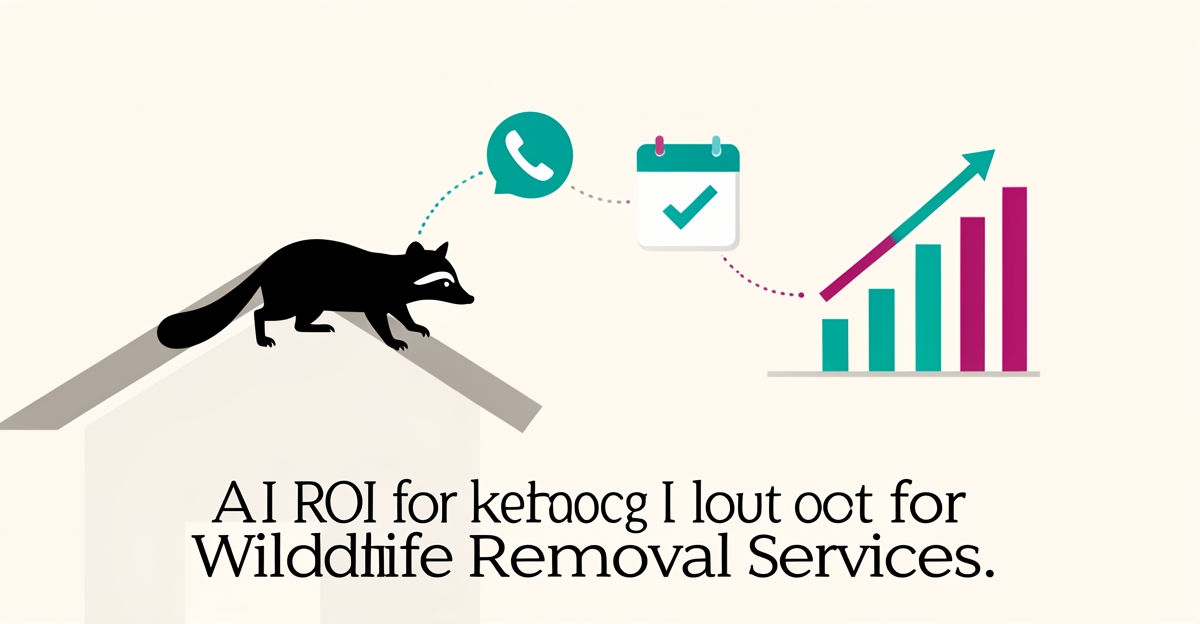
Is AI Worth It for Your Wildlife Removal Business? A ROI Breakdown
Key Facts
- Modern AI assistants can typically resolve a large share of routine customer inquiries instantly, freeing your team for field work and complex cases.
- Most AI pilots fail because the business case is weak, not because the technology doesn't work. Tie every AI project to a measurable cost or revenue outcome.
- Some large companies that went all-in on AI-only customer service have since brought human agents back into the loop over service quality concerns, human oversight still matters.
- AIQ Labs has deployed 200+ multi-agent systems and runs four live SaaS products daily, so the recommendations here come from systems in production, not theory.
- Trustworthy AI stays assistive with a human in the loop, not an autonomous black box making untraceable decisions in your business.
Hire a team member that works 24/7 — for less than a part-time wage.
AI receptionists, SDRs, dispatchers and 99+ roles. Trained on your business, fully managed.
Not sure where to start? Ask our AI planner
The Hidden Cost of Running Wildlife Removal on Phones, Paper, and Memory
Wildlife removal is an emergency business. A squirrel in an attic or a raccoon in a chimney can't wait until Monday, and neither can the caller. Yet most operators still run on a patchwork of cell phones, paper job tickets, and one person's memory. The costs don't show up on any invoice, but they're real:
- Missed calls are missed jobs. If you can't answer, the homeowner calls the next company on Google. You don't get a second chance at a 2 a.m. skunk call.
- Manual dispatch burns fuel and hours. Someone has to look at the board, call techs, shuffle appointments, and re-call customers when things slip.
- Nothing gets tracked. Without service records in one place, follow-up visits get forgotten, warranties are hard to honor, and upsells (exclusion work, attic restoration) never happen because nobody remembers the original job.
None of this is a technology problem. It's a cost problem wearing a technology costume. Before you spend a dollar on AI, you need to know which of these leaks is the biggest.
Where AI Actually Pays: Call Handling, Dispatch, and Service Tracking
AI earns its keep in three places in a wildlife removal operation:
1. Call handling
An AI receptionist answers every call, text, and web inquiry instantly, 24/7, including the nights and weekends when wildlife is most active. It quotes your standard services, books inspections, captures the address and animal details, and escalates genuine emergencies to a human. Compared to hiring a front-desk person, a managed AI employee typically costs a fraction of a human salary, AIQ Labs' AI Employees run at roughly 80% less than a human hire, with no training time and no sick days.
2. Dispatch
An AI dispatcher assigns jobs by location, tech availability, and job type, and updates customers automatically when a tech is running late. That means fewer windshield hours, tighter routes, and no more phone-tag between the office and the field.
3. Service tracking
Every job, follow-up visit, warranty window, and exclusion recommendation lives in one system. The AI nudges customers about scheduled return visits and flags jobs where attic restoration or exclusion work was quoted but never closed. That's revenue you're currently leaving on the table.
Notice what's not on this list: anything futuristic. No drones, no robot traps. Just the three workflows that quietly drain your margins today.
The ROI Math: Investment Thresholds and Payback Timelines
Here's how to run the numbers for your own shop, without a spreadsheet full of made-up industry averages:
- Count your leak. How many calls go unanswered per week? Multiply by your close rate and average job value. If you miss 10 calls a week, close half of what you answer, and average $400 a job, that's $2,000/week walking to a competitor.
- Price the fix. A managed AI receptionist or dispatcher is a monthly cost, typically far below a part-time hire. A single rebuilt workflow is a fixed-price project. A full AI operating system is phased, so you pay as value comes online.
- Compare. If the monthly cost of an AI employee is less than the value of even one or two recovered jobs a week, the payback period is measured in weeks, not years.
A rough rule of thumb as of late 2026: if you run more than a few hundred jobs a year and currently miss calls or dispatch manually, the math almost always favors at least automating call handling first. If you're a solo operator doing 50 jobs a year, start smaller, maybe just after-hours answering, and grow from there. AIQ Labs publishes its payment models plainly (Start Monthly, Build in Milestones, Own It Outright) with no invented case-study numbers, so you can run this comparison with real figures. See /pricing for how each model works.
How to Implement AI Without Losing Control of Your Business
The graveyard of AI projects is full of tools that were bought before anyone asked what problem they solved. Avoid that with three rules:
- Start with one workflow, not everything. Pick the single most expensive bottleneck, usually call handling or dispatch, and fix only that first. AIQ Labs' Workflow Builds are scoped exactly this way: one workflow, fixed price, delivered in phases.
- Keep a human in the loop. AI should book the inspection, not decide how to handle a bat colony in an occupied nursery. Escalation paths to a real person are non-negotiable.
- Own your system. If you eventually want everything connected, calls, dispatch, tracking, invoicing, build it in phases and own it outright rather than renting pieces forever. That's what AI Operating Systems are designed for.
Phased implementation also protects your cash flow: you see results from phase one before committing to phase two.
Your Next Step: Get a Real Business Case, Not a Sales Pitch
Anyone can tell you AI is the future. What your business needs is a specific answer: which workflow, what it costs now, and what fixing it is worth. That takes twenty minutes, not a sales marathon.
Start with the free two-minute Fit Check to identify your highest-impact automation opportunity. If it looks promising, book a free 30-minute strategy call and we'll map the ROI math for your actual numbers, missed calls, job values, dispatch hours. If the numbers don't work, we'll tell you. You can reach the team anytime at [email protected].
Still paying for 10+ subscriptions that don’t talk to each other?
We build custom AI systems you own outright. No vendor lock-in. Full control.
Not sure where to start? Ask our AI planner
Frequently Asked Questions
How can AI actually save time in a wildlife removal business?
What's the biggest reason AI projects fail in small businesses like mine?
Can AI replace my receptionist or dispatcher entirely?
Will using AI end up costing me more than I save?
What's a safe, high-ROI place to start with AI in my wildlife removal business?
How do I know if an AI tool is trustworthy and won't make untraceable mistakes?
Turning AI Potential into Wildlife Removal Profit
AI isn't futuristic hype for wildlife removal businesses, it's a fix for real, costly bottlenecks: missed calls, manual dispatch, and service records that live in someone's head. The ROI comes from practical wins: AI Employees answering after-hours inquiries, automated dispatch cutting fuel and response times, and service tracking that turns one-off jobs into follow-up revenue, all while you stay in control of the high-judgment work. The next step is simple: take the free two-minute Fit Check to find your highest-impact opportunity, then book a free 30-minute strategy call to map a clear, measurable path forward. No guesswork, no invented numbers, just your math, applied to your business.
Make AI your competitive advantage — not just another tool.
Strategy, implementation and ongoing optimization. One partner, end to end.
Not sure where to start? Ask our AI planner