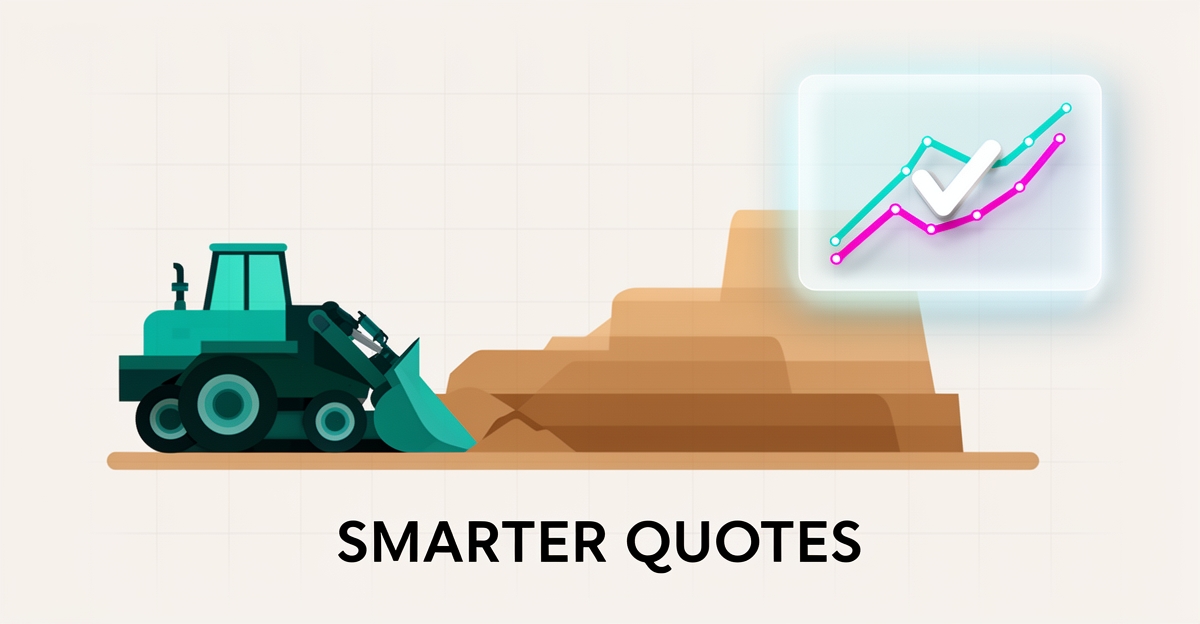
Should Excavation Contractors Use AI for Client Quotes and Pricing?
Key Facts
- AI-driven pricing engines can significantly reduce quoting errors when fed clean, structured job data
- A large share of AI project time is typically spent on data cleansing, data quality is the foundation of accurate modeling
- Faster quote turnaround directly improves win rates: the first credible number often wins the job
- Most AI projects that fail do so from poor planning and hidden costs, not from the technology itself
- Cyber security breaches remain common across businesses, making security critical for AI quoting systems
- Agentic AI enables pricing engines to adapt to changing site conditions without manual reprogramming
- AI-powered tools can analyze data from sensors and drones to predict risks and improve project outcomes in civil engineering contexts
Hire a team member that works 24/7 — for less than a part-time wage.
AI receptionists, SDRs, dispatchers and 99+ roles. Trained on your business, fully managed.
Not sure where to start? Ask our AI planner
The Cost of Inaccurate Quoting in Excavation Contracting
A single mispriced excavation bid can quietly erase the profit margin of an entire project. In an industry where quotes depend on variables like soil type, site access, and shifting project scope, manual quoting processes leave contractors exposed to errors that compound long before the first bucket hits the ground.
The core problem is that excavation estimates rely on dozens of interdependent variables. Soil conditions alone can swing a project dramatically, advanced soil mechanics principles exist precisely because soil behavior under real-world field stress conditions is difficult to predict without sophisticated analysis. A contractor quoting from experience and spreadsheets may miss a change from loam to dense clay, and the cost of that miss lands directly on their bottom line.
Manual quoting also creates delays that cost work. When a potential client requests a quote, the contractor who responds first with a credible number often wins the job. Time-consuming manual estimates, gathering soil data, calculating access constraints, pricing equipment and labor, slow the quoting cycle down, and slow quotes frequently mean lost bids to faster competitors.
The financial impact of inaccurate bidding shows up in three ways:
- Underbidding, where unaccounted variables like soil type or limited site access turn a "profitable" job into a loss.
- Overbidding, where padding estimates to cover uncertainty prices contractors out of work entirely.
- Scope creep losses, where changes mid-project go unpriced because the original estimate lacked a structured model to update.
This is where AI-driven pricing engines enter the conversation. As research on AI in civil engineering projects notes, AI-powered tools can analyze data from multiple sources, including sensors and drones, to predict risks and improve project outcomes. Applied to quoting, that same analytical approach can factor soil types, access points, and project scope into site-specific estimates in minutes rather than days, reducing errors and speeding up quoting cycles.
The payoff framework matters, though. Technology leaders are generally advised to measure AI initiatives against concrete outcomes: revenue growth, cost savings, and cycle time reduction. For excavation contractors, that translates directly, fewer mispriced jobs, faster quote turnaround, and more bids submitted per week. Industry experience also shows that most AI projects that drain budgets with zero ROI fail for predictable reasons: poor data quality and unplanned hidden costs. Contractors considering AI quoting should treat it as an investment to be measured, not a gadget to be tried.
At AIQ Labs, our work with trades and field services businesses has shown a consistent pattern: the quoting bottleneck is rarely a knowledge problem, it's a process problem. Estimators know what a job should cost, but assembling that knowledge into an accurate, timely quote manually creates the errors and delays that cost revenue. That's why our AI Workflow Builds focus on rebuilding the one workflow that costs the most, often quoting, at a fixed price, in phases.
The question, then, isn't whether inaccurate quoting is expensive. It's whether the fix should remain manual, or whether AI can price a job as precisely as the crew that digs it.
How AI-Driven Pricing Engines Improve Quote Accuracy and Speed
AI-driven pricing engines are transforming how excavation contractors generate quotes by analyzing site-specific variables like soil composition, access constraints, and project scope in real time. This dynamic approach reduces human error and accelerates the quoting process, turning what once took days into a matter of hours. By leveraging agentic AI systems that continuously learn from project outcomes, contractors can align pricing more closely with actual site conditions and resource requirements.
A large share of AI project time is typically spent on data cleansing, which highlights the importance of clean, structured inputs for accurate modeling. For excavation contractors, this means investing in reliable soil surveys, geospatial data, and historical job performance to feed the AI engine. When properly configured, these systems can meaningfully reduce quoting errors and cut cycle time, directly improving win rates and customer satisfaction.
Agentic AI capabilities enable pricing engines to adapt recommendations based on changing site conditions, such as unexpected rock formations or water table shifts, without requiring manual reprogramming. This adaptability mirrors the reasoning loops seen in advanced agentic frameworks, where AI agents balance competing objectives like cost, safety, and timeline. The result is a quote that evolves with the project, not one that becomes obsolete after the first site visit.
- Analyzes soil bearing capacity, moisture content, and compaction data to adjust excavation estimates
- Evaluates access points, terrain slope, and equipment mobility constraints for accurate labor and machine allocation
- Integrates historical job data to predict overruns and recommend contingency buffers
- Outputs transparent, auditable quote breakdowns that build client trust
AIQ Labs' approach to custom AI workflow automation ensures these pricing engines are built to owned specifications, integrated with existing estimating tools, and continuously optimized based on real-world performance, delivering measurable gains in both quote accuracy and speed. And because we build systems you own outright, your pricing logic stays yours, not locked behind someone else's subscription.
Implementation Roadmap: Data, Risks, and ROI for Excavation Contractors
Excavation contractors considering AI for quoting face a critical path where preparation determines success. Industry experience shows that a large share of AI project time is typically spent on data cleansing, making data quality the foundational step before any model training begins. Contractors must audit historical project data, soil reports, access constraints, equipment logs, and past quotes, to ensure it's accurate, complete, and structured for AI ingestion. Poor data leads to flawed predictions, undermining the very accuracy AI promises to deliver.
Beyond data, cybersecurity risks demand attention. Recent government surveys have found that a substantial share of businesses report a breach or attack in a given 12-month period, and AI quoting systems handling client details, project specs, and pricing logic become attractive targets. Robust encryption, access controls, and regular vulnerability assessments are non-negotiable. Contractors should treat AI implementation not as a standalone tool but as an integrated system needing the same security rigor as their financial or operational platforms.
A phased approach minimizes risk while building confidence. Start with a pilot focused on one project type or geographic zone, measuring quote accuracy against manual methods and tracking time saved per estimate. Use this phase to refine data inputs, validate security protocols, and calculate early ROI indicators like reduced rework from quoting errors. Only after demonstrating consistent value should contractors scale to broader project types or integrate AI into their CRM and estimating workflows. This methodical progression aligns with how AIQ Labs builds: assessment, controlled piloting, and data-driven scaling, whether that's a single workflow rebuild or a full AI Operating System that connects quoting, scheduling, and dispatch in one owned layer. For contractors ready to assess their specific opportunity, start with the 2-minute Fit Check, then book a free 30-minute strategy call to get clarity on whether AI quoting aligns with your current data maturity and business goals.
Still paying for 10+ subscriptions that don’t talk to each other?
We build custom AI systems you own outright. No vendor lock-in. Full control.
Not sure where to start? Ask our AI planner
Frequently Asked Questions
Why do excavation quotes so often end up inaccurate?
How does AI actually improve the accuracy and speed of excavation quotes?
What kind of ROI should an excavation contractor expect from AI quoting tools?
What data do I need before AI can generate reliable excavation quotes?
Are there security risks when using AI for client quotes and pricing?
What's the safest way for an excavation contractor to start using AI for quoting?
From Guesswork to Precision: Why AI Quoting Is the Next Competitive Edge
Excavation contractors know that inaccurate quoting isn't just a minor headache, it's a profit killer. As we've seen, manual estimates fail under the weight of shifting soil conditions, site access challenges, and scope changes, leading to underbidding, overbidding, and costly rework. AI-driven pricing engines offer a clear path forward: by analyzing real-time data on soil composition, terrain, and historical performance, these systems can cut quoting errors and dramatically shorten turnaround. But success hinges on preparation, clean data, strong security, and a phased rollout are non-negotiable. For contractors ready to move beyond spreadsheets and guesswork, the first step is understanding where AI can deliver real, measurable value. Start the Fit Check, a two-minute assessment, to see if AI-powered quoting aligns with your data maturity and business goals, then schedule a free 30-minute strategy call to map your next moves.
Make AI your competitive advantage — not just another tool.
Strategy, implementation and ongoing optimization. One partner, end to end.
Not sure where to start? Ask our AI planner