Should Geotechnical Firms Invest in AI for Compliance & Regulatory Reporting?
Key Facts
- AI-powered compliance tools are increasingly used to navigate complex regulatory landscapes and reduce non-compliance risk.
- In construction and engineering, AI is typically applied to automate data analysis and reporting, improving decision-making speed and consistency.
- Platforms such as Autodesk Construction Cloud integrate AI directly into project workflows so teams work more efficiently.
- AI conformity assessment evaluates whether an AI system meets legal, technical, and ethical requirements under applicable frameworks.
- As of late 2026, AI conformity assessments are required under the EU AI Act for high-risk AI systems.
- AIQ Labs has deployed 200+ multi-agent systems and runs 4 live SaaS products daily, including compliance-oriented platforms with full audit trails.
Hire a team member that works 24/7 — for less than a part-time wage.
AI receptionists, SDRs, dispatchers and 99+ roles. Trained on your business, fully managed.
Not sure where to start? Ask our AI planner
The Growing Compliance Burden in Geotechnical Engineering
Compliance pressure in geotechnical engineering is no longer a back-office task. It is a project-wide risk that compounds with every site, standard, and submission.
Regulatory compliance is a critical aspect of geotechnical firms' operations, and AI can help ensure compliance with relevant laws and regulations. AI-powered compliance solutions are increasingly used to help firms navigate complex regulatory landscapes and reduce the risk of non-compliance. That complexity keeps growing as local, national, and international codes update on different cycles.
Manual reporting processes amplify the strain. Teams copy data between field logs, lab results, and design platforms, then reformat it for regulators and clients. Industry analysis of AI in construction shows the technology is typically applied to automate tasks such as data analysis and reporting, and to improve decision-making. Without automation, inconsistencies creep in and audit trails fragment.
Frequent code updates create a moving target. An engineering standard revised in one jurisdiction can affect reporting templates, retention periods, and sign-off workflows across an entire program. Platforms like Autodesk Construction Cloud show how AI is being integrated directly into construction workflows so teams can work more efficiently. Geotechnical firms face the same integration challenge when standards change mid-project.
The consequences of manual compliance are measurable in risk and delay. Common pressure points include:
- Inconsistent documentation across projects due to copy-paste reporting
- Audit risks from missing updates to local, national, and international codes
- Costly delays when submissions are returned for formatting or evidence gaps
- Reduced consistency as project teams interpret requirements differently
AI systems can reduce risk and ensure consistency across projects, improving efficiency and accuracy. Audit-ready reports and automatic regulatory update tracking are capabilities now available for geotechnical compliance use cases. This shifts compliance from reactive checking to continuous monitoring.
The regulatory environment for AI itself is also tightening. AI conformity assessment is a regulatory process that evaluates whether an AI system meets legal, technical, and ethical requirements under applicable frameworks. As of late 2026, conformity assessments are required under the EU AI Act for high-risk AI systems, and organizations must demonstrate accountability and ensure lawful deployment.
For geotechnical firms, that means compliance tools must be both compliant and auditable. AIQ Labs approaches this through AI Workflow Builds that generate audit-ready reports and track regulatory updates automatically, reducing risk and ensuring consistency across projects. The focus is on maintaining standards while removing manual bottlenecks that create exposure.
How AI Automates Audit-Ready Reporting and Regulatory Tracking
Geotechnical documentation lives under constant pressure: field logs, lab results, and changing standards must be accurate, complete, and defensible under audit. Manual assembly creates lag, inconsistency, and exposure when regulators ask for proof of compliance.
AI systems can generate audit-ready reports and track regulatory updates automatically, reducing risk and ensuring consistency across projects. That capability directly addresses the core compliance burden for geotechnical firms, where documentation must mirror engineering standards and evolving legal requirements. Industry research on AI in construction shows the technology is commonly used to automate tasks such as data analysis and reporting and to improve decision-making.
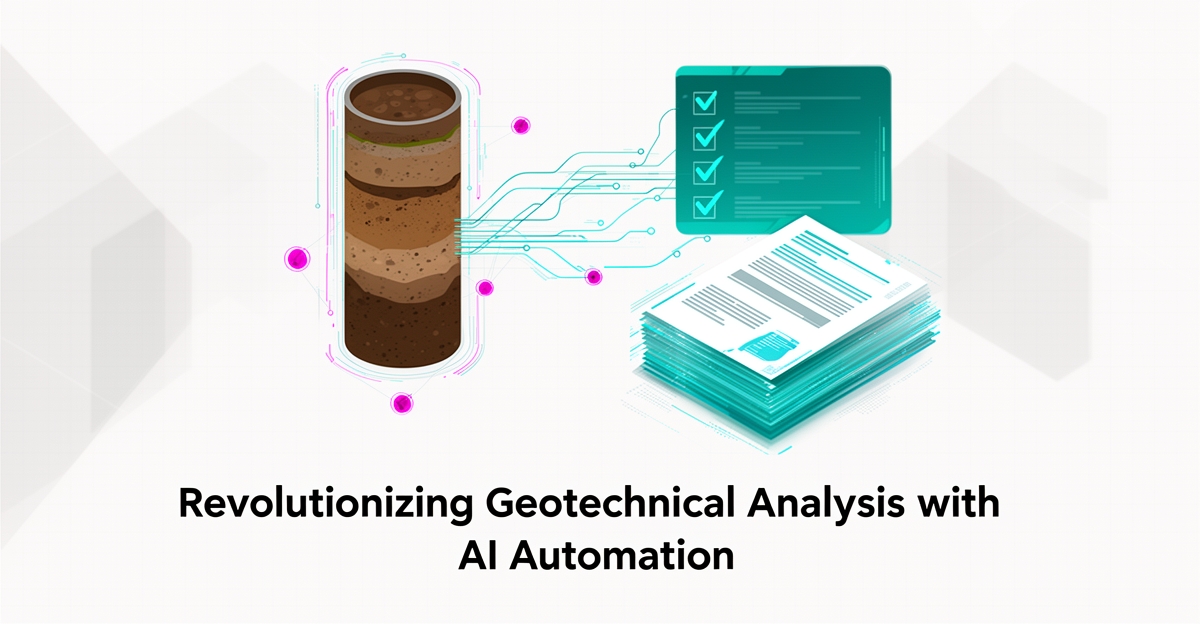
In practice, automation starts with extraction and synthesis. Field logs, borehole records, and laboratory test results are ingested and structured into a single source of truth. The system reconciles formats, flags missing parameters, and maps data to the relevant standard clauses.
Continuous regulatory tracking keeps documentation current. Instead of relying on periodic manual reviews, AI monitors updates to codes, standards, and jurisdictional requirements and alerts teams when a project deliverable needs revision. AI-powered compliance solutions help firms navigate complex regulatory landscapes and reduce the risk of non-compliance.
Audit readiness becomes a byproduct of the workflow, not a last-minute scramble. Reports are assembled from verified source data, with full lineage and timestamps preserved for review. This mirrors how modern construction platforms embed AI directly into project workflows so teams can work more efficiently and effectively.
AIQ Labs builds systems that apply these principles to geotechnical documentation, creating compliant geotechnical reports and continuously monitoring regulatory changes so documentation remains up to date and audit-ready. The result is consistent, traceable reporting across projects without manual rework.
Key automation outcomes include:
- Automatic extraction and normalization of data from field logs and lab results
- Mapping of findings to current engineering standards and regulatory clauses
- Real-time alerts for regulatory changes affecting active projects
- Generation of audit-ready reports with embedded data lineage
Governance matters as AI itself becomes part of the compliance stack. AI conformity assessment evaluates whether an AI system meets legal, technical, and ethical requirements under applicable frameworks. For high-risk applications, conformity assessments are required under the EU AI Act, and organizations must demonstrate accountability and ensure lawful deployment.
Real-World Impact: Risk Reduction and Operational Efficiency Gains
When a geotechnical report reaches a regulator, every figure, methodology note, and signature carries legal weight. A single inconsistency between project documents can trigger rework, delayed approvals, or worse, a compliance finding that damages a firm's standing. This is precisely where AI is proving its value, not as a futuristic concept but as a practical layer of quality control across reporting workflows.
The core benefit is reduced human error in reporting. AI systems can generate audit-ready reports and track regulatory updates automatically, ensuring documentation reflects the current state of engineering standards rather than an outdated template. For geotechnical firms managing dozens of concurrent projects, this means every submission starts from a consistent, verified baseline instead of a manually patched-together draft.
Consistency across projects is the second major gain. Manual reporting often varies by author, project history, or time pressure — one engineer's "adequate" is another's "insufficient." AI-driven document systems enforce a uniform structure and standard of evidence, which is exactly what auditors and regulators look for. Firms adopting AI in construction workflows typically report improved efficiency and decision-making as automated data analysis and reporting replace repetitive manual tasks.
The compliance dimension deserves particular attention. As regulatory frameworks grow more complex, AI-powered compliance solutions help firms navigate evolving requirements and reduce the risk of non-compliance. The regulatory environment itself is also formalizing around AI: under the EU AI Act, high-risk AI systems require conformity assessments to demonstrate legal, technical, and ethical accountability. Firms deploying AI for compliance work should therefore choose systems built with audit trails and governance from the start, not retrofitted later.
What does this look like in practice? Firms working with experienced AI developers typically see benefits across four areas:
- Automated generation of audit-ready reports aligned to current engineering standards
- Continuous tracking of regulatory updates, so no submission relies on stale requirements
- Consistent documentation quality regardless of which engineer produces the report
- Complete audit trails that make regulator queries faster and less stressful to answer
The operational efficiency gains compound over time. When engineers stop rebuilding report structures from scratch and stop manually checking whether a standard has changed, they redirect hours toward actual geotechnical analysis — the work clients are paying for. Faster turnaround on regulatory submissions also shortens project timelines, since approval bottlenecks often sit in documentation review rather than field work.
The key differentiator is deployment experience. AIQ Labs has deployed 200+ multi-agent systems and runs 4 live SaaS products daily, including compliance-oriented platforms with full audit trails — demonstrating that compliance-first AI architecture works in production, not just in theory. The same principles apply when generating audit-ready documentation for geotechnical work: validation layers, human-in-the-loop controls, and complete logging are what separate a trustworthy system from a liability.
For firms weighing the investment, the question is less whether AI can improve compliance reporting and more which risks — error, inconsistency, stale regulations — they are currently absorbing manually. Quantifying those risks is usually the fastest path to a clear answer.
Taking the First Step: AI Transformation for Geotechnical Firms
Starting an AI transformation doesn't require a massive upfront investment or a complete operational overhaul. The most successful geotechnical firms begin by mapping their current compliance workflows to pinpoint where manual effort creates the most risk.
The first step is a structured assessment of how your team handles regulatory documentation today. Identify which reports consume the most engineering hours, where version control fails, and which regulatory updates are missed because no one owns the monitoring process. AI conformity assessment frameworks require organizations to demonstrate accountability and lawful deployment, and a clear picture of current gaps makes that accountability possible.
Next, prioritize high-impact automation opportunities that deliver measurable results within weeks. The strongest candidates typically share three characteristics:
- Repetitive report generation that follows predictable templates
- Regulatory tracking across multiple jurisdictions or standards bodies
- Data extraction from field logs, lab results, or historical project files
AIQ Labs helps firms validate these opportunities through a two-minute Fit Check followed by a free 30-minute strategy call that maps your specific workflows to proven AI capabilities. Depending on where the exposure sits, that can mean a fixed-price Workflow Build that rebuilds the one compliance workflow costing you the most, AI Employees that handle reporting and monitoring at a fraction of the cost of another hire, or a phased AI Operating System that connects everything you own outright.
A pilot project should target one complete workflow, such as generating audit-ready geotechnical reports for a specific regulation or client type. This approach lets you measure time savings, error reduction, and consistency improvements against your current baseline before scaling. Automated tracking and reporting reduce non-compliance risk while freeing senior engineers for higher-value work.
The key is moving from evaluation to execution with a partner who owns the outcome. AIQ Labs builds in milestones so you pay as value is delivered, offers straightforward monthly starts for lighter needs, and can hand you a system you own outright — no vendor lock-in, no subscription chaos. Payment models are laid out plainly at aiqlabs.ai/pricing.
Still paying for 10+ subscriptions that don’t talk to each other?
We build custom AI systems you own outright. No vendor lock-in. Full control.
Not sure where to start? Ask our AI planner
Frequently Asked Questions
Is AI really worth it for compliance and regulatory reporting in geotechnical engineering?
How does AI handle constantly changing local and national codes?
Do we need to worry about compliance for the AI tools themselves?
Can AI automate the messy field logs and lab results we deal with?
Will AI replace our engineers or just create more work?
How do we start an AI compliance project without a huge upfront investment?
From Compliance Burden to Competitive Advantage
The evidence is clear: manual compliance processes in geotechnical engineering create avoidable risk, inconsistency, and delay that directly impact project timelines and firm reputation. AI offers a practical path forward, not as a distant innovation, but as a deployable capability today that automates audit-ready reporting, tracks regulatory changes continuously, and ensures consistency across every submission. For firms ready to move beyond evaluating the problem, the next step is identifying where manual effort creates the most exposure in your current workflow. AIQ Labs helps geotechnical firms take that step through a free 30-minute strategy call and Fit Check that maps your specific compliance bottlenecks to proven AI solutions, without requiring a massive upfront investment or operational overhaul. The goal isn't just to meet regulatory demands — it's to transform compliance from a reactive cost center into a source of operational reliability and client trust. To see where your firm stands and what's possible, start with the two-minute Fit Check at aiqlabs.ai/apply to explore your highest-impact automation opportunity.
Make AI your competitive advantage — not just another tool.
Strategy, implementation and ongoing optimization. One partner, end to end.
Not sure where to start? Ask our AI planner