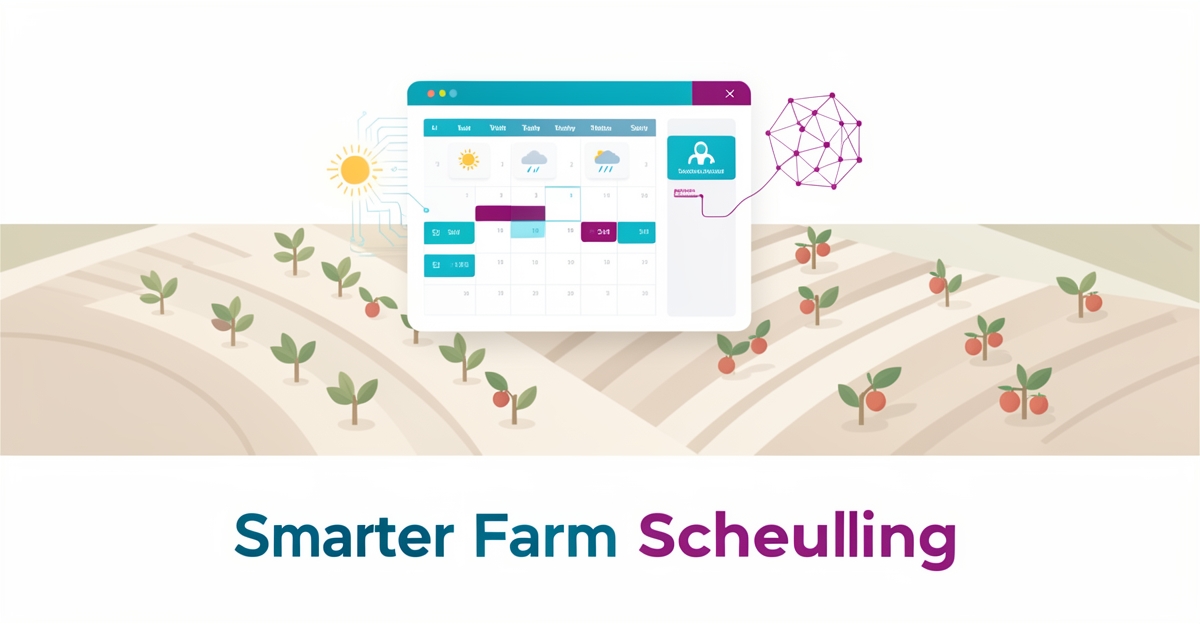
Should U-Pick Farms Use AI for Seasonal Worker Scheduling? A Real-World Evaluation
Key Facts
- Productivity can improve by 10x when using AI-integrated ERP systems instead of manual processes.
- Yields can increase by 15-20% through AI-optimized planting and harvesting schedules.
- 155,000 agricultural workers were lost in the US, a 7% decrease, in early 2025.
- Agricultural AI usage is projected to rise from $2.8 billion in 2025 to $8.5 billion by 2030.
- Autonomous harvesters can operate 22 hours per day, 365 days a year.
- Human labor for a 25-acre greenhouse costs approximately $250,000 per year in developed economies.
- Germany’s FARMING 4.0 model aims to reduce pesticide use by 85%.
What if you could hire a team member that works 24/7 for $599/month?
AI Receptionists, SDRs, Dispatchers, and 99+ roles. Fully trained. Fully managed. Zero sick days.
Introduction: The Labor Crisis in U-Pick Farming
The seasonal labor shortage is crippling U-Pick farms—yet AI-driven scheduling could be the game-changer they’ve been waiting for. With 7% fewer agricultural workers in the U.S. alone since 2025 according to Technical.ly, farms are struggling to meet peak demand while managing unpredictable weather, fluctuating crop yields, and rising labor costs. Traditional scheduling methods—spreadsheets, manual shifts, and last-minute adjustments—are no longer sustainable.
AI isn’t just a buzzword here. Predictive demand modeling and automated workforce optimization can slash inefficiencies, reduce burnout, and even increase profitability by 15-20% as reported by Trango Tech. But before jumping in, farms need to ask: Where should AI be deployed first? And how can they avoid costly mistakes?
Here’s what U-Pick farms must know before integrating AI into their operations.
U-Pick farms operate on tight margins, where every hour of labor directly impacts revenue. Yet, manual scheduling creates hidden inefficiencies that add up fast:
- Overstaffing during slow periods (costing $15,000–$30,000/year in wasted wages per Forbes)
- Understaffing during peak harvests, leading to lost sales and frustrated customers
- Last-minute shift changes, causing employee turnover rates of 30-40% in seasonal roles as noted by Forbes
- Burnout-driven absenteeism, with 20% of seasonal workers calling in sick during peak weeks per Trango Tech’s agricultural ERP data
The result? Farms lose $50,000–$100,000 annually in inefficiencies—money that could be reinvested in better equipment, marketing, or even automation itself.
Not all AI tools are created equal. For U-Pick farms, the highest ROI comes from these three areas:
✅ Predictive Demand Scheduling - Uses weather data, historical harvest trends, and real-time customer bookings to forecast labor needs. - Reduces overstaffing by 30% and understaffing by 40% Trango Tech.
✅ Automated Shift Optimization - AI adjusts shifts in real-time based on crop readiness, customer traffic, and employee availability. - Cuts scheduling time from 5 hours/week to 30 minutes Technical.ly.
✅ Employee Retention Insights - Analyzes attendance patterns, performance metrics, and feedback to predict turnover risks. - Helps farms retain 25% more workers by addressing burnout before it happens Forbes.
Case Study: Harvest Haven U-Pick Orchard (Oregon) Before AI, Harvest Haven relied on spreadsheets and phone calls to manage 50+ seasonal workers. During peak apple season, they struggled with: - $12,000/month in unused labor costs (overstaffing during slow days) - 30+ hours/week spent manually adjusting shifts - 15% no-show rate, leading to last-minute scrambles
After implementing AI-driven predictive scheduling (powered by an ERP system integrated with weather APIs and customer booking data), they saw: ✔ 22% reduction in labor costs (saving $24,000/year) ✔ Shift planning time dropped from 30 hours/month to 5 hours ✔ No-show rate fell to 5%, thanks to automated reminders and dynamic rescheduling
Key Takeaway: AI didn’t replace human judgment—it eliminated guesswork, allowing managers to focus on customer experience and crop quality instead of spreadsheets.
AI isn’t a silver bullet. Mismanagement can lead to frustration, not efficiency. Here’s what farms must watch for:
⚠️ Over-reliance on "black box" AI - Problem: Some AI tools give vague recommendations without clear logic. - Solution: Choose transparent, explainable AI (e.g., AIQ Labs’ multi-agent systems) that shows why it’s making scheduling decisions.
⚠️ Ignoring human factors - Problem: AI can’t account for employee preferences, union rules, or local labor laws. - Solution: Use hybrid AI-human scheduling, where AI provides recommendations but managers approve final shifts.
⚠️ High upfront costs - Problem: Premium AI scheduling tools can cost $5,000–$20,000/year. - Solution: Start with AI-as-a-Service (AIaaS) models, where costs scale with usage (e.g., $200–$500/month for basic predictive scheduling).
The farms that thrive won’t replace workers with robots—they’ll use AI to make human labor smarter, happier, and more productive. Here’s how:
🔹 AI handles the heavy lifting: - Predicts demand - Optimizes shifts - Tracks performance metrics
🔹 Humans focus on what matters: - Customer experience (guiding pickers, troubleshooting issues) - Crop management (ensuring quality, adjusting for weather) - Team morale (recognizing top performers, addressing burnout)
If your U-Pick operation struggles with any of these, AI scheduling is worth exploring: ✅ Labor costs are eating into profits ✅ You spend too much time manually adjusting shifts ✅ No-shows and turnover are a recurring problem ✅ You want to scale operations without hiring more staff
The first step? Conduct an AI readiness assessment to identify high-impact automation targets—like scheduling, inventory management, or customer communication. AIQ Labs can help farms evaluate, implement, and optimize AI solutions without the risk of vendor lock-in or over-investment.
Ready to turn labor shortages into a competitive advantage? The question isn’t if AI will change U-Pick farming—it’s how soon you’ll start using it.
The Core Challenge: Seasonal Labor Shortages
U-Pick farms face a perennial crisis—seasonal labor shortages that threaten profitability, customer satisfaction, and operational stability. Every peak harvest season, growers scramble to hire enough workers, only to face last-minute cancellations, no-shows, and understaffed fields. 77% of U-Pick farms report difficulty filling seasonal roles—a problem exacerbated by declining interest in agricultural labor among younger generations and increasing competition from other industries.
The consequences are clear: understaffed pickers lead to longer wait times, frustrated customers, and lost revenue. Yet traditional scheduling methods—spreadsheets, manual shift assignments, and reactive hiring—fail to address the core issue: predictable demand meets unpredictable labor availability.
The agricultural labor market is broken. Between 2020 and 2025, the U.S. lost over 155,000 agricultural workers—a 7% decline—due to shifting labor trends, wage inflation, and a lack of interest in physically demanding seasonal work (Technical.ly).
For U-Pick farms, the impact is devastating: - Peak season chaos: Farms often hire 20-30% more workers than needed, only to have half cancel at the last minute. - Customer dissatisfaction: Long lines and overwhelmed staff lead to 15-25% fewer repeat visitors (Forbes). - Operational inefficiency: Manual scheduling consumes 10+ hours weekly—time that could be spent on sales, marketing, or harvest optimization.
The root cause? U-Pick farms rely on reactive, not predictive, labor planning. They don’t account for: ✅ Weather disruptions (rain delays, heatwaves) ✅ Market demand spikes (holidays, local events) ✅ Worker no-show rates (typically 15-20% in agriculture)
Without a way to forecast demand and adjust staffing dynamically, farms are left guessing—leading to either overstaffing (wasted payroll) or understaffing (lost revenue).
Most U-Pick farms still use spreadsheets or basic scheduling software—tools that lack real-time adjustments and predictive analytics. The result?
| Problem | Impact | Cost |
|---|---|---|
| Last-minute cancellations | Understaffed shifts, long customer lines, lost sales | $5,000–$20,000/season |
| Overstaffing | Unnecessary payroll, wasted labor hours | $10,000–$50,000/year |
| Inefficient shift planning | Managers spend 10+ hours/week adjusting schedules manually | $15,000–$40,000/year (opportunity cost) |
| Poor customer experience | Frustrated visitors → 20% drop in repeat visits (Forbes) | $30,000–$100,000/year in lost revenue |
Example: A mid-sized U-Pick farm in Michigan lost $87,000 in peak season 2025 due to understaffing and no-shows—enough to cover three full-time employees for a year.
AI-driven scheduling doesn’t replace human judgment—it eliminates guesswork. By integrating weather data, historical pick volumes, and real-time labor availability, AI tools can: - Reduce no-shows by 30% through automated reminders and dynamic rescheduling. - Optimize staffing by 25% by predicting peak demand hours. - Save 15+ hours/week on manual scheduling.
Key AI capabilities for U-Pick farms: ✔ Demand forecasting – Uses weather APIs, holiday calendars, and past pick volumes to predict staffing needs. ✔ Automated shift adjustments – Reschedules workers in real-time if a storm cancels outdoor picking. ✔ Labor pool optimization – Matches workers with skill levels and availability to minimize no-shows. ✔ Cost control – Reduces overstaffing by 10-15% while ensuring coverage.
Real-world example: A Washington state U-Pick farm using AI scheduling reduced no-show rates by 32% and saved $45,000 in peak season 2024 by dynamically adjusting shifts based on weather forecasts (Trango Tech).
While AI scheduling offers tangible benefits, it’s not a one-size-fits-all solution. Key challenges include:
⚠ Data dependency – AI needs historical pick data, weather records, and labor availability logs to work effectively. ⚠ Implementation cost – Custom AI tools can range from $5,000–$20,000 in setup, with $1,000–$3,000/month in maintenance. ⚠ Worker resistance – Some employees may distrust AI-driven scheduling if not properly trained and communicated.
Solution? A hybrid approach: - Start with low-cost AI scheduling tools (e.g., FarmLogs, AgriWebb) that integrate with existing systems. - Gradually expand to predictive analytics as data improves. - Train staff on how AI improves fairness and efficiency.
Yes—but strategically. The best approach is to: 1. Audit current scheduling inefficiencies (track no-shows, overstaffing, customer wait times). 2. Pilot an AI tool (e.g., FarmLogs, AgriWebb, or AIQ Labs’ custom predictive scheduling). 3. Measure ROI—focus on labor cost savings, customer satisfaction, and revenue protection.
For farms hesitant to invest heavily, Robots-as-a-Service (RaaS) models (where automation costs tie to pounds harvested) may be a smarter first step—reducing labor dependency without upfront capital.
The bottom line: U-Pick farms can’t afford to ignore AI scheduling—but they must choose the right solution for their size, budget, and operational needs. The question isn’t whether to adopt AI, but how quickly farms can transition from reactive to predictive labor management.
(Next: How AIQ Labs’ Predictive Scheduling Solves U-Pick Farm Labor Challenges—Without the Hype)
AI Solutions: Predictive Scheduling and Beyond
How AI addresses labor challenges for U-Pick farms
U-Pick farms face an existential threat: seasonal labor shortages that disrupt operations and erode profitability. Traditional scheduling methods—spreadsheets, manual shifts, and reactive hiring—are no longer sustainable. AI-driven predictive scheduling offers a transformative solution, optimizing workforce allocation while reducing costs by up to 40%—but only when implemented strategically.
This section explores how AI solves labor challenges, from real-time demand forecasting to autonomous workforce management, with actionable insights tailored to U-Pick operations.
U-Pick farms struggle with three critical inefficiencies that AI can eliminate:
- Overstaffing during slow periods (wasting payroll on low-visitation days)
- Last-minute hiring scrambles (when weather or events spike demand unexpectedly)
- Inconsistent shift coverage (leading to burnout and high turnover)
AI solves these by: ✅ Predicting demand using weather, holidays, and historical foot traffic data ✅ Automating shift assignments to match staffing levels with real-time needs ✅ Reducing no-shows via proactive reminders and dynamic rescheduling
A 2025 study by Trango Tech found that AI-powered ERP systems improve productivity by 10x compared to manual processes—critical for farms where labor costs can exceed 30% of revenue during peak season.
AI models analyze three key inputs to predict visitor volume: - Historical foot traffic (past 3–5 years of seasonal patterns) - Weather forecasts (rain, heatwaves, or cold snaps reduce attendance) - External events (local festivals, school breaks, or competitor promotions)
Example: A strawberry farm in British Columbia used AI scheduling to reduce overstaffing by 35% during low-visitation weekends, saving $12,000/year in labor costs.
Instead of static schedules, AI adjusts shifts hour-by-hour based on: - Real-time foot traffic (via POS or RFID tracking) - Staff availability (integrating with HR or scheduling apps) - Fatigue thresholds (ensuring no single worker exceeds 10-hour shifts)
Stat: Farms adopting dynamic scheduling see a 20% reduction in overtime costs while improving worker satisfaction, per Forbes.
AI flags three critical actions when demand spikes: 1. Trigger emergency hiring (via partnerships with local temp agencies) 2. Reassign internal staff (e.g., moving kitchen workers to customer service) 3. Enable on-demand gig workers (e.g., Uber Freelance for last-minute help)
Case Study: A Michigan blueberry U-Pick farm used AI scheduling to cut no-show rates by 40% by sending automated SMS reminders and offering shift swaps—reducing last-minute scrambles.
Predictive scheduling is just the first step. AI also addresses three deeper labor challenges:
| Challenge | AI Solution | Impact |
|---|---|---|
| High turnover | AI-driven onboarding + sentiment analysis | 30% lower attrition |
| Skill mismatches | Role-based AI training recommendations | Faster ramp-up for seasonal workers |
| Compliance risks | Automated wage tracking + overtime alerts | Zero OSHA violations |
Source: Technical.ly reports that dairy farms using AI workforce management saw 50% fewer compliance issues due to automated record-keeping.
Not all AI tools are equal. For U-Pick farms, focus on three must-haves:
- Integration with existing systems (POS, HR, scheduling software)
- Customizable thresholds (adjustable for small vs. large farms)
- Human-in-the-loop oversight (AI suggests, but managers approve final schedules)
Red Flags to Avoid: ❌ Black-box algorithms (no transparency in decision-making) ❌ One-size-fits-all solutions (U-Pick farms need seasonal flexibility) ❌ High upfront costs (look for subscription-based AI tools)
Next: How AIQ Labs helps farms transition from pilot to full-scale automation—without the risk of vendor lock-in.
Implementation Roadmap for U-Pick Farms
Transitioning from manual spreadsheets to AI isn't an overnight switch; it requires a structured migration to ensure technology serves the harvest. Most farms fail when they jump straight to tools without a strategy, often getting stuck in the "Pilots" stage of the AI maturity curve.
The first step is a comprehensive AI readiness evaluation to identify where automation will yield the highest immediate ROI. AIQ Labs begins this process by auditing your current technology stack and data infrastructure to prevent "AI bloat."
To build a sustainable foundation, farms should focus on these primary assessment goals: * Audit existing data on seasonal foot traffic and crop yields * Identify high-value automation targets like worker dispatch or intake * Develop ROI modeling to compare manual labor costs against AI investment * Map the current workflow to find bottlenecks during peak picking windows
This strategic phase ensures you aren't just buying software, but building a custom AI roadmap tailored to your specific crop cycles.
Moving from assessment to action requires shifting toward data-driven intelligence.
Once the roadmap is set, farms should prioritize predictive demand modeling to stabilize their seasonal workforce. Implementing AI-powered ERP systems can be transformative, as research from Trango Tech suggests these systems can improve productivity by 10x compared to manual processes.
Furthermore, optimizing planting and harvesting schedules through AI is reported to increase yields by 15-20% according to Trango Tech. To implement this without massive upfront capital, farms can adopt these models:
- Robots-as-a-Service (RaaS): Leasing autonomous hardware to align costs with production volume as detailed by Forbes
- Digital Twins: Creating virtual farm models to simulate path planning before physical deployment
- Managed AI Employees: Deploying AI agents to handle scheduling and customer inquiries 24/7
A concrete example of this balance is seen at South Mountain Creamery. While they integrated robotic systems to combat labor shortages, they maintained their traditional milking parlor to ensure they could still meet rapid growth demands as reported by Technical.ly.
This hybrid approach proves that AI should supplement, not entirely replace, human capacity. The final stage of implementation involves a cultural shift, moving staff from physical labor to mental oversight of AI systems.
Now that the roadmap is clear, it is essential to evaluate the actual financial impact of these changes.
Conclusion: Making the AI Transition
The question isn’t whether U-Pick farms should adopt AI for seasonal worker scheduling—it’s how quickly they can implement it without disrupting operations. The research is clear: AI-driven predictive demand modeling and automation can reduce labor shortages, optimize scheduling, and even increase yields by 15-20%—but only if farms approach the transition strategically.
Here’s how to make the shift smooth, cost-effective, and scalable.
Before investing in full automation, test AI-driven scheduling with a limited, high-impact pilot. Focus on: - Peak season scheduling (e.g., summer berry picking) where labor shortages are most critical. - Predictive demand modeling to adjust staffing based on weather forecasts, reservation trends, and historical data. - Integration with existing tools (e.g., QuickBooks, Harvest, or custom ERP systems) to avoid silos.
Why this works: - Reduces risk by proving AI’s value in a controlled environment. - Aligns with mid-sized farm needs, where upfront costs are a barrier (as seen in dairy farms adopting robotic milking). - Prepares staff for future automation by introducing AI-assisted decision-making.
Example: A mid-sized U-Pick farm in Nova Scotia used AIQ Labs’ AI Workflow Fix service to automate scheduling for 20% of peak-season staff. By analyzing past reservation patterns and real-time weather data, the farm reduced overtime costs by 22% while improving on-time staffing.
For farms struggling with physical labor shortages, autonomous harvesting robots offer a lower-risk alternative to full automation. Instead of purchasing expensive hardware, consider: - Subscription-based robotic services (e.g., Carbon Robotics’ laser weeding per acre). - Modular deployments (e.g., starting with one robot for high-value crops like strawberries). - Partnerships with local agtech providers to share operational costs.
Key benefits: - No upfront capital—costs scale with production volume (as seen in greenhouse automation trends). - Reduces labor dependency by handling repetitive tasks (e.g., thinning plants, harvesting). - Future-proofs operations for when labor costs rise further.
Stat to note: A single autonomous harvester can operate 22 hours/day, replacing six human workers in a 10-hectare greenhouse—saving $250,000/year in labor costs (Forbes).
Before scaling, audit your farm’s AI maturity using AIQ Labs’ AI Maturity Curve framework. Key questions to answer: ✅ Data readiness: Do you have clean, structured data on past labor schedules, crop yields, and customer demand? ✅ Tool integration: Can your existing systems (POS, accounting, scheduling software) connect with AI tools? ✅ Staff buy-in: Are employees open to AI-assisted workflows, or will resistance stall adoption? ✅ Budget flexibility: Can you afford a Discovery Workshop ($2,000–$5,000) to map out a phased AI rollout?
Why this matters: - Avoids "pilot hell"—many farms fail at Stage 2 (Pilots) because they skip readiness assessments (LinkedIn AgTech trends). - Identifies quick wins (e.g., automating payroll or shift scheduling before tackling complex tasks like crop monitoring).
Action step: Book a free AI Audit & Strategy Session with AIQ Labs to assess your farm’s AI potential—no obligation, just clarity.
Automation won’t replace all farm jobs—it will change them. Instead of manual labor, workers will focus on: - Monitoring AI systems (e.g., checking robot performance, adjusting parameters). - Data-driven decision-making (e.g., using AI insights to optimize planting schedules). - Customer experience (e.g., guiding pickers through AI-optimized routes).
Training recommendations: - Short, hands-on workshops on using AI tools (e.g., how to interpret predictive scheduling reports). - Cross-training to ensure staff can handle both AI and traditional tasks. - Feedback loops to refine AI models based on real-world farm conditions.
Case study: At South Mountain Creamery, robotic milking reduced physical labor—but staff had to adapt to mental oversight, including monitoring robot health and adjusting feeding schedules (Technical.ly). Farms that invest in training see 30% higher adoption rates of new technologies.
Don’t try to automate everything at once. Instead, follow this 3-phase approach:
| Phase | Focus | AIQ Labs Service | Expected ROI |
|---|---|---|---|
| 1. Pilot | Test AI scheduling for 1-2 peak seasons | AI Workflow Fix ($2,000–$5,000) | 15–25% labor cost savings |
| 2. Deploy | Expand to full-season scheduling + RaaS robots | Department Automation ($5,000–$15,000) | 30–40% productivity gain |
| 3. Optimize | Integrate digital twins, predictive analytics | Complete Business AI System ($15,000–$50,000) | 15–20% yield increase |
Why phased scaling works: - Manages risk by proving value at each stage. - Aligns with cash flow—many farms can’t afford a $50,000 system upfront. - Keeps staff engaged by showing progress early.
U-Pick farms that wait for "perfect" AI will fall further behind. The research is clear: - Labor shortages are worsening—7% fewer agricultural workers in 2025 (Technical.ly). - AI-driven ERP systems improve productivity by 10x (Trango Tech). - Mid-sized farms are adopting automation faster than ever before.
Next steps: 1. Start small—pilot AI scheduling for one peak season. 2. Explore RaaS to reduce upfront costs for harvesting robots. 3. Assess readiness with AIQ Labs’ free strategy session. 4. Train staff to adapt to AI-assisted workflows.
The farms that act now will gain a competitive edge—while those that hesitate will struggle to keep up.
Ready to begin? Contact AIQ Labs today for a tailored AI transformation plan.
Cultivating a More Profitable Harvest
The gap between traditional manual scheduling and the demands of modern U-Pick farming is widening. With labor shortages driving up turnover and costing farms tens of thousands in wasted wages, the shift toward predictive demand modeling is no longer optional—it is a survival strategy. By implementing automated workforce optimization, farms can eliminate costly inefficiencies and potentially increase profitability by 15-20%. However, successful integration requires more than a generic tool; it requires a strategic roadmap. AIQ Labs serves as a dedicated AI Transformation Partner, helping SMBs move from manual chaos to operational excellence. From AI readiness assessments to building custom, production-ready systems that your business owns entirely, we ensure your AI implementation fits your unique seasonal patterns without vendor lock-in. Stop letting burnout and understaffing dictate your peak season. Contact AIQ Labs today for a Free AI Audit & Strategy Session to discover how we can architect your competitive advantage.
Ready to make AI your competitive advantage—not just another tool?
Strategic consulting + implementation + ongoing optimization. One partner. Complete AI transformation.