Should You Hire an AI Technician or a Human for Line Location Requests?
Key Facts
- Hybrid AI-human models typically outperform either approach alone in scalability and decision quality
- AIQ Labs has deployed 200+ multi-agent systems and runs 4 live SaaS products daily
- AI Employees cover 99+ roles, including dispatchers and intake specialists, at roughly 80% less cost than a human hire, working 24/7/365
- AIQ Labs delivered a full dispatch automation platform for an electrical services company covering scheduling, dispatch, and lead capture end-to-end
Hire a team member that works 24/7 — for less than a part-time wage.
AI receptionists, SDRs, dispatchers and 99+ roles. Trained on your business, fully managed.
Not sure where to start? Ask our AI planner
The Line Location Dilemma: When Every Call Competes for Limited Technicians
Every locate request lands in the same queue, and not every request deserves a truck roll. Utility locating teams are squeezed between routine, non-emergency calls that eat technician hours and safety-critical jobs that cannot wait. The pressure creates a dispatch bottleneck where missed calls and delayed responses compound.
Across service industries, AI adoption is accelerating, particularly for automating repetitive intake and routing work. Utility locating is no exception. The question is no longer whether to automate, but which parts of the workflow to automate and which to keep in human hands.
Routine locate requests are high-volume, low-variance, and time-sensitive. They require accurate data capture, ticket creation, and status updates, not field expertise. Human-only handling limits scalability and efficiency, while an AI-only approach risks lack of human judgment and expertise when conditions change.
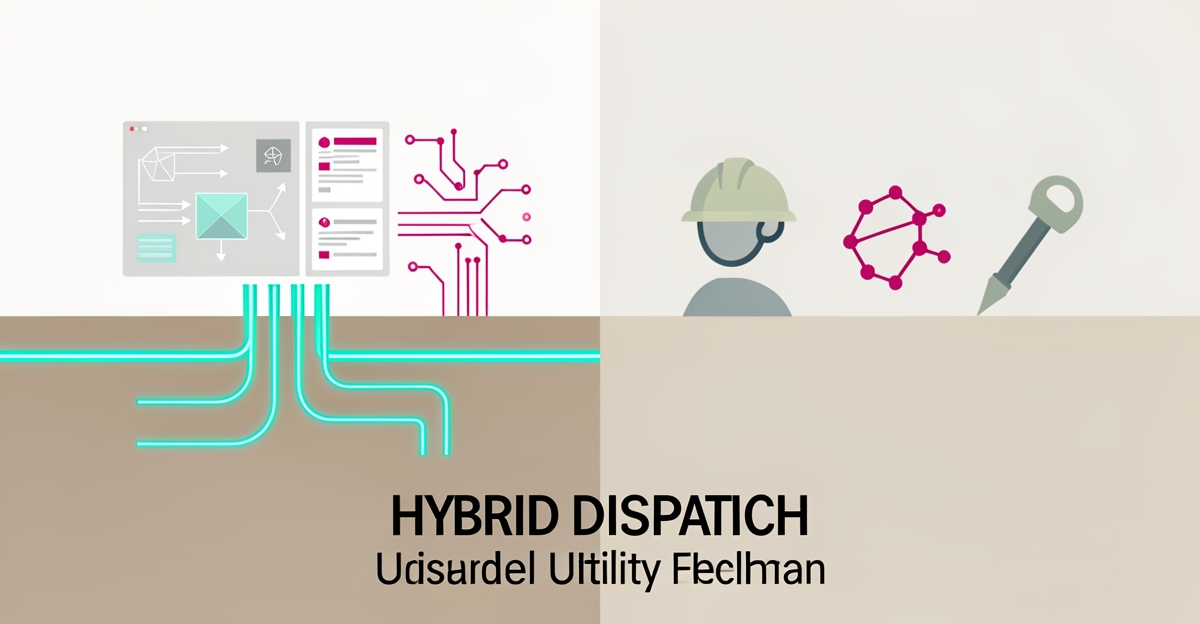
Hybrid models that combine the strengths of both AI and human technicians are becoming increasingly popular. These models allow companies to leverage the efficiency and accuracy of AI while also benefiting from the expertise and judgment of human professionals. The framing of AI-only versus human-only is a false choice.
A practical hybrid splits the workflow by risk and complexity:
- AI handles initial call intake, caller verification, and ticket triage 24/7
- AI performs automated dispatching for standard, non-emergency locates
- Human technicians receive pre-qualified jobs with full context and maps
- Humans take over high-risk, complex, or ambiguous locations requiring judgment
This division protects technician time for work only a human can do. The cost of missed calls is not just lost revenue; it is delayed projects, compliance exposure, and eroded customer trust when locates slip.
Integration is the critical challenge. Managing the integration of AI and human professionals in hybrid models requires clear escalation rules, transparent handoffs, and audit trails for safety decisions. Ensuring the accuracy and reliability of AI-powered tools is essential before any field dispatch is authorized.
AIQ Labs works with utility and field service teams to map routine intake to managed AI employees while keeping humans on safety-critical tasks. The goal is maximizing both efficiency and reliability, not replacing technicians.
The market is already moving this way. Demand for intelligent triage in operations is growing as service businesses look to absorb routine volume without adding headcount.
When routine calls compete for limited technicians, the winning approach is not more headcount. It is designing a hybrid operating model where AI absorbs the repetitive front end and humans focus on judgment, safety, and complex locates.
The Hybrid Model: AI Handles the Routine, Humans Handle the Risk
In utility locating, routine requests like marking standard residential lines or scheduling non-urgent checks often consume disproportionate time and resources when handled by human technicians alone. AI voice agents excel at managing these predictable intake workflows, answering calls, verifying addresses, scheduling dispatches, and routing tickets, without fatigue or delay. This frees skilled human locators to focus on high-risk scenarios such as emergency strikes, complex utility corridors, or environmentally sensitive zones where judgment and field expertise are irreplaceable.
Experience across deployments consistently shows that blending human skills with automation outperforms either approach in isolation. Organizations combining AI efficiency with human judgment typically achieve better scalability and decision quality than those relying solely on one method. For utility locators, this means AI handles volume and repetition while humans manage ambiguity and safety-critical nuance.
AIQ Labs implements this balance through managed AI Employees that serve as intelligent dispatchers and intake specialists, operating 24/7 to triage requests, update job statuses, and coordinate schedules, while human technicians receive only the tasks requiring on-site assessment, locate precision, or damage prevention oversight. This division of labor reduces bottlenecks in routine processing and ensures that experienced staff are deployed where their training prevents costly errors or service disruptions.
The result is a resilient workflow: AI maintains consistent throughput for standard locates, and humans apply their expertise where it matters most, protecting infrastructure, ensuring compliance, and responding to evolving field conditions. By aligning automation with human strengths, utility locating businesses gain both operational efficiency and risk mitigation without sacrificing service quality or safety standards.
A Decision Framework: Which Requests Go to AI, Which Go to Humans
Splitting locate requests by risk and complexity protects margins without sacrificing safety. The right triage lets routine work flow to automation while humans stay on high-stakes jobs.
Request type is the first filter. Standard residential marks with clear site access and no known conflicts are ideal for AI intake and dispatch. Complex commercial sites, multi-utility coordination, or requests with incomplete address data need human review. Sector-specific design matters more than generic automation, AI tools built for a specific industry's workflows consistently outperform one-size-fits-all systems.
Risk level dictates the handoff point. Low-risk, non-emergency locates with low consequence of error can be handled end-to-end by AI. Medium-risk jobs with proximity to sensitive infrastructure or prior damage history benefit from AI triage plus human verification. High-risk, emergency, or safety-critical requests stay with human technicians. Hybrid models leverage AI efficiency and accuracy while retaining human expertise and judgment.
Customer profile and urgency complete the matrix. Repeat commercial customers with standardized processes and portal access are good AI candidates. First-time callers, municipalities, or customers with compliance documentation needs usually require human touch. Urgent same-day requests with ambiguous scope should route to humans; routine next-day windows can be AI-dispatched.
A simple decision matrix you can apply today:
- AI First: Standard residential, complete data, low risk, non-urgent
- AI Triage + Human Verify: Commercial, partial data, medium risk, standard urgency
- Human First: Emergency, high risk, safety-critical, complex coordination
- Human with AI Assist: New customer, compliance-heavy, first-time site
Practical implementation follows the same principles across industries: embed AI deeply into every layer of the process, prioritize value-driven tools, regularly assess the tech stack, and blend human skills with automation. This approach mirrors how AIQ Labs designs hybrid models where AI handles initial calls and dispatching while humans take over high-value or safety-critical tasks, maximizing both efficiency and reliability.
Implementing Your Hybrid Dispatch System Without Disrupting Operations
Most AI initiatives in service businesses stall not because the technology fails, but because the rollout tries to change everything at once. A phased approach, one workflow, one category, one measurable win, keeps your dispatch operation stable while you build proof.
Start with an honest audit of your current call flow. Map every line location request from first ring to dispatched ticket: who answers, what information gets captured, where tickets get logged, and where handoffs break down. This baseline matters because the automation landscape is crowded, and without a clear map of your own process, vendor selection becomes guesswork.
Next, pilot an AI dispatcher on a single, defined request category. Routine, non-emergency line location requests are the ideal candidate: they follow predictable scripts, require structured data capture, and carry low risk if escalation is needed. Define success metrics before launch, call answer rate, ticket accuracy, average handling time, so the pilot produces evidence, not anecdotes.
Integration is where pilots become permanent. Your AI dispatcher must write directly into your existing ticketing system and GIS platform, not create a parallel workflow your team has to reconcile manually. At AIQ Labs, this is exactly how our workflow builds are structured: our Build in Milestones model splits the work into phases, so you approve and pay for each stage as it ships, and keep everything built so far if priorities change. For an electrical services client, we delivered a full dispatch automation platform covering scheduling, dispatch, and lead capture end-to-end, proving the model in the field services context.
A practical rollout sequence looks like this:
- Audit current call flow and document every handoff point
- Select one routine request category for the AI pilot
- Integrate with existing ticketing and GIS systems before go-live
- Run the pilot with defined metrics for 30–60 days
- Expand to additional categories only after results are verified
Finally, measure relentlessly and keep humans in the loop. Implementation experience consistently points to blending automation with human expertise rather than replacing one with the other. AI works best when experienced professionals supervise the edges. In line location, that means your technicians stay focused on complex, safety-critical locates while the hybrid dispatch model absorbs the routine volume.
The businesses that succeed here treat implementation as an operational change, not a software install. Move in phases, measure everything, and let results, not hype, dictate the pace of expansion.
The Bottom Line: Efficiency and Safety Aren't Competing Goals
The question isn't whether AI or human technicians are better for line location requests, it's about designing a system where each does what it does best. Across sectors, AI tools are being adopted to handle routine tasks while preserving human expertise for complex decisions.
For utility locating, this means AI can efficiently manage initial call triage, standard locate requests, and dispatch routing, freeing human technicians to focus on high-risk scenarios like emergency digs, utility conflicts in dense urban areas, or projects requiring nuanced interpretation of as-built plans. This division of labor isn't theoretical; it mirrors the hybrid approach gaining traction in fields like HVAC, where AI optimizes scheduling and diagnostics while humans handle installation and safety-critical adjustments.
A well-designed hybrid model delivers measurable gains: AI handles volume with consistency, reducing response times for non-emergency requests, while humans apply judgment where safety and regulatory compliance are paramount. The result is an operation that scales efficiently without compromising reliability, a balance that's especially critical when locating live gas, electric, or telecom lines.
If you're evaluating your current workflow, start with a low-risk step: assess where AI could take over repetitive intake or dispatch tasks without disrupting your core locating process. AIQ Labs helps utility locating businesses map these opportunities through a free strategy call that identifies high-ROI automation points tailored to your operation.
Schedule your free 30-minute strategy call to explore how a hybrid AI-human system can improve both efficiency and safety in your line location workflow, no obligation, just clarity on where AI fits best.
Still paying for 10+ subscriptions that don’t talk to each other?
We build custom AI systems you own outright. No vendor lock-in. Full control.
Not sure where to start? Ask our AI planner
Frequently Asked Questions
Should I replace my human technicians with AI for line locates?
What types of locate requests are actually safe for AI to handle?
Won't using AI mean missed calls and compliance exposure?
Is AI adoption really moving fast enough to matter for utility locating?
How do I pilot AI dispatch without disrupting my current operation?
What's the difference between hybrid and AI-only in practice?
Stop Choosing Between AI and Humans, Start Combining Them
The debate isn't AI versus human technicians, it's how to structure them so routine volume doesn't bury critical expertise. AI excels at 24/7 intake, verification, and dispatch for standard residential locates, while human judgment remains non-negotiable for emergency strikes, dense urban corridors, and safety-critical interpretation. Start small. Pilot AI dispatch on one routine category, like standard residential marks, while keeping humans on high-risk tickets. Measure call answer rates and ticket accuracy for 30 days before expanding. AIQ Labs has deployed 200+ multi-agent systems and helps utility locating teams design hybrid workflows that map where automation ends and expertise begins. Ready to see where AI fits in your operation? Book a free 30-minute strategy call to identify your highest-ROI automation opportunities, no obligation, just a clear roadmap for your dispatch workflow.
Make AI your competitive advantage — not just another tool.
Strategy, implementation and ongoing optimization. One partner, end to end.
Not sure where to start? Ask our AI planner