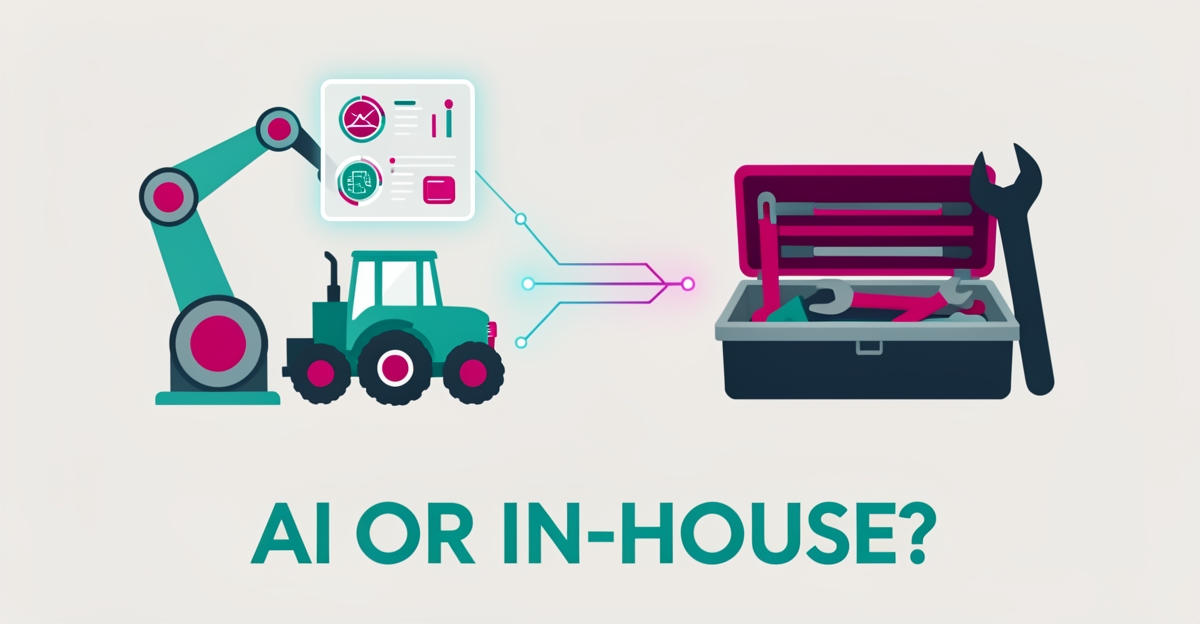
Should You Hire an AI Technician or Keep Repair Work in House?
Key Facts
- A fully loaded human technician typically costs $4,000–$7,000 monthly for 40 hours weekly, while AI employees work 24/7/365 for roughly 80% less than a human hire.
- Workforce research consistently shows most companies report roles have already changed or been reshaped by automation—the shift is toward task redistribution, not wholesale replacement.
- The repair shop tasks most exposed to AI are the repetitive ones: phone intake, scheduling, status calls, and data entry—exactly the tasks pulling your highest-cost labor away from billable work.
- AI knowledge capture systems can sharply reduce repetitive technician questions by turning tribal knowledge into searchable institutional memory.
- Maintenance software analysis shows AI's biggest immediate value is helping technicians troubleshoot complex machines by instantly searching thousands of manual pages.
- AIQ Labs has deployed 200+ multi-agent systems and runs 4 live SaaS products daily—real operational experience, not theory.
Hire a team member that works 24/7 — for less than a part-time wage.
AI receptionists, SDRs, dispatchers and 99+ roles. Trained on your business, fully managed.
Not sure where to start? Ask our AI planner
The Technician Shortage Is Reshaping Farm Equipment Shops
The labor market for skilled trades is tightening just as automation expectations are accelerating. Farm equipment shops feel the squeeze first, where a single diesel or hydraulic technician can determine service capacity for an entire season.
Macro trends show the pressure is systemic. As of late 2026, widely cited workforce research reports that most companies say roles have already changed or been reshaped by automation, and large majorities of workers worry about AI's impact on their jobs. The anxiety is not theoretical—it's showing up in hiring plans, retention, and how shops schedule work.
For farm equipment dealers, that national trend collides with a local reality. Shops compete for a shrinking pool of certified technicians, and retention is fragile when overtime, seasonal demand, and rural location make the role unattractive. The result is longer repair backlogs, lost revenue, and owners forced to choose between turning away work or paying unsustainable premiums.
AI in maintenance is no longer a single tool. It spans a spectrum from generative assistants that read manuals to predictive models and computer vision. Maintenance software reviews note the biggest immediate value is helping new technicians troubleshoot complex machines by instantly searching thousands of PDF manual pages. That capability directly addresses skill gaps.
The shortage reframes the hire-versus-automate decision as survival, not experimentation. Owners evaluate:
- Cost and scalability of a human technician versus a managed AI employee that works 24/7/365
- Skill retention risk when experienced staff leave and tribal knowledge walks out the door
- Speed to service during peak harvest and planting windows when downtime costs farmers daily
Data quality remains the bottleneck. Analysis of AI maintenance tools emphasizes AI models are garbage-in, garbage-out, and the best software helps capture clean data from the shop floor first. That means shops must digitize work orders, parts history, and diagnostic notes before automation delivers value.
This is where an AI strategy and transformation consulting lens helps. A comparative analysis of in-house technicians versus AI employees for farm equipment shops focuses on cost, scalability, and skill retention, not hype. AIQ Labs works with SMBs to map which workflows are best suited for augmentation versus full automation, and how to phase adoption without disrupting service.
The decision is not about replacing people outright. It is about protecting capacity while the labor market reshapes. Shops that treat automation as a workforce strategy, not a tech upgrade, are more likely to keep repair work in house on their own terms.
What an AI Technician Actually Does in a Repair Shop
The term "AI technician" sounds like science fiction, but on the shop floor it breaks down into three distinct capabilities: Generative AI that reads manuals, Predictive AI that forecasts failures, and Computer Vision that inspects components. AI in maintenance isn't one thing—it ranges from assistants reading thousands of PDF pages to vibration analysis predicting bearing wear before a combine stops in the field.
Generative AI delivers the fastest ROI for most shops. A new hire facing a Tier 4 engine fault code no longer spends hours flipping through binders; the AI ingests the entire OEM library and surfaces the exact torque spec or wiring diagram in seconds. Predictive AI shifts the conversation from "what broke" to "what will break next week" by analyzing vibration, oil analysis, and thermal trends across the fleet. Computer Vision handles the visual grind—scanning hydraulic fittings for micro-leaks or reading worn serial plates that human eyes miss under shop lights.
- Instant OEM manual retrieval across thousands of PDFs for any model year
- Work order triage that routes the right tech with the right parts before the bay opens
- Parts lookup and cross-referencing that sharply cuts phone time with dealers
- Compliance logging that auto-populates EPA, OSHA, and warranty records
None of this turns a wrench. The AI cannot feel a loose kingpin, smell burnt clutch material, or improvise when a 20-year-old implement has zero documentation. It augments the journeyman—handling the lookup, the logging, the scheduling—so the technician spends more time diagnosing and repairing. Workforce research consistently shows the shift is toward task redistribution, not wholesale replacement. The shops winning with AI aren't firing technicians; they're giving each technician a digital apprentice that never forgets a spec sheet.
Cost Comparison: AI Employee vs. Human Technician at Scale
The math behind the "hire or automate" question changes completely once you look past the hourly wage and count what a human technician actually costs your shop. When you factor in salary, benefits, taxes, recruiting, and training, a fully loaded technician typically runs $4,000–$7,000 per month for 40 hours a week of availability—and that number climbs fast in a tight rural labor market.
Now compare that to an AI Employee: a flat monthly plan that costs roughly 80% less than a human hire, with build, training, tool integrations, monitoring, and improvements included. The AI works 24/7/365 with zero missed calls, and broader economics back this up—industries with high AI exposure have consistently outpaced low-exposure sectors on revenue per employee growth in recent analyses.
Here's how the unit economics play out at three shop sizes:
- Solo owner: You're the technician, service writer, and receptionist. An AI Employee answers every call, books jobs, and handles intake while you wrench—recovering billable hours that currently evaporate to a ringing phone.
- 3-bay shop: Call volume and scheduling complexity outgrow the front counter. AI absorbs overflow diagnostics inquiries and scheduling, so your techs stay on billable work instead of context-switching.
- 10-bay fleet operation: At this scale, AI handles the full coordination layer—dispatch, status updates, follow-ups—while your human team focuses exclusively on high-skill repair work.
The crossover point arrives sooner than most owners expect. The tasks most exposed in a repair shop are exactly the repetitive ones: phone intake, scheduling, status calls, and data entry. Those are also the tasks pulling your highest-cost labor away from revenue-generating work.
Importantly, this isn't about replacing skilled technicians—it's about protecting them. Maintenance technology analysis notes AI's biggest immediate value is helping technicians troubleshoot complex machines faster, not doing the wrenching itself. The shops winning this equation pair human diagnostic skill with AI handling everything around the repair.
The right split depends on your call volume, bay count, and growth plans—which is exactly what AIQ Labs maps in a free strategy session, with real numbers tailored to your operation rather than generic benchmarks. See the pricing models for how payment works at each level.
Skill Retention & Knowledge Capture: The Hidden ROI
The real cost of losing a senior technician isn't just their salary—it's the silent drain of undocumented expertise walking out the door. When torque specs, fault code quirks, and vintage tractor nuances live only in a veteran's memory, every repair becomes a gamble and onboarding new hires stretches into months. This tribal knowledge gap forces shops to repeatedly answer the same questions, slowing productivity and frustrating teams.
AI changes this dynamic by turning daily repair work into a structured knowledge capture process. By requiring technicians to log symptoms, actions, and outcomes through guided workflows, the system forces clean, consistent data entry from the shop floor—addressing the garbage-in, garbage-out reality that undermines most AI tools. Over time, this builds a searchable repository of institutional memory that anyone can access, reducing reliance on individual experts.
Shops using structured knowledge capture typically see a sharp drop in repetitive questions as technicians self-serve solutions from the AI-powered knowledge base. New hires ramp up faster, not because they're memorizing manuals, but because they're learning from real-world repair patterns encoded in the system. This transforms AI from a simple automation tool into a retention engine that preserves expertise long after senior techs retire.
- Captures torque specs, fault code nuances, and equipment quirks as searchable data
- Forces clean data entry from the shop floor to ensure AI accuracy
- Cuts repetitive questions sharply through instant knowledge access
- Accelerates onboarding by turning tribal knowledge into guided learning
- Preserves institutional memory when experienced technicians leave
The result isn't just fewer interruptions—it's a self-improving system where every repair makes the next one easier. As experienced staff transition out, their knowledge doesn't vanish; it becomes embedded in the workflow, guiding newer technicians with context-aware suggestions that reflect real shop-floor wisdom. This creates a virtuous cycle: better data capture leads to smarter AI, which in turn encourages more accurate logging, continuously refining the knowledge base.
For farm equipment shops facing workforce turnover or growth plateaus, this hidden ROI—skill retention through structured knowledge capture—often outweighs the obvious labor savings. The AI doesn't replace the technician; it amplifies their impact by making their expertise scalable, searchable, and sustainable across shifts and seasons. In an industry where one undocumented fix can cost hours of downtime, turning intuition into intelligence isn't just efficient—it's essential.
Decision Framework & Next Steps for Your Shop
Deciding whether to keep repair work in-house, deploy an AI employee for dispatch and diagnostics, or build a connected automation layer requires a clear, scored framework. Start by evaluating your shop's daily repair volume, the complexity of diagnostic tasks, and the readiness of your historical service data. Shops handling over 15 repairs per day with standardized fault codes and documented service histories are stronger candidates for AI augmentation, especially when data quality is high—since AI models require clean, shop-floor data to function effectively and deliver value in troubleshooting complex machines by instantly searching thousands of manual pages.
Next, assess your budget constraints and growth trajectory. If your monthly labor budget for intake and dispatch is under $3,000 and you're in a scaling phase, an AI Employee via the Start Monthly model offers 24/7 availability at roughly 80% less than a human hire, with setup, training, tool integrations, and ongoing improvements included. For shops with moderate volume but evolving workflows—such as those adding new equipment lines or service tiers—an AI Workflow Build lets you rebuild the one workflow that costs the most (like service dispatch) in phases, paying only for completed milestones and retaining everything built so far. Targeted AI integration is becoming a baseline for operational resilience as automation reshapes roles across industries.
For mature shops planning multi-year growth or seeking to eliminate manual bottlenecks across scheduling, parts lookup, and technician routing, an AI Operating System through the Own It Outright model delivers one connected operating layer you own outright—full control over code, agents, and data. This path supports long-term scalability and skill retention by preserving institutional knowledge in an AI-enhanced system rather than relying solely on individual technicians. Regardless of the path chosen, the decision should reflect your current capacity, data readiness, and strategic goals—not just immediate cost savings.
- Score volume: Low (<5 repairs/day), Medium (5–15), High (>15)
- Score complexity: Basic (standard faults), Moderate (multi-system), High (intermittent/unknown)
- Score data readiness: Poor (no logs), Fair (sporadic), Good (structured, searchable)
- Score budget: Constrained (<$3k/mo), Moderate ($3k–$6k/mo), Flexible (>$6k/mo)
- Score growth stage: Stable, Scaling, Transforming
Based on your scores, choose: keep fully in-house (low volume, low complexity, poor data), deploy an AI Employee for dispatch/intake/diagnostics (medium volume, moderate complexity, good data, constrained budget), or build an AI Operating System (high volume, high complexity, good data, scaling/transforming stage). Each path maps directly to AIQ Labs' three payment models—Start Monthly, Build in Milestones, or Own It Outright—ensuring you only pay for the level of automation that matches your shop's readiness and trajectory. No fake prices, no invented case-study numbers.
To get a personalized assessment of where your shop stands and which AI transformation path delivers the highest ROI, start the free Fit Check—a two-minute evaluation that leads to a no-obligation 30-minute strategy call with an AIQ Labs engineer. We'll map your biggest bottleneck, validate your automation opportunities, and tell you plainly if there's a clear win—or if now isn't the right time. No pitch. Just clarity.
Still paying for 10+ subscriptions that don’t talk to each other?
We build custom AI systems you own outright. No vendor lock-in. Full control.
Not sure where to start? Ask our AI planner
Frequently Asked Questions
What does an AI technician actually do in a farm equipment repair shop?
How much does an AI employee cost compared to a human technician?
Will using an AI technician replace my skilled repair staff?
How does AI help with skill retention when experienced technicians leave?
What kind of data do I need for AI to work effectively in my shop?
Is now the right time to adopt AI in my farm equipment shop?
Protect Capacity, Not Just Headcount
The technician shortage isn't a temporary hiring squeeze, it's a structural shift forcing farm equipment shops to choose between turning away work and paying unsustainable premiums. AI doesn't replace the wrench, it protects the capacity to use it. Generative AI handles manual lookups and logging, predictive models flag failures before harvest, and computer vision catches what eyes miss, while clean shop-floor data capture turns tribal knowledge into a searchable asset that survives turnover. The decision isn't hire versus automate, it's how to keep repair work in-house on your terms by augmenting people where they add the most value. Score your volume, complexity, data readiness and budget, then match it to the right level of support—Start Monthly with an AI Employee, Build in Milestones on a Workflow Build, or Own It Outright with an AI Operating System. AIQ Labs maps that fit for SMBs with a comparative analysis focused on cost, scalability and skill retention, not hype, backed by 200+ multi-agent systems deployed and 4 live SaaS products the company runs daily. Start with clarity, not commitment. Start the Fit Check for a free 30-minute strategy call to map your bottleneck and see if there's a clear win. As automation reshapes roles across industries, the shops that treat it as a workforce strategy are the ones keeping service local.
Make AI your competitive advantage — not just another tool.
Strategy, implementation and ongoing optimization. One partner, end to end.
Not sure where to start? Ask our AI planner