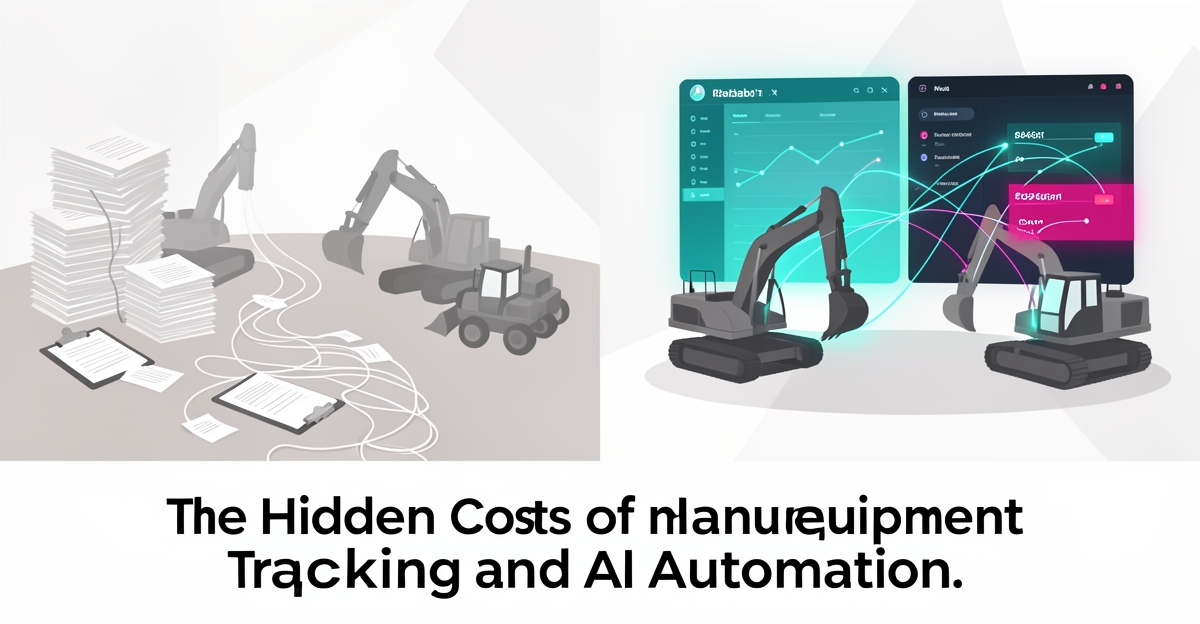
The Hidden Cost of Manual Equipment Tracking: How AI Can Save Dealers Thousands in Operational Waste
Key Facts
- Equipment managers typically spend the majority of their week on paperwork instead of strategic decisions according to industry research
- The average hunt for a lost tool can consume 90 minutes of paid labor time that generates zero productivity studies show
- A single misplaced $80 grinder can exceed $300, several times its original value, when factoring in project delays and replacement costs research reveals
- Manual data entry introduces significant error rates in maintenance records, leading to incorrect service schedules and premature equipment failure data confirms
- Emergency repairs typically cost 3-5 times more than planned maintenance due to delayed issue detection industry analysis shows
- Mid-sized companies can lose roughly 5% of total equipment value annually through theft, misplacement, and accountability gaps analysis indicates
- For a dealer managing $2 million in equipment, untracked assets can translate to $100,000 in avoidable losses each year studies estimate
Hire a team member that works 24/7 — for less than a part-time wage.
AI receptionists, SDRs, dispatchers and 99+ roles. Trained on your business, fully managed.
Not sure where to start? Ask our AI planner
The Real Price of Manual Equipment Tracking: Beyond Labor Costs
The true cost of manual equipment tracking extends far beyond labor hours. Equipment managers routinely spend most of their time on paperwork instead of strategic decisions, creating a fundamental drain on operational intelligence industry research confirms. This administrative burden prevents teams from focusing on predictive maintenance, workflow optimization, or growth initiatives that drive real value.
When assets go missing, the financial impact compounds rapidly. The average hunt for a lost tool can consume 90 minutes of paid labor time that generates zero productivity studies show. When combined with project delays and replacement costs, a single misplaced $80 grinder can exceed $300, several times its original value, turning routine oversight into significant profit leakage.
These inefficiencies trigger cascading costs throughout operations. Manual data entry introduces meaningful error rates in maintenance records, leading to incorrect service schedules and premature equipment failure data reveals. Emergency repairs then cost 3-5 times more than planned maintenance, while untracked equipment can result in mid-sized companies losing roughly 5% of total equipment value annually through theft, misplacement, and accountability gaps analysis indicates. For a dealer managing $2 million in equipment, this can translate to $100,000 in avoidable losses each year, funds that could instead support strategic investments or AI-powered transformation initiatives.
- Lost productivity from asset searches consuming up to 90 minutes per incident
- Error-related rework from inaccurate maintenance records
- Compounding costs from reactive maintenance at 3-5x planned service expenses
- Annual equipment value erosion of up to 5% due to tracking gaps
- Opportunity cost of skilled staff spending most of their time on administrative tasks
How AI Automation Eliminates Equipment Tracking Waste
Manual equipment tracking creates operational waste that erodes profitability in subtle but significant ways. Equipment managers spend most of their time on paperwork instead of strategic decisions, turning skilled professionals into data clerks according to industry research. This administrative burden compounds when emergency repairs cost 3-5x more than planned maintenance due to delayed issue detection.
AI-powered automation eliminates these inefficiencies through real-time visibility, predictive maintenance, and automated document processing. Organizations implementing AI automation report dramatic reductions in equipment breakdowns and operational downtime by shifting from reactive to predictive models as documented in field studies. These systems process information with near-zero error rates, delivering substantially faster processing times compared to manual workflows that typically contain data entry errors per operational analysis.
- Continuous monitoring through IoT sensors analyzes thousands of data points per second to detect anomalies before failures occur
- Dynamic maintenance scheduling optimizes resource allocation based on actual equipment conditions rather than arbitrary calendars
- Automated document processing eliminates manual data entry while maintaining audit trails for compliance
- Real-time dashboards provide instant visibility into equipment status, location, and utilization across distributed fleets
- Predictive analytics forecast maintenance needs, extending equipment life while minimizing unnecessary downtime
For dealers managing inventory and equipment status, AIQ Labs integrates these capabilities into custom systems that automate document processing and create real-time operational dashboards. This approach eliminates the hidden costs of manual tracking by reducing labor-intensive searches, preventing duplicate purchases through accurate inventory, and enabling data-driven decisions that keep revenue-generating equipment in service rather than idle in storage yards. The transformation shifts focus from reactive problem-solving to proactive optimization, directly addressing the operational waste that plagues equipment-dependent businesses. Dealers who want to start smaller can rebuild the single most expensive workflow first with an AI Workflow Build before committing to a full system.
From Manual Chaos to Real-Time Control: Implementing AI Tracking with AIQ Labs
The shift from manual chaos to real-time control begins with a single decision: stop accepting operational waste as the cost of doing business. Dealers who make this transition unlock a compounding advantage, every automated workflow becomes a permanent asset that pays dividends in reclaimed time, eliminated errors, and faster decisions.
Implementation follows three distinct phases, each building on the last. First, data integration connects fragmented systems, CRM, accounting, inventory, dispatch, into a unified digital backbone. IoT sensors and telematics feed live equipment status into this layer, while legacy records are converted into structured, machine-readable formats that AI can analyze. Second, AI agents are trained on historical patterns: maintenance cycles, failure modes, seasonal demand fluctuations, and cost structures across maintenance strategies. This training phase is where the system learns your business, not generic industry benchmarks. Third, autonomous operation takes hold as agents begin making real-time scheduling, routing, and allocation decisions that optimize utilization without human micromanagement.
- Connect equipment to digital ecosystems through IoT sensors and cloud platforms for real-time data aggregation
- Train AI agents on historical maintenance records, failure patterns, and operating conditions specific to your fleet
- Deploy autonomous decision-making for maintenance scheduling, resource allocation, and operational optimization
- Monitor performance continuously and retrain models with new data to improve accuracy over time
The measurable impact is immediate. Organizations implementing AI automation report substantial reductions in equipment breakdowns and operational downtime, while processing time drops sharply and operational costs fall. Where skilled analysts process 100 records per hour, AI systems can analyze thousands in the same window with high accuracy, enabling real-time transaction processing, instant reporting, and effortless scaling without proportional headcount increases.
AIQ Labs structures this transformation through three entry points. AI Employees deploy as managed AI staff, dispatchers, inventory managers, order processors, and AP clerks that work around the clock, integrate with your tools, and cost roughly 80% less than a comparable human hire. AI Workflow Builds rebuild the one workflow that costs you the most, at a fixed price and in phases. And AI Operating Systems connect everything into one operating layer, built in phases and owned outright, no subscription dependencies, no vendor lock-in. You can start monthly, build in milestones, or own it outright. Together, these options move dealers from pilot-stage experimentation to embedded AI capability that drives strategic advantage.
The financial logic is unambiguous. Mid-sized companies can lose roughly 5% of total equipment value annually through theft, misplacement, and accountability gaps, for a $2 million fleet, that's $100,000 per year, or $300,000 over three years in replacements alone. An average hunt for a lost tool can consume 90 minutes of paid labor, and a single misplaced $80 grinder can cost upwards of $300 when project delays and replacement are factored in. Manual data entry introduces recurring accuracy issues in maintenance records, while emergency repairs run 3-5x the cost of planned maintenance.
Still paying for 10+ subscriptions that don’t talk to each other?
We build custom AI systems you own outright. No vendor lock-in. Full control.
Not sure where to start? Ask our AI planner
Frequently Asked Questions
How much does manual equipment tracking actually cost a dealership each year?
What's the real cost of a single lost tool?
Can AI really reduce equipment breakdowns and downtime?
Why is manual data entry such a problem for maintenance records?
How long does it take to implement AI-powered equipment tracking?
Will AI tracking replace my equipment managers?
From Hidden Waste to Measurable Control
Manual equipment tracking quietly erodes dealer profitability long before it shows up on a P&L. When managers spend most of their time on paperwork, tools vanish for 90-minute hunts, maintenance records carry recurring error rates, and emergency repairs cost 3-5x planned service, a $2M fleet can lose roughly 5% of its value annually through theft, misplacement and accountability gaps analysis indicates. AI flips that equation by replacing reactive firefighting with real-time visibility, predictive maintenance and automated document processing that cuts breakdowns, downtime and processing time while freeing skilled staff for strategic work. The shift starts with connecting fragmented systems, digitizing legacy records, and training AI on your fleet's actual patterns so decisions are driven by conditions, not calendars. If you're ready to see where the waste is hiding in your operation, start the two-minute Fit Check at https://aiqlabs.ai/apply for a free 30-minute strategy call at https://aiqlabs.ai/book where an AI engineer will map your biggest bottleneck and identify high-ROI automation opportunities with no obligation.
Make AI your competitive advantage — not just another tool.
Strategy, implementation and ongoing optimization. One partner, end to end.
Not sure where to start? Ask our AI planner