The Hidden Costs of Not Automating Customer Service in HVAC Businesses
Key Facts
- Roughly half of companies report measurable productivity improvements after implementing AI document solutions, according to document AI research
- A majority of large enterprises reportedly use AI to automate at least one major document workflow per industry research
- Document automation projects typically deliver ROI in 10-14 months based on implementation data
- Most organizations plan to deploy agentic AI in the coming years, but only a small fraction have so far per AWS market tracking
- AI-powered HVAC maintenance software has been associated with meaningful reductions in downtime and energy use per industry analysis
- AI support agents enable 24/7 intake and appointment booking that captures demand outside business hours per customer support AI guidance
- AIQ Labs has deployed 200+ multi-agent systems and runs four live SaaS products daily, with AI Employees typically costing around 80% less than a human hire
Hire a team member that works 24/7 — for less than a part-time wage.
AI receptionists, SDRs, dispatchers and 99+ roles. Trained on your business, fully managed.
Not sure where to start? Ask our AI planner
The Silent Revenue Leak: Missed Calls, Repeat Visits, and Lost Trust
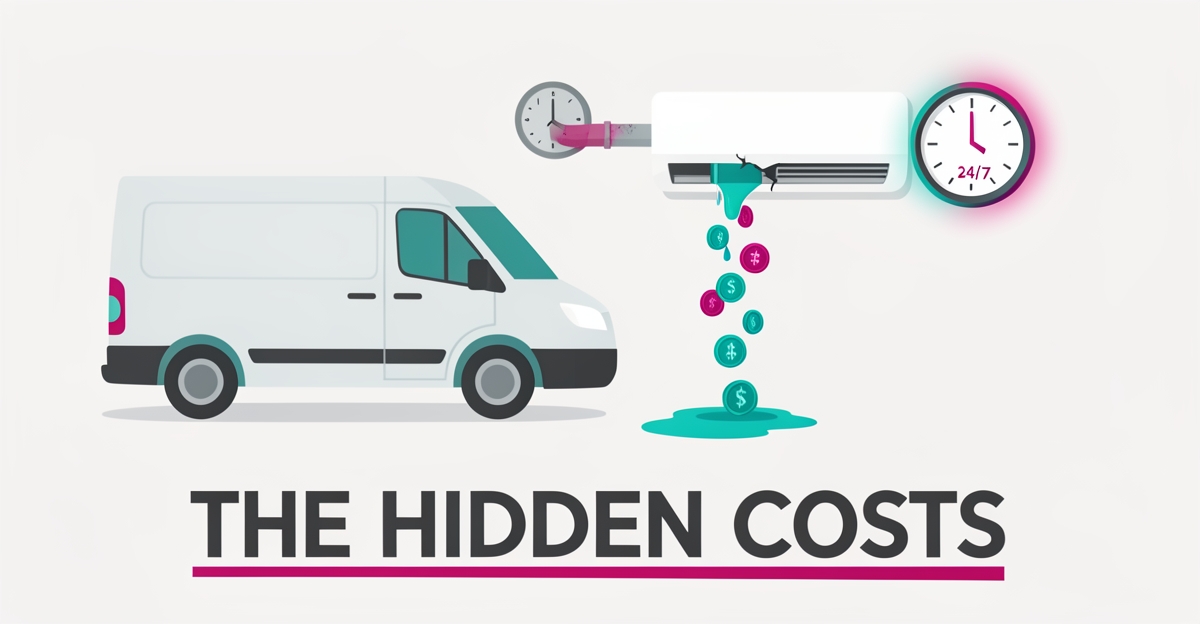
Every unanswered ring during a January cold snap is money walking out the door. When a furnace fails at 2 a.m., homeowners don't leave voicemails, they call the next company on the list, and that job is gone forever.
The scale of this leak is bigger than most HVAC owners realize. Calls that go unanswered during peak season don't just cost a single repair ticket; they cost the maintenance contract, the seasonal tune-ups, and every referral that customer would have sent. Yet many shops still rely on a single office phone and whoever happens to be near it.
Incomplete intake compounds the problem. When a rushed phone conversation misses key details, equipment model, symptoms, access instructions, technicians arrive unprepared. That means a second dispatch, a second truck roll, and a second slot of billable time spent on a job that should have been closed in one visit. Multiply that across a winter, and the "minor inconvenience" becomes a measurable cost center.
Repeat visits also drain trust. A customer who waited two days for the first appointment and then watches the tech show up without the right part doesn't blame the technician, they blame the company. In a market where reviews drive local search visibility, that erosion is expensive in ways that never appear on a P&L line item.
The operational data backs this up. Companies that automate routine customer interactions see measurable gains: research on document AI adoption has found that roughly half of companies report measurable productivity improvements after implementing AI document solutions, with automation projects typically delivering ROI in 10-14 months. In the HVAC sector specifically, AI-powered maintenance software has been associated with significant reductions in downtime along with meaningful energy savings.
The pattern is clear across the broader market: AWS market tracking indicates most organizations plan to deploy agentic AI in the coming years, though only a small fraction have so far, meaning early adopters in trades like HVAC still have a window to capture customers their competitors are missing.
The cost centers stack up in three predictable ways:
- Missed calls during peak season, where every unanswered ring is a job handed directly to a competitor
- Repeat dispatches caused by incomplete intake, burning technician hours and fuel on avoidable second visits
- Eroded customer trust from slow response and unprepared service, suppressing reviews, referrals, and contract renewals
This is why AI support agents have become practical for furnace repair companies. A well-designed agent answers common questions around the clock, schedules diagnostics directly into the calendar, and captures complete intake details before the technician ever rolls, reducing the burden on office staff while eliminating the after-hours gap. As customer support AI guidance emphasizes, success depends on planning: clear handoff boundaries to humans, training on the company's actual workflows, and transparency with customers. AIQ Labs builds these agents as managed AI Employees, answering common questions, booking diagnostics, and keeping intake complete so the first visit is usually the only visit.
None of these losses announce themselves on a monthly report. They show up quietly, as a slower season, a thinner margin, a review that never gets written. Measuring them honestly is the first step to closing the leak.
Why AI Customer Service Changes the Economics for HVAC
Missed calls and delayed replies don’t just frustrate homeowners; they quietly erode margin in HVAC businesses. AI changes that equation by turning reactive customer service into a continuous, accurate operation.
AI is transforming customer service by providing personalized, efficient, and accurate support. For HVAC, that translates to faster answers, fewer repeat visits, and protected trust, without the marketing hype. What matters is what the system actually does after deployment.
Productivity gains show up first in document and workflow automation. Document AI research finds roughly half of companies report measurable productivity improvements after implementing AI document solutions. The same industry research notes a majority of large enterprises now use AI to automate at least one major document workflow, with typical ROI of 10-14 months for document automation projects.
That efficiency compounds with 24/7 coverage. AI support agents answer common questions, schedule diagnostics, and route urgent calls without waiting for office hours. The result is reduced downtime and improved operational agility, not just for customers but for dispatch and technicians.
AI-powered maintenance adds a second economic lever. HVAC industry analysis links AI-powered maintenance software to meaningfully less downtime and notable energy savings. Fewer emergency callbacks mean fewer truck rolls, better first-time fix rates, and higher customer retention.
Together, these effects shift cost structure. Routine inquiries are handled automatically, staff focus on high-value escalations, and service data flows into smarter scheduling. AIQ Labs helps furnace repair companies deploy AI support agents to answer common questions, schedule diagnostics, and reduce the burden on human staff, at a fraction of the cost of an additional hire.
The practical benefits for HVAC operations include:
- 24/7 intake and appointment booking that captures demand outside business hours
- Automated document processing for work orders, invoices, and service reports
- Context-aware routing to the right technician with the right parts
- Proactive maintenance prompts that cut downtime and energy use
Adoption is still early. Market data shows most organizations say they'll deploy agentic AI within the next few years, but only a small share have. Early movers in HVAC capture the upside before coverage becomes table stakes.
When AI handles the repetitive, accurate, always-on work, the business gains speed, accuracy, and capacity without adding headcount.
Building an HVAC AI Support Agent That Answers, Schedules, and Relieves Staff
Missed calls in HVAC turn into frozen pipes, lost jobs, and reviews that linger long after the season ends. An AI support agent answers, schedules, and relieves staff without adding headcount.
AIQ Labs maps HVAC-specific support automation to the real pressure points of furnace repair companies. The approach starts with an AI Employee that handles common questions, books diagnostics, and pushes work orders into dispatch tools. It works 24/7/365 and learns from each interaction, reducing the burden on human staff while keeping service consistent.
Production experience matters here. AIQ Labs has deployed 200+ multi-agent systems and runs four live SaaS products daily, so the patterns behind an HVAC support agent are production-tested, not theoretical. Industry research also reports that roughly half of companies gain measurable productivity improvements after implementing AI document solutions, and most large enterprises now automate at least one major document workflow. For HVAC, that translates to fewer manual entries and faster scheduling.
The agent is built for field service realities, not generic chat. It answers service questions, checks appointment availability, and schedules diagnostics directly with dispatch. Integration with existing CRM, calendar, and work-order systems keeps data in one place and avoids duplicate entry. Human handoff is designed in from the start.
Practical guardrails keep the experience trustworthy. Implementation follows best-practice guidance to define clear boundaries for AI agents, including when to hand off conversations to humans, and to train agents with customer context, brand guidelines, and workflows. Best-practice guidance also stresses designing every AI interaction with a clear human exit and being transparent when customers are talking to AI.
Guardrails applied in HVAC deployments include:
- Human handoff triggers for pricing, complex diagnostics, and emergency escalation
- Training on brand voice, service scripts, and local compliance requirements
- Transparency cues so customers know they are speaking with an AI Employee
- Integration with dispatch tools to confirm appointments and update technicians in real time
The result is faster first response and fewer repeat calls. AI-powered HVAC maintenance software is associated with meaningful reductions in downtime and energy use, according to industry analysis, showing how automation supports both customer experience and operational efficiency.
AIQ Labs delivers this as a managed AI Employee, with the option to start monthly at roughly 80% less than the cost of a human hire. The build includes training on your business, tool integrations, monitoring, and improvements, with the ability to pause or adjust anytime.
From Pilot to 24/7 Coverage: A Lean Implementation Path for HVAC Teams
HVAC teams can’t afford to lose coverage when the phone stops being answered after hours. A lean rollout of AI support keeps field operations running while closing the gaps that create missed calls, repeat visits, and lost trust.
Start by defining clear boundaries for AI agents and when to hand off to humans. This is one of the core best practices for AI in customer support and prevents customers from looping in automation. Train the agent on customer context, brand guidelines, and real HVAC workflows, and design every interaction with a clear human exit. As best-practice guidance notes, AI isn’t magic; it’s a strategy that has to be planned, adapted, and rolled out based on goals and team capacity.
Segment by customer value, not just query type. High-value commercial accounts and repeat residential customers get prioritized routing and faster escalation, while routine questions like hours, pricing ranges, and diagnostic prep are handled 24/7 by AI. Redesign human roles for what AI escalates, so technicians and dispatchers focus on diagnosis and resolution instead of repetitive intake.
A practical pilot path for HVAC businesses looks like this:
- Scope a single workflow first, such as after-hours triage and appointment scheduling, with defined handoff rules.
- Connect the agent to existing dispatch, calendar, and CRM tools so actions are taken, not just logged.
- Run a limited pilot with a defined customer segment, measure missed-call reduction and first-contact resolution, then expand.
- Keep transparency in place so customers know when they’re speaking with AI and how to reach a human.
This staged approach mirrors how AI adoption actually scales. Industry tracking shows most organizations say they’ll deploy agentic AI in the coming years, but only a small share have, highlighting the pilot-to-scale gap many teams face.
Once boundaries and segments are set, choose a build model that fits the operation. Start Monthly works well for a first AI Employee covering phones and scheduling, with a flat monthly plan that costs roughly 80% less than a human hire. Build in Milestones suits rebuilding the one workflow that costs the most, like dispatch and service coordination, with approval and payment per phase. Own It Outright delivers a full AI operating system, built in phases and owned outright, code, agents, and data included.
AIQ Labs helps furnace repair companies deploy AI support agents to answer common questions, schedule diagnostics, and reduce burden on human staff, using the same production-tested architectures that power live SaaS platforms. In HVAC more broadly, AI-powered maintenance software is linked to meaningful reductions in downtime and energy use, showing the operational upside of automation beyond the call center.
With clear boundaries, value-based segmentation, and a payment model matched to risk tolerance, teams move from pilot to 24/7 coverage without disrupting field operations.
Still paying for 10+ subscriptions that don’t talk to each other?
We build custom AI systems you own outright. No vendor lock-in. Full control.
Not sure where to start? Ask our AI planner
Frequently Asked Questions
How much revenue am I actually losing from missed calls in peak season?
Do HVAC businesses really see ROI from automating customer service?
Will an AI agent sound robotic and hurt my brand trust?
Is it too late to adopt AI in HVAC, or is everyone already doing it?
What’s the first step if I want to try AI without disrupting my team?
How do I make sure the AI captures the right details so my techs don’t make repeat visits?
Turn the Leak Into Your Competitive Edge
The hidden costs of missed calls, repeat visits, and eroded trust aren’t just operational headaches, they’re silent profit drains that compound season after season. Automating customer service with AI support agents doesn’t just fix after-hours gaps; it captures complete intake, reduces truck rolls, and turns every interaction into a chance to build loyalty. For HVAC businesses, this means faster first-response times, higher first-time fix rates, and stronger customer retention, all without adding headcount. Market signals as of late 2026 suggest early adopters in trades like HVAC still have a window to outpace competitors, with most organizations planning agentic AI but only a small share having deployed it. If you’re ready to stop losing jobs to voicemail and start turning every call into a closed loop, the next step is a clear, no-pressure conversation. Start the Fit Check, a two-minute assessment that leads to a free 30-minute strategy call with our team to map your biggest bottleneck and identify where AI can deliver real ROI. No pitch, just clarity on your opportunity.
Make AI your competitive advantage — not just another tool.
Strategy, implementation and ongoing optimization. One partner, end to end.
Not sure where to start? Ask our AI planner