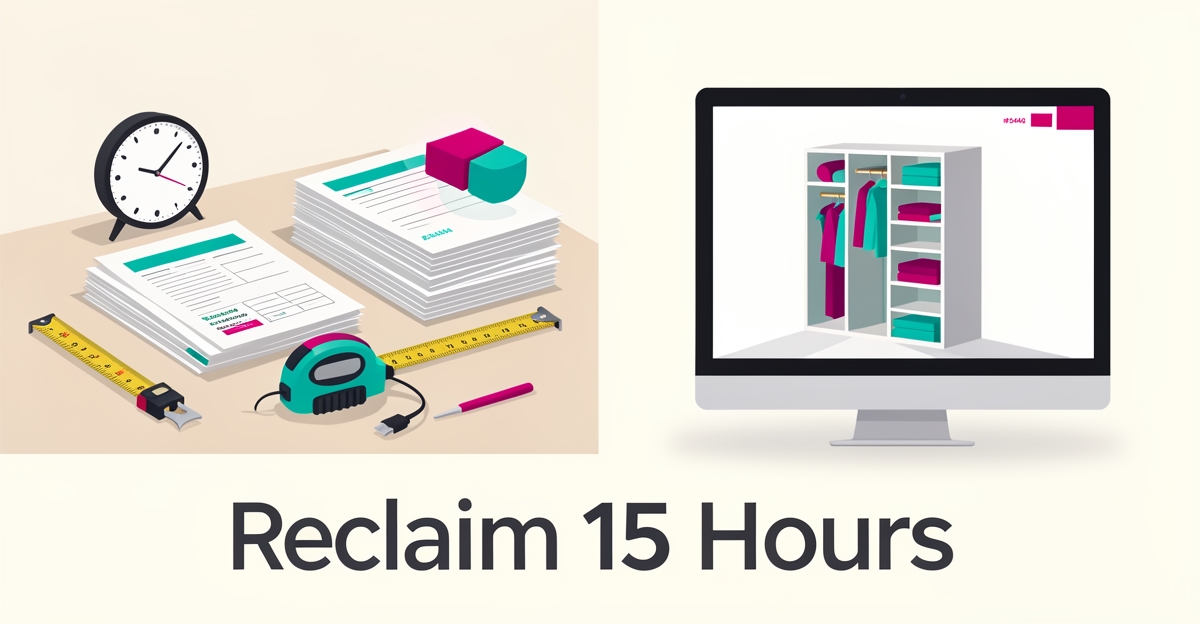
The Real Cost of Manual Closet Consultations: How AI Can Save You 15+ Hours Per Week
Key Facts
- Task switching between manual activities fragments focus and extends consultation time, a well-documented productivity drain in service businesses
- Automating routine administrative tasks typically saves employees several hours per week, and clustered, high-friction consultation workflows can exceed 15 hours weekly
- Modern AI design tools can generate closet layouts from photos in under a minute, though accuracy claims vary by vendor and space type
- Roughly half of routine work activity is automatable with current technology, according to widely cited industry analyses
- Small service businesses use automation to compete with larger firms without adding headcount
Hire a team member that works 24/7 — for less than a part-time wage.
AI receptionists, SDRs, dispatchers and 99+ roles. Trained on your business, fully managed.
Not sure where to start? Ask our AI planner
The Hidden Labor Drain in Manual Closet Consultations
The hidden labor drain in manual closet consultations begins long before the first client meeting and extends well after the final design is approved. Employees spend significant time on scheduling coordination, travel to client sites, taking detailed measurements, and filling out forms that capture space dimensions, storage needs, and style preferences. Task switching between these varied activities is a documented productivity killer, every context shift fragments focus and extends what should be a streamlined process into a multi-hour endeavor per consultation.
Each consultation typically involves multiple design iterations, where employees create layout options, present them to clients, gather feedback, and revise plans, often requiring additional visits or virtual meetings. Follow-up communications to answer questions, provide updates, and manage revisions further extend the timeline, while implementation coordination with contractors adds another layer of administrative overhead. For businesses handling even a modest client load, these individual time investments compound rapidly. Industry analyses consistently find that automating routine tasks saves employees several hours per week, and when applied to the clustered, high-friction processes of manual consultations, the cumulative burden can exceed 15 hours per week per employee. This hidden labor cost represents not just time spent, but strategic capacity diverted from revenue-generating activities like client acquisition or design innovation. AIQ Labs addresses this drain through AI workflow automation that eliminates manual scheduling, measurement logging, and revision tracking, allowing employees to redirect their expertise toward higher-value interactions rather than process administration.
How AI Automates Closet Design and Wardrobe Workflows
What if your design consultations could happen in minutes instead of hours? Modern AI transforms closet design from a days-long manual process into a fast, precise workflow by layering computer vision, natural language processing, and multi-agent automation.
Current AI design platforms can analyze photos of actual spaces and generate functional layouts in under a minute, no manual measurements required to start. The systems interpret spatial relationships, lighting conditions, and architectural quirks through computer vision, dramatically cutting the back-and-forth of manual measuring and initial drafting that traditionally consumes hours per client. As with any vendor claim, treat published accuracy figures as a starting point and validate against your own project mix.
Beyond spatial design, specialized AI wardrobe platforms use layered architectures to handle styling and personalization. The typical stack looks like this:
- Deep Learning Vision Engine: Automatically catalogs garments, extracting category, color, material, pattern, and seasonality data
- Color Theory & Styling Intelligence: Applies harmony rules to generate outfit combinations using complementary, analogous, and triadic color schemes
- Personalization & Context Learning: Builds preference profiles over time, tailoring recommendations to individual style constraints and local conditions
This multi-layer approach mirrors the multi-agent orchestration used in business automation. While consumer apps apply these techniques to wardrobe management, businesses leverage similar architectures, like those built by AIQ Labs, to automate complex operational workflows across departments. The same computer vision that identifies a wool blazer can extract data from invoices; the same natural language processing that interprets style preferences can handle client intake conversations.
Unlike generic AI tools that treat closets as static visual problems, specialized design systems increasingly understand the practical constraints of the trade, ventilation requirements for wool, hanging heights for delicate fabrics, and weight distribution for storage solutions. The best of them generate contractor-ready plans rather than pretty pictures, bridging the gap between digital concept and physical reality. By automating both the spatial design and the inventory management components, these systems collapse workflows that once required multiple professionals into seamless, self-serve experiences.
From Hours to Minutes: Building an AI-Powered Consultation System
The gap between your team's current reality and an AI-powered workflow isn't a chasm, it's a series of deliberate, manageable steps. Widely cited automation research suggests roughly half of routine work activity is automatable with current technology, but the transformation happens one process at a time, not overnight.
Start with intake automation. Replace paper forms and email tag with conversational AI that captures client requirements, style preferences, and budget parameters 24/7. This mirrors the approach behind modern wardrobe apps, which use deep learning vision engines to extract detailed information from unstructured inputs like photos and descriptions.
Next, implement photo-based measurement and analysis. AI can now analyze spatial photos to generate accurate layouts without manual tape measures, turning what was once a site visit into a digital upload. Build in a quick human verification step for anything structural.
Then automate design generation. Instead of drafting iterations manually, deploy AI that produces multiple layout options in seconds based on spatial constraints and client needs. This shift from days to minutes is the core efficiency gain, allowing your team to focus on refinement rather than creation.
Streamline client follow-ups with AI Employees that handle scheduling, answer routine questions, and manage revision requests automatically. These managed digital team members work around the clock, ensuring no lead goes cold while your designers focus on high-value creative work.
For implementation, AIQ Labs offers three entry points with flexible payment models:
- Start Monthly with a single AI Employee to handle intake and follow-ups, typically far less than the cost of a part-time hire, while you validate the workflow
- Build in Milestones to rebuild the one workflow that costs you the most, like design automation, paying per phase and keeping everything built so far
- Own It Outright with a connected AI operating system built in phases, where you control the code, agents, and data without vendor lock-in
AIQ Labs structures these transitions through managed AI staff, fixed-price workflow builds, and phased operating systems, ensuring each phase integrates with your existing CRM and project management tools. Whether you deploy an AI Employee for client communications or rebuild your entire consultation pipeline, the goal remains the same: converting 15 hours of weekly administrative drag into minutes of strategic oversight.
ROI, Risk and Real-World Considerations
Manual closet consultations hide labor costs that compound fast, and the business case for automating them is quantifiable. The shift is not speculative; it is measurable in hours saved, cost avoided, and competitive positioning.
Adoption barriers start with accuracy expectations. AI closet design tools perform well on standard residential spaces, but irregular spaces with angled walls, sloped ceilings, or built-in alcoves still require human review, published accuracy claims from vendors should be validated against your own project types. Privacy is another real consideration, especially when client photos and measurements are involved. Local-first architectures and clear data handling policies help address this risk for consultation businesses.
The ROI case is reinforced by broader automation adoption. Industry research consistently finds that roughly half of routine work activity is automatable, and a majority of companies cite cost savings as a primary automation driver. That cost focus is not limited to enterprises, small service businesses increasingly use automation to compete with larger companies without adding headcount, a critical lever for boutique closet studios and design firms.
Risk management matters as much as savings. Common real-world considerations include:
- Accuracy limits for non-standard spaces and the need for human-in-the-loop validation
- Privacy and data security for client photos, measurements, and style preferences
- Adoption friction when moving from in-person meetings to AI-assisted workflows
- Integration with existing scheduling, CRM, and contractor tools
When these factors are addressed, the payoff scales. Automating intake forms, photo analysis, measurement capture, and follow-up communications can reclaim up to 15 hours per week per employee, redirecting time to high-value design and client relationship work. That is the core of AI Workflow & Task Automation applied to a service business.
AIQ Labs approaches this through AI Workflow Builds that you own outright, and AI Employees that handle real consultation tasks end-to-end. The result is a measurable reduction in manual overhead with retained quality control and client trust.
Still paying for 10+ subscriptions that don’t talk to each other?
We build custom AI systems you own outright. No vendor lock-in. Full control.
Not sure where to start? Ask our AI planner
Frequently Asked Questions
How much time am I actually losing with manual closet consultations?
Can AI design a closet accurately without me taking measurements?
What does a manual closet consultation cost compared to AI?
Is it safe to upload client photos and measurements to AI?
How quickly can we start automating our consultation workflow?
Will AI work for weird or custom closet spaces?
From Time Drain to Strategic Gain: Your Path Forward
Manual closet consultations silently erode productivity through scheduling, measurements, revisions, and follow-ups, consuming 15+ hours weekly per employee. AI transforms this workflow by automating intake, photo-based measurement, design generation, and client communications, turning hours of administrative drag into minutes of strategic oversight. With proven ROI in reclaimed time for design innovation and client relationships, the shift isn't just about efficiency, it's about redirecting expertise where it drives real business value. The journey begins with a single step: identifying your highest-impact automation opportunity. Start the Fit Check at https://aiqlabs.ai/apply for a free, no-obligation strategy call to map your biggest bottleneck and see where AI can save you time today.
Make AI your competitive advantage — not just another tool.
Strategy, implementation and ongoing optimization. One partner, end to end.
Not sure where to start? Ask our AI planner