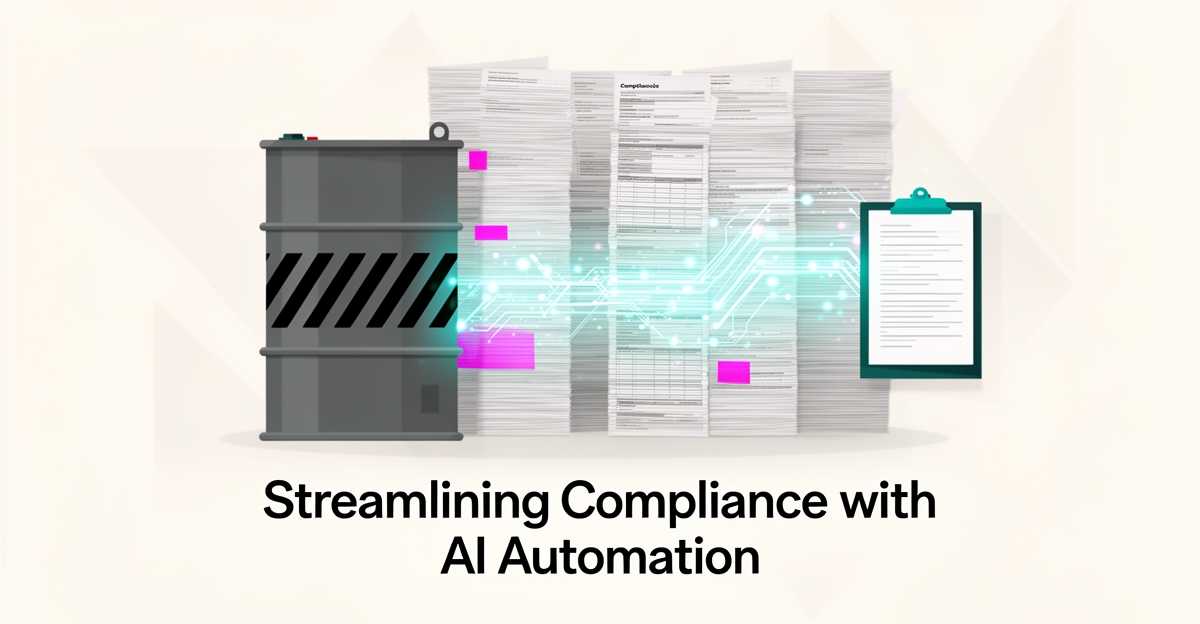
The Real Cost of Manual Compliance in Hazardous Waste Disposal
Key Facts
- Most business data is unstructured, scattered across emails, scanned documents, and paper manifests, making manual transcription a major source of compliance error.
- Teams that automate document review typically see large reductions in manual review time, often in the 40-60% range as of late 2026.
- Manual compliance drains labor through repetitive review, error correction, audit delays and penalties.
- Properly implemented AI document processing typically reaches accuracy levels well above what manual review sustains at volume.
- Automation only pays off when it's tracked, through defined objectives, relevant metrics, and continuous data collection.
Hire a team member that works 24/7 — for less than a part-time wage.
AI receptionists, SDRs, dispatchers and 99+ roles. Trained on your business, fully managed.
Not sure where to start? Ask our AI planner
The Hidden Financial Drain of Manual Hazardous Waste Compliance
For SMBs handling hazardous materials, compliance paperwork often feels like background noise, until someone adds up the hours. The truth is that manual compliance operates as a silent tax on the business, draining labor capacity, introducing costly errors, and stretching audit timelines month after month.
The scale of the problem starts with time. Industry analyses of workflow automation consistently point to the same finding: teams can typically achieve 40-60% reductions in manual document review time through AI automation. That means for every hour your staff currently spends reviewing manifests, disposal records, and regulatory filings, as much as half of it may be recoverable.
Compounding the labor burden is the nature of the data itself. The large majority of business data is unstructured, scattered across emails, scanned documents, and paper manifests. For hazardous waste operators, that unstructured data becomes a compliance liability: every manually transcribed waste code, shipment date, or facility certification is an opportunity for human error to slip into the record.
Those errors carry real consequences. Manual compliance is inherently time-consuming and labor-intensive, and mistakes in documentation can trigger audit delays, rework, and regulatory scrutiny. AI automation addresses this directly, modern document processing systems typically sustain high accuracy across thousands of pages, a level of consistency that manual review struggles to match.
The financial impact stacks up across four channels:
- Labor hours consumed by repetitive document review and data entry
- Error correction and rework when inaccurate records surface during audits
- Audit preparation delays caused by fragmented, unstructured records
- Regulatory penalties and remediation costs tied to compliance failures
The upside is measurable. By automating repetitive extraction and reporting tasks, operators commonly recover a large share of the labor cost tied to compliance, often enough to fund growth initiatives instead of paperwork.
The caveat, as industry guidance on measuring AI performance makes clear, is that automation only pays off when it's tracked, through defined objectives, relevant metrics, and continuous data collection. That's the principle behind how AIQ Labs approaches compliance automation: building measurable performance dashboards so businesses can see exactly where hours are saved and where error rates drop, rather than relying on vague promises of efficiency.
Manual compliance doesn't just cost what appears on a payroll line. It costs accuracy, audit readiness, and the strategic attention of the people who should be running the business.
How AI Automation Reduces Compliance Costs
AI automation transforms hazardous waste compliance by targeting the repetitive, error-prone tasks that drain resources and increase risk. Automating data extraction, form filling, and audit trail generation typically reduces compliance labor costs substantially while eliminating most human error in reporting. This shift allows organizations to redirect skilled labor toward strategic initiatives instead of manual data handling.
The impact on accuracy is equally significant, AI systems typically sustain high accuracy in high-volume processing, a critical improvement when regulatory penalties for incorrect waste manifests or misclassified materials can exceed six figures. By removing fatigue-induced mistakes and standardizing data capture across disparate sources, companies avoid costly rework, delayed audits, and potential fines. For hazardous waste operations managing thousands of monthly shipments, this precision translates directly into operational reliability and regulatory trust.
- Automated data extraction from safety data sheets, shipping logs, and disposal certificates
- Real-time form generation for EPA RCRA and state-specific hazardous waste reports
- Immutable audit trail creation with timestamped, tamper-evident records
- Exception routing for anomalies requiring human review
- Continuous compliance monitoring against evolving regulatory thresholds
AIQ Labs supports this transformation by embedding intelligent automation into compliance workflows, whether through managed AI Employees that handle ongoing monitoring and reporting, or a targeted Workflow Build that rebuilds the one compliance workflow that costs you the most. Either way, you own the system outright and get measurable reductions in labor costs and error rates. The result is a compliance function that operates with consistent precision, scales with volume, and delivers auditable proof of adherence without the hidden costs of manual oversight.
Implementing AI Compliance Automation: A Practical Roadmap for SMBs
The difference between AI compliance systems that deliver results and those that stall often comes down to implementation discipline. For hazardous waste operations, a structured rollout transforms ambitious automation goals into measurable cost reductions.
Start by defining precise objectives that target your highest-friction compliance workflows. Rather than vague goals like "improve efficiency," specify targets such as reducing manifest review time or eliminating documentation errors in waste profiling. Organizations that establish clear parameters upfront typically see the largest cost reductions by focusing automation on repetitive, rule-based tasks.
Next, select metrics that matter to hazardous waste operations. Track document processing times, error rates in regulatory filings, and audit preparation hours. Since most business data is unstructured, including safety data sheets, disposal manifests, and inspection reports, your metrics should capture how effectively AI converts this chaos into actionable compliance intelligence.
Data preparation follows. Audit your historical compliance records for completeness and accuracy, as AI systems require high-quality training data to recognize waste classification patterns and regulatory triggers. This phase often reveals gaps in existing documentation practices that, once addressed, improve operations even before full automation launches.
- Pilot testing: Deploy AI on a single waste stream or facility to validate accuracy before scaling
- Integration mapping: Connect AI tools with existing EHS platforms and document management systems
- Human-in-the-loop protocols: Establish review checkpoints for high-risk waste classifications
System testing demands rigorous validation against real-world scenarios. Properly implemented AI typically achieves high accuracy in high-volume document processing, but reaching that benchmark requires iterative training with your specific waste codes and regulatory requirements.
AIQ Labs structures this journey through flexible payment models, Start Monthly, Build in Milestones, or Own It Outright, where each phase, from an initial workflow fix to a full AI Operating System, delivers measurable ROI before further investment. Whether you start with a targeted compliance workflow fix or deploy a managed AI Employee for ongoing monitoring, the key is matching implementation pace to your operational readiness.
By following this disciplined roadmap, hazardous waste SMBs typically see major reductions in manual review time within the first deployment phase, and transform compliance from a cost center into a competitive advantage.
Still paying for 10+ subscriptions that don’t talk to each other?
We build custom AI systems you own outright. No vendor lock-in. Full control.
Not sure where to start? Ask our AI planner
Frequently Asked Questions
How much staff time is actually wasted on manual hazardous waste compliance?
Is AI accurate enough to handle hazardous waste manifests and EPA reports?
What does manual compliance cost beyond payroll?
How do I prove AI automation is saving money and reducing errors?
Why is hazardous waste data so error-prone when done manually?
Can a small hazardous waste business afford to automate compliance?
Turn Compliance from Cost Center to Competitive Advantage
Manual hazardous waste compliance is a silent drain on SMB resources, consuming hours, introducing errors, and delaying audits. AI automation typically cuts compliance labor costs substantially while improving accuracy in document processing. The path forward is clear: define precise objectives, track meaningful metrics, and implement automation with discipline. AIQ Labs has deployed 200+ multi-agent systems and runs four live SaaS products daily, so the systems we build are systems we use ourselves. Whether you need a targeted workflow fix or a full AI Employee deployment, we provide the dashboards and support to prove ROI at every stage. Ready to reclaim your team's time and reduce compliance risk? Start with a free 2-minute Fit Check at https://aiqlabs.ai/apply, then book a no-obligation 30-minute strategy call to map your highest-impact automation opportunity. If there isn't a clear win, we'll tell you.
Make AI your competitive advantage — not just another tool.
Strategy, implementation and ongoing optimization. One partner, end to end.
Not sure where to start? Ask our AI planner