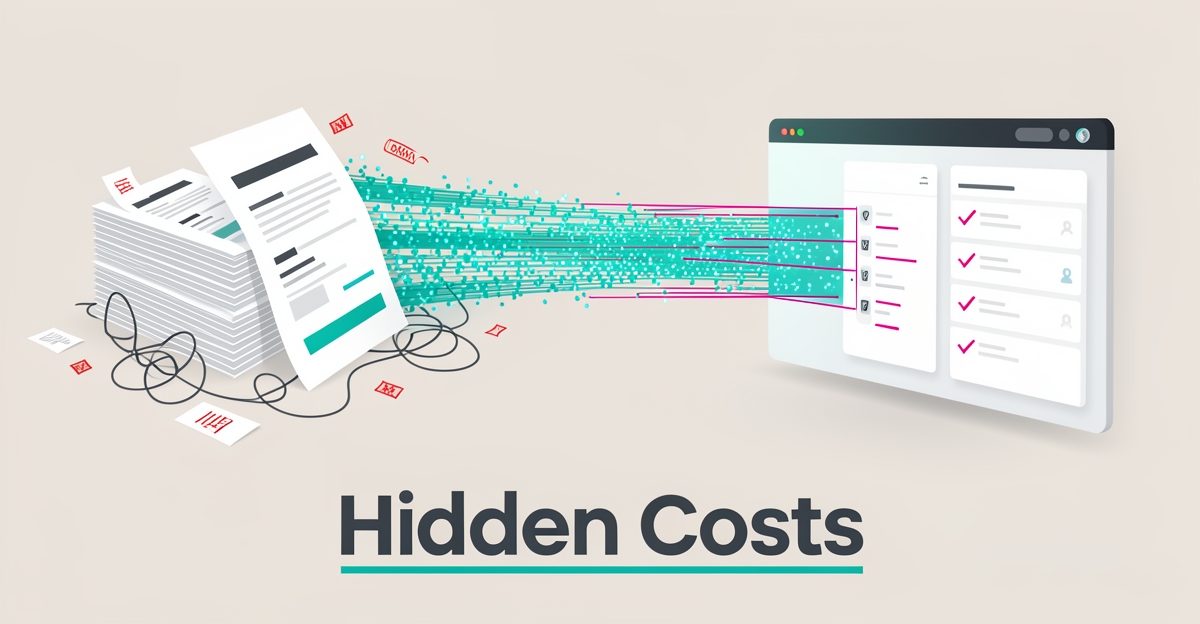
The Real Cost of Manual Data Entry in Electrical Supply Chains
Key Facts
- Manual data entry typically costs electrical distributors 25-30 hours weekly in staff time, with a single invoice often taking 10-15 minutes to process.
- Human data entry is inherently error-prone—industry estimates commonly place accuracy in the low-to-mid 90s percent range, meaning roughly one in ten manual entries can contain costly errors.
- Modern AI-powered data capture typically achieves 95%+ accuracy on structured documents, with well-tuned systems performing even higher on repeat vendor formats.
- Automating invoice processing commonly reduces handling time by 80% and can accelerate month-end close by several days.
- Businesses using hybrid AI-human data entry models frequently report meaningful cost savings, often in the 30-40% range depending on volume and document mix.
- Electrical manufacturers moving from spreadsheets to automated procurement workflows typically reduce overall procurement costs through fewer errors and better supplier data.
- Even a 2% error rate in manual entry creates dozens of costly mistakes monthly for distributors managing thousands of SKUs.
Hire a team member that works 24/7 — for less than a part-time wage.
AI receptionists, SDRs, dispatchers and 99+ roles. Trained on your business, fully managed.
Not sure where to start? Ask our AI planner
The Hidden Financial Drain of Manual Data Entry in Electrical Supply Chains
Electrical distributors lose significant time and money to manual data entry across invoices, purchase orders, and delivery records, with cascading financial impacts that extend far beyond labor costs. Processing a single invoice manually can take 10-15 minutes, and with small distributors handling hundreds of transactions weekly, this accumulates to 25-30 hours of staff time each week solely on data entry tasks. Human data entry is inherently error-prone—accuracy estimates commonly land in the low-to-mid 90s percent range—so roughly one in ten entries can contain errors that require costly rework, delayed payments, or incorrect shipments. These inaccuracies trigger a chain reaction: wrong part numbers lead to stockouts or overstocking, pricing errors erode margins, and mismatched POs and invoices strain supplier relationships. For distributors managing thousands of SKUs, even a 2% error rate in manual entry can result in dozens of costly mistakes monthly, each requiring hours to resolve. The hidden drain isn't just the visible labor—it's the opportunity cost of skilled employees stuck in repetitive tasks instead of negotiating better terms, optimizing inventory, or pursuing new business. AI-powered automation transforms this reality by capturing data from emails, PDFs, and vendor forms with 95%+ accuracy, reducing processing time from minutes to seconds per document. This shift doesn't just cut labor costs—it eliminates the costly ripple effects of inaccuracies that silently bleed profitability in high-volume electrical supply chains. Industry experience consistently shows that manual spreadsheet use in electrical manufacturing creates version control issues and scalability barriers that compound these losses, while hybrid AI-human models frequently deliver 30-40% cost savings while maintaining accuracy—making automation not just efficient but essential for resilience. By replacing error-prone manual entry with intelligent data capture, distributors reclaim time, reduce financial leakage, and redirect focus toward strategic growth—turning a persistent cost center into a competitive advantage. To uncover your specific savings potential, start with a two-minute Fit Check and map your biggest bottlenecks and high-ROI automation opportunities.
How AI Automation Eliminates Errors and Cuts Processing Time by 80%+
Every wrong part number keyed into a purchase order sets off a chain reaction: an incorrect order, a delayed job site, a production stoppage. In an electrical supply chain managing thousands of components, these aren't occasional slip-ups—they're the predictable output of manual data entry. The fix isn't more careful typing. It's removing the typing altogether.
AI-powered data capture replaces manual input with two complementary technologies. Optical Character Recognition (OCR) converts images of text—invoices, scanned POs, vendor forms—into machine-readable data, while Natural Language Processing (NLP) understands context, distinguishing a billing address from a shipping address or correctly interpreting payment terms like "Net 30." Together, they automate the capture of data from the exact channels that bog down electrical distributors today: email orders, purchase orders, and vendor paperwork.
The accuracy gap between human and machine is well established. Human typists work at a finite pace with error rates that compound across thousands of entries, while modern AI extraction handles the same documents in seconds. Many AI data entry solutions now achieve 95%+ accuracy on structured documents, with well-configured systems performing even higher on repeat vendor formats. For electrical supply chains, that difference is measured in avoided incorrect orders and stoppages—errors that industry analysis of spreadsheet-based procurement consistently identifies as a primary source of costly delays.
The time savings compound across every invoice and order. AI-powered invoice and accounts payable automation commonly reduces invoice processing time by 80%, can accelerate month-end close by several days, and transforms tasks that previously took hours into processes completed in minutes. The financial impact is equally clear:
- Businesses using hybrid manual and AI-powered data entry frequently report 30-40% cost savings, depending on document volume and complexity.
- Electrical manufacturers adopting automated procurement workflows typically reduce overall procurement costs through fewer errors, cleaner supplier data, and stronger negotiation positions.
- Real-time dashboards replace static spreadsheets, cutting the overstocking and stockouts caused by missing visibility into current inventory and order status.
- Automated workflows generate transparent audit trails, replacing version-control chaos when purchasing teams, engineers, and suppliers all edit the same file.
Automation doesn't eliminate human judgment—it repositions it. A common failure mode is "automating bad information," which simply speeds up errors. That's why a human-in-the-loop model works best: AI handles high-volume extraction while your team reviews exceptions and ambiguous documents. Instead of matching invoices line by line, procurement staff shift to supplier negotiations and cost optimization, where their expertise actually moves the needle.
This is precisely how AIQ Labs approaches the problem. Through AI Workflow Builds, we rebuild the one workflow that costs you the most—like invoice and PO processing—at a fixed price, in phases, so you see results before committing to a full rollout. The systems learn from your invoices, POs, and vendor forms to improve accuracy and reporting over time, rather than relying on rigid templates that break every time a vendor changes their layout.
If your team is still keying in orders from email, the error rate isn't a personnel issue. It's a systems issue—and one that AI data capture now solves at 95%+ accuracy.
Implementing AI Data Entry: A Practical Roadmap for Electrical Distributors
For electrical distributors still relying on manual data entry, the path to automation begins with a clear-eyed assessment of current workflows. Mapping out how invoices, purchase orders, and delivery documents move through your systems reveals where time is lost and errors accumulate—often in repetitive tasks like data keying from emails or PDFs. Human entry accuracy commonly sits in the low-to-mid 90s percent range, while AI-powered systems typically achieve 95% or better, directly reducing costly mistakes in part numbers, quantities, and pricing. This foundational step ensures automation targets the right pain points before any technology is deployed.
Starting small but strategically maximizes early wins and builds confidence across teams. Focus initial efforts on high-volume, standardized processes like invoice processing—where AI can extract data from emails and vendor forms with minimal complexity—before tackling less predictable document types. Beginning with low-complexity tasks avoids integration headaches and delivers measurable efficiency gains quickly. For SMB electrical distributors, this might mean automating AP workflows first, potentially cutting invoice processing time by up to 80% and accelerating month-end close by several days, freeing staff for supplier negotiations and inventory optimization.
Seamless integration with existing ERP and accounting systems is non-negotiable for sustained success. The AI solution must connect fluidly with platforms like QuickBooks or Xero to ensure extracted data flows directly into financial records without manual re-entry, eliminating a common bottleneck in hybrid setups. Planning for this integration early—using pre-built connectors or flexible APIs—prevents data silos and maintains a single source of truth across purchasing, inventory, and sales teams. Equally important is adopting a human-in-the-loop model: let AI handle high-volume extraction while experienced staff review complex exceptions, balancing speed with the nuanced accuracy needed for critical financial data. This approach not only safeguards against errors but also shifts employee focus from tedious entry to strategic activities like cost analysis and vendor management. For distributors ready to connect data entry to the rest of the operation—inventory, quoting, dispatch—an AI Operating System provides one connected layer built in phases and owned outright. To explore how AIQ Labs can tailor this roadmap to your specific electrical distribution operations, complete the Fit Check and book a free 30-minute strategy call to map your highest-impact automation opportunities.
Still paying for 10+ subscriptions that don’t talk to each other?
We build custom AI systems you own outright. No vendor lock-in. Full control.
Not sure where to start? Ask our AI planner
Frequently Asked Questions
How much time does manual data entry actually take for processing invoices in electrical supply chains?
What is the accuracy rate of human data entry compared to AI-powered systems in invoice processing?
Can AI automation really reduce invoice processing time by 80% or more?
What kind of cost savings can electrical distributors expect from switching to AI-powered data entry?
Is it necessary to have human oversight when using AI for data entry in supply chains?
What are the first steps an electrical distributor should take to implement AI data entry automation?
Turning Data Entry from a Cost Center into Your Competitive Edge
Manual data entry in electrical supply chains isn't just a time sink—it's a hidden drain on profitability, with errors in part numbers, pricing, and quantities triggering costly ripple effects from stockouts to strained supplier relationships. As this article shows, AI-powered automation delivers 95%+ accuracy and commonly slashes processing time by 80%+, transforming hours of repetitive work into seconds while freeing your team to focus on strategic initiatives like inventory optimization and supplier negotiations. The shift isn't about replacing people—it's about elevating their impact. For distributors ready to move beyond spreadsheets and manual keying, the path forward starts with a clear assessment of where automation will deliver the highest ROI. Take the first step by completing the two-minute Fit Check and scheduling a free 30-minute strategy call to map your bottlenecks and uncover your specific savings potential—no obligation, just clarity on how AI can work for your business.
Make AI your competitive advantage — not just another tool.
Strategy, implementation and ongoing optimization. One partner, end to end.
Not sure where to start? Ask our AI planner