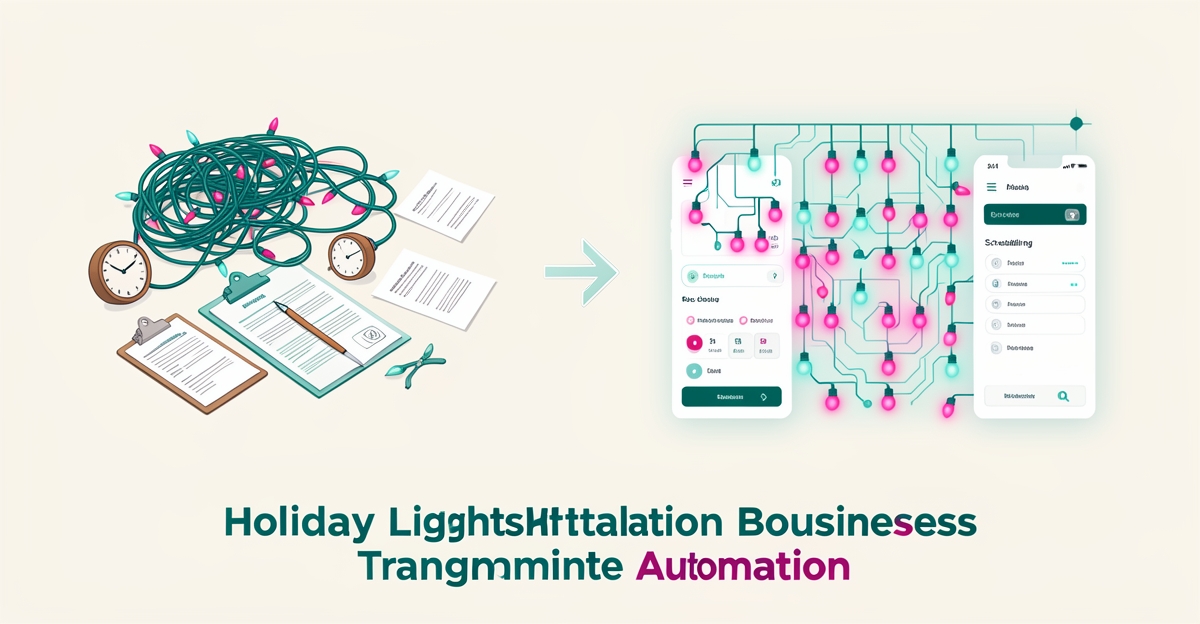
The Real Cost of Manual Holiday Operations: How AI Can Cut Labor by 30% in Light Installation
Key Facts
- AI automation can deliver reductions of roughly 30% in labor costs for seasonal operations by eliminating routine coordination work.
- Businesses that automate repetitive workflows typically report meaningful cost reductions within the first year, though results vary by operation.
- Custom AI tools handling scheduling, qualification, and customer communication can substantially reduce operational overhead compared to manual staffing.
- AI qualification agents working 24/7 dramatically cut the cost per qualified lead versus manual intake.
- As of late 2026, most large retailers use AI for inventory management, demand forecasting, and customer service during peak season.
- AIQ Labs has deployed 200+ multi-agent systems and runs 4 live SaaS products daily.
Hire a team member that works 24/7 — for less than a part-time wage.
AI receptionists, SDRs, dispatchers and 99+ roles. Trained on your business, fully managed.
Not sure where to start? Ask our AI planner
The Hidden Costs of Manual Holiday Operations
When the holiday season hits full swing, light installation companies often assume their biggest expense is labor itself. In reality, the true cost lies in the invisible layers wrapped around that labor: overtime premiums, chaotic scheduling, unfilled shifts, and the rework that follows when mistakes slip through.
Consider what manual operations actually demand during peak season. Crews work extended hours at premium rates, coordinators spend evenings rebuilding schedules around no-shows, and every miscommunication between the office and the field translates into a truck roll that costs money but generates no revenue. None of these costs appear neatly on a P&L, yet they compound week after week through November and December.
The scale of the problem becomes clearer when you look at what customers are up against. With price increases still squeezing household budgets as of late 2026, customers scrutinize quotes more closely than ever, and every dollar of hidden operational waste eats directly into already-thin margins.
Manual processes also introduce error-driven rework that multiplies costs. A single misquoted job, a missed appointment, or an incorrectly scheduled crew triggers a chain of corrective labor: callbacks, rescheduling, and customer service hours that weren't budgeted anywhere. In an industry where the entire revenue window spans just a few weeks, that rework doesn't just cost money, it costs capacity you can never recover.
The financial contrast between manual and automated operations is stark. Businesses that automate repetitive coordination work typically report meaningful cost reductions in the first year, and operations that hand scheduling, qualification, and customer communication to AI systems often see overhead fall far more dramatically than they expect.
The hidden costs of manual holiday operations typically cluster in four areas:
- Overtime premiums paid to cover scheduling gaps and last-minute demand spikes
- Administrative hours lost to manually building, revising, and communicating schedules
- Error-driven rework from misquotes, missed appointments, and misrouted crews
- Lost revenue capacity when coordinators spend peak hours on paperwork instead of bookings
It's worth noting that the broader industry has already moved. As of late 2026, the large majority of major retailers leverage AI for inventory management, demand forecasting, and customer service, a clear signal that automation is now the standard for surviving peak season profitably.
For light installation businesses, the same principle applies. AI systems that automate scheduling, lead qualification, and customer communication can cut labor costs by roughly 30% by eliminating the routine work that consumes coordinator hours. AIQ Labs builds managed AI staff, receptionists, dispatchers, SDRs, and 99+ other roles, at a fraction of the cost of a human hire, with full ownership options so you're permanently lowering your cost structure, not renting relief for one season. The first step is simply auditing where those hidden hours actually go.
Why AI Automation Delivers 30% Labor Savings in Light Installation
The holiday rush turns light installation into a logistical marathon where every hour spent on scheduling, dispatch, and paperwork is an hour not spent on revenue-generating work. Businesses that automate these coordination layers typically report cost reductions in the 30% range in the first year, and AI-driven approaches are pushing that benchmark further.
Custom AI workflows can reduce operational overhead dramatically by replacing manual coordination with intelligent systems that handle scheduling, crew dispatch, customer communication, and invoice processing without human bottlenecks. At the same time, AI qualification agents cut lead qualification costs sharply, ensuring crews only deploy to confirmed, high-value jobs.
Retailers have already validated this model at scale. As of late 2026, most major retailers leverage AI for inventory management, demand forecasting, and customer service, the same operational pillars that drive profitable holiday light installation.
- Automated scheduling that matches crew availability to job sites in real time
- AI dispatch that optimizes routes and reduces drive time between installations
- Conversational agents handling customer confirmations, changes, and FAQs 24/7
- Invoice capture and payment follow-up that closes the cash cycle without manual chasing
AIQ Labs builds these systems as owned assets, not rented bots, so the labor savings compound year after year without recurring per-seat fees. The result is a leaner operation that scales with demand instead of buckling under it.
From Manual to Automated: A 5-Step Implementation Roadmap
The gap between knowing automation works and actually implementing it stops most businesses cold. Research consistently shows that companies automating repetitive workflows capture meaningful cost reductions in year one, yet many stall before they start. Here's the exact sequence that moves holiday light installation businesses from manual chaos to automated efficiency.
Start with an audit of repetitive workflows. Document every task your team performs more than twice daily, dispatch calls, appointment confirmations, customer follow-ups, invoice generation. Track time spent on each. You'll likely discover that routine coordination consumes 15-20 hours weekly per office staff member during peak season.
Pilot automation in one high-friction department, not across your entire operation. Choose either dispatch coordination or customer intake, whichever creates the most bottlenecks during your November rush. AI qualification agents typically cut qualification costs sharply, making intake an ideal proving ground. Run the pilot for 30 days with clear metrics: response time, booking conversion, staff hours saved. A fixed-price workflow build targeting your single most expensive workflow is the fastest way to test this.
Select tools that integrate with your existing systems rather than forcing platform migrations. Your AI solution needs to connect with your CRM, scheduling software, and communication channels. Custom AI tools deliver their largest overhead reductions when properly integrated. AIQ Labs builds systems that connect directly with the tools you already use, eliminating the data silos that kill automation ROI.
Partner with specialists who understand seasonal field service operations, not generic software vendors. The difference matters when your AI dispatcher needs to handle weather delays, crew availability changes, and customer rescheduling simultaneously. Look for partners who offer phased implementation approaches, you should be able to start with one workflow and expand without rebuilding from scratch.
Train your team before full deployment, not after problems emerge. Address the fear directly: automation handles repetitive tasks so your staff can focus on customer relationships and complex problem-solving. Adoption succeeds when teams understand the division of labor, and by late 2026, most large retailers have already proven the hybrid model works at scale.
- Map your three most time-consuming manual processes this week
- Choose one department for a 30-day automation pilot
- Verify any AI tool integrates with your current CRM and scheduling systems
- Establish baseline metrics before automation starts so you can measure actual savings
The businesses that capture that 30% labor cost reduction don't wait for perfect conditions. They start with one workflow, prove the model works, then scale systematically across operations.
AI Employees vs. Seasonal Hires: The New Holiday Workforce Model
Holiday staffing for light installation peaks just when margins are thinnest. Seasonal crews are hired fast, trained faster, and then disappear, leaving overtime, missed calls, and scheduling chaos behind.
Manual holiday operations carry hidden costs that compound every December. Businesses that automate routine coordination typically see labor costs fall by roughly 30% by taking repetitive tasks off human plates.
Seasonal hires bring availability gaps and turnover risk. An AI Employee works 24/7/365, never calls in sick, and maintains a flat monthly cost under a part-time hire, typically around 80% less than the equivalent human role. That model replaces the overtime spikes and training lag typical of holiday staffing with consistent coverage for dispatch, scheduling, intake, and collections.
The cost contrast is stark. Seasonal staff means overtime premiums, recruiting and training spend, and missed calls during peak demand. AI Employees handle multi-step workflows with full tool integration and ongoing optimization, while the business retains ownership of the system built. AIQ Labs delivers this through managed AI employees that work alongside human teams, not as software subscriptions.
Where seasonal teams struggle, managed agents stabilize operations:
- Dispatch and scheduling with real-time calendar and crew integration, eliminating double-books
- Intake and qualification 24/7, sharply reducing the cost per qualified lead
- Collections and follow-ups automated across voice, SMS, and email with compliance tracking
- Continuous learning from performance data, so accuracy improves each season
Operational overhead also falls. Custom AI tools handling routine coordination can reduce overhead costs dramatically compared to manual staffing. That frees crews to install, not chase paperwork.
Retailers are already moving this way. As of late 2026, the large majority of major retailers leverage AI to enhance inventory management, demand forecasting, and customer service during peak periods. The same pressure applies to installation businesses serving customers who are scrutinizing every quote.
The new holiday workforce model is hybrid by design. Humans lead high-value, on-site work while AI Employees handle the always-on coordination layer. With flat monthly plans that include build, training, integrations, monitoring, and improvements, the model costs less than a part-time hire and scales without recruiting cycles.
For expense management and financial automation, this shift directly lowers labor expense while protecting revenue. The result is predictable cost, zero missed calls, and a workforce that does not disappear after the holidays.
Own Your AI Systems: Avoid Vendor Lock-In While Scaling
Holiday labor spikes are predictable, but the cost of renting capacity every year is not. Light installation crews scale fast in October and December, then shrink, leaving businesses to absorb overtime, scheduling errors, and lost bookings.
Manual holiday operations hide costs in overtime, missed calls, and repetitive admin. Automating that coordination layer typically delivers labor cost reductions around 30%. That margin is decisive when crews are working nights and weekends.
Ownership changes the math. Subscription tools rent capability and lock data inside a vendor platform. True ownership means the system, agents, and data stay with the business and can be extended across departments over time.
AIQ Labs builds custom AI systems with a true ownership model where clients own what is built, no vendor lock-in. That ownership is delivered through three flexible payment paths:
- Start Monthly, one AI employee with setup plus a flat monthly plan that costs less than a part-time hire, includes build, training, integrations, monitoring and improvements, and can be paused or adjusted anytime.
- Build in Milestones, one workflow or department system split into phases, approve and pay per phase, stop anytime and keep everything built so far.
- Own It Outright, a full AI operating system with one project price or a monthly Build Partnership, with full ownership of code, agents, and data when complete.
These paths let light installation businesses build permanent AI assets instead of renting subscriptions. A dispatch and booking agent can handle inbound inquiries 24/7/365, qualify leads, and sync with calendars, while an operations agent automates invoicing and follow-ups.
The cost impact is measurable. Custom AI tools handling scheduling, qualification, and communication routinely cut operational overhead by a wide margin. For seasonal crews, that means fewer missed installs and less manual coordination during peak demand.
Retailers are already moving this direction under pressure. As of late 2026, most major retailers leverage AI to enhance inventory management, demand forecasting, and customer service, while consumers continue scrutinizing prices closely.
With owned systems, the holiday playbook compounds. The same agents trained on installation scheduling can later support sales, customer support, and finance without rebuilding from scratch. Permanent assets scale where rented tools reset each season.
Businesses can start with one critical workflow and expand as ROI proves out, keeping control of intellectual property and future development. Questions about fit? Reach the team at [email protected].
Still paying for 10+ subscriptions that don’t talk to each other?
We build custom AI systems you own outright. No vendor lock-in. Full control.
Not sure where to start? Ask our AI planner
Frequently Asked Questions
How much can AI actually reduce labor costs for my holiday light installation business?
What's the difference between hiring seasonal staff and using AI Employees for holiday operations?
Will I be locked into a subscription or vendor platform if I build AI systems?
How do I know which workflows to automate first for the biggest impact?
Can AI handle the complexity of holiday scheduling with weather delays and crew changes?
What does implementation actually look like and how long before we see results?
Don't Let Another Season Slip Away
The math is clear: manual holiday operations drain resources through overtime, scheduling chaos, and error-driven rework that compounds week after week. With businesses automating their coordination layers typically capturing labor cost reductions around 30% in the first year, the question isn't whether AI delivers ROI, it's whether you'll capture those savings this season or watch competitors pull ahead while you're stuck rebuilding schedules at midnight. The businesses that thrive don't wait for perfect conditions. They audit their workflows, pilot one high-friction process, and scale what works. AIQ Labs builds these systems as owned assets, not rented subscriptions, so the efficiency gains compound year after year without vendor lock-in. Your holiday calendar is already filling up. The only question is whether you'll spend it managing chaos or growing revenue. Start with the two-minute Fit Check at https://aiqlabs.ai/apply to map your biggest bottleneck and identify your highest-ROI automation opportunity.
Make AI your competitive advantage — not just another tool.
Strategy, implementation and ongoing optimization. One partner, end to end.
Not sure where to start? Ask our AI planner