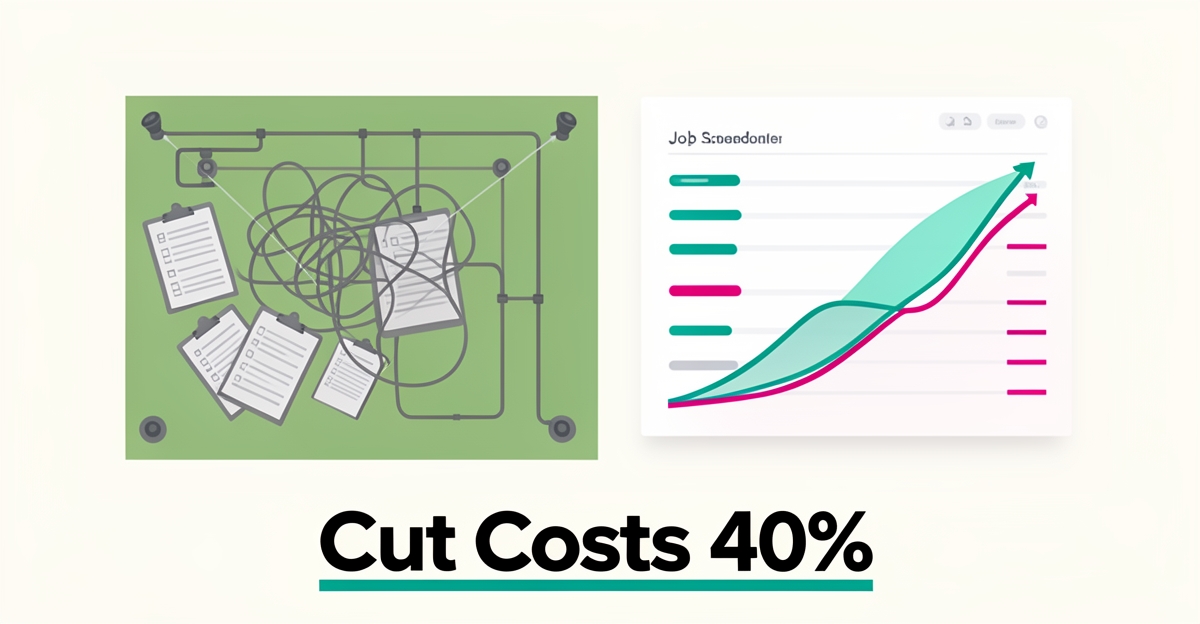
The Real Cost of Manual Job Tracking in Irrigation Installation, And How AI Cuts It by 40%
Key Facts
- 88% of organizations reported using AI tools in at least one business function in McKinsey's State of AI 2025 research as reported by TechRadar
- Only about 5% of enterprises had AI actually integrated into real workflows, per MIT research cited around 2025 via TechRadar
- AI can cut the real cost of manual job tracking by roughly 40%, according to AIQ Labs internal analysis of the systems it has deployed
- AI-enhanced systems have been reported to reduce logistics costs by 15% and improve inventory accuracy by 35% per McKinsey analysis cited by LiquidWeb
- 23% of organizations had moved agentic AI beyond pilot programs as of McKinsey's 2025 reporting per TechRadar
- AI can predict scenarios, recommend solutions, and even execute them per intelligent workflow automation research
Hire a team member that works 24/7 — for less than a part-time wage.
AI receptionists, SDRs, dispatchers and 99+ roles. Trained on your business, fully managed.
Not sure where to start? Ask our AI planner
The Hidden Drain: What Manual Job Tracking Really Costs Irrigation Businesses
The reality of manual job tracking in irrigation installation is a daily struggle against inefficiency. Teams spend excessive time on paperwork, phone calls, and chasing updates instead of installing systems. This administrative overload directly translates to scheduling delays, missed revenue opportunities, and frustrated field crews who can't focus on their core work.
Research confirms how widespread this problem is: 88% of organizations reported using AI tools in at least one business function in McKinsey's 2025 State of AI research, yet only about a third had begun scaling AI across the enterprise, and roughly 5% of enterprises had AI actually integrated into workflows. For irrigation businesses still relying on clipboards and spreadsheets, this gap represents a significant competitive disadvantage.
The hidden costs accumulate quickly: delayed schedules mean fewer jobs completed per week, lost revenue from idle crews and equipment, and increased overtime to catch up. Administrative staff drown in manual data entry, error correction, and status update requests, pulling them away from higher-value tasks. Most critically, businesses consistently underestimate the true cost of doing nothing, viewing manual tracking as a necessary evil rather than a solvable inefficiency draining profitability.
This operational drag isn't just frustrating; it's quantifiable. AI-powered job tracking systems eliminate the need for constant manual updates by automating progress tracking and providing real-time visibility into every job site. Field teams receive instant updates on schedule changes, material needs, and client requests without stopping work to make calls or fill out forms. Dispatchers gain a live dashboard showing crew locations, job completion percentages, and potential bottlenecks before they escalate.
The impact is measurable: AI can cut the real cost of manual job tracking by roughly 40%, according to AIQ Labs' internal analysis of the systems it has deployed. This reduction comes from slashing administrative hours, minimizing scheduling conflicts, and enabling crews to complete more billable work per day. When job tracking stops being a bottleneck, field productivity rises, customer satisfaction improves with accurate ETAs, and revenue leakage from delays and errors diminishes.
For irrigation contractors still managing jobs through fragmented systems, the path forward isn't about adopting another software tool, it's about implementing purpose-built automation that owns the workflow end-to-end. The businesses seeing the highest returns aren't just tracking jobs better; they've removed the manual burden entirely, letting AI handle the updates while their teams focus on what they do best: installing irrigation systems right the first time, on time.
Start the Fit Check, a two-minute assessment at aiqlabs.ai/apply leading to a free 30-minute strategy call at aiqlabs.ai/book to map your biggest bottleneck and identify high-ROI automation opportunities. If there isn't a clear win, we'll say so, no obligation, just clarity on your AI opportunity.
Why Most Irrigation Companies Are Stuck in the AI Pilot Phase
If your irrigation business has dabbled in AI but hasn't seen the promised transformation, you're in good company. The gap between AI adoption and actual workflow integration is the defining challenge of this technology cycle, and it's creating winners and losers faster than most owners realize.
The numbers tell a striking story. According to McKinsey's State of AI 2025 report, 88% of organizations reported using AI tools in at least one business function. Yet only about a third had begun scaling AI to the enterprise level, and just 23% had moved agentic AI beyond pilot programs. Even more sobering, MIT research showed only about 5% of enterprises with AI actually embedded in real workflows.
This isn't a technology problem, it's an integration problem. Most irrigation companies have experimented with chatbots for emails or scheduling assistants, but these tools live outside actual operations. As Faisal Masud, President of WW Digital & Lifecycle Services at HP, put it: "AI is on nearly every desktop, but it's in almost no workflows. The gap is becoming a structural divide."
For irrigation contractors, this divide creates a narrow window of opportunity. While competitors struggle to move beyond pilots, businesses that embed AI directly into job tracking, scheduling, and customer communication can capture market share before the gap closes.
The pilot phase trap typically looks like this:
- Testing AI for isolated tasks without connecting to field operations
- Running parallel manual and automated systems that create more work
- Waiting for "perfect" solutions while competitors gain efficiency
- Investing in generic tools that don't fit irrigation-specific workflows
Breaking out requires a different approach. Rather than layering AI on top of broken processes, successful companies rebuild workflows around automation. This is where AIQ Labs focuses, through AI Workflow Builds that rebuild the one workflow costing you the most, at a fixed price and in phases. The result isn't AI as a novelty, but AI as invisible infrastructure.
The small share of enterprises with embedded AI aren't necessarily larger or better funded. They simply committed to integration over experimentation. For irrigation businesses tired of administrative overhead eating into margins, that commitment is the only path to the roughly 40% cost reduction that manual tracking currently steals.
How AI-Powered Job Tracking Works in the Field, And Where the 40% Savings Comes From
Imagine knowing the exact status of every irrigation job, every crew, every task, every delay, without making a single phone call. That's what AI-powered job tracking delivers, and it's where the 40% cost reduction becomes real.
The mechanics are straightforward. Rather than relying on paper logs, end-of-day texts, or spreadsheets updated hours after the fact, an AI system captures job progress as it happens. Field crews interact with a simple interface, often voice or a few taps on a phone, and the system logs milestones, flags delays, and updates schedules automatically. According to research on intelligent workflow automation, AI can predict scenarios, recommend solutions, and even execute them, which means the system doesn't just record what happened, it anticipates what comes next.
Here's where the savings break down in practice:
- Automated progress logging eliminates the administrative hours office staff spend chasing updates, re-entering data, and reconciling conflicting reports
- Real-time schedule adjustments reduce windshield time and idle crew hours by resequencing jobs the moment a delay or early finish occurs
- Accurate completion timestamps tighten billing cycles and reduce disputes, directly improving cash flow
- Reduced miscommunication between field and office cuts the rework and callback visits that silently erode margins
Together, these capabilities address the core inefficiencies that make manual tracking so expensive, the hidden labor, the scheduling gaps, the revenue that slips through when jobs run long or invoices go out late. AIQ Labs' internal analysis of the multi-agent systems it has deployed puts the combined reduction at roughly 40% of the real cost of manual job tracking, a figure grounded in what happens when you remove the human bottleneck from every status update, schedule change, and progress report.
Adjacent data reinforces the pattern. McKinsey research cited by LiquidWeb's analysis of AI in inventory management found that AI-enhanced systems reduced logistics costs by 15% while improving inventory accuracy by 35% and service levels by 65%. Those numbers come from supply chain contexts, but the underlying mechanism is identical: replace manual tracking with real-time AI monitoring, and costs drop while accuracy climbs.
The gap between knowing AI works and actually deploying it remains wide. MIT research showed only about 5% of enterprises with AI genuinely integrated into workflows, even though McKinsey's State of AI 2025 report found 88% of organizations using AI in at least one function. For irrigation contractors still running on clipboards and phone calls, that gap represents a direct competitive opening, one that AIQ Labs helps field service businesses close with custom-built tracking systems designed for their specific workflows, not generic software they have to adapt to.
From Manual Chaos to Automated Operations: What Implementation Actually Looks Like
Moving from theory to practice, implementing automated job tracking begins with a clear audit of your current workflow, identifying where manual updates create delays, errors, and revenue loss. Many irrigation businesses start by mapping how job data flows from initial client contact through scheduling, field execution, and final invoicing, pinpointing the exact moments where human intervention introduces friction. This discovery phase is critical because, as research has shown, only a small fraction of enterprises have AI truly integrated into workflows, meaning most still rely on disconnected spreadsheets, paper logs, or siloed software that forces teams to re-enter data multiple times according to MIT research cited by TechRadar. Without this baseline, automation efforts risk solving the wrong problem or creating new inefficiencies.
Once the workflow audit is complete, the next step is deciding whether to fix a single broken process or pursue a broader operational overhaul, this is where engagement models shape the approach. For businesses overwhelmed by daily scheduling conflicts or missed follow-ups, AIQ Labs often recommends starting with an AI Workflow Build: targeting one critical pain point, like manual job status updates between the office and field teams, and replacing it with a custom, production-ready system at a fixed price, delivered in phases. This phased approach allows teams to see measurable gains quickly, such as reduced administrative burden and fewer scheduling delays, without disrupting entire operations. Alternatively, businesses ready for deeper transformation may opt for an AI Operating System, integrating job tracking with inventory, invoicing, and customer communication under one connected operating layer they own outright.
Deployment follows a structured path: custom development, integration with existing tools like CRMs or scheduling software, rigorous testing, and user training tailored to field technicians and dispatchers. Throughout, AIQ Labs emphasizes true ownership, clients receive full control of the system, avoiding vendor lock-in while ensuring the solution scales with their growth. The result isn't just a faster process; it's a foundation for continuous improvement, where AI doesn't just track jobs but learns from patterns to predict delays, optimize routes, and proactively alert teams, turning reactive tracking into a strategic advantage. This is how automation moves from concept to capability, delivering the roughly 40% cost reduction AIQ Labs has observed across real-world deployments.
The Competitive Divide Is Already Here, Which Side Is Your Business On?
The divide isn't coming, it's already here. While some irrigation contractors are automating job tracking with AI to cut administrative burden by roughly 40%, others remain stuck in manual processes that bleed time and revenue daily. This isn't just about efficiency, it's about who gets to compete in the next wave of field service innovation.
The data shows a stark split: 88% of organizations reported using AI tools in at least one business function as of 2025, yet only about 5% had fully integrated AI into core workflows like job tracking and scheduling. Most are still experimenting or running isolated pilots that never scale. For irrigation installers, this gap translates directly to delayed dispatches, inaccurate completion times, and missed opportunities to serve more clients per day.
What separates the AI Haves from the Have-Nots isn't technology access, it's execution. As Faisal Masud put it, "AI becomes truly valuable only when it is embedded and integrated into processes and data. Companies that are working toward this are the AI Haves. Those that aren't, the Have-Nots." In irrigation installation, where every minute on-site impacts crew utilization and customer satisfaction, manual tracking isn't an operational hiccup, it's a competitive liability.
The field is already splitting. One side uses AI to automate job updates in real time, reducing scheduling conflicts and freeing up crews for more billable work. The other side relies on clipboards and spreadsheets, reacting to delays instead of preventing them. The cost isn't just in lost hours, it's in eroded trust, missed service commitments, and revenue walking out the door to competitors who show up faster and communicate better.
If your team is still tracking jobs manually, you're not just behind on efficiency, you're falling behind in market position. The good news? The gap can close faster than you think. Start with a clear-eyed assessment of where AI can deliver immediate impact in your workflow.
Take the two-minute Fit Check at https://aiqlabs.ai/apply, then schedule your free 30-minute strategy call at https://aiqlabs.ai/book. We'll map your biggest bottlenecks, identify high-ROI automation opportunities, and give you a straight answer, no pitch, just clarity on whether AI can give you the edge you need.
Still paying for 10+ subscriptions that don’t talk to each other?
We build custom AI systems you own outright. No vendor lock-in. Full control.
Not sure where to start? Ask our AI planner
Frequently Asked Questions
How much does manual job tracking actually cost an irrigation business?
Why are so many companies using AI but not seeing results in the field?
What does AI-powered job tracking look like day-to-day for crews?
Where do the 40% savings actually come from?
Do I need to replace all our software to get this benefit?
Is AI job tracking just for big enterprises?
Stop Paying the Manual Tax, Your Next Move Starts With One Question
The math is hard to argue with: manual job tracking quietly drains irrigation installation businesses through administrative hours, scheduling conflicts, delayed billing, and crews stuck doing paperwork instead of billable work. AI-powered tracking eliminates that burden at the source, automating progress logging, adjusting schedules in real time, and cutting the real cost of manual tracking by roughly 40% based on AIQ Labs' internal analysis. And with only about 5% of enterprises having AI truly embedded in their workflows, the contractors who commit to integration over experimentation will own their markets while competitors stay stuck in pilots. The question isn't whether AI can help your business, it's which workflow to fix first. Start with the two-minute Fit Check at aiqlabs.ai/apply, then book your free 30-minute strategy call at aiqlabs.ai/book. You'll map your biggest bottleneck and get a straight answer on your highest-ROI automation opportunity, and if there isn't a clear win, we'll tell you that too. No obligation, just clarity.
Make AI your competitive advantage — not just another tool.
Strategy, implementation and ongoing optimization. One partner, end to end.
Not sure where to start? Ask our AI planner