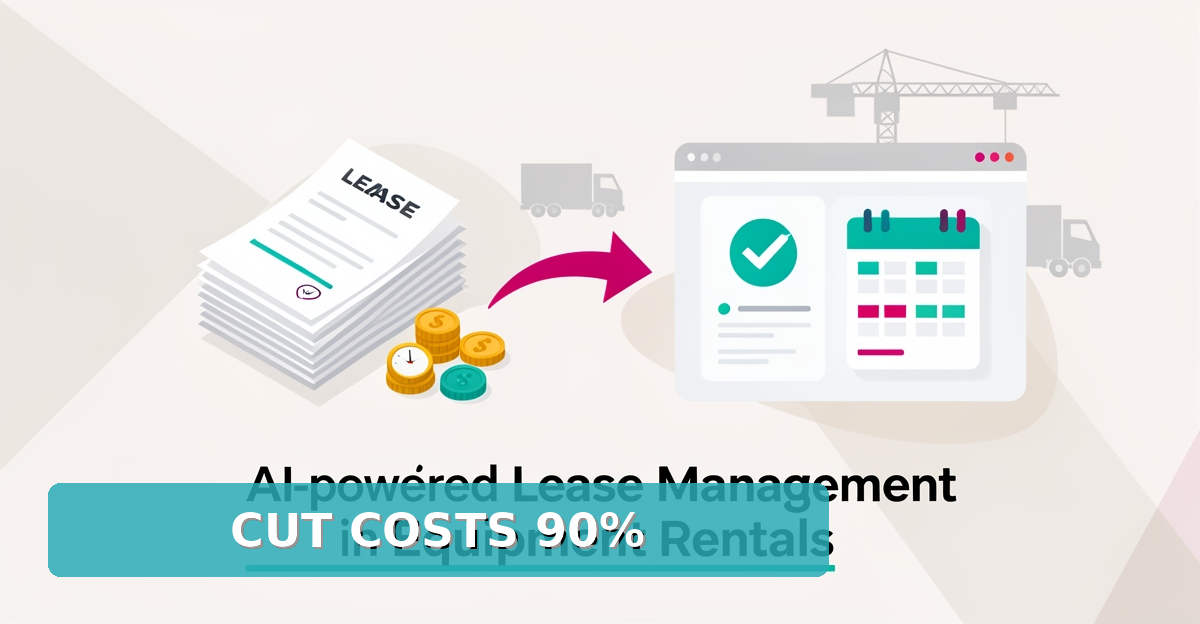
The Real Cost of Manual Lease Management in Equipment Rentals (And How AI Saves $10K+ Annually)
Key Facts
- Manual lease abstraction typically costs €200-500 per lease and takes 4-8 hours, based on industry benchmarks as of late 2026
- AI-assisted processing handles a typical lease in minutes rather than hours, cutting time by 85-95%
- AI extraction commonly achieves 90-97% accuracy on standard commercial lease terms, versus roughly 85-92% for manual first-pass review
- Missed critical dates are widely estimated to cost companies 2-5% of annual rent across a portfolio
- Hybrid AI-human workflows can reach 99%+ accuracy while reducing total handling time to 20-30 minutes per lease
Hire a team member that works 24/7 — for less than a part-time wage.
AI receptionists, SDRs, dispatchers and 99+ roles. Trained on your business, fully managed.
Not sure where to start? Ask our AI planner
The True Cost of Manual Lease Abstraction: Beyond Labor Hours
Manual lease abstraction looks like an admin task until you price the full impact on cash flow and risk. For equipment rental firms, the real cost hides in labor, errors, and missed dates that compound across a portfolio.
Industry benchmarks as of late 2026 put fully loaded in-house abstraction at roughly €200-500 per lease. That figure reflects 4-8 hours of analyst time per document, with manual error rates often running 8-15% on individual data points. For a modest 25-tenant portfolio, direct labor alone can reach €5,000-12,500 and consume 1-2 weeks of processing time.
Speed is only part of the problem. Manual processes introduce variability that creates financial exposure. Missed critical dates are widely estimated to cost 2-5% of annual rent across a portfolio, and firms with weak critical date tracking tend to overpay accordingly. Compliance failures carry even larger downside when inconsistent lease data forces financial restatements.
The hidden cost stack for manual lease management includes:
- Labor drag: 4-8 hours per lease at €200-500 each, scaling linearly with portfolio growth
- Error and rework: 8-15% error rates on data points, with a meaningful share of abstracts containing material errors
- Missed renewals and notices: estimated 2-5% annual rent overpayment and weaker renegotiation leverage
- Compliance and dispute risk: CAM reconciliation disputes that can run tens of thousands of dollars in legal fees
These burdens are not theoretical. Benchmark testing generally places manual first-pass accuracy at 85-92% by trained reviewers, while AI extraction commonly achieves 90-97% on standard commercial terms. The gap widens when fatigue and volume increase, because reviewer-dependent consistency breaks down at scale.
For rental firms, lease abstraction sits inside broader expense management workflows where late payments, missed renewals, and administrative labor erode margins. AIQ Labs rebuilds these workflows through AI Workflow Builds — a fixed-price, phased approach that targets the one workflow costing you the most. Standardized extraction and automated critical date flagging prevent the compounding losses described above.
When abstraction costs are calculated per portfolio, the scale becomes clear. Manual abstraction for a 25-tenant portfolio can cost €5,000-12,500, and the same math grows to €60,000-150,000 for 200 leases. AI typically reduces abstraction labor by 70-90% while processing leases in minutes rather than hours, shifting staff from data entry to analysis and renewal strategy.
How AI Lease Abstraction Cuts Costs by 85-95% While Boosting Accuracy
AI-powered lease abstraction changes how equipment rental firms manage critical lease data by delivering step-change improvements in speed, accuracy, and cost. Modern AI extraction platforms process a typical commercial lease in just 2-5 minutes — compared to 4-8 hours for manual abstraction — a time reduction of 85-95% per industry benchmarks. This acceleration moves firms from document receipt to actionable data in minutes rather than days, freeing analyst capacity for higher-value work like financial analysis and portfolio optimization.
Cost savings are equally substantial, with AI extraction typically reducing per-lease expenses from €200-500 ($220-550) to roughly €20-60 ($22-66). For a 500-lease portfolio, that shift can translate to tens of thousands of dollars in annual labor savings when moving from manual in-house methods to AI abstraction. These figures do not even account for the downstream financial impacts of errors — such as missed renewals or compliance failures — which can cost 2-5% of annual rent in the worst cases.
Accuracy improvements further amplify the value. AI commonly achieves 90-97% accuracy on standard commercial lease terms, outperforming the 85-92% first-pass accuracy of trained reviewers in field-level benchmark studies. When combined with lightweight human review — focusing on the roughly 10% of edge cases like complex clauses or handwritten annotations — hybrid workflows consistently deliver 99%+ accuracy while cutting total processing time to 20-30 minutes per lease. This approach eliminates reviewer-dependent variability and produces consistent, audit-ready data across entire portfolios.
- Processing time drops from 4-8 hours to 2-5 minutes per lease
- Cost per lease falls to roughly €20-60 ($22-66) vs. €200-500 manually
- Accuracy improves to 90-97% with AI, reaching 99%+ in hybrid workflows
- Large portfolios can save $10K+ annually — often far more at 500-lease scale
- Human review focuses on only ~10% of complex cases for quality assurance
For equipment rental firms, these efficiencies directly address the hidden costs buried in manual processes — late payments from missed critical dates, administrative labor wasted on repetitive data entry, and compliance risks from inconsistent abstraction. AIQ Labs builds these systems so extracted data flows directly into your accounting and property management tools without manual re-entry. The result is a scalable, auditable foundation for lease management that typically pays for itself within the first year through labor savings alone — while positioning firms to capture better terms at renegotiation through disciplined critical date tracking.
From Missed Dates to Compliance Risks: The Hidden Financial Leaks AI Prevents
Equipment rental companies lose thousands of dollars annually to preventable financial leaks that manual lease management creates. These hidden costs compound silently until they surface as missed opportunities, compliance penalties, or expensive legal disputes.
Critical date failures represent the most common drain. When renewal deadlines, break option windows, and rent review dates slip by unnoticed, companies are widely estimated to overpay by 2-5% of annual rent across their portfolio. For a rental firm managing $2 million in annual lease obligations, that translates to $40,000-$100,000 in preventable losses every year.
Compliance failures carry even steeper consequences. Financial restatements driven by inconsistent lease data can shave significant value off a company, and many private companies adopting IFRS 16 have experienced delays or restatements from poor lease data quality. Manual processes introduce 8-15% error rates on individual data points, creating audit vulnerabilities that cascade through financial reporting.
CAM reconciliation disputes add another layer of expense. These conflicts can cost tens of thousands of dollars in legal fees per dispute, draining resources that could fund growth initiatives. Manual abstraction's material error rate makes these disputes nearly inevitable for portfolios managed through spreadsheets and manual review.
AI eliminates these leaks through systematic automation:
- Automated critical date flagging identifies renewal deadlines, break options, and notice periods before they expire, preventing overpayment penalties
- Standardized data extraction creates consistent, auditable records that satisfy ASC 842 and IFRS 16 requirements without the 8-15% error rates of manual processing
- Continuous audit trails document every data point's source and validation, eliminating compliance ambiguity
- Real-time alerts replace the "someone noticed on page 47" approach that fails under portfolio complexity
The technology commonly achieves 90-97% accuracy on standard commercial lease terms compared to 85-92% for manual first-pass review. When combined with human oversight for complex clauses, accuracy exceeds 99% while processing time drops from 4-8 hours to 20-30 minutes per lease.
AIQ Labs builds lease management systems that combine critical date tracking, compliance monitoring, and automated data extraction into one connected layer. For firms ready to go beyond a single workflow, AI Operating Systems connect lease data with dispatch, billing, and finance so nothing falls through the cracks — built in phases and owned outright.
Implementing AI Lease Abstraction: A Practical 7-Step Workflow for Equipment Rental Firms
Manual lease review is quietly draining rental firms. Every missed renewal, late payment, and misfiled amendment adds up to lost cash flow and compliance risk.
A practical seven-step workflow makes AI lease abstraction fast, accurate, and safe for equipment rental teams without requiring technical expertise.
Start with a scoping session to map your specific document types and critical data points. Upload lease documents in bulk to the platform; uploading a PDF typically takes seconds. The AI parses the full document in 2-5 minutes versus 4-8 hours manually, per industry benchmarks.
Review is targeted, not exhaustive. AI commonly achieves 90-97% accuracy on standard commercial lease terms, while manual first-pass accuracy sits around 85-92%. Human reviewers validate flagged items, complex clauses, and edge cases in a few minutes. This hybrid model cuts total abstraction time from hours to 20-30 minutes and pushes accuracy to 99%+.
Export structured data to CSV or Excel in seconds and integrate with accounting systems for automated critical date tracking. The workflow standardizes rent amounts, renewal windows, notice periods, and equipment schedules so finance teams stop chasing spreadsheets.
The implementation path is:
- Define extraction fields for equipment leases and amendments
- Upload PDFs and let AI extract terms in minutes with 90-97% accuracy
- Conduct targeted human review on the ~10% of edge cases
- Export structured data and connect to accounting and lease management systems
Cost impact is immediate. Manual abstraction typically costs €200-500 per lease in-house, while AI extraction runs roughly €20-60 per document. For rental firms, that shift frees analysts from repetitive reading and moves them to portfolio analysis and cash flow optimization.
AIQ Labs delivers this kind of automation through AI Workflow Builds — we rebuild the one workflow that costs you the most, at a fixed price and in phases, so you see value before you scale. And if lease administration itself is the bottleneck, an AI Employee can handle the recurring lease admin work at a fraction of the cost of a human hire. With a hybrid AI-human approach, teams get speed without sacrificing control, and lease data becomes a reliable asset rather than a hidden liability.
Still paying for 10+ subscriptions that don’t talk to each other?
We build custom AI systems you own outright. No vendor lock-in. Full control.
Not sure where to start? Ask our AI planner
Frequently Asked Questions
How much does manual lease abstraction actually cost per lease?
How much faster is AI lease abstraction compared to manual?
Is AI accurate enough for ASC 842 and IFRS 16 compliance?
What hidden financial leaks come from manual lease management?
Will AI actually save money on a large equipment rental portfolio?
Do I need technical expertise to implement AI lease abstraction?
Turn Lease Management from a Cost Center into a Strategic Advantage
Manual lease management silently drains equipment rental firms through labor-intensive abstraction, error-prone data entry, and costly oversights like missed renewals and compliance risks. These hidden costs add up — manual abstraction typically runs €200-500 per lease, missed critical dates are estimated to cause 2-5% annual rent overpayment, and compliance failures can trigger severe losses. AI-powered abstraction flips this equation: cutting processing time from hours to minutes, reducing per-lease costs to roughly €20-60, and boosting accuracy to 90-97% (or 99%+ with light human review). For most portfolios that means $10K+ in annual savings while eliminating the fatigue and variability that undermine manual processes. The result is not just efficiency — it is reliable, auditable lease data that supports better cash flow, stronger renegotiation leverage, and proactive risk management. To see how this applies to your specific portfolio and workflow, start with the free, 2-minute Fit Check to map your biggest bottlenecks — then book a free 30-minute strategy call with our team to explore a tailored path forward.
Make AI your competitive advantage — not just another tool.
Strategy, implementation and ongoing optimization. One partner, end to end.
Not sure where to start? Ask our AI planner