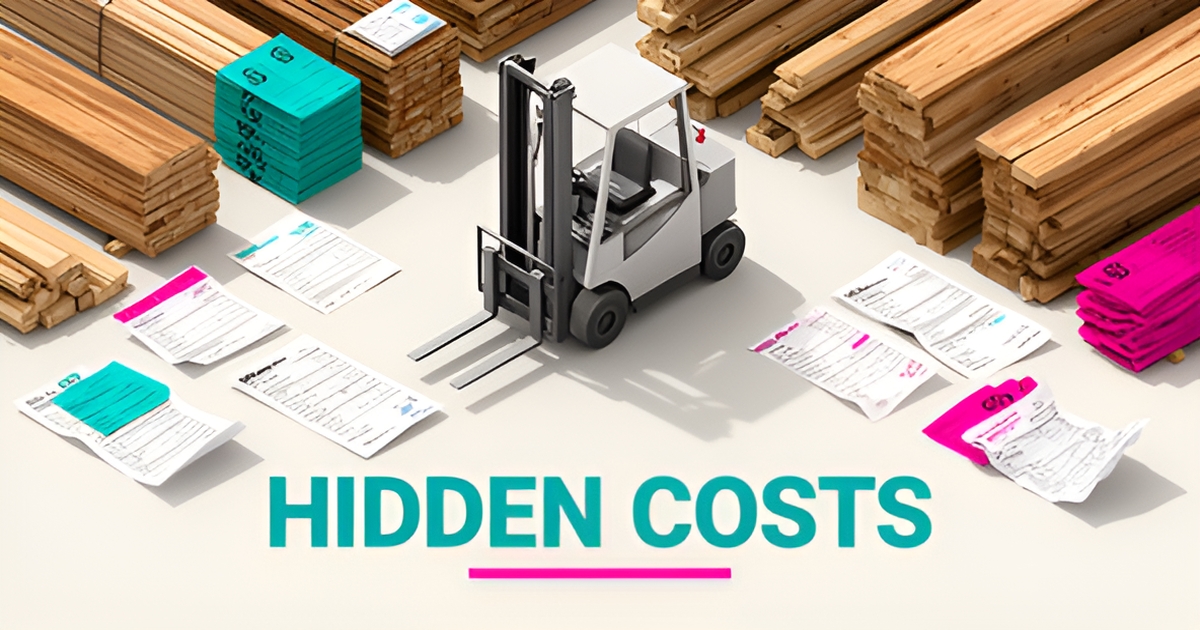
The Real Cost of Manual Order Processing in a Lumber Yard
Key Facts
- Manual order processing typically costs $5 to $15 per order and consumes 12 to 15 minutes of staff time according to widely cited APQC benchmark data
- Processing 500 purchase orders monthly can equal roughly 3 full-time equivalents in labor per procurement benchmarking research
- Manual data entry error rates of 1% to 3% per field compound on multi-line lumber orders, triggering an estimated $25 to $50 per error incident per Aberdeen Group research
- AI-driven order processing can reduce costs by up to 60% while cutting error rates below 0.5% per industry comparisons
- Intelligent document processing platforms report accuracy rates around 98% with substantial cost reduction through automation per enterprise AI platform benchmarks
- AI order agents can process B2B purchase orders in 10 to 30 seconds for an estimated $0.50 to $2.00 each per industry benchmarks
- Error correction typically adds 5% to 10% to total manual processing costs from short shipments, returns, and chargebacks per order management analysis
Hire a team member that works 24/7 — for less than a part-time wage.
AI receptionists, SDRs, dispatchers and 99+ roles. Trained on your business, fully managed.
Not sure where to start? Ask our AI planner
The Hidden Labor Costs Buried in Every Order
Ask most lumber yard managers what it costs to process an order, and they'll quote you a salary number. The real figure is hiding in plain sight — buried across dozens of small, repetitive tasks that never show up as a single line item.
According to APQC benchmark data, the median cost to manually process a single B2B sales order runs between $5 and $15 per order, with each order consuming 12 to 15 minutes of staff time. In a lumber yard, where orders often involve custom cuts, mixed loads, and delivery coordination, that estimate skews toward the higher end.
But the purchase order itself is only the beginning. Analysis of procurement workflows shows that the median total processing time for a direct procurement PO can reach roughly 60 minutes of buyer labor across its full lifecycle — once you account for everything that happens after the order is written.
That hidden hour breaks down into tasks most yards treat as "just part of the job":
- Manual data entry of order details into inventory and accounting systems
- Supplier follow-up calls and emails to confirm pricing, availability, and lead times
- Logging acknowledgments and monitoring delivery schedules
- Re-entering supplier responses into the ERP or order system
- Handling exceptions — discrepancies, backorders, and spec changes — which affect an estimated 15–25% of POs and consume 20 to 45 minutes each
The math compounds quickly at scale. A yard processing 300 purchase orders per month is burning the equivalent of nearly two full-time employees (1.9 FTE) on order administration alone. Push that to 500 POs monthly, and you're looking at roughly 3.1 FTE equivalents — before accounting for the errors.
And errors are expensive. Aberdeen Group research on order management puts manual data entry error rates at 1% to 3% per field. On a multi-line lumber order with dozens of SKUs, quantities, and grade specifications, those odds guarantee mistakes. Each one triggers downstream costs — short shipments, returns, chargebacks, and customer calls — estimated at $25 to $50 per incident, adding another 5% to 10% on top of already-inflated processing costs.
This is precisely the kind of quietly expensive workflow that AI automation is built to eliminate. AIQ Labs rebuilds the one workflow that costs you the most — data extraction, supplier communication, exception routing — end to end through AI Workflow Builds, and industry comparisons show AI-driven order processing can cut these costs by up to 60%. For a mid-size yard, that can translate to six figures in recovered labor every single year.
The Error Multiplier: How Small Mistakes Become Major Margin Erosion
A single mistyped SKU doesn't just sit in a database — it triggers a cascade of short shipments, return freight, and chargeback fees that can cost $25 to $50 per incident to resolve. In a lumber yard where margins are already thin, those corrections add an estimated 5% to 10% on top of every order's processing cost, according to order processing benchmarks. The error rate itself is deceptively small: manual entry produces a 1% to 3% error rate per field, per Aberdeen Group research, but across a multi-line purchase order those probabilities compound fast.
- One wrong quantity field turns a 2x4 order into a 2x6 delivery
- A transposed grade code ships premium stock at standard pricing
- Missed line items create partial shipments and angry contractors
- Each correction burns 15–20 minutes of staff time on calls and credits
When you process 50 to 200 orders a day, those "small" mistakes become a silent margin killer that doesn't show up on any P&L line item. The median cost to process a single sales order manually already ranges from $5 to $15, per APQC benchmarking data — before you layer in error correction. AI-driven automation can reduce that per-order cost to an estimated $0.50 to $2.00 while cutting error rates below 0.5% with validation, a shift that AIQ Labs helps lumber and building materials operators achieve through custom workflow integration and managed AI employees that handle end-to-end order capture without manual re-keying.
Why Lumber Yards Hit a Scaling Wall With Manual Workflows
Manual order processing feels manageable until volume moves. In a lumber yard, that tipping point arrives fast, and the cost of staying manual compounds with every truckload.
The scaling trap is linear. Buyer labor for direct procurement sits at a median of about 60 minutes per purchase order across the full lifecycle, according to procurement benchmarking research. That translates to roughly 0.6 FTE for 100 orders per month, 1.9 FTE for 300, and about 3.1 FTE for 500 orders per month. At 1,000 orders per month you're near 6.3 FTE, and at 2,000 you need roughly 12.5 FTE. Headcount grows in lockstep with orders.
Seasonality makes that math volatile. Spring building season and remodel surges push order intake up 2-3x, while winter thins it out. Hiring for the peak and carrying staff through the trough drives overtime, training cycles, and turnover. Manual entry also carries a 1% to 3% error rate per field, and order management analysis shows every wrong SKU or missed line creates downstream work costing an estimated $25 to $50 per incident. Error costs add another 5% to 10% to total manual processing costs.
The workload itself is repetitive and time-intensive. Comparative data on order agents finds manual entry takes 12 to 15 minutes per order at $5 to $15 per order, while an AI order agent can process B2B purchase orders in under 30 seconds at less than $1 per order. Median cost to process a single sales order in B2B typically ranges from $5 to $15, depending on industry and complexity.
AI flattens the curve. Once configured, the marginal cost of processing an additional order stays near flat, while manual labor scales one-to-one. That means 200+ orders per day can be handled without adding headcount, removing the seasonal hiring and firing cycle that erodes margins in lumber yards.
The hidden burden of manual workflows shows up in daily operations:
- Data entry and cross-checking that consume hours on repetitive tasks like order confirmation and tracking
- Error propagation from 1-3% per field error rates that compound on multi-line lumber orders
- Staffing volatility from peak seasonality and 2 to 4 week onboarding for each new hire
- Downstream rework from short shipments, returns, chargebacks, and customer calls
AI-driven automation can reduce the costs associated with manual order processing by up to 60%, and analysis of repetitive workflows notes AI can bring error rates under 1% for structured work versus 1-5% manually. For order-to-billing workflows, AIQ Labs builds systems you own outright rather than layering another subscription on top. The result is consistent 24/7 processing with near-flat scalability instead of a permanent headcount treadmill.
The AI Alternative: 60% Cost Reduction at $0.50–$2.00 Per Order
The gap between manual and AI-driven order processing isn't a marginal efficiency gain — it's a fundamental shift in unit economics. Where manual entry costs $5 to $15 per order and consumes 12 to 15 minutes of staff time, industry benchmarks show AI agents can process the same B2B purchase orders in 10 to 30 seconds for an estimated $0.50 to $2.00 each. For a mid-sized lumber yard handling 50 orders daily, that delta can translate to roughly $8,750 in monthly savings — before accounting for the error correction costs that manual entry inevitably generates.
Accuracy compounds these savings. Manual data entry carries a 1% to 3% error rate per field, with each mistake triggering an estimated $25 to $50 in downstream corrections from short shipments, returns, and reconciliation headaches. AI order agents can maintain error rates below 0.5% while operating continuously, eliminating the fatigue-related mistakes that plague afternoon shifts and seasonal rushes.
The technology maps directly onto lumber yard workflows through three core capabilities:
- Document extraction: Intelligent processing pulls line items, quantities, and pricing from faxed purchase orders, emailed PDFs, or handwritten delivery tickets with accuracy rates around 98%, eliminating manual keying entirely.
- ERP integration: Direct connections to systems like SAP, Oracle, or Microsoft Dynamics push validated orders into inventory and accounting modules without human middleware, enabling real-time stock allocation.
- Exception routing: When POs contain ambiguities — mismatched SKUs, unclear delivery instructions, or pricing discrepancies — the system flags them for human review rather than guessing, ensuring complex orders still receive expert attention.
This automation extends beyond initial entry into PO acknowledgment, delivery tracking, and invoice reconciliation — workflows that traditionally consume up to 60 minutes of buyer labor per purchase order. AI handles the routine status updates and three-way matching, escalating only the exceptions that require negotiation or judgment. The result is touchless processing for standard orders while preserving human oversight for edge cases.
For lumber yards operating on thin margins, this represents a potential 60% reduction in processing costs while simultaneously improving order accuracy and customer response times. The yard that once needed additional clerks to handle spring volume now scales seamlessly, with AI agents processing orders at 2 AM with the same precision as 2 PM.
From Calculation to Implementation: Your 30-Day Path to Automation
Start by measuring your current cost-per-order to establish a baseline for improvement. Manual order processing in lumber yards typically incurs $5 to $15 per order due to labor-intensive data entry, tracking, and billing tasks, with error rates between 1% and 3% per field that compound into costly corrections. Industry research shows these hidden costs — like short shipments and chargebacks — can add another 5% to 10% to total processing expenses, making automation a financially urgent priority.
Next, audit your highest-volume document types to target the biggest impact areas first. Purchase orders (POs), invoices, and delivery tickets often represent 80%+ of manual workload in lumber operations, with PO acknowledgment alone consuming significant buyer labor — averaging up to 60 minutes per PO across the lifecycle. Procurement benchmarking data confirms that processing 300 POs monthly equals nearly two full-time employees, creating a clear pilot opportunity for AI-driven automation.
Begin your 30-day implementation by piloting AI on a single workflow like PO acknowledgment using a milestone-based build model. This approach lets you approve and pay for each phase as it ships, preserving ownership while integrating with existing ERP or accounting systems. SME-focused analysis suggests AI can reduce such workflow costs by up to 60% after setup, with processing times dropping from minutes to seconds per document and error rates falling below 0.5% through validation.
- Week 1-2: Document current PO processing time, error frequency, and labor allocation
- Week 3: Deploy AI agent for PO data extraction and acknowledgment routing
- Week 4: Validate accuracy against your baseline and measure time savings
Scale success by replicating the model across invoices and delivery tickets, using the same phased payment structure to maintain control and avoid vendor lock-in. AIQ Labs' Workflow Builds run on a Build in Milestones model — you keep everything built so far and expand automation only when ROI is proven, turning manual bottlenecks into owned, scalable assets that reduce operational costs without disrupting core systems.
Still paying for 10+ subscriptions that don’t talk to each other?
We build custom AI systems you own outright. No vendor lock-in. Full control.
Not sure where to start? Ask our AI planner
Frequently Asked Questions
What does it actually cost to manually process a single purchase order in a lumber yard?
How many full-time employees does manual order processing really require at different volumes?
What's the real impact of data entry errors on lumber yard margins?
How much can AI-driven order processing actually reduce costs compared to manual workflows?
What does implementation look like and how fast can we see ROI?
Will AI automation work with our existing ERP and accounting systems?
Stop Paying the Manual Tax on Every Order
Manual order processing isn't just an operational headache — it's a silent margin killer. Between the $5 to $15 burden per order, the 60-minute labor drain across the PO lifecycle, and the 1-3% error rate that compounds into costly chargebacks and short shipments, the status quo can quietly bleed six figures annually from mid-sized yards. The math is hard to ignore: manual workflows scale linearly, forcing you to add headcount just to keep pace with seasonal surges, while AI flattens that curve entirely.
The alternative isn't just incremental improvement — it's a fundamental shift to an estimated $0.50–$2.00 per order with AI-driven processing that can cut costs by up to 60% while reducing errors below 0.5%. This isn't about replacing your team; it's about freeing them from data entry so they can focus on exceptions and customer relationships.
Ready to quantify your specific savings? Start with the two-minute Fit Check at https://aiqlabs.ai/apply. It's a no-obligation assessment that maps your current workflow against automation potential — if there's a clear win, we'll show you exactly how to capture it on a free 30-minute strategy call.
Make AI your competitive advantage — not just another tool.
Strategy, implementation and ongoing optimization. One partner, end to end.
Not sure where to start? Ask our AI planner