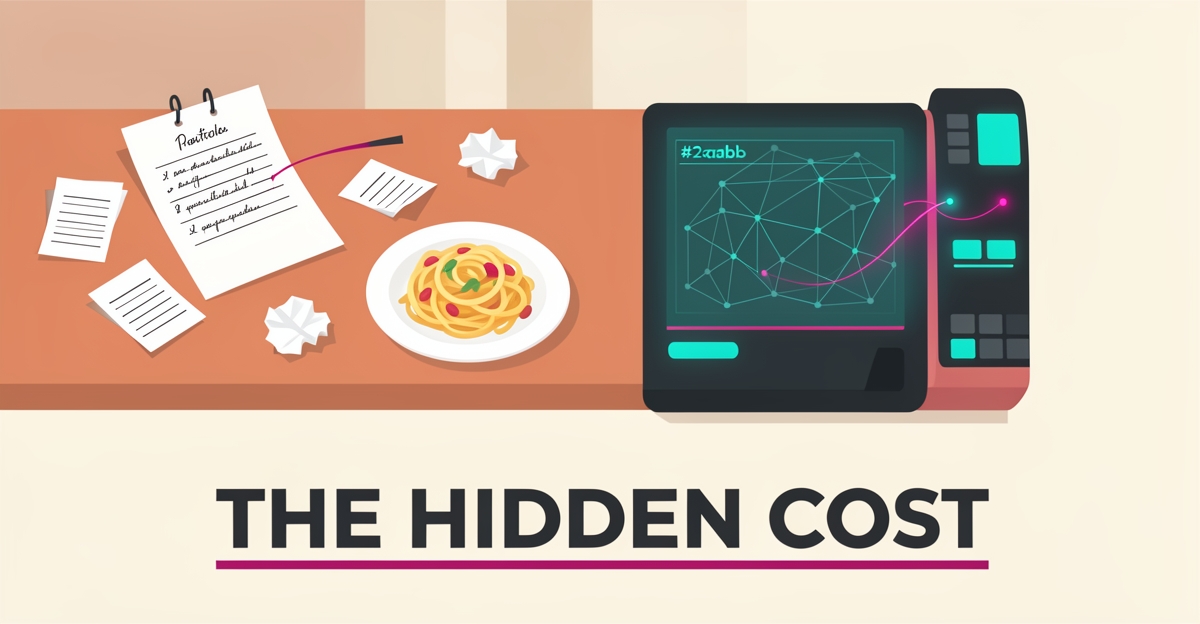
The Real Cost of Manual Order Taking in Italian Restaurants, And How AI Cuts It
Key Facts
- Manual order taking scales linearly: more orders means more staff hours and more payroll
- AI order capture runs continuously without the fatigue-driven accuracy drop humans show late in a shift
- AI errors are consistent and repeatable, so they can be fixed once at the system level; human errors are random and resist root-cause fixes
- Transcription errors show up on the P&L as remakes, comps, and food cost creep
- Ownership matters: systems built for you and owned outright keep costs flat as volume grows, unlike stacked subscriptions
Hire a team member that works 24/7 — for less than a part-time wage.
AI receptionists, SDRs, dispatchers and 99+ roles. Trained on your business, fully managed.
Not sure where to start? Ask our AI planner
The Hidden Costs Behind Every Handwritten Order
Handwritten tickets look cheap until you count what they actually cost during service. In Italian restaurants, the price is paid in remakes, lost minutes, and staff who leave because the rush never lets up.
Manual order taking creates bottlenecks when volume spikes. Staff must transcribe orders by hand, a repetitive task that pulls attention from guests. AI order capture runs continuously, while manual work is constrained by time and effort. The result is slower tables, longer waits, and revenue left on the table.
Error rates turn into food cost. Misread handwriting and rushed shorthand lead to incorrect preparation, customer dissatisfaction, and costly remakes. Each mistake requires additional staff time to identify and correct, compounding the original labor spend. And unlike a machine, human accuracy varies by person, by shift, and by how far into a double someone is, that variability is expensive during peak hours.
The human cost is just as real. Monotonous transcription under high pressure drives fatigue and turnover. Training and supervision overhead rises as new hires learn the shorthand, the menu exceptions, and the kitchen's preferences. Manual work needs workforce expansion to keep up, so teams stretch thinner as demand grows.
Hidden expenses accumulate in ways managers rarely see on a P&L:
- Remakes and comps from transcription errors that erode food cost and tips
- Time wasted on corrections during service instead of guest engagement
- Ongoing training and supervision to maintain quality standards across shifts
- Staff burnout from repetitive, high-pressure order accuracy demands
These costs are structural, not seasonal. AI-powered order taking directly addresses them by capturing orders accurately at the source and routing them to POS and kitchen displays without retyping. AI reduces long-term operating costs despite higher upfront investment, because the marginal cost per order approaches zero once the system is running.
AIQ Labs builds these systems through AI Workflow Builds, we rebuild the one workflow that costs you the most, at a fixed price, in phases. For order taking, that means integrating with your existing POS and kitchen display workflows and replacing error-prone transcription with consistent capture, while preserving the service feel that keeps your dining room warm.
Why Manual Processes Break Down at Scale, and AI Doesn't
A restaurant that takes 200 orders on a Friday night doesn't have a staffing problem, it has a scaling problem. Manual order taking works fine at lunch on a Tuesday, but the moment volume spikes, every human bottleneck in the process gets exposed.
The core difference comes down to how each system grows. AI scales instantly while manual work requires workforce expansion, meaning a busy Saturday service forces restaurants to add headcount just to keep pace, while an AI system absorbs the surge without breaking a sweat.
The cost structures diverge just as sharply. Manual order taking carries a linear cost: more orders, more staff hours, more payroll. AI flips that equation with a near-zero marginal cost per additional order, processing order number 500 costs essentially the same as order number 5.
Accuracy tells a similar story. Human accuracy varies by person, shift, and fatigue level, which is why handwritten orders lead to misread tickets, remade dishes, and comped meals. AI accuracy, by contrast, improves over time as it learns from data and feedback loops. And when errors do occur, their patterns differ fundamentally:
- AI errors are consistent and repeatable, once identified, they can be corrected at the system level and never happen the same way again.
- Human errors are random and unpredictable, tied to individual skill, stress, and workload.
- Systematic errors compound predictably at scale, while random errors resist root-cause fixes entirely.
Then there's the endurance factor. AI runs continuously, while a server on hour seven of a double shift simply cannot match the accuracy of the same person at hour one. That fatigue feeds directly into staff burnout, turnover, and the constant cycle of retraining that manual systems demand.
This is where purpose-built automation earns its keep. AIQ Labs builds custom order-taking systems that integrate directly with existing POS and kitchen displays, capturing orders accurately at the source and eliminating the transcription step where most errors originate. The goal isn't replacing staff, it's freeing them from repetitive, error-prone tasks so they can focus on the hospitality work humans do best.
One caution worth noting: AI adoption brings its own management burden. Stacked subscriptions, per-seat licenses, and opaque usage fees quietly erode margins, and many businesses discover too late they can't see what they're actually spending on AI tools. Restaurants choosing AI should demand transparent pricing and clear ownership of what's built. AIQ Labs publishes its payment models plainly, Start Monthly, Build in Milestones, or Own It Outright, with no invented numbers or hidden fees. See pricing for the full picture.
What Good AI Order Taking Looks Like in a Real Dining Room
Manual order taking looks simple until the dinner rush hits and the hidden costs surface. In Italian restaurants, the real friction is not the menu, it's transcription errors, repeated corrections, and staff stretched thin during peak volume.
Good AI order taking is designed around the dining room, not around the technology. It starts with transparency with guests, making it clear when they interact with AI versus a human. Transparency builds trust and sets appropriate expectations for system capabilities and limitations. Keeping tools intuitive, transparent, and sensitive to real human needs is what makes automation user-friendly rather than alienating.
Seamless integration is non-negotiable. The system must connect directly with existing POS and kitchen display systems so orders flow without re-entry or manual handoffs. AI enables continuous operations while manual work is constrained by time and effort, but that cost structure only pays off when integration is smooth and errors do not compound at the pass.
Interaction must fit real behavior. Diners expect choice, not a single rigid flow. Effective deployments offer multiple interaction modes so guests can speak naturally, tap a screen, or follow a guided workflow depending on context and comfort.
- Voice capture for natural ordering with speech recognition that handles accents and background noise
- Touch interfaces for visual menu browsing, modifications, and allergen flags
- Guided workflows that confirm items, portions, and customizations before submission
Human connection is preserved by design. AI handles repetitive, rules-based order capture while staff stay focused on hospitality, customization, and exceptions. Easy handoff to staff for complex requests prevents frustration and maintains service quality. AI errors are consistent and fixable at the system level; human errors are unpredictable and tied to fatigue.
For Italian restaurants navigating labor inefficiencies and burnout, these design principles translate into fewer remakes, faster table turns, and calmer service. AIQ Labs approaches order taking as a workflow problem first, typically through AI Workflow Builds for a single high-cost process, or an AI Operating System when you want order taking, reservations, and dispatch connected in one layer you own outright. Human oversight is always kept for exceptions.
How to Implement AI Order Taking Without Disrupting Service
Before diving into AI order taking, restaurant owners must first understand exactly where their current process breaks down. Staff interviews consistently reveal that handwritten orders create delays during peak service, with servers spending valuable time deciphering unclear notes or chasing down missing details. These friction points are exactly the kind of repetitive, rules-based workflows that AI handles well.
Testing AI order taking with real staff in actual dining conditions proves far more effective than lab simulations. By running pilot shifts where servers use voice-to-order interfaces alongside traditional methods, managers can observe how the system handles background noise, accents, and complex modifications in real time. This approach aligns with best practices emphasizing transparency, ensuring both employees and customers know when they're interacting with AI, while maintaining easy pathways to human support for special requests or exceptions.
Successful implementation hinges on building feedback loops that capture frontline insights. After each service period, managers should gather quick input from servers and kitchen staff about order accuracy, speed, and any workflow disruptions, then use this data to refine the AI's understanding of menu items and common customizations. Crucially, the system must integrate seamlessly with existing POS and kitchen display units, not as a disruptive overlay but as a natural extension of current operations. AIQ Labs specializes in this type of integration, building custom systems in phases so nothing changes for staff until each phase is proven. The goal isn't to replace human judgment but to eliminate the repetitive transcription errors that plague manual systems, freeing up teams to focus on hospitality rather than paperwork.
Measuring the Payback: From Error Rates to Staff Retention
Deploying an AI order-taking system isn't the finish line, it's the starting point for a measurement framework most restaurants never build. Without tracking the right metrics, you can't prove ROI, spot regressions, or justify scaling the system further.
Start with error rate reduction. AI accuracy improves over time while manual accuracy varies by person, so track order corrections, remakes, and comped meals weekly, not just monthly. A baseline before deployment makes the delta undeniable.
Next, measure peak-hour order throughput. Manual systems bottleneck when volume spikes; AI operates continuously without degradation. Time how long a Friday-night order takes from customer to kitchen display before and after implementation, and watch whether ticket times compress during your busiest windows rather than just your slowest.
Customer satisfaction and staff health matter just as much. Monitor review sentiment around order accuracy, and survey your team on workload stress. Automating repetitive tasks frees staff for higher-value, relationship-driven work, which directly affects burnout and turnover.
A practical measurement framework includes:
- Order error rate (per 100 orders, tracked weekly)
- Average order-to-kitchen time during peak hours
- Customer satisfaction scores tied to order accuracy
- Staff turnover rate and burnout indicators
- Total AI spend versus measurable labor savings
That last metric trips up more businesses than any other. Stacked subscriptions, per-seat licenses, and opaque usage fees quietly erode the ROI the automation was supposed to create, and plenty of businesses discover they can't clearly see what their AI tooling actually costs them. Demand visibility into every dollar before you sign anything.
This is where ownership models change the math. AIQ Labs builds custom order-taking systems that restaurants own outright, integrated directly with POS and kitchen displays, rather than renting fragmented tools with compounding fees. When you own the code, agents, and data, your cost structure stays flat as order volume grows, and the payback calculation stays honest.
The restaurants that win with AI aren't the ones that deploy fastest. They're the ones that measure relentlessly, keep spend visible, and choose systems built for long-term ROI rather than short-term convenience.
Still paying for 10+ subscriptions that don’t talk to each other?
We build custom AI systems you own outright. No vendor lock-in. Full control.
Not sure where to start? Ask our AI planner
Frequently Asked Questions
How much does manual order taking really cost my Italian restaurant?
Will AI order taking actually be more accurate than my servers?
Can AI handle a Friday night rush without hiring more staff?
Isn't AI just another expensive subscription that'll drain my margins?
Will customers feel like they're losing the human touch?
What metrics should I track to prove ROI after switching?
From Handwritten Tickets to Hospitality: The Real ROI of AI in Italian Restaurants
Manual order taking quietly drains Italian restaurants through remakes, staff burnout, and missed opportunities during peak service, costs that compound with every rushed ticket and transcription error. AI-powered order taking flips this script by capturing orders accurately at the source, integrating seamlessly with existing POS and kitchen displays, and freeing staff to focus on the hospitality that keeps guests coming back. The result isn't just fewer mistakes; it's calmer rushes, faster table turns, and a team that stays engaged instead of stretched thin. For owners ready to measure what matters, error rates, peak-hour throughput, and staff retention, the path forward starts with understanding where their current process breaks down. Start with AIQ Labs' 2-minute Fit Check, then book a free 30-minute strategy call to see if AI order taking is the right fit for your restaurant's workflow and bottom line. Questions first? Reach the team at [email protected].
Make AI your competitive advantage — not just another tool.
Strategy, implementation and ongoing optimization. One partner, end to end.
Not sure where to start? Ask our AI planner