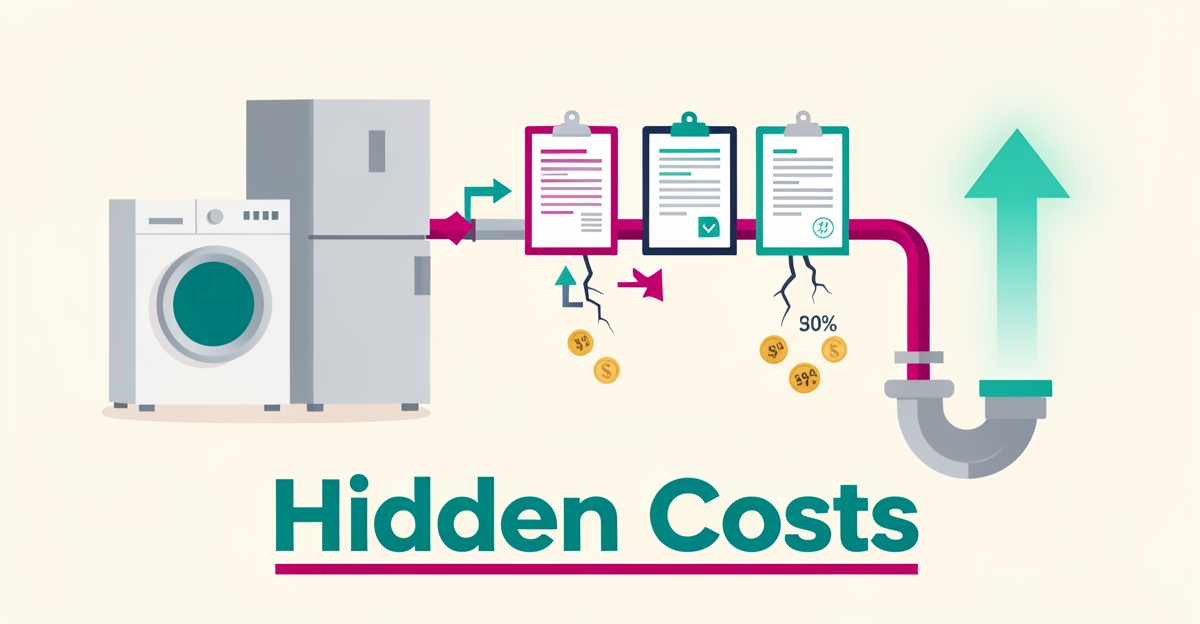
The Real Cost of Manual Repair Workflows: A Breakdown for Appliance Businesses
Key Facts
- Workflow automation deployments have historically reported strong multi-year ROI, with three-year returns often cited in the hundreds of percent according to workflow automation research
- Businesses that fully automate workflows commonly report productivity gains in the 30-40% range in the first year as shown by industry data
- A meaningful share of annual revenue, often estimated at 20-30%, is lost through manual re-keying, duplicated effort, and lost approvals in manual operations
- AI-assisted predictive maintenance is typically associated with fewer unplanned failures and longer asset lifespans per industry analysis
- AI automation can reduce labor and overhead by up to 30% while improving service quality per workflow efficiency studies
- Intelligent dispatching matches the right technician to each job based on skills and location to optimize repair workflows
Hire a team member that works 24/7 — for less than a part-time wage.
AI receptionists, SDRs, dispatchers and 99+ roles. Trained on your business, fully managed.
Not sure where to start? Ask our AI planner
The Hidden Cost Drain in Manual Repair Operations
Manual repair operations look busy on the surface, but the busyness hides a steady drain on margin. Every phone call, work order, and parts request that moves by hand creates friction that compounds across the week.
Re-keying the same job details into dispatch, invoicing, and customer records burns technician and office hours. Workflow automation research suggests that in heavily manual operations, a significant share of annual revenue, often estimated at 20-30%, evaporates through re-keying, duplicated effort, and lost approvals. That is not a one-off error; it is a structural leak in scheduling, parts ordering, and billing.
Missed appointments follow directly from that friction. When dispatch relies on spreadsheets and phone tags, confirmation messages are delayed, travel windows overlap, and customers are left waiting. The result is lost time on the road and technicians returning with no completed jobs, which drives overtime and erodes daily capacity.
Customer complaints rise in parallel. Slow updates, incorrect arrival windows, and surprise invoices damage trust in a category where reliability is the brand. Manual handoffs also increase rework, because a missed approval or duplicated entry forces the crew back to the site.
The labor overhead is measurable. Industry data on workflow automation shows businesses that fully automate workflows commonly report 30-40% productivity gains in the first year, and multi-year ROI figures in the hundreds of percent, driven largely by fewer repeat visits and faster cycle times.
Common cost drains in manual repair workflows include:
- Manual re-keying across dispatch, CRM, and invoicing systems
- Duplicated effort when work orders are lost or re-entered
- Lost approvals that delay parts ordering and technician dispatch
- Missed or double-booked appointments reducing billable hours
These patterns create churn as well as cost. Customers who experience inconsistent communication and delays are more likely to switch providers, while technicians disengage when their day is spent chasing paperwork instead of completing repairs.
AIQ Labs works with appliance businesses to map these manual choke points and model the labor and overhead impact before any build begins. Some businesses start with AI Employees, managed AI staff like receptionists and dispatchers that handle call intake and scheduling at a fraction of a human hire's cost, while others rebuild the one workflow that costs the most through AI Workflow Builds. The focus is on aligning data, people, and process to create measurable operational impact, not technology for its own sake.
Where Manual Workflows Fail: Time, Errors, and Asset Risk
Manual dispatch boards and paper work orders create a lag between a problem appearing and a technician responding. That lag compounds into missed windows, repeated truck rolls, and assets pushed past safe operating limits.
Dispatchers juggle phone calls, texts, and spreadsheets while trying to match skill sets to jobs in real time. The result is delayed interventions that shorten asset lifespans and increase unplanned failures. According to industry research, sensor-based early detection with AI can flag degradation weeks before failure, a pattern that consistently drops downtime and extends asset life.
Scheduling errors multiply the cost. Double bookings, late arrivals, and incomplete follow-ups erode trust and drive customer complaints. Workflow automation data points to the same pattern: in manual operations, revenue leaks through re-keying, duplicated effort, and lost approvals. For appliance businesses, that loss shows up as no-shows, reschedules, and technicians arriving without the right parts.
Equipment damage is not an abstract risk. Reactive rather than planned maintenance is widely linked to equipment failure events, and delayed follow-up means small issues escalate into major repairs, raising both cost and safety exposure.
The failure points cluster around three manual choke points:
- Dispatch: phone-based triage causes slow routing and skill mismatches
- Scheduling: spreadsheets lead to missed appointments and idle technician time
- Follow-up: manual reminders result in incomplete repairs and repeat calls
These friction points keep teams busy without making them effective. AIQ Labs frames this as an ROI modeling challenge, where labor and overhead can typically be reduced by up to 30% through automation that aligns data, people, and process.
Predictive maintenance shifts the equation. Businesses deploying AI-assisted predictive maintenance typically see materially fewer unplanned failures and longer asset lifespans, with some programs reporting reductions in infrastructure failures of 50% or more. The benefit is measurable operational impact, not technology for its own sake.
Manual workflows reward firefighting. Automated workflows reward prevention, with fewer callbacks, higher first-time fix rates, and protected asset value over time.
How AI Automation Cuts Labor and Overhead by Up to 30%
AI automation transforms repair workflows from reactive firefighting into proactive efficiency. By eliminating manual bottlenecks, appliance businesses can reduce labor and overhead costs by up to 30% while improving service quality.
The financial impact extends beyond simple labor savings. According to workflow automation research, businesses deploying full automation commonly see 30-40% productivity gains in the first year alone, and enterprises implementing these systems have historically reported strong multi-year ROI, returns that compound rather than arrive as one-time savings.
Predictive maintenance represents one of the most powerful applications for appliance repair operations. Industry analysis shows AI-driven predictive systems can substantially reduce unplanned equipment failures while extending asset lifespans. Instead of waiting for breakdowns, your team addresses issues before they escalate into costly emergency calls.
AI automation improves operational efficiency through several key mechanisms:
- Automated scheduling eliminates double-bookings and optimizes technician routing
- Intelligent dispatching matches the right technician to each job based on skills and location
- Real-time inventory tracking prevents delays from missing parts
- Automated customer communications reduce no-shows and missed appointments
These improvements compound across your operation. When AI workflow automation handles routine administrative tasks, your technicians spend more time on billable repairs and less time on paperwork. This shift directly addresses the revenue typically lost to manual re-keying, duplicated effort, and lost approvals, as documented in workflow efficiency studies.
Accuracy improvements deliver additional cost savings. Manual data entry errors cascade through repair workflows, causing billing disputes, incorrect parts orders, and repeat service calls. AI systems maintain consistent data quality across all touchpoints, reducing these costly mistakes while creating a reliable foundation for business decisions.
Scalability becomes achievable without proportional overhead increases. Manual workflows require hiring additional administrative staff as call volume grows. AI-powered systems handle increased demand without adding headcount, allowing your business to grow revenue while maintaining lean operations. This operational leverage proves especially valuable during seasonal peaks when appliance failures spike.
AIQ Labs helps appliance businesses identify which workflows deliver the fastest ROI when automated. We map your current processes, quantify the cost of manual inefficiencies, and build a business case for automation investment. For businesses ready to connect scheduling, dispatch, billing, and customer communication into one system, AI Operating Systems provide a single connected operating layer built in phases and owned outright. Our approach focuses on measurable outcomes rather than technology for its own sake.
The transition from manual to automated workflows requires careful planning and data preparation. However, businesses that make this shift position themselves to compete on efficiency and customer experience rather than price alone. The question isn't whether to automate, but which workflows to prioritize first for maximum impact.
Building a Justifiable ROI Model for Repair Automation
A credible ROI model is the difference between an AI project that gets funded and one that stalls in committee. For appliance repair businesses, the goal is simple: quantify what manual workflows cost today, then measure automation's impact against that baseline.
Start by establishing your current cost baseline. Research suggests that in manual operations, a significant share of annual revenue evaporates through re-keying, duplicated effort, and lost approvals. For a repair business, this translates to dispatchers re-entering customer information, technicians calling for job details, and service managers chasing down parts orders.
Next, identify your automation targets. Workflow automation research indicates that enterprises deploying these platforms have historically seen strong multi-year ROI, with first-year productivity gains commonly in the 30-40% range. In practical terms, this means fewer missed appointments, faster invoicing, and reduced administrative overhead.
Your ROI framework should account for these core components:
- Labor cost reduction: Track hours saved on scheduling, dispatch, and customer follow-up
- Error elimination: Measure the drop in data entry mistakes and duplicate work orders
- Capacity gains: Calculate additional service calls completed with the same team size
- Customer retention: Monitor complaint rates and repeat business improvements
Data quality determines whether your automation delivers these results. Accurate and consistent data is crucial for any successful automation project. Before implementation, audit your customer records, service histories, and parts inventories. Clean data in means reliable automation out.
Implementation complexity varies by workflow. A single dispatch automation might take weeks, while a full customer-to-cash system requires months. The key is matching scope to readiness. AIQ Labs structures engagements in phases, you can start monthly, build in milestones, or own the system outright, so you can start with one high-impact workflow and expand as ROI proves out.
Change management often determines whether automation sticks. Research on AI in maintenance workflows emphasizes that success isn't about technology first, it's about aligning data, people, and process. Your technicians need training, your dispatchers need clear escalation paths, and your managers need dashboards that show real-time performance.
Build your business case with conservative estimates. If automation reduces labor and overhead by even 20% instead of the potential 30%, does the investment still make sense? Factor in implementation costs, ongoing monitoring, and the time required to reach full adoption. A realistic model beats an optimistic one that collapses under scrutiny.
The strongest ROI models connect automation directly to revenue impact. When your AI system books one additional service call per day or prevents two missed appointments per week, those gains compound quickly. Track these metrics from day one, and you'll have the data to justify expansion into the next workflow.
Still paying for 10+ subscriptions that don’t talk to each other?
We build custom AI systems you own outright. No vendor lock-in. Full control.
Not sure where to start? Ask our AI planner
Frequently Asked Questions
What percentage of annual revenue do appliance businesses typically lose due to manual repair workflows?
How much can AI automation reduce labor and overhead costs for appliance repair businesses?
What ROI can enterprises expect from deploying workflow automation platforms in repair operations?
How does predictive maintenance impact equipment failure rates and asset lifespan in appliance repair?
Why is data quality critical when implementing AI automation in repair workflows?
What are the main manual choke points in appliance repair workflows that automation targets?
From Hidden Costs to Measurable Gains: Your Next Step
Manual repair workflows silently drain appliance businesses through re-keying, missed appointments, and reactive firefighting, eroding both margins and customer trust. AI automation flips this script by aligning data, people, and process to cut labor and overhead by up to 30%, boost first-time fix rates, and extend asset lifespans through predictive maintenance. The real opportunity isn't just saving time, it's building a scalable, efficient operation that competes on service, not just price. To see where your biggest wins lie, start with a free, no-obligation strategy call. AIQ Labs will map your current bottlenecks, quantify the cost of manual inefficiencies, and show you exactly which workflows to automate first for maximum impact, because the best AI investments begin with clarity, not assumptions. Start with the 2-minute Fit Check, then book your free 30-minute strategy call and turn operational friction into measurable growth.
Make AI your competitive advantage — not just another tool.
Strategy, implementation and ongoing optimization. One partner, end to end.
Not sure where to start? Ask our AI planner