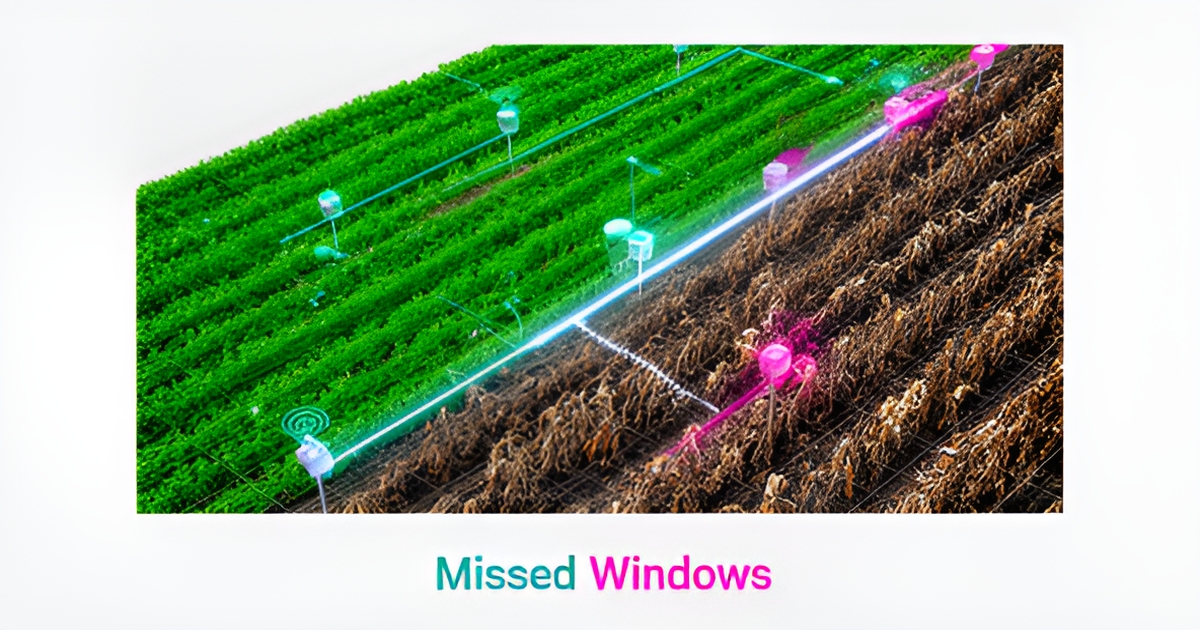
The Real Cost of Missed Application Windows: How AI Prevents Crop Damage
Key Facts
- XGBoost imputation for crop damage shows MSE 0.0213 and R² 0.99 in a Nature study
- At production scale, roughly 1 in 20 AI requests fails due to capacity limits, not model accuracy, according to TechRadar analysis
- IoT-based crop damage frameworks integrate sensor data with machine learning and ensemble learning as described in the paper
- Smart agricultural systems use IoT and analytics to monitor, diagnose, and control farming operations
- Production AI reliability matters more than model accuracy for closing spray windows on time
- AIQ Labs has deployed 200+ multi-agent systems and runs four live SaaS products daily
Hire a team member that works 24/7 — for less than a part-time wage.
AI receptionists, SDRs, dispatchers and 99+ roles. Trained on your business, fully managed.
Not sure where to start? Ask our AI planner
The Hidden Financial Impact of Missed Spray Windows
Missing a spray window does not just postpone protection, it rewrites the economics of the entire season. When pests establish and stress compounds, the cost moves beyond a single input to lost yield, downgraded quality, and a harder fight next cycle.
Smart agricultural systems now leverage IoT and data analytics to monitor, diagnose, and control farming operations, providing essential insights to both farmers and consumers regarding agricultural products and systems. That real-time visibility is what separates reactive spraying from precision timing.
An efficient IoT-based crop damage prediction framework integrates IoT sensor data with advanced machine learning and ensemble learning techniques to predict crop damage within smart agricultural systems. The framework is designed as a reliable decision support system for forecasting crop health status and classifying crops as healthy, pesticide-damaged, or affected by other stressors.
Model trust is built on imputation and validation performance, not assumptions. In that study, the imputation capability of the XGBoost model is validated through a low Mean Squared Error of 0.0213 and a high R-squared value of 0.99. That level of accuracy supports confident decisions when data gaps occur in real-time agricultural datasets.
Precision timing changes the cost equation because delays cascade quickly:
- Yield exposure grows as pest pressure increases between detection and action
- Quality downgrades accumulate when stress is visible at harvest
- Compounding pest resistance raises future input costs and treatment frequency
AI-powered scheduling and alerts convert sensor signals into executable workflows. By embedding intelligent, production-grade AI workflows into daily operations, teams receive timely recommendations aligned to field conditions rather than calendar guesses.
This is where AI workflow automation delivers measurable risk reduction. AIQ Labs applies these same principles through its Workflow Builds — rebuilding the one workflow that costs your operation the most, at a fixed price and in phases — turning IoT streams into automated alerts, task creation, and follow-up verification without manual handoffs.
Operational reliability matters as much as model accuracy. The proposed approach incorporates robust data imputation strategies using both traditional machine learning methods and powerful ensemble learning models. That resilience is critical for resource-constrained environments where connectivity and sensor gaps are common.
When timing is governed by validated predictions, growers protect margin instead of chasing losses. Precision timing separates profitable harvests from preventable losses, and the financial impact of a missed window becomes visible before it is irreversible.
Why Traditional Scheduling Fails in Modern Agriculture
Most farms still run spray schedules on paper calendars or static spreadsheets, treating a living ecosystem like a fixed assembly line. That approach worked when weather patterns were predictable and labor was plentiful — neither is true today. A smart agricultural systems study confirms that real-time field conditions demand dynamic decision support, not rigid timetables.
Weather volatility alone shreds static plans. A three-day rain window can delay fungicide application past the critical growth stage, and no paper calendar adjusts for that. Equipment downtime compounds the problem — a single sprayer breakdown during peak season can push hundreds of acres past their treatment window. Labor shortages mean fewer certified applicators available when the window finally opens. And data fragmentation — soil sensors, satellite imagery, and field scouting reports living in separate systems — leaves decision-makers flying blind.
- Weather shifts that invalidate fixed schedules within hours
- Equipment failures that cascade into missed treatment windows
- Labor gaps that leave no one to execute when conditions align
- Siloed data that prevents unified field intelligence
These aren't theoretical gaps. At production scale, industry analysis suggests roughly 1 in 20 AI requests fails due to capacity limits — rate limits, quotas, and concurrency caps — not model accuracy. If advanced AI systems need operational discipline to handle volatility, static schedules have no chance. The failure mode is the same: rigid infrastructure cannot absorb dynamic reality.
AIQ Labs sees this pattern across industries — workflows designed for stability crumble when conditions shift. The same operational discipline behind the 200+ multi-agent systems AIQ Labs has deployed, and the four live SaaS products the company runs daily, applies to agriculture: dynamic scheduling, real-time alerts, and automated escalation replace hope-based planning. When the spray window opens, the system must already know which fields need treatment, which equipment is available, and which applicators can deploy — not scramble to find out.
How AI-Powered Workflows Close the Application Gap
Missed spray windows compound quickly in the field, turning a narrow timing opportunity into measurable yield risk. Intelligent scheduling systems are built to shrink that gap by turning fragmented signals into coordinated action.
Smart agricultural systems leverage IoT and data analytics to monitor, diagnose, and control farming operations, providing essential insights to both farmers and consumers regarding agricultural products and systems. A Nature Scientific Reports framework shows how an IoT-based crop damage prediction model integrates sensor streams with advanced machine learning and ensemble learning techniques to forecast crop health status and classify stressors.
Reliable prediction starts with complete data. The proposed approach incorporates robust data imputation strategies using both traditional machine learning methods and powerful ensemble learning models. The paper notes the imputation capability of the XGBoost model is validated through a low Mean Squared Error of 0.0213 and a high R-squared value of 0.99, supporting stable decisions even with missing real-time inputs.
In production AI, operational reliability matters as much as model accuracy. Industry analysis finds that roughly 1 in 20 AI requests fails once applications reach scale in production systems, with failures driven more by capacity limits than model bugs. That risk is mitigated by architectures designed for continuous operation.
AIQ Labs applies this operational discipline through workflows that fuse live sensor inputs with predictive analytics and multi-agent orchestration — whether as a single high-cost Workflow Build or as part of a full AI Operating System that connects your whole operation in one layer, built in phases and owned outright. In these designs, real-time IoT sensor streams feed decision models that continuously assess crop stress and application readiness.
A closed-loop workflow typically includes:
- Sensor ingestion and imputation to handle gaps in field data
- Predictive scoring of damage risk and optimal application windows
- Automated alerts and parameter adjustments routed to equipment operators
- Orchestrated rerouting and logging for audit and compliance
By embedding ensemble learning for damage prediction within an autonomous scheduling layer, the system reduces manual monitoring and shortens response time. The framework is particularly suited for deployment in resource-constrained agricultural environments, advancing smart farming through intelligent, data-driven solutions.
From Alert to Action: Implementing Autonomous Crop Protection
Moving from insight to execution requires a deployment pathway that treats AI as an operational capability, not a pilot project. The shift mirrors what happened in cloud computing: the competitive edge no longer belongs to whoever has the best model, but to whoever can operate AI reliably, efficiently, and safely at scale. In production environments, roughly 1 in 20 requests fails — and the majority of those failures stem from capacity limits like rate limits and concurrency caps rather than model accuracy issues, according to field CTO analysis.
- Sensor integration and model training on historical application windows, weather patterns, and crop-stage data
- CRM and ERP connections so the AI can read field schedules, write work orders, and update inventory in real time
- Human-in-the-loop escalation paths for edge cases — unexpected pest pressure, equipment downtime, regulatory hold — with full audit trails for compliance
- Closed-loop execution where a dispatcher-role AI Employee confirms completion, logs results, and feeds outcomes back into the forecasting model
This is exactly the architecture AIQ Labs delivers through its Start Monthly payment model: a managed AI Employee — one of 99+ roles, from dispatchers to coordinators — operating at roughly 80% less cost than a human hire, with monitoring and continuous improvement included. The system connects to your existing tools and grows from there: Start Monthly to prove it, Build in Milestones to expand, or Own It Outright when it becomes core infrastructure. The same production discipline behind AIQ Labs' 200+ deployed multi-agent systems and four live SaaS products runs daily across revenue-generating platforms. Governance, compliance, and human oversight are built in from day one, not bolted on later.
Still paying for 10+ subscriptions that don’t talk to each other?
We build custom AI systems you own outright. No vendor lock-in. Full control.
Not sure where to start? Ask our AI planner
Frequently Asked Questions
What's the real financial impact of missing a pesticide spray window?
How accurate are AI crop damage prediction models when sensor data is incomplete?
Why do traditional paper calendars and static spreadsheets fail for modern spray scheduling?
Do AI systems fail in production because of model accuracy problems?
How does AI turn sensor data into actual spray operations without manual handoffs?
What does it take to implement autonomous crop protection beyond just buying software?
The Window Is Open — Will You Be Ready?
Missed spray windows don't just delay a task — they rewrite the economics of the season, compounding yield loss, quality downgrades, and future resistance costs into a debt that's paid at harvest. Static calendars and siloed data can't absorb the volatility of modern agriculture: weather shifts, equipment failures, labor gaps, and fragmented signals all converge to close the window before a decision is made. The research is clear — reliable prediction depends on complete data, validated models, and operational resilience. An IoT-based crop damage framework using ensemble learning reports an R-squared of 0.99 for data imputation, giving growers confidence even when sensors go dark. But model accuracy alone isn't enough. In production AI, roughly 1 in 20 requests fails due to capacity limits, not model bugs, which is why AIQ Labs builds managed AI Employees with monitoring, escalation, and continuous improvement baked in — not bolted on. The shift from reactive spraying to precision timing isn't a technology upgrade; it's a margin protection strategy. Start the two-minute Fit Check at aiqlabs.ai/apply to map your biggest bottleneck, or book a free 30-minute strategy call at aiqlabs.ai/book to see where autonomous scheduling pays for itself.
Make AI your competitive advantage — not just another tool.
Strategy, implementation and ongoing optimization. One partner, end to end.
Not sure where to start? Ask our AI planner