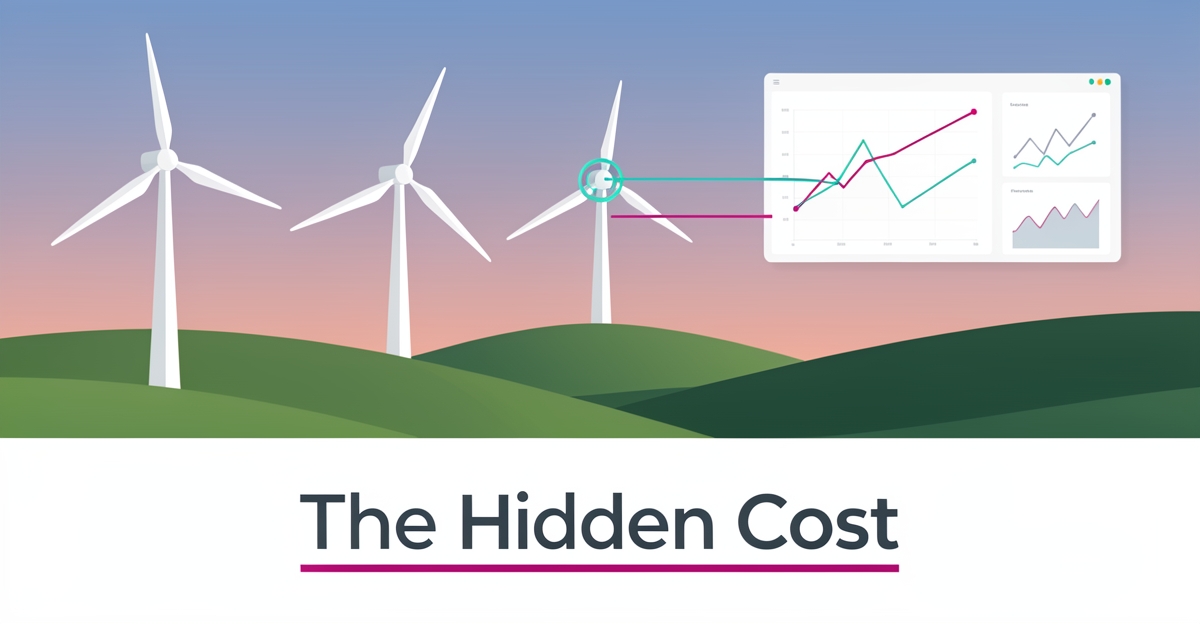
The Real Cost of Not Automating Wind Energy Field Operations
Key Facts
- India's installed wind capacity has continued to grow through 2025–2026, with multi-gigawatt annual additions reported by industry analyses
- Newer wind turbines typically deliver substantially more capacity per machine than older fleets, raising the stakes on every hour of downtime
- Industry commentary suggests a meaningful share of wind developments, often cited around 15%, fail due to unforeseen challenges
- Manual field processes commonly delay technician dispatch by several hours due to paper-based work orders and siloed communication
- Manual repairs often succeed on the first attempt only 60–70% of the time, driving redundant truck rolls and labor costs
- Automation is reshaping work across energy, logistics, and manufacturing as of 2026
Hire a team member that works 24/7 — for less than a part-time wage.
AI receptionists, SDRs, dispatchers and 99+ roles. Trained on your business, fully managed.
Not sure where to start? Ask our AI planner
The Hidden Financial Drain of Manual Field Operations
Every wind turbine that goes un-inspected and every repair that slips a week is money leaking out of a service company's margins, quietly, invisibly, and at scale. The industry's own growth makes the problem worse, not better.
The wind sector keeps expanding. India alone has passed roughly 54 GW of installed capacity, with multi-gigawatt annual additions reported through 2025, and industry analyses note that newer turbines deliver substantially more capacity per machine than older fleets. More machines, more megawatts, more field work, and the same manual processes straining under the load.
The core issue is an execution gap: capacity is being deployed faster than operational readiness can keep pace. Industry leaders have argued that if wind is to play a larger role in the power mix, auctions must reflect execution readiness, grid strength must match modern turbines, and operating capability must evolve. Service companies feel this gap directly as missed inspections, delayed repairs, and crews dispatched without the right information.
The financial drain shows up in three places:
- Missed inspections that turn minor defects into catastrophic failures, extreme wind events have caused turbine failures with serious safety, economic, and grid-resilience consequences.
- Delayed repairs that keep equipment offline longer, converting reactive maintenance into lost uptime and lost revenue.
- Wasted labor, with technicians spending hours on routine tasks like manual tracking and reporting instead of complex problem-solving.
The risk compounds at the portfolio level. Industry commentary suggests roughly 15% of wind developments fail due to unforeseen challenges, and successful developers focus on "what will kill their project" rather than a site's known qualities. Companies that cannot see their operational risks clearly, because those risks live in spreadsheets, paper forms, and tribal knowledge, are managing blind.
This is why measurement comes before automation. AI-driven performance dashboards that track KPIs like response time, repair success rate, and equipment uptime give service companies the concrete numbers needed to justify automation investments, and to see exactly where manual processes are eroding margin. Across manufacturing, logistics, healthcare, and energy, automation has moved from emerging to essential as of 2026.
At AIQ Labs, we help wind service companies build exactly these kinds of AI-driven performance dashboards, typically as a fixed-price workflow build targeting the one process that costs the most. The first step is visibility: you cannot fix a financial drain you cannot measure.
Why 'Unknown Unknowns' Make Manual Operations a Risk Multiplier
Manual field operations turn small blind spots into project-ending failures because there is no data to see them coming. In wind energy, the gap between what crews know on site and what leadership knows in the office creates a risk multiplier that compounds over time.
Industry research suggests that a meaningful share of wind developments, often cited around 15%, fail due to unforeseen challenges. Expert analysis emphasizes that successful developers focus on what will kill their project, not the known qualities of a site. Without visibility, routine gaps become catastrophic.
Unknown unknowns, factors where there is neither knowledge of occurrence nor knowledge of impact, are amplified by manual workflows. Unexpected environmental conditions, regulatory changes, grid limitations, and stakeholder opposition remain hidden until they trigger missed inspections, delayed repairs, and wasted labor.
Manual processes create an execution gap between capacity deployment and system readiness. Projects are awarded before evacuation timelines are firm and higher-capacity turbines connect to weak grid nodes. When field teams rely on spreadsheets and phone calls, the data needed to anticipate those mismatches never surfaces.
The risk multiplier shows up in three ways:
- Response time drifts because dispatch depends on individual memory rather than tracked KPIs
- Repair success rate varies by crew and is never standardized or measured
- Equipment uptime is reported after the fact, not monitored in real time
These gaps mean problems are discovered when turbines are already down, not when they are forming. Data visibility turns unknowns into manageable risks.
Automation is no longer confined to manufacturing. It is reshaping how work gets done across energy, logistics, and other industries, and what was once emerging is now essential. AI-driven performance dashboards that track KPIs like response time, repair success rate, and equipment uptime provide the evidence base to justify automation investments.
AIQ Labs helps implement AI-driven performance dashboards that make field performance measurable and comparable, whether as a standalone workflow build or as the first phase of a broader AI operating system for the whole business. With continuous tracking, service companies can see where manual workflows create delay and where targeted automation reduces cost and risk.
The industry is moving toward proactive risk management. Developers are advised to make a list of everything that might kill a project, run dozens of what-if scenarios, and maintain meaningful buffers on capacity at early stage. Manual operations make that discipline impossible to sustain.
Treating AI as a collaborative partner rather than a black box offers a model for wind operations automation. When teams guide, review, and refine AI suggestions, they keep control while gaining speed and consistency.
Without data visibility, every routine operational gap carries the potential to become a project failure. Manual workflows do not just slow operations; they hide the signals that would prevent the failure rate from becoming your project.
From Reactive to Predictive: The Automation Shift Reshaping Energy Operations
Every hour a technician spends chasing a fault that a dashboard could have flagged days earlier is money leaving the business. Yet most wind energy service companies still run field operations on reactive guesswork, dispatching crews after failures occur, with no systematic way to measure whether the response actually worked. The industry's own trajectory makes this unsustainable: capacity keeps growing, newer turbines deliver substantially more output per machine, and sites get more complex. More capacity, more sophisticated equipment, and more complex sites demand a fundamentally different operating model.
The shift now underway is from reactive maintenance to predictive, measurable operations. AI-driven performance dashboards sit at the center of this shift, converting field activity into tracked KPIs that leadership can actually act on:
- Response time, how quickly crews reach and resolve reported issues, exposing dispatch bottlenecks that manual coordination hides.
- Repair success rate, whether fixes hold, standardizing quality instead of leaving outcomes dependent on individual expertise.
- Equipment uptime, the metric that ties maintenance discipline directly to revenue, moving operations from breakdown response toward predictive maintenance.
This matters because the cost of not measuring is invisible until it's catastrophic. Expert commentary points out that roughly 15% of wind developments fail due to unforeseen challenges, and that successful operators focus on what will kill the project, not its known qualities. Applied to field service, that mindset means treating untracked downtime, unverified repairs, and unmeasured labor as the risks that quietly erode margins. Concrete KPIs are precisely what justify automation investments; without them, companies cannot quantify what manual inefficiency costs or prove what automation returns.
The broader automation trend reinforces the urgency. Automation is no longer confined to a single industry or application, it's reshaping how work gets done across manufacturing, logistics, healthcare, energy, and beyond. What was once emerging is now essential, and accelerating. Wind operators who treat AI as a collaborative tool rather than a black box, guiding, reviewing, and refining its output, capture the gains while keeping human control over critical decisions.
For service companies evaluating this shift, the practical starting point is a clear-eyed baseline. AIQ Labs works with businesses to implement AI-driven performance dashboards that consolidate field data into a single view of response time, repair success, and uptime, turning scattered reports into an operating layer leaders can steer by. The companies that make this transition first won't just cut waste; they'll have the measurable evidence to scale automation confidently while competitors are still guessing.
Building the Business Case: KPIs That Justify Automation Investment
Manual field operations in wind energy create hidden costs that erode profitability before they're even visible on the balance sheet. Missed inspections, delayed repairs, and inefficient labor allocation compound over time, turning operational friction into financial leakage. The real cost isn't just in overtime wages or emergency callouts, it's in lost energy production, accelerated equipment wear, and eroded customer trust.
To justify automation investment, service companies must quantify these inefficiencies using concrete KPIs that reflect both performance and financial impact. Response time directly correlates with revenue protection, every hour of turbine downtime due to delayed fault response translates to measurable energy loss. Repair success rate indicates whether fixes are effective the first time, reducing repeat visits and parts waste. Equipment uptime, the ultimate output metric, reveals how well maintenance strategies translate into actual power generation. Together, these KPIs form a diagnostic triad for operational health.
- Baseline current response times for fault detection to technician dispatch, manual processes often introduce delays of several hours due to paper-based work orders and siloed communication.
- Track first-time repair success rate; industry observations suggest manual repairs often succeed on the initial attempt only 60–70% of the time, driving redundant truck rolls and labor costs.
- Measure actual equipment uptime against potential, gaps here frequently stem from preventive maintenance backlogs and reactive-only strategies.
By modeling the financial impact of improving each KPI, such as cutting response time in half or lifting repair success toward 90%, companies can project ROI from automation in terms of recovered energy revenue, reduced O&M costs, and extended asset life. This data-driven approach transforms automation from a cost center into a strategic lever for margin improvement, providing the evidence needed to secure internal buy-in and prioritize investment. AIQ Labs supports this transition with fixed-price, phased builds, see our payment models, implementing AI-driven performance dashboards that continuously monitor these KPIs, turning operational insights into actionable intelligence for sustained performance gains.
Implementation Roadmap: Automating Field Operations Without Disruption
Wind energy service companies can modernize field operations without downtime by adopting a phased automation approach that starts small and scales strategically. Begin with a single critical workflow, such as inspection scheduling or repair dispatch, that directly impacts response time and equipment uptime. This focused effort allows teams to validate automation benefits while maintaining operational continuity, addressing the reality that most wind sites face execution gaps between capacity deployment and system readiness, with a meaningful share of developments failing due to unforeseen challenges.
Integrate the new workflow with existing dispatch and maintenance systems using secure API connections to create a unified data flow. This ensures real-time synchronization of work orders, technician availability, and asset history without disrupting current processes. Teams can then track key performance indicators like repair success rate and mean time to repair through an AI-driven dashboard, turning manual logs into actionable insights. As confidence grows, expand automation to adjacent workflows such as preventive maintenance triggers and parts inventory alerts, gradually building toward a unified operating layer that provides enterprise-wide visibility.
Throughout the rollout, prioritize change management by involving field technicians in configuration and training sessions, ensuring the technology adapts to their expertise rather than replacing it. This collaborative approach mirrors AI-assisted development best practices, where humans guide and refine automated suggestions to maintain quality and relevance. By scaling incrementally and measuring impact at each stage, wind energy service companies can achieve full operational automation while avoiding the productivity losses and safety risks associated with abrupt system overhauls. To map your specific automation pathway and identify the highest-impact workflow to begin with, start the 2-minute Fit Check, then book a free 30-minute strategy call.
Still paying for 10+ subscriptions that don’t talk to each other?
We build custom AI systems you own outright. No vendor lock-in. Full control.
Not sure where to start? Ask our AI planner
Frequently Asked Questions
How fast is wind capacity growing in India?
What percentage of wind developments fail due to unforeseen challenges?
How much more capacity per machine do new wind turbines deliver compared to older fleets?
What are the three key KPIs that AI-driven performance dashboards track to justify automation investments in wind field operations?
What is the typical range for first-time repair success rate in manual wind turbine repairs?
How does treating AI as a collaborative partner improve wind operations automation?
The Wind Industry's Next Frontier Is Measurable
Manual field operations don't just slow wind service companies down, they hide the signals that separate profitable portfolios from the developments that fail due to unforeseen challenges. The execution gap between rapid capacity deployment and operational readiness is widening, and spreadsheets can't close it. AI-driven performance dashboards that track response time, repair success rate, and equipment uptime turn invisible friction into measurable KPIs, giving leadership the evidence to justify automation where it pays off most. Capacity keeps growing and newer turbines deliver substantially more per machine, making every hour of unmeasured downtime more expensive than the last. AIQ Labs helps service companies build that visibility first, then scale automation without disruption, with 200+ multi-agent systems deployed across industries. The companies that quantify their operational risk today will be the ones capturing margin tomorrow. Start the Fit Check at aiqlabs.ai/apply for a free 30-minute strategy call to map your highest-impact automation opportunity.
Make AI your competitive advantage — not just another tool.
Strategy, implementation and ongoing optimization. One partner, end to end.
Not sure where to start? Ask our AI planner